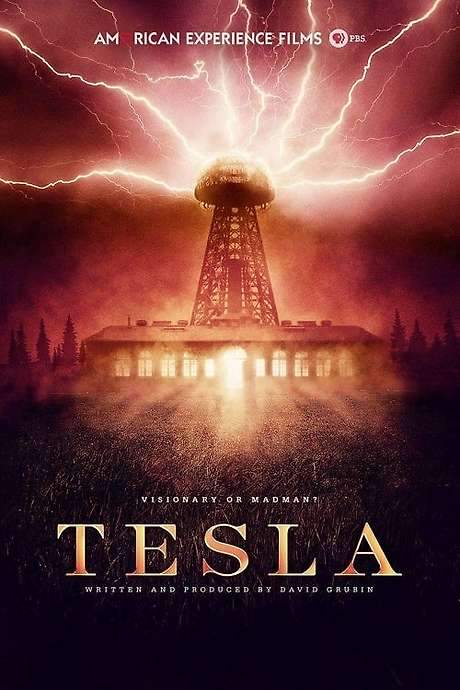
Nikola Tesla’s fascinating life story unfolds through the voice of Michael Murphy, who guides us through the key moments and discoveries of this visionary inventor. The narrative begins with a childhood memory, where Tesla, as a young boy, experiences a sudden flash of electrical energy while petting his pet cat, hinting at his innate connection to electricity and his future pursuits.
In the bustling streets of 1884 New York City, Tesla (portrayed by Ethan Hawke) is working alongside Thomas Edison (Kyle MacLachlan), who doesn’t seem to hold Tesla in high regard. Their relationship is filled with tension, especially after a heated confrontation where they smash ice cream cones into each other's faces—a petty but illustrative moment of their rivalry. During this period, Tesla struggles with financial hardship and is overshadowed by Edison, whose fame and influence far surpass Tesla’s initial recognition. Despite this, Tesla’s innovative mind relentlessly pushes forward, leading to his development of the induction motor, a breakthrough innovation that begins to attract attention and respect from others in the industry.
A scene features Anne Morgan (Eve Hewson), who appears as the narrator, suggesting that history may not be as straightforward as it seems. She notes that when one searches for Tesla, only a few images and stories pop up, whereas Edison’s results are much more plentiful. She emphasizes Tesla’s early hardships with poverty and showcases his first flashes of inspiration, hinting that these moments laid the groundwork for his groundbreaking inventions.
Tesla’s journey takes him into collaborations with prominent figures like George Westinghouse, who acquires Tesla’s patents for his inventions, and helps bring Tesla’s AC (alternating current) technology to the forefront by overseeing its production in Pittsburgh. This rivalry with Edison intensifies, as Edison champions direct current and dismisses Tesla’s alternating current as dangerous. The film also captures the personal side of Tesla’s life—his relationship with Anne, who is the daughter of JP Morgan (Donnie Keshawarz). Their love story develops amidst the chaos of industrial battles and the fight for electrical supremacy.
Tesla’s experiments expand, with notable scenes including the successful demonstration of his Tesla coil in Colorado, which impresses but also causes chaos when it blows up a local generator. His pioneering inventions continue to attract interest, and Morgan invests a significant sum to support Tesla’s vision of transforming global electricity. The story depicts the clash of ambitions and the struggle to balance invention, finance, and personal dreams.
The narrative also hints at darker moments, like the gruesome execution of William Kemmler with an electric chair, which Edison initially claims as proof of the dangers of Tesla’s alternating current. Meanwhile, Tesla’s infatuation with actress Sarah Bernhardt (Rebecca Dayan) adds a layer of personal longing and distraction, culminating in tense encounters with Edison, who resents Tesla’s growing success.
As Tesla’s achievements become more widely recognized—especially after the 1893 World’s Columbian Exposition where Tesla’s technology is showcased—the rivalry begins to soften. Edison, in a rare moment of concession, admits he was wrong, but the narrator clarifies that this reconciliation never truly happened. Instead, Edison’s bitterness remains, while Tesla’s innovations continue to gain prominence.
Tesla’s relationship with JP Morgan begins to take a more serious turn as he pitches his ideas for revolutionary technologies, including a device to map brain waves and signals that could potentially originate from Mars—an ambitious and controversial claim that reflects Tesla’s visionary mindset. Morgan, skeptical yet intrigued, invests a considerable amount of money into Tesla’s projects, but the landscape remains uncertain. The film dives into Tesla’s later years, revealing his struggles to find support and recognition for his increasingly ambitious inventions.
Throughout the story, Tesla’s personal sacrifices and loneliness are highlighted, as he outlives many of his contemporaries, including Edison, Westinghouse, Bernhardt, and Morgan. In the end, Tesla dies alone at the age of 87, just as Anne Morgan reflects on his enduring legacy, suggesting that perhaps he overreached or that the world was built on dreams he first envisioned. She concludes with the poignant thought that maybe, just maybe, the world we live in is one that Tesla dreamed first.
The film masterfully blends historical fact with reflection, underscoring Tesla’s brilliant yet often misunderstood contributions to science and technology, and leaving viewers to ponder the elusive nature of genius and innovation.