Plot Explained Spoilers guaranteed!
Plot Explained

Browse by genre

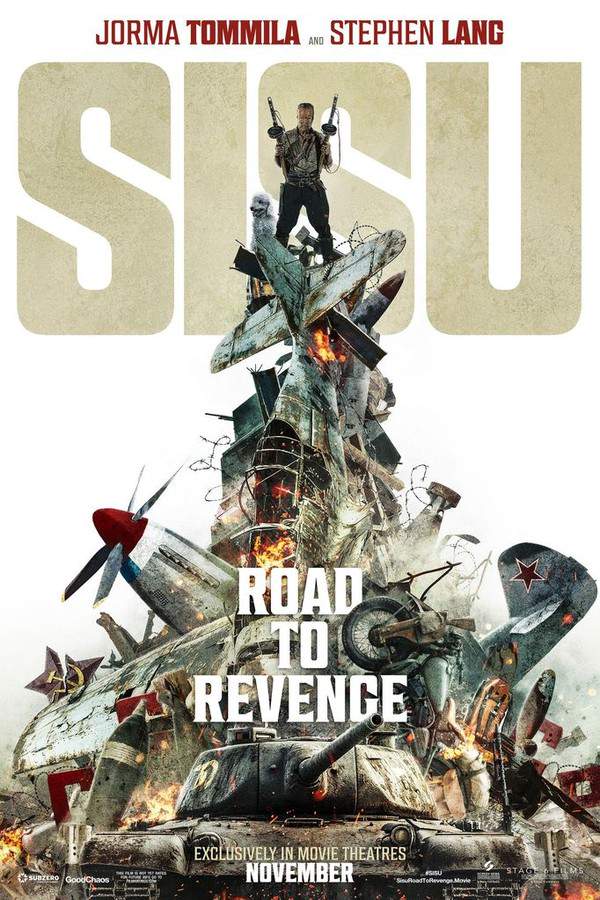
Sisu: Road to Revenge (2025) movie poster

Plot Summary

Sisu: Road to Revenge (2025) Plot Summary & Ending Explained

Release, runtime and language
2025 · 1 h 28 m · English
Echo score 76
Loading streaming availability…
Directed by
Jalmari Helander
Starring
Stephen Lang, Richard Brake, Tommi Korpela, Jorma Tommila, Ergo Küppas, Einar Haraldsson
Budget
$12.2M

Returning to the house where his family was brutally murdered during the war, the “man who refuses to die” (Jorma Tommila) dismantles the ruined home, loads its remnants onto a truck, and vows to rebuild it in a safe place as a tribute. When the Red Army commander responsible for the massacre (Stephen Lang) returns, determined to finish the job, a relentless showdown ensues.

On this page (6)
  1. 1 Where to watch
  2. 2 What happens: full plot
  3. 3 Plot questions answered
  4. 4 How it ends
  5. 5 Movie threads
  6. 6 Every angle
Loading streaming availability…

Full plot summary · contains spoilers

What Happens in Sisu: Road to Revenge: Full Plot Summary

The whole story of Sisu: Road to Revenge (2025) explained, from the opening scene to the final frame: every key event, every twist and what it all adds up to. Read it as a quick recap before the sequel, to check a scene you missed, or to finally understand what really happened.

The film opens with a quiet, somber narration about the end of World War II, when Finland is compelled to cede Karelia to the Soviet Union. This political shift uproots families and sends many Finns, including those who still dream of home, to the Finnish side of the border. At the center of this upheaval is Aatami Korpi, a man who trudges back toward his old life with his loyal dog by his side, carrying the physical remnant of a lost past: wood from the home he used to share with his wife and two sons. He moves with a stubborn resolve, breaking down the timber and gathering it up, determined to rebuild his life on the Finnish side even as the memory of what was taken haunts him.

Elsewhere, in a stark contrast of fates, a Soviet Red Army commander named Igor Draganov sits in a Siberian prison and is freed. A KGB officer, played by Richard Brake, recognizes that Draganov is the man behind the murder of Aatami’s family. This brutal act has forged Draganov into a relentless killing machine known as Koschei, and the officer offers a dark incentive—payment to track down Aatami and finish what was begun years earlier.

Back on the Finnish side, Aatami’s return with the salvaged wood triggers a deadly pursuit. Draganov and his men close in, intent on a decisive kill. In a tense sequence aboard the truck, Aatami fights for his life, turning his machine into a weapon of escape and retribution. He shoots and sabotages, managing to decimate several of his attackers in a brutal display of improvisation and ferocity. For a moment, the hunter and the hunted lock eyes, and Draganov’s menacing presence hints at an inevitable confrontation to come.

The pursuit escalates into a ferocious motor onslaught. Motorcycles roar into the chase, and Aatami’s response is a brutal ballet of violence: crushing, blasting, and outsmarting his pursuers with ruthless efficiency. Aatami’s dog remains by his side, faithful and fearless, as the battle spills into every corner of the land he seeks to protect. The chase detonates into chaos as explosions ripple through the landscape, and Draganov doubles down, ordering reinforcements to unleash an unholy hell on the road.

A new danger arrives in the form of fighter jets streaming in to finish the job. Aatami slips into a barn to hide, but once the air strikes lift, he charges forward again with cold, calculated resolve. He is able to down one jet in a wood-filled snare, tearing at the wing and sending the pilot to a fiery crash. The air war intensifies as another jet appears along a cliff, and the pilot ejects, steering the doomed aircraft toward Aatami’s truck. Aatami cleverly pulls a few pieces of wood forward to conjure a ramp, sending the jet hurtling back into a fatal blaze. Surviving the barrage, he pushes on, only to see the third wave strike and drive him toward a cliff edge. The vehicle plunges into a river, taking wood and dog with it. Yet fortune smiles as Aatami and his companion emerge from the water in a makeshift raft, drifting toward a waiting tank ahead.

From that moment, a dramatic gambit unfolds. Aatami arms himself with an abundance of explosives and drives the tank toward the Soviet border where Draganov and his goons lie in wait. The plan is audacious: he detonates the fuel, sends the tank careening past the boundary, and races toward the threat that has haunted him for years. The tank collapses as it crosses the border, and the pursuit reaches a fever pitch as Aatami is captured, the KGB eager to keep him alive for a final accounting.

On a brutal train ride back to Siberia, Draganov brutalizes Aatami as punishment and as a reminder of the past. Draganov reveals he is the monster Aatami believes him to be, recounting the night his family was torn apart and boasting of the grisly details that forged his legend. The memory of his fallen son becomes a blood-stirring fire in Aatami, and when a guard’s distraction leaves an opening, Aatami uses a hidden knife to cut free himself, slashing and slicing through the car as guards fall one by one. A violent struggle explodes through the train, and a violent misstep by fate sends one guard into a tree, ending another thread in the bloodied chain of events.

In the final, most brutal stretch, Aatami charges toward revenge with a single-minded fury. He fights his way through the sleeping soldiers in the train cars, employing a mix of stealth, brutal force, and resourcefulness. He encounters a brutal confrontation with Draganov in the same car, where the two face off in a life-or-death struggle over a colossal missile. Draganov lunges to seize a chance at escape, but Aatami seizes the moment: he snatches a bolt from the missile, and the weapon becomes a raging instrument of justice. The missile detaches and tears toward Draganov’s cart, its explosive power ending the chase in a blaze of glory.

At the border, Aatami returns with his recovered wood and a sense of hard-won closure. A border guard recognizes him, saluting as a quiet acknowledgment of the long road he has traveled and the home he has finally won back. The final image is one of tentative peace and stubborn resilience as Aatami begins to rebuild his life, and a hopeful sense of community returns. With his dog by his side and his shelter restored, he is greeted by neighbors bearing tools and a willingness to help; the shared effort signals a future where healing can begin, even after a history of loss.

In the end, the story leaves Aatami Korpi standing at the threshold of a new home, his past answered with a fierce and unwavering resolve, his path forward lit by a stubborn, steady hope.
Last updated: November 25, 2025 at 01:01

Was this helpful?

Plot questions answered

Sisu: Road to Revenge Plot Explained: Your Questions Answered

The questions people ask most about Sisu: Road to Revenge (2025): what happens in the confusing scenes, why the characters do what they do, the twists, hidden details and what the ending means. Each answer contains spoilers.

Q1

Why does Aatami risk his life to retrieve the wood from his old house?

Aatami retrieves the wood because it is the only physical remnant of his former life with his wife and two sons. After his family was murdered and their home destroyed, he views salvaging the timber and rebuilding the house in Finland as a way to reclaim what was taken from him and honor their memory. The wood represents his past and his determination to create a new home despite his loss.

Foreshadowing: Earlier narration establishes that many Finns were displaced when Karelia was ceded to the Soviet Union, making the journey both personal and symbolic of the broader refugee experience.

  • aatami korpi
  • wood
  • Karelia
  • family
  • home
  • rebuilding
  • motivation
Q2

Why does the Soviet commander Draganov want to kill Aatami?

Draganov was the one who ordered the massacre of Aatami's family during the war. When a KGB officer releases Draganov from a Siberian prison, he offers payment for Draganov to finish what he started, tracking down and killing Aatami. Draganov has become known as 'Koschei,' a ruthless killing machine forged by his brutal past actions, and completing this kill is both a financial opportunity and a chance to eliminate the only person who might recognize his crimes.

Foreshadowing: The opening establishes that Aatami's family was brutally murdered during the war, hinting that the perpetrator would eventually surface.

  • draganov
  • koschei
  • aatami
  • family massacre
  • revenge
  • kgb
Q3

How does Aatami survive the fighter jet attacks?

Aatami survives through constant improvisation. When fighter jets arrive, he hides in a barn during the initial strike. He then shoots down the first jet by clipping its wing with a well-placed shot from the forest. For the second jet, he uses his remaining wood to create a ramp, flipping the aircraft back toward its own flight path and causing it to crash. When his truck is bombed off a cliff into a river, he and his dog construct a makeshift raft to continue.

Foreshadowing: Aatami is established early as 'the man who refuses to die,' setting up his ability to survive seemingly impossible odds.

  • fighter jets
  • aatami
  • survival
  • improvisation
  • truck
  • chase
Q4

Why does the KGB want to keep Aatami alive instead of killing him?

The KGB wants Aatami alive for a 'final accounting', essentially a formal trial or interrogation. This suggests they want to extract information from him or make a public example of him. When Aatami's tank crashes across the border, the KGB soldiers specifically instruct their men not to kill him, choosing instead to capture him and transport him by train to Siberia.

Foreshadowing: The KGB officer who arranges Draganov's release demonstrates strategic interest in Aatami's fate from the beginning.

  • kgb
  • aatami
  • alive
  • capture
  • siberia
  • prison
Q5

How does Aatami escape from the train going to Siberia?

Aatami escapes by retrieving a hidden knife that was strapped to his own leg, a precaution he apparently made. During the brutal train ride, when Draganov taunts him with details of his family's murder, Aatami waits for a guard's distraction, then uses the knife to cut free from his restraints. He then silently dispatches guards cart by cart as he moves through the train, eventually reaching the final car where Draganov waits.

Foreshadowing: Earlier, when Aatami is captured, he is seen being restrained with bindings, suggesting he had opportunity to conceal the knife beforehand.

  • aatami
  • train escape
  • knife
  • sibia
  • draganov
  • guards
Q6

What happens to Aatami's dog during the pursuit?

Aatami's dog remains faithfully by his side throughout most of the chase, surviving the truck ambush, motorcycle battle, and air strikes. When Aatami drives the tank toward the border with explosives, the dog is released to safety before the vehicle explodes. The dog reappears at the end when Aatami returns to Finland, staying with him as he begins rebuilding his new home.

Foreshadowing: The dog is introduced early as Aatami's loyal companion, and the narrative keeps it safe specifically to provide emotional continuity and a symbol of loyalty at the end.

  • dog
  • aatami
  • safety
  • tank
  • return
  • loyalty
Q7

Why does Draganov tell Aatami the details of his family's murder?

Draganov reveals the massacre details deliberately to torture and break Aatami psychologically during the train ride. He boasts about the grisly acts that forged his legend as Koschei, using the story as both punishment and a power play. However, this tactic backfires, instead of breaking Aatami, it fuels his rage and provides the emotional spark that helps him seize his opportunity to escape and fight back.

Foreshadowing: Draganov's characterization as a brutal villain who takes pride in his atrocities is established when he is first introduced as a ruthless killing machine.

  • draganov
  • massacre
  • family
  • torture
  • motivation
  • revenge
Q8

How does Aatami use the missile to kill Draganov?

In the final train car, Aatami discovers a massive missile and struggles with Draganov over control of it. Aatami manages to detach the missile and ignite its propulsion, turning it into a guided weapon that propels itself toward Draganov's cart. The missile drills into Draganov's car and explodes, killing him in a fiery blast that ends the chase.

Foreshadowing: The train's cargo of military equipment is established early, and the escalating nature of the film suggests a massive final confrontation.

  • missile
  • draganov
  • train
  • explosion
  • death
  • revenge
Q9

Why does the border guard salute Aatami when he returns to Finland?

The border guard recognizes Aatami as a survivor who has endured extraordinary hardship and successfully completed a seemingly impossible journey. The salute is a mark of respect and acknowledgment, from one soldier or veteran to another, honoring what Aatami has survived and accomplished. It marks his return as a victory, both personal and symbolic, after years of pursuit.

Foreshadowing: The entire narrative establishes Aatami as a symbol of Finnish resilience and stubborn survival against overwhelming odds.

  • border guard
  • salute
  • recognition
  • return
  • respect
  • finish
Q10

Why does Aatami spare Draganov during the first truck ambush?

Aatami spares Draganov because he does not recognize him. At this point in the story, Aatami has no idea that this Soviet commander is the one responsible for his family's murder. He sees Draganov as just another soldier and chooses to focus on surviving the attack rather than killing every pursuer. This sets up the dramatic irony of their eventual confrontation, where Aatami learns Draganov's true identity and the personal stakes of their chase.

Foreshadowing: The narrative establishes that Aatami knows only that his family was murdered, not by whom, creating the opportunity for this initial non-recognition.

  • draganov
  • spare
  • ambush
  • recognition
  • family
  • murder

Ending explained

What Happens at the End of Sisu: Road to Revenge?

How Sisu: Road to Revenge (2025) ends, in short: the final scene, the last twist and what it means for the characters. The full ending explained, with every spoiler, lives on its own page.

Read the full ending explained

The film closes with Aatami Korpi finally confronting the Soviet enforcer who has haunted him since the tragedy that destroyed his family. After a relentless chase across the frozen frontier, Korpi corners Igor Draganov and, in a brutal, almost ritualistic duel, ends the man who orchestrated the massacre of his loved ones. The kill is swift and ruthless, underscoring the immortal reputation Korpi has earned, but also delivering the personal vengeance that has driven him forward.

With Draganov dead, the immediate threat evaporates and Korpi is able to continue the perilous trek toward the Finnish border, where the remains of his family’s house await reconstruction. Instead of facing a new battlefield, he is met by a group of locals who step in to help rebuild the dwelling. The final scenes linger on Korpi’s rare, almost silent astonishment as he accepts their assistance—a moment that reveals the lingering humanity beneath his hardened exterior. He is shown working side‑by‑side with his new neighbours, tools in hand, his blood‑stained rifle set aside.

Continue reading the ending (1 more paragraphs)

The closing shot, framed like a still photograph of Korpi and the community completing the house, serves as both an emotional resolution and a quiet promise. It suggests that, after a path of relentless violence, the Immortal can finally lay down his weapons and reclaim a piece of the life that was taken from him—whether that marks the end of his saga or a doorway to future conflicts is left to the imagination.

Sisu: Road to Revenge ending explained in full

Movie threads

More Movies Like Sisu: Road to Revenge, by Mood & Story

Curated lists built around what makes Sisu: Road to Revenge tick: the same mood, the same kind of story or the same emotional payoff. Each list explains why these movies belong together.

One-Man Army Movies like Sisu: Road to Revenge

Stories of a singular protagonist taking on an entire hostile force through sheer will. If you enjoyed the lone warrior standing against an army in Sisu: Road to Revenge, you'll find similar cathartic battles in these films. This list features movies about unstoppable protagonists facing overwhelming odds, driven by revenge or survival, with high-intensity, brutal action sequences.

  • relentless
  • brutal
  • cathartic
  • vengeful
  • unstoppable
  • grim
  • Tone: dark, brutal, cathartic
  • Pacing: fast, relentless
Why these movies?

The story pattern: Narratives in this thread follow a simple, powerful arc: a grievous wrong creates a singular, hyper-capable avenger. The plot is a direct escalation of violence as the protagonist systematically dismantles the antagonist's organization, leading to a final, explosive confrontation that tests the limits of human endurance.

Why they belong together: These films are grouped by their shared core conflict—a lone wolf versus a pack. They deliver a specific, cathartic power fantasy rooted in visceral action, minimal dialogue, and a dark tone fueled by loss and vengeance, resulting in a consistently high-tension, fast-paced experience.

Cathartic Revenge Stories like Sisu: Road to Revenge

Emotionally heavy journeys where revenge provides a painful but necessary closure. For viewers who appreciated the heavy emotional weight and bittersweet closure of Sisu: Road to Revenge, this list features movies about grief-driven vengeance. These films explore the brutal but necessary path of revenge as a way to overcome trauma, blending somber moods with explosive, cathartic action.

  • somber
  • cathartic
  • vengeful
  • grim
  • heavy
  • brutal
  • Tone: dark, somber, bittersweet
  • Pacing: fast, driven
Why these movies?

The story pattern: The narrative begins with a horrific, personal loss that shatters the protagonist's world. The central journey is a linear, violent quest to confront the source of that trauma. The climax is not just about defeating the enemy but about symbolically conquering the past, often leading to a bittersweet ending where peace is purchased at a great cost.

Why they belong together: These movies are united by their exploration of vengeance as a form of emotional processing. They balance heavy themes of grief and loss with intense, brutal action, creating a specific emotional mix: a somber, grim mood punctuated by moments of cathartic release, ultimately leading to a resolution that feels earned but emotionally costly.

Every angle

Sisu: Road to Revenge (2025) Explained: Plot, Ending, Timeline & Characters

Everything about Sisu: Road to Revenge in one place: what happens in the plot summary, the timeline in chronological order, the characters and meaning, the ending explained and a spoiler-free summary. What's After the Movie adds the cast, box office and post-credit scenes.

Coming soon on iOS and Android

The Plot Explained Movie Summary App

Plot summaries, endings explained and timelines on your phone. Catch up on any movie in minutes, save your favorites and never miss a twist again.

Be the first to know when we launch. Your email stays private, always.

Learn more about the app