Flash of Genius

Flash of Genius

Year: 2008

Runtime: 119 min

Language: English

Director: Marc Abraham

Drama

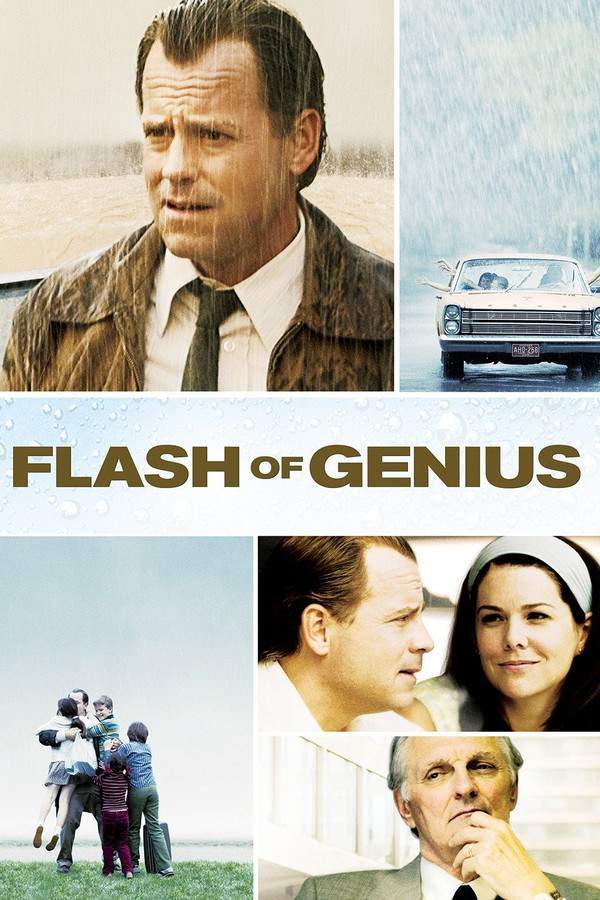
Robert Kearns, an unacknowledged inventor, fights for recognition when his windshield wiper design is secretly adopted by major American car manufacturers. This professor’s persistent quest to claim his due leads to a protracted legal battle against the powerful auto industry. Facing significant setbacks and personal consequences, Kearns refuses to back down, ultimately challenging corporate giants in a dramatic fight for justice and the validation of his ingenuity.

Warning: spoilers below!

Haven’t seen Flash of Genius yet? This summary contains major spoilers. Bookmark the page, watch the movie, and come back for the full breakdown. If you're ready, scroll on and relive the story!

Flash of Genius (2008) – Full Plot Summary & Ending Explained

Read the complete plot breakdown of Flash of Genius (2008), including all key story events, major twists, and the ending explained in detail. Discover what really happened—and what it all means.

On his wedding night in 1953, in Detroit, Michigan, an unexpected champagne cork incident leaves college engineering professor Robert Kearns (Greg Kinnear) nearly blind in his left eye. Renowned as the automobile capital of the USA, Detroit is home to major car manufacturers like Ford, Chrysler, Jeep, GM, AMC, and Dodge. Fast forward a decade later, Robert is living a joyful life with his wife, Phyllis (Lauren Graham), and their six children.

While driving his Ford Galaxie through a slight drizzle, Robert finds the repetitive motion of the windshield wipers increasingly bothersome due to his impaired vision. He becomes acutely aware that toggling the wiper on and off is necessary; while active, it cleans the windshield, but causes a drag on the spotless glass, and when off, the rain obscures his sight. This realization sparks an idea for a new wiper blade mechanism inspired by the human eye, designed to blink intermittently rather than operate continuously.

After some initial trials, Robert discovers that a mechanical solution won’t work to create pauses between wipes, leading him to explore an electronic alternative. With the backing of Gil Previck (Dermot Mulroney), who runs a car dealership, Robert transforms his basement into a makeshift laboratory. Here, he develops a prototype and tests it in a fish tank, aware of the vast potential—20 million cars are produced annually in America, all of which could utilize his innovation.

Supportive of Robert’s ambition to manufacture his wipers, Gil learns that major car manufacturers are also pursuing similar “intermittent” wiper technologies, with Mercury having worked on it for over a year. He encourages Robert to present his invention to Ford, which shows interest in a meeting. After securing a patent, Robert showcases his wiper to Ford’s engineers, who have struggled with a similar design.

When the Ford researchers realize Robert has devised a solution, they are eager to integrate his invention into their vehicles. However, Robert is cautious and demands a fair deal before disclosing the intricate workings of his mechanism. The engineers at Ford inform their higher-ups that Robert’s invention could revolutionize their offerings, leading executive Macklin Tyler (Mitch Pileggi) to ask Robert for a comprehensive business plan.

Despite his efforts and commitments—including renting a sizable warehouse and sourcing parts from Motorola—Robert is left in limbo as Ford pulls support for his project after initially showing great interest. During a Ford dealer convention, he witnesses the Mustang’s debut, which promotes the uninterrupted wiper as a standout feature, leaving him devastated—his concept was appropriated without recognition or compensation.

Determined to seek justice, Robert considers legal action against Ford, but Gil hesitates to provoke Ford given their previous lucrative relationship. This turmoil impacts Robert significantly, leading him into despair and ultimately a breakdown, landing him in a mental health facility. After his release, he is determined to fight for acknowledgment of his invention.

Robert’s legal battles span years, causing a rift in his marriage and distancing him from his children. Initially, Ford offers a settlement of $400,000, which Robert declines, insisting on recognition of their wrongdoing. As time passes, the offer increases to $1 million, but still without any admission of fault.

When the trial finally commences, Robert decides to represent himself after his attorney, Gregory Lawson (Alan Alda), withdraws due to Robert’s refusal to settle. By this time, his ex-wife and children rally behind him, supporting his fight. Nearing the trial’s conclusion, Ford offers a staggering $30 million, still failing to acknowledge their wrongdoing. Ultimately, Robert chooses to let the jury decide his fate, who conclude that Ford infringed on his patents while determining the infringement was not intentional. He is awarded $10.1 million, and later triumphs in securing an impressive $18.7 million judgment against Chrysler Corporation as well.

Last Updated: November 08, 2024 at 02:24

Mobile App Preview

Coming soon on iOS and Android

The Plot Explained Mobile App

From blockbusters to hidden gems — dive into movie stories anytime, anywhere. Save your favorites, discover plots faster, and never miss a twist again.

Sign up to be the first to know when we launch. Your email stays private — always.

Explore Movie Threads

Discover curated groups of movies connected by mood, themes, and story style. Browse collections built around emotion, atmosphere, and narrative focus to easily find films that match what you feel like watching right now.

Obsessive underdog stories like Flash of Genius

When one ordinary person becomes consumed by a fight for principle.Find more movies like Flash of Genius where a lone protagonist engages in a long, draining battle against a powerful system. These stories explore the psychological toll of obsession and the bittersweet nature of fighting for what's right, perfect for viewers who appreciate tense, character-driven legal and ethical dramas.

obsessivedeterminedfrustratinglonelylegal dramapersistenttenseprincipled

Narrative Summary

The narrative follows a linear, often years-long, progression where a protagonist's initial grievance or discovery spirals into an all-consuming battle. The central conflict is less about physical action and more about intellectual, legal, or ethical endurance. The story structure typically involves escalating setbacks, personal strain on relationships, and a final outcome that validates the fight but underscores its heavy price.

Why These Movies?

Movies are grouped here by their shared focus on a character's obsessive, lonely journey. They share a tense, determined mood, a steady pace that mirrors the protracted nature of the struggle, and a thematic core centered on justice, recognition, and the cost of principle.

Bittersweet legal dramas like Flash of Genius

Stories where winning the case doesn't mean winning back your life.If you liked the ending of Flash of Genius, explore these movies about costly legal and ethical battles. These films feature tense courtroom drama or moral conflicts that culminate in a victory tempered by personal loss, offering similar themes of justice, obsession, and the price of principle.

bittersweetfrustratingsoberinglegal victorypersonal costtensemoral conflictjustice

Narrative Summary

The narrative builds towards a climactic legal or moral reckoning. While the protagonist achieves a form of victory—a court win, an ethical vindication—the journey has irrevocably damaged their relationships, mental well-being, or former life. The story emphasizes that some battles are won at a price that outweighs the prize, leaving the audience with a complex, contemplative feeling.

Why These Movies?

These films are united by their specific emotional arc: a hard-fought struggle leading to a Pyrrhic victory. They share a bittersweet ending feel, a medium to heavy emotional weight, and a thematic exploration of the true cost of justice and recognition.

Unlock the Full Story of Flash of Genius

Don't stop at just watching — explore Flash of Genius in full detail. From the complete plot summary and scene-by-scene timeline to character breakdowns, thematic analysis, and a deep dive into the ending — every page helps you truly understand what Flash of Genius is all about. Plus, discover what's next after the movie.

Flash of Genius Timeline

Track the full timeline of Flash of Genius with every major event arranged chronologically. Perfect for decoding non-linear storytelling, flashbacks, or parallel narratives with a clear scene-by-scene breakdown.

Flash of Genius Timeline

Characters, Settings & Themes in Flash of Genius

Discover the characters, locations, and core themes that shape Flash of Genius. Get insights into symbolic elements, setting significance, and deeper narrative meaning — ideal for thematic analysis and movie breakdowns.

Characters, Settings & Themes in Flash of Genius

Flash of Genius Spoiler-Free Summary

Get a quick, spoiler-free overview of Flash of Genius that covers the main plot points and key details without revealing any major twists or spoilers. Perfect for those who want to know what to expect before diving in.

Flash of Genius Spoiler-Free Summary

More About Flash of Genius

Visit What's After the Movie to explore more about Flash of Genius: box office results, cast and crew info, production details, post-credit scenes, and external links — all in one place for movie fans and researchers.

More About Flash of Genius

Similar Movies to Flash of Genius

Discover movies like Flash of Genius that share similar genres, themes, and storytelling elements. Whether you’re drawn to the atmosphere, character arcs, or plot structure, these curated recommendations will help you explore more films you’ll love.