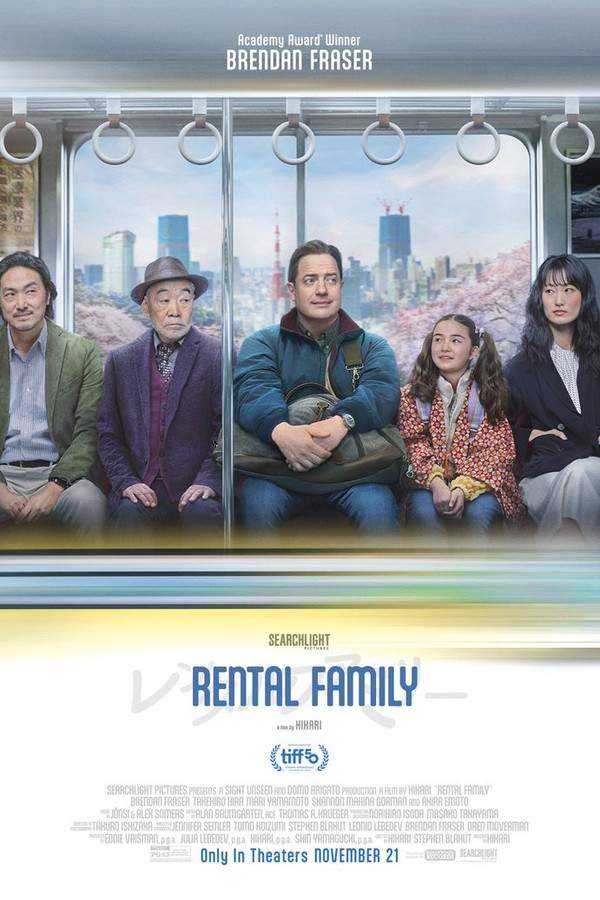
American actor Brendan Fraser plays Phillip Vandarpleog, a working American who lives in Japan and keeps chasing solid acting jobs after his moment in a toothpaste commercial. He finds himself stuck in small roles, hustling for gigs, until he lands with Rental Family, a company run by Shinji Ozeki that supplies actors to pose as pretend family members and friends for strangers. The premise is outlandish, almost absurd, but Phillip’s need for money pushes him to join as the company’s “token white guy” and to see what kinds of connections such a gig might offer.
Phillip’s first assignment is to pose as the fiancé of Yoshie, a married lesbian who wants to stage a traditional wedding for her parents before she and her wife depart for Canada. He nearly backs out, unsure about the emotional weight of pretending to be family for a moment that’s meant to be real, but he accepts the job and discovers that even a fabricated commitment can carry real feelings and consequences. The experience leaves him with a sense of purpose he hadn’t felt in his other auditions, a glimmer of how genuine human bonds might emerge from even the most commercially arranged scenarios.
Following that initial success, Phillip takes on two more roles. One has him playing the estranged father to a young Hāfu girl named Mia, whose mother Hitomi is trying to secure a private school placement for her. The other assignment has him as a journalist profiling a retired actor, Kikuo Hasegawa, who is living under constant surveillance by his daughter Masami. These jobs pull Phillip into intimate, fragile spaces where family history, language barriers, and cultural expectations collide, testing his ability to stay detached or to let the roles blend with real life.
As Phillip grows closer to both Kikuo and Mia, he begins to reinterpret what it means to “be there” for someone. Mia initially resents the idea that a stranger could become a father figure, but Phillip’s consistent presence and patient listening slowly win her trust. Kikuo, meanwhile, awakens a nostalgic ache in Phillip as they explore Kikuo’s past and the countryside that once formed the edges of his childhood. In this evolving dynamic, Phillip finds himself weighing the value of genuine connection against the transactional nature of his work for Rental Family.
Aiko Nakajima, Mari Yamamoto in the cast, is another coworker whose assignments reveal the darker side of the job. Her gigs as a pretend mistress—apologizing to wives of unfaithful husbands—often put her in dangerous, abusive situations, illustrating the personal cost of the company’s business model. Phillip becomes aware that for Aiko, the lines between performance and harm are dangerously thin, a realization that deepens his unease about the kind of “trust” Rental Family asks its actors to cultivate. Shinji cautions that endings with clients are a natural part of the work, yet Phillip suspects a deeper pattern of exploitation behind those partings.
After a successful school interview for Mia, Phillip tells her that he must return to the United States. Her progress and their time together inspire him to ask Kikuo to visit his countryside childhood home, a place overtaken by nature and memory. Kikuo discovers a time capsule buried years earlier and, with quiet gratitude, thanks Phillip for bringing him there. The moment briefly shifts Phillip’s view of his role: he’s not just an actor playing a part; he’s helping someone reclaim a piece of their past.
Tensions soon rise as Shinji lashes out, accusing Phillip of “kidnapping” Kikuo, while Phillip pushes back, arguing that Rental Family has been using people to fill hollow spaces rather than to forge real, meaningful bonds. Shinji reveals an unsettling truth: many of the people Phillip has trusted—the “wife” and the teenage “son” who accompany him in certain jobs—are actors hired by the company. The revelation jolts Phillip and drives a wedge between him and the system, prompting a confrontation about whether the work can ever be ethical.
In the wake of that confrontation, Phillip is briefly detained after the incident with Kikuo’s hospitalization, and the line between law, loyalty, and manipulation becomes even blurrier. Mia learns Phillip’s true identity when she spots him in a TV movie, which strains her trust in her mother and tests the bond she’s formed with Phillip. Yet she forgives the deception, recognizing the care that lay behind Phillip’s choices. In a tense sequence, Aiko—for her part—breaks character during a session, tells the wife the truth, and exits. Kota Nakano, Fumiya Kimura in the cast, and Aiko then stage a discreet act as lawyers to coax Kikuo into admitting what happened, while Shinji materializes as a police detective, intensifying the cat-and-mouse dynamic and testing the actors’ loyalties.
Phillip’s release comes with gratitude toward those who helped him uncover truth at the heart of the matter. The story’s emotional core remains Mia’s welfare and Kikuo’s fragile health as he eventually passes away in his sleep. The funeral brings together Phillip, Aiko, Shinji, and Kota to honor the life that became a shared journey rather than a performance. In the aftermath, Phillip visits Mia again; she has been admitted to school, and the two rekindle a friendship rooted in mutual care rather than fabrication.
What remains steady, even as the dust settles, is Phillip’s continued involvement with Rental Family, but with a crucial shift in its culture. The company moves away from the exploitative “apology services” that once underpinned some of Aiko’s abusive experiences, signaling a broader change in the company’s approach to the people it hires. Phillip ends his journey by seeking a quieter, more honest form of connection, spending time at the shrine where Kikuo once prayed, a small gesture of continuity amid the complex, occasionally troubling tapestry of his line of work.
In the end, the story blends bittersweet realism with the possibility of genuine human bonds formed under unusual circumstances. Phillip’s experience with Rental Family reveals the tension between performance and authenticity, while offering a hopeful note: even in a world built on rented identities, there can be moments of real care, real growth, and real closure for the people who allow themselves to be seen.