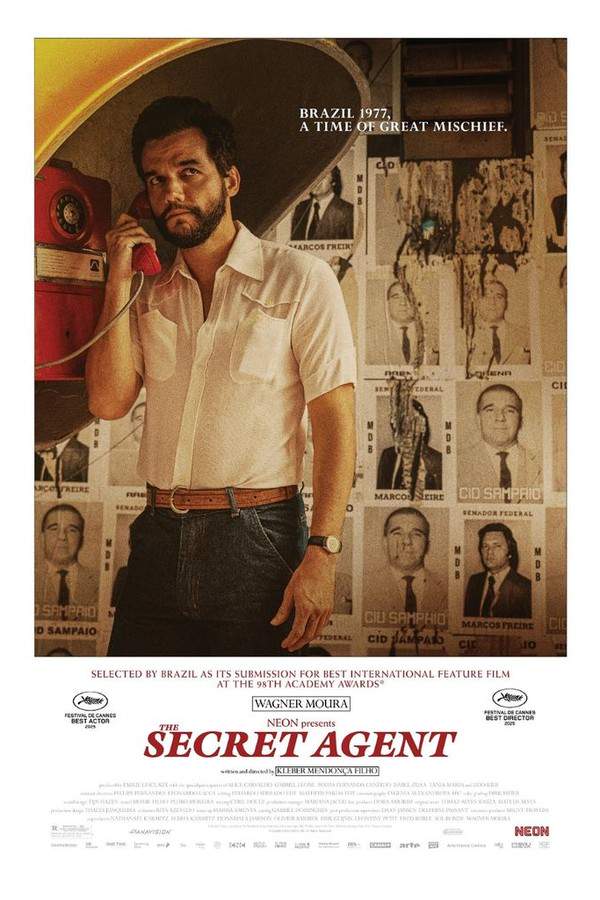
In 1977, amid Brazil’s military dictatorship, a former teacher named Armando arrives in Recife during the carnival period and finds shelter at Dona Sebastiana’s home. He is welcomed into a small, precarious refuge alongside Claudia [Hermila Guedes], Haroldo [João Vitor Silva], and Antonio [Licínio Januário], as well as others displaced by the war and political turmoil, including two Angolan Civil War immigrants, Thereza Vitória and Antonio. Nearby, the city is tense: the holiday is interrupted by a grisly mystery—a human leg found inside a captured tiger shark, a discovery that becomes a flashpoint for fear, rumor, and political corruption.
Armando’s presence in the city soon collides with local power dynamics. He is registered under the alias Marcelo in Recife’s social registration archives and is welcomed by the corrupt chief of police, Euclides, whose patronizing attitude gnaws at Armando. The clash reveals a deeper fault line: Hans, a Jewish Holocaust survivor who is mistakenly suspected of Nazi ties, becomes a target of harassment and suspicion, an echo of the era’s paranoia and prejudice. The tension around Armando’s supposed safety grows as violence begins to ripple through the city.
Across the country, in São Paulo, two hitmen, Bobbi and Augusto, are hired by a former Eletrobras president who holds a vendetta against Armando. In Recife, the discovery of the leg triggers a surreal, violent sequence: Sergio and Arlindo throw the limb into the Capibaribe River, where the story takes a bizarre turn as the limb “revives” and lashes out at gay men in a park, fueling a public frenzy and a media storm that swirls around corruption, carnival euphoria, and fear.
As the danger crescendos, Armando receives a warning from Elza, the head of a resistance movement in the Brazilian northeast. He is urged to flee the country in the coming days, and the sense of imminent peril tightens. Anticipating an escape, Armando says goodbye to Dona Sebastiana and the other refugees, while he clings to fragments of memory, particularly a handful of papers about his late mother, India. Vilmar, a local gunman, is hired to locate Armando. The pursuit intensifies: Vilmar identifies Armando but fails to kill him, wounding Arlindo and a fellow officer in the process. Bobbi, watching from a distance, pursues Vilmar and later kills him in a barbershop, sealing a grim chase in the city’s memory.
In the present day, Flavia, a history student, dives into Elza’s resistance network through audio recordings and newspaper archives. Her research reveals that Armando was assassinated, a revelation that challenges the stories told about that turbulent carnival week. Flavia travels to Recife and meets Fernando, now a middle‑aged doctor, who agrees to be interviewed in his hospital after Flavia donates blood. The interview unravels Armando’s political past and murder, yet Fernando confesses he does not hold a single memory of his father or his childhood in 1977, leaving the truth of Armando’s fate enshrouded in silence and memory.
- Claudia [Hermila Guedes] makes her first appearance as a central figure among the refugees, a steady though wary presence in Armando’s circle.
- Hans, [Udo Kier], emerges as a focal point of the story’s tension, a Holocaust survivor who is misread through the lens of fear and prejudice.
- Haroldo [João Vitor Silva] is one of the refugees sheltered with Armando and is part of the fragile network of support and threat.
- Antonio [Licínio Januário] appears as one of the refugees sheltering with Armando, a quiet link to the northern refugee community.
- Fátima [Alice Carvalho] is referenced as Armando’s late wife, whose memory lingers as he searches for documents about India, his mother.
- Doutora Inês [Fabiana Pirro] appears in the narrative through hospital scenes that intersect with Armando’s legacy.
- The present-day arc features Armando’s legend refracted through Flavia’s study, with [Alice Carvalho] and [Fabiana Pirro] occupying routes back to the past through their connections to memory and authority.
The film blends the personal with the political, using a carnival backdrop to explore how a society’s violence, prejudice, and secrecy ripple through generations. Its mood shifts between intimate, character-driven moments and broad, fear‑driven scenes of conspiracy and upheaval, all while tracing the stubborn persistence of memory in the face of erasure.