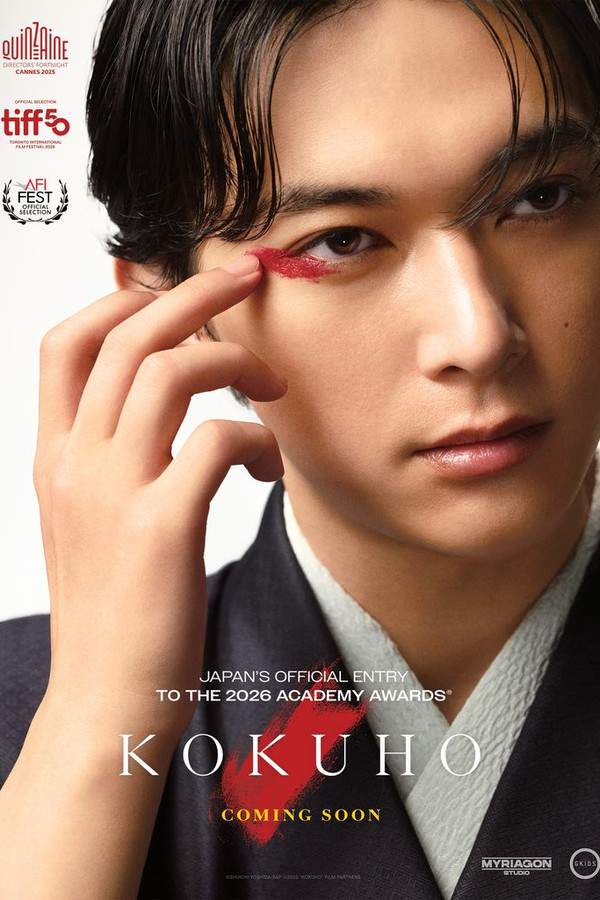
Renowned kabuki actor Ken Watanabe plays Hanjiro Hanai II, a seasoned onnagata whose presence anchors a New Year gathering that pulls the Tachibana yakuza world into focus. As the celebration unfolds, a rival yakuza faction launches a brutal assault that claims the life of Gongoro Tachibana (portrayed by Masatoshi Nagase), and Hanjiro and the young heir Kikuo Tachibana face a moment that will shape the entire family’s future. In the chaos, Kikuo’s loyalty to his bloodline collides with the thin line between vengeance and craft, and the moment marks the beginning of a reckoning that spans decades.
Following the tragedy, Kikuo bears a back tattoo of an eagle owl—a symbol of gratitude and the idea that debts are never truly settled—an emblem that will come to define his path within kabuki and beyond. His girlfriend Harue Fukuda, played by Mitsuki Takahata, can’t help but worry about how far he will go in pursuit of revenge, but the lure of mastery and recognition pulls him forward alongside a young Tokuji who shares his hunger. The friends’ first collaboration—an attempted deadly strike against their rivals—ends in failure, underscoring how power in this world is earned, not granted.
A year later, the year of Kikuo’s fifteenth birthday becomes a turning point when Ryô Yoshizawa steps into the frame as Kikuo Tachibana, the heir who finds himself apprenticed to Hanjiro. The marriage of tradition and ambition is tested as Hanjiro’s wife Sachiko Ogaki—portrayed by Shinobu Terajima—watches with wary eyes at the studio gates; bloodline and lineage are everything in this art form, and outsiders are treated with caution. Kikuo, now given the stage name Toichiro, trains alongside Hanjiro’s son Shunsuke (adult), known in the family circle as Hanya, in a bond that blends brotherhood with rival ambition. The two young men push each other toward excellence, setting a course that will shape kabuki’s present and future.
Tohan, the duo formed by Kikuo and Shunsuke, draws critical praise after a debut in Wisteria Maiden, and their rising profile catches the attention of Umeki from the Mitomo corporation, a heavyweight in the kabuki business. Umeki’s influence opens doors to larger venues, including a high-profile invitation to perform Ninin Dojoji at the Osaka Shochikuza Theatre. The corporate voice, however, is wary of hereditary limits—the idea that kabuki’s bloodline can both propel and imprison a performer—an undercurrent that foreshadows friction within the ranks. Takeno, a Mitomo employee, voices a cynical warning that the career path for Kikuo may be built more on privilege than merit, a thought that drives Kikuo to protect his standing with a sudden, visceral outburst.
The Tohan duo’s early triumphs bring unexpected light to Kikuo’s life, and he asks Harue to marry him. Yet Harue hesitates, sensing that the meteoric rise could corrode their relationship and complicate her own future. Meanwhile, a life-altering accident leaves Hanjiro nearly blind from diabetes, disrupting the plan for his upcoming leading role as Ohatsu in The Love Suicides at Sonezaki. In a surprising decision, Hanjiro designates Kikuo as his successor, passing the mantle of lead onnagata to him despite Sachiko’s protests. Shunsuke, unable to reconcile with the loss and feeling betrayed, withdraws from the stage; Kikuo, now forced to shoulder the full weight of the Hanai lineage, threads a precarious path between art and obligation as the world watches.
Eight years pass, and the aging master’s health deteriorates further. Hanjiro’s plan to pass the title of Hanai Hanjiro III to Kikuo moves forward, while Shunsuke returns with his own family, now having a son of his own, complicating the delicate balance of succession. Public sentiment shifts against Kikuo, as his yakuza background, his inked back, and the existence of an illegitimate daughter clash with the idealized image of the Hanai line. In the fold, Kikuo secretly begins a relationship with Akiko, the daughter of a prominent kabuki investor. Akiko’s father disapproves and tries to disown her, but love endures, drawing Akiko away from her family’s control and toward a life with Kikuo.
Tensions rise as Shunsuke and Kikuo collide again, their alliance strained as injuries mount. After a painful break, Kikuo retires from the stage and, for a time, makes a living by performing at banquets and small venues with Akiko by his side. A chance for redemption appears when Mangiku, now aged and retired, reaches out to Kikuo, inviting him back into the fold. The reunion is electric; Kikuo returns to the main stage as part of the Han-han duo with Shunsuke’s blessing, and he begins coaching Shunsuke’s son in kabuki—though his own heart keeps an eye on a different future, one that may involve basketball more than stage makeup.
A pivotal moment arrives during Ninin Dojoji, when Shunsuke cannot climb a ladder and Kikuo steps in to complete the scene. Shunsuke’s diabetes worsens, forcing him to amputate his left foot, and the disease soon spreads to his right foot. Despite the mounting pain, the two press on, delivering a performance that earns incredible acclaim but leaves Shunsuke on the brink of collapse. With Shunsuke’s health deteriorating and his future uncertain, the duo’s bond becomes all the more fragile, and Kikuo confronts the personal toll of carrying the Hanai name.
Fast forward to 2014, when Shunsuke is posthumously named Hanai Byakko V, and Kikuo is recognized as a kokuho, his status secured as a master of the art. He prepares to perform Heron Maiden in his honor, and in a quiet parallel, Ayase—Kikuo’s daughter through Fujikoma—emerges as a witness to his enduring legacy. In a reflective interview, Kikuo is asked what he seeks next, and he answers with a sentiment that echoes years earlier after Ninin Dojoji—he longs for a particular kind of scenery that can only be found on stage. The photograph in this moment is taken by Ayase, who has become both observer and participant in her father’s world, hinting at a complicated, unresolved connection between them.
When the curtain rises for Heron Maiden, the theatre is full and the lights blaze with a wintery glow. Kikuo delivers a performance that feels like a culmination and a rebirth all at once, and as the final notes fade, he looks up at the lights and imagines snow descending from above. The moment is intimate, intimate enough to feel like a confession: in awe of the scene before him, he allows himself to be moved by the beauty of scenery and sound, a reminder that, in kabuki, art and life are never truly separate. The story closes on a quiet, reflective note, with Kikuo’s eyes tracing the lights and the snow—an image that lingers long after the curtain falls.