Plot Explained Spoilers guaranteed!
Plot Explained

Browse by genre

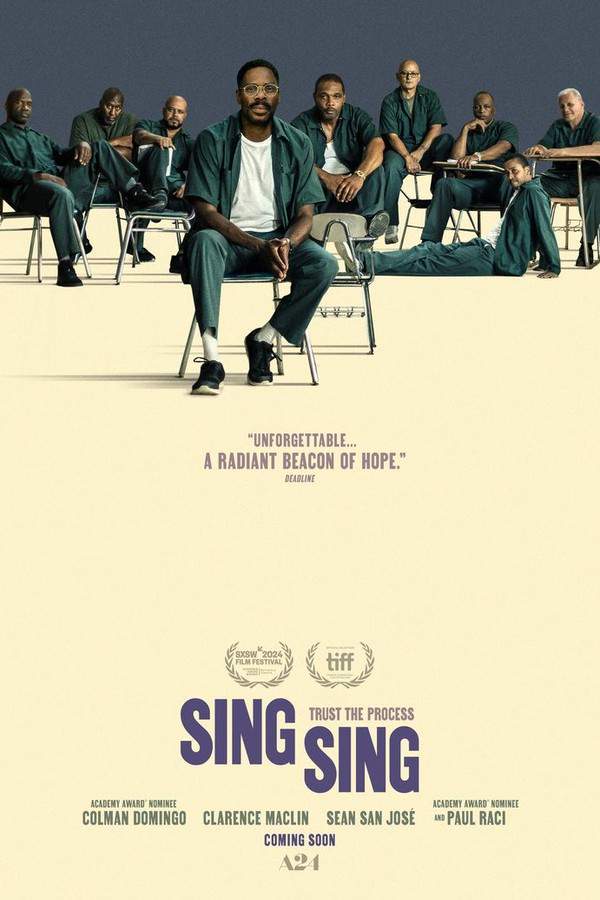
Sing Sing (2024) movie poster

Plot Summary

Sing Sing (2024) Plot Summary & Ending Explained

Release, runtime and language
2024 · 1 h 45 m · English
Echo score 83
JustWatch #4,313 44
Directed by
Greg Kwedar
Starring
Colman Domingo, Paul Raci, Johnny Simmons, Sharon Washington, Clarence Maclin, Sean Blackman
Budget
$2M

Wrongfully accused and imprisoned at Sing Sing, inmate Divine G finds purpose and hope through a theater troupe. He mentors a young newcomer, and their connection deepens as they confront issues of identity, injustice, and the enduring strength of the human spirit. This is a poignant true story about artistic resilience and the transformative power of theater within the confines of a maximum-security prison.

On this page (7)
  1. 1 Where to watch
  2. 2 What happens: full plot
  3. 3 Plot questions answered
  4. 4 How it ends
  5. 5 Movie threads
  6. 6 Movies like Sing Sing
  7. 7 Every angle

Where to watch

Where to Watch Sing Sing (2024)

Where can you watch Sing Sing? Stream, rent or buy it in the US, including on History Vault, Amazon Video and Apple TV Store: current JustWatch availability with up-to-date prices.

Streaming availability powered by JustWatch

Full plot summary · contains spoilers

What Happens in Sing Sing: Full Plot Summary

The whole story of Sing Sing (2024) explained, from the opening scene to the final frame: every key event, every twist and what it all adds up to. Read it as a quick recap before the sequel, to check a scene you missed, or to finally understand what really happened.

Participating in a small theater group made up of fellow inmates, Divine G, portrayed with great empathy, navigates life in Sing Sing Correctional Facility after being wrongfully imprisoned. With a strong desire to clear his name, he immerses himself in an original production titled Breakin' the Mummy's Code, which is facilitated by the Rehabilitation Through the Arts (RTA) program. This initiative uses the transformative power of theater as a means of rehabilitation, allowing Divine G to embrace his passion for acting under the guidance of Brent Buell, the talented theater director.

As he takes on the role of the leading playwright and performer, Divine G eagerly recruits new members for their production. Among them is Divine Eye, a tough and combative prisoner who initially dismisses the idea of acting as a pointless pursuit. However, Divine G views theater as a vital, healing channel that fosters personal growth and connection. Their differing opinions about the genre of their play spark a rivalry, with Divine Eye advocating for a light-hearted comedy, while Divine G insists on a more profound drama to challenge his acting abilities. Tensions rise particularly when Divine Eye decides to audition for the only serious role in the comedy, leaving Divine G confused and frustrated by this apparent contradiction.

Over the ensuing weeks, Brent Buell leads various acting exercises to help the inmates access their emotions and build camaraderie. While Divine G effortlessly taps into his emotional depths, Divine Eye struggles initially, finding it difficult to embrace vulnerability. However, a candid conversation reveals their personal battles, prompting Divine Eye to approach the program with earnestness. Through this mentorship, he gradually earns the respect of Divine G and the other inmates, showcasing a remarkable evolution in his acting skills.

As the RTA team prepares to present their play to the prison's executive board, they are caught off guard when their disjointed performance receives approval for the production. However, tragedy strikes when Mike Mike, a fellow prisoner and close friend of Divine G, passes away. This loss profoundly impacts Divine G, who, at his parole hearing, passionately argues how acting has transformed his life. Yet, to his shock, the interviewer questions the authenticity of his emotions during this critical moment. Despite receiving parole, Divine Eye moves on, while Divine G faces another rejection.

The stress mounts as dress rehearsals approach, culminating in a breaking point where Divine G lashes out at his peers, frustrated by their perceived lack of commitment. In a moment of despair, he isolates himself from the group, seeking solace in solitude. After some time, Divine Eye reaches out, and they reconcile. Divine G apologizes for his earlier behavior, and Divine Eye assures him that he is always welcome back into the fold before finally departing the facility.

A year later, Divine G finally passes his parole hearing and is released. Waiting outside is Divine Eye, who shares a heartfelt reunion with Divine G, filled with optimism for their futures. The film concludes with real footage from Sing Sing's Rehabilitation Through the Arts program, illustrating the genuine performers who once were prisoners yet found a transformative outlet through theater.
Last updated: June 11, 2025 at 06:37

Was this helpful?

Plot questions answered

Sing Sing Plot Explained: Your Questions Answered

The questions people ask most about Sing Sing (2024): what happens in the confusing scenes, why the characters do what they do, the twists, hidden details and what the ending means. Each answer contains spoilers.

Q1

Why was Divine G in prison if he was wrongfully accused?

Divine G was wrongfully imprisoned at Sing Sing Correctional Facility for a crime he did not commit. Despite maintaining his innocence, he was convicted and sentenced, leaving him to serve time while hoping to eventually clear his name.

  • wrongful imprisonment
  • convicted
  • innocence
  • cleared
Q2

Why did Divine G join the theater group in prison?

Divine G joined the Rehabilitation Through the Arts program to find purpose and hope during his wrongful imprisonment. Theater became a healing channel that helped him cope with his situation and reconnect with his passion for acting.

Foreshadowing: The summary establishes Divine G's desire for meaning early in his sentence.

  • theater program
  • RTA
  • purpose
  • acting
  • rehabilitation
Q3

Why did Divine Eye refuse to join the theater program at first?

Divine Eye initially dismissed acting as a pointless pursuit, viewing the theater program as futile. He was tough and combative, seeing no value in what he considered an unproductive activity behind bars.

  • Divine Eye
  • resistance
  • acting
  • inmate
Q4

Why did Divine Eye audition for the serious role in the comedy he wanted?

Despite advocating for a light-hearted comedy, Divine Eye chose to audition for the only serious role in that comedy. This contradiction confused Divine G but revealed Divine Eye's hidden depth and genuine interest in challenging himself as an actor.

Foreshadowing: Earlier scenes show Divine Eye dismissing theater, making this decision unexpected.

  • Divine Eye
  • audition
  • comedy
  • role
  • contradiction
Q5

What happened to Mike Mike in the movie?

Mike Mike, a fellow prisoner and close friend of Divine G, passed away during their time in Sing Sing. This devastating loss profoundly impacted Divine G and made him question the purpose of his journey.

  • Mike Mike
  • death
  • friend
  • loss
  • inmate
Q6

Why was Divine G denied parole after his emotional speech about transformation?

At his parole hearing, Divine G passionately explained how theater had transformed his life, but the interviewer questioned the authenticity of his emotions. Despite his heartfelt testimony, this skepticism led to his rejection.

Foreshadowing: The parole board had previously approved Divine Eye's release, creating contrast.

  • parole hearing
  • denial
  • transformation
  • rejected
  • sincerity
Q7

Why did Divine G lash out at his fellow inmates before the performance?

As dress rehearsals approached and stress mounted from the upcoming presentation and past disappointments, Divine G reached a breaking point. He berated his peers for what he perceived as lack of commitment, temporarily isolating himself from the group.

Foreshadowing: Earlier tensions between Divine G and Divine Eye had been building.

  • breakdown
  • rehearsal
  • frustration
  • conflict
  • performance
Q8

How did Divine G and Divine Eye reconcile after their conflict?

After Divine G isolated himself following his outburst, Divine Eye reached out to him. They reconciled when Divine G apologized for his behavior, and Divine Eye assured him he was always welcome back, reaffirming their bond.

Foreshadowing: Their earlier conflict centered on differing views about theater and genres.

  • reconciliation
  • conflict
  • apology
  • forgiveness
  • friendship
Q9

Did Divine G get released from prison at the end?

Yes, Divine G was finally released after passing his parole hearing a year later. He was met outside the facility by Divine Eye, marking a hopeful reunion with shared optimism for their futures.

Foreshadowing: Divine Eye had already been released earlier, promising to wait for Divine G.

  • release
  • freedom
  • reunion
  • parole
  • future
Q10

What was the play Breakin' the Mummy's Code about?

Breakin' the Mummy's Code was the original play that Divine G and the theater group created and performed. As the lead playwright and performer, Divine G insisted on a drama to challenge his acting abilities rather than the comedy that Divine Eye proposed.

  • play
  • production
  • theater
  • drama
  • performance
Q11

How did Divine Eye change from the beginning to the end?

Divine Eye transformed from a skeptical, combative inmate who dismissed acting into a committed performer who earned respect from his peers. Through his mentorship with Divine G and the program, he discovered vulnerability and genuine growth.

Foreshadowing: His initial resistance and refusal to take the program seriously contrasted with his later dedication.

  • transformation
  • character growth
  • redemption
  • Divine Eye

Ending explained

What Happens at the End of Sing Sing?

How Sing Sing (2024) ends, in short: the final scene, the last twist and what it means for the characters. The full ending explained, with every spoiler, lives on its own page.

Read the full ending explained

At the end of Sing Sing, we see that the characters Divine G and Divine Eye have both found a sense of purpose and hope through their involvement in theatre. Divine G, who has been unfairly imprisoned due to a flawed justice system and racial prejudice, finally uncovers a piece of crucial evidence proving his innocence—yet a technicality prevents him from being released. This highlights the tragic reality that even the truth can be powerless against the injustices of the legal system. Meanwhile, Divine Eye, who entered the prison with a tough exterior and a criminal past, experiences a transformative journey thanks to the theatre group. Through acting, he begins to open up emotionally, confront his guilt, and develop genuine friendships, especially with Divine G. When Divine G finally gets parole a year after the play’s success, it's touching to see him reunited with Divine Eye outside the prison, both aware of the challenges ahead but also of the resilience they have developed. The film ends on a hopeful note, emphasizing that despite societal injustices and past mistakes, life can still be redirected, and redemption is always possible through connection, arts, and inner strength. The story underscores that even in the harsh environment of prison, there lies an opportunity for growth, change, and the forging of meaningful bonds that transcend the walls. Ultimately, Sing Sing celebrates the healing power of art and the human spirit’s capacity to find hope and purpose in the bleakest circumstances.

Sing Sing ending explained in full

Movie threads

More Movies Like Sing Sing, by Mood & Story

Curated lists built around what makes Sing Sing tick: the same mood, the same kind of story or the same emotional payoff. Each list explains why these movies belong together.

Movies about redemption through art like Sing Sing

Stories where creative expression provides a path to healing and self-discovery in difficult circumstances. Explore more movies like Sing Sing where characters use art as a tool for healing and redemption. If you enjoyed the theme of theater transforming lives in prison, you'll find similar inspiring stories about the power of creativity to overcome hardship in these films.

  • inspiring
  • cathartic
  • hopeful
  • resilient
  • transformative
  • brotherly
  • Tone: hopeful, inspiring, reflective
  • Pacing: steady, character-driven
Why these movies?

The story pattern: These narratives typically follow characters who are lost or broken, discovering an artistic outlet that becomes their salvation. The journey involves mastering a craft, forming bonds with fellow creators, and using artistic expression to process trauma, confront injustice, and ultimately redefine themselves, leading to a hopeful or cathartic resolution.

Why they belong together: Movies in this thread are united by their central belief in art's healing potential. They share a hopeful, reflective tone and a character-driven pace, focusing on emotional breakthroughs and the building of community. The experience is consistently inspiring and cathartic, emphasizing resilience over despair.

Prison dramas about found family like Sing Sing

Films about unlikely bonds and supportive communities that form within the walls of a prison. Discover more prison dramas like Sing Sing that focus on hope and human connection. If you liked the themes of brotherhood and mentorship in a maximum-security prison, these movies offer similar stories about finding family and purpose behind bars.

  • brotherly
  • hopeful
  • resilient
  • courageous
  • inspiring
  • mentorship
  • Tone: hopeful, courageous, brotherly
  • Pacing: steady, focused on character development
Why these movies?

The story pattern: The narrative pattern centers on a group of incarcerated individuals who, despite their circumstances, build a community based on mutual support and understanding. Central conflicts often involve overcoming institutional cynicism, personal demons, or internal group tensions, but the core of the story is the strengthening of bonds through shared struggle, leading to positive change for the characters involved.

Why they belong together: These films are grouped together because they prioritize the emotional landscape of prison life over its brutal mechanics. They share a steady pacing, a medium emotional weight, and a consistently hopeful tone that emerges from the focus on camaraderie, personal growth, and the resilience of the human spirit in confinement.

If you liked this

Movies Like Sing Sing

Similar movies to Sing Sing: the same genre, themes or kind of story. Each one comes with its own plot summary, timeline and ending explained.

Browse all movie summaries

Every angle

Sing Sing (2024) Explained: Plot, Ending, Timeline & Characters

Everything about Sing Sing in one place: what happens in the plot summary, the timeline in chronological order, the characters and meaning, the ending explained and a spoiler-free summary. What's After the Movie adds the cast, box office and post-credit scenes.

Coming soon on iOS and Android

The Plot Explained Movie Summary App

Plot summaries, endings explained and timelines on your phone. Catch up on any movie in minutes, save your favorites and never miss a twist again.

Be the first to know when we launch. Your email stays private, always.

Learn more about the app