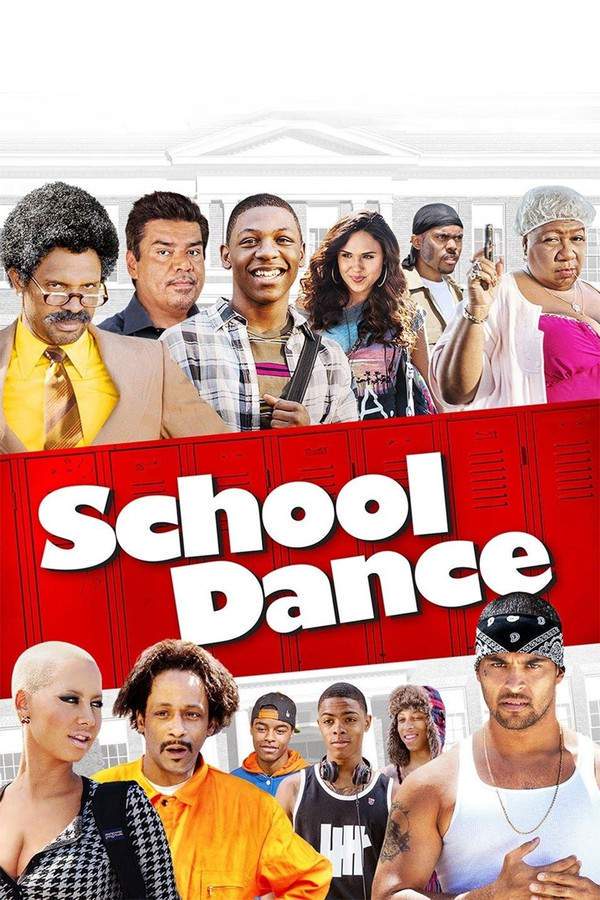
The film opens with a brisk news broadcast that anchors a tense moment at Monte Vista High School: a teenager named Jason Jackson has been shot outside the school’s dance lock-in. From there, the story unfolds through Jason’s own narration, guiding us back to the events that led up to that moment. Jason resolves to break into the school’s most coveted social circle—the Ranger$—and sets a hard, almost comical initiation: he must obtain a pair of panties from one of the Sweet Gyrls by midnight. The audacious plan places Jason on a collision course with social hierarchies, crushes, and a string of bold moves that test his nerve and ambitions.
As the clock ticks, Jason shifts his aim toward his longtime crush, Anastacia. He decides to seize the moment during the lock-in to reach her in a way that could redefine his place at the school. The plot thickens with a family obligation subplot that brings extra pressure to his ambitions: Day Day, a member of the Ranger$ and Jason’s older cousin, still owes Anastacia’s eldest brother Junior a hefty sum — two thousand dollars — after a dominoes game verdict that left Day Day defeated. Their father, Darren, has insisted that Day Day must settle the debt, and that tension provides an undercurrent of stakes beyond high-school popularity.
Meanwhile, in class, Jason pours his feelings into a poem about Anastacia. When the teacher assigns homework, he writes it for her, and the moment is charged with a mix of admiration and vulnerability. The class and Anastacia alike react to the gesture as something unexpectedly genuine, a small act that hints at a potential bond beyond the typical schoolyard rivalries. After school, Anastacia offers Jason her number, sparking the possibility that they might collaborate on a song together—an idea that suggests music could be a bridge between their worlds.
Parallel to these personal dramas runs a lighter, more chaotic law-and-order thread: Officer P’eniss and Officer Lagney are chasing the New Boyz on their way to the lock-in, only for the pursuit to derail into a scene where the youths are found with weed brownies and “grape juice.” The pursuit veers into comic misadventure when Lagney drinks the concoction, underscoring the movie’s blend of humor with its streetwise tension.
When the lock-in arrives, the school’s social theater expands to include not just the Ranger$ and the Sweet Gyrls, but a full night of performances and games. The group tries a popular party ritual—“seven minutes in heaven”—and the mood shifts when Anastacia bluntly tells Jason that she already knows his plan. The moment could have derailed his ambitions, but the two decide to stay friends, keeping the door open to other possibilities while preserving the fragile trust they’ve built.
The night continues with a talent show that promises a two-thousand-dollar prize. The Ranger$ take the stage, and Jason, facing his fears, steps forward to deliver a rap that could clinch victory for his crew. Yet the competition proves unpredictable: the Sweet Gyrls ultimately win the prize, suggesting that popularity and charisma often dance to their own rhythms around the school’s social map.
Midnight brings a dramatic, dangerous turn: Jason and the Ranger$ encounter the Eses in a shadowy parking lot, only to be blocked by a looming drive-by threat from wannabe gangsters. In a moment that cements the film’s stakes, Jason acts to shield Anastacia, taking a bullet in the process. The shooting sends him to the hospital, with Anastacia choosing to stay by his side. Her loyalty deepens as she becomes his girlfriend and even passes the two-thousand-dollar prize money to Flaco, a gesture that ties back to the earlier debt subplot and underscores themes of loyalty, risk, and support.
The film closes on a note that blends heartbreak with a burst of defiant energy. Jason’s mother, Mamma Tawanna, arrives in the parking lot armed with a gun, seeking answers about who shot her son. In a bold meta moment, she looks directly at Nick, the producers, and the crew, breaking the fourth wall to shout an address to the audience—an abrupt interruption that leaves viewers pondering the boundary between the film’s world and the real world that consumes it.
Throughout, the narrative threads—Jason’s desire for social ascent, the romantic if cautious connection with Anastacia, the family debts and loyalties, the comedic police subplot, the tension of the Eses, and the hospital recovery—are interwoven to present a portrait of a high school year where friendships are tested, risks are taken, and a single night becomes a catalyst for change. The tone stays steady and accessible, balancing teen aspiration with the grit of street-seasoned realities, and it keeps the focus on character choices, the consequences of those choices, and the ways in which a community can rally—or fracture—under pressure.
In the end, the movie leaves viewers with a charged sense of unfinished business: love, loyalty, protective impulses, and the search for belonging all collide in a night that starts with a dare and ends with a stark reminder of fragility, courage, and the unpredictable ways in which a community responds to crisis. The result is a vivid, at-times rough-edged snapshot of adolescence where every decision carries weight and where the line between high spirits and high stakes can blur in an instant.