Reversal of Fortune

Reversal of Fortune

Year: 1990

Runtime: 111 min

Language: English

Director: Barbet Schroeder

DramaMystery

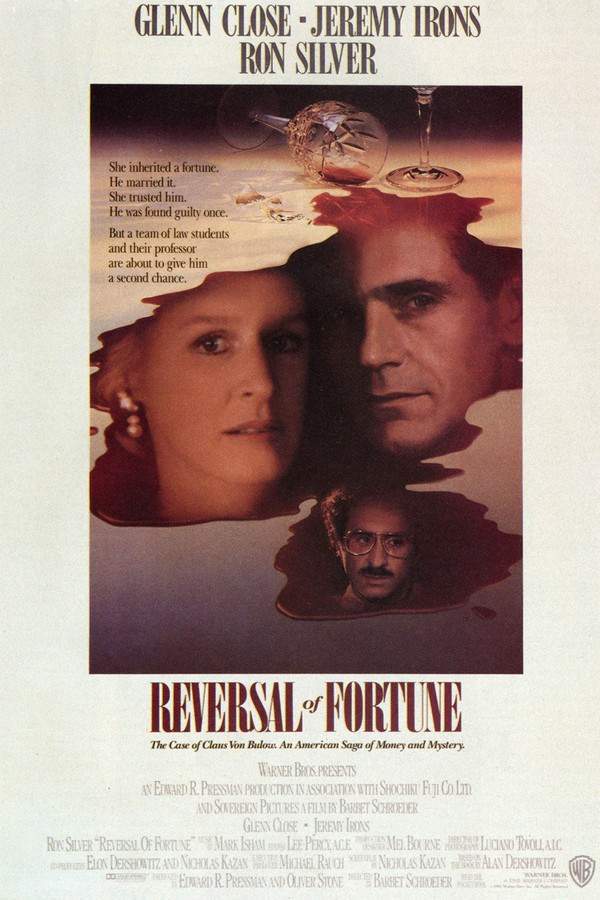
The puzzling coma of socialite Sunny von Bülow leads to a murder investigation centering on her husband, Claus. Initially convicted, Claus seeks to clear his name, prompting Harvard Law professor Alan Dershowitz to take on the complex case. Driven by intellectual challenge and a hope to demonstrate his client’s innocence, Dershowitz confronts the legal and media storm surrounding the high-profile trial, grappling with doubts and uncovering hidden truths.

Where to Watch Reversal of Fortune?

Find where to stream, rent, or buy Reversal of Fortune (1990) in the US with current JustWatch availability, up-to-date pricing, and platform listings for subscription, rental, and digital purchase options.

Warning: spoilers below!

Haven’t seen Reversal of Fortune yet? This summary contains major spoilers. Bookmark the page, watch the movie, and come back for the full breakdown. If you're ready, scroll on and relive the story!

Reversal of Fortune (1990) – Full Plot Summary & Ending Explained

Read the complete plot breakdown of Reversal of Fortune (1990), including all key story events, major twists, and the ending explained in detail. Discover what really happened, and what it all means.

Sunny von Bülow, Glenn Close, a millionaire heiress and socialite, lies in a hospital bed in a persistent vegetative state after slipping into a coma from diabetic shock on December 21, 1980. A year earlier, she had fallen into a coma on December 26, 1979, but was revived. Her husband Claus von Bülow, Jeremy Irons, is charged with attempted murder by injecting the hypoglycemic Sunny with an overdose of insulin. During the trial, it is revealed that Claus was having an affair with actress Alexandra Isles and stood to gain financially if Sunny had died. He is found guilty on two counts of attempted murder.

While Claus von Bülow is released on bond, he files an appeal and seeks representation from Harvard law professor Alan Dershowitz. Dershowitz agrees only if Claus pays him three hundred dollars an hour, as he also works on a separate case where he tries to save two young black brothers from the electric chair. As he reviews the case, Dershowitz becomes convinced Claus is guilty based on the testimony of Maria, the von Bülows’ maid. He is given 45 days to file an appeal and assembles several of his law students to help review the details.

Dershowitz is later informed of David Marriott, a potential witness. At Marriott’s New York apartment, Marriott confesses that he worked as a drug trafficker, but Dershowitz remains skeptical about his reliability. Meanwhile, Dershowitz’s team learns that Robert Brillhoffer, the plaintiff’s attorney, had illegally withheld notes that could aid Claus’s defense. They are also alerted to a magazine interview given by Truman Capote, who stated that Sunny enjoyed mixing drugs and alcohol and taught herself how to self-inject.

Claus lunches with Dershowitz’s legal team and is questioned about Sunny’s overdose on aspirin three weeks before her second coma. Claus is unclear on what could have motivated her to suicide, but he assumes she was unhappy. After Sunny is revived from her first coma, she reprimands Claus for calling a doctor and implies that he would be better off if she had died.

Dershowitz’s defense team receives a toxicology report on the encrusted needle, which reveals no trace of insulin. Marriott arrives again at Dershowitz’s house, claiming his affidavit is not accurate. He covertly records their conversation, then edits the recording to make it look as if Dershowitz agreed to pay Marriott as a witness. Before the trial, Claus recounts what led up to Sunny’s second coma, describing how he found her lying face down on the bathroom floor with the windows open in frigid room temperature. Based on Claus’s testimony, Dershowitz believes Claus is innocent and tells his team that he will seek to overturn the conviction on grounds of insufficient evidence.

When Dershowitz dismisses his class, his students inform him that the jury reversed two convictions and they have obtained Brillhoffer’s notes. He arrives at a New York hotel suite where Claus is staying and hands him the notes, having uncovered conflicting circumstantial evidence that could exonerate Claus in his second trial. Relieved, Claus agrees to pay Dershowitz his legal fees. While Dershowitz calls it a legal victory, he delivers a blunt moral warning: > Morally, you are on your own.

Claus von Bülow is tried for a second time and acquitted, while the two young brothers remain on death row.
Last updated: February 18, 2026 at 23:43

Was this helpful?

Reversal of Fortune (1990) Plot Questions Answered – Summary FAQ

Explore frequently asked questions about Reversal of Fortune (1990) with spoiler-rich answers covering the full plot summary, major story beats, character motivations, hidden details, and ending meaning. This movie summary FAQ helps explain confusing scenes, plot twists, and narrative decisions in clear, searchable detail.

Q1

Why was Claus von Bülow initially found guilty?

A.

Claus von Bülow was convicted based on evidence presented during trial revealing he was having an affair with actress Alexandra Isles and stood to gain financially if his wife Sunny died. The prosecution argued he injected Sunny with an overdose of insulin, leading to her coma.

claus von bülow convictionaffairalexandra islesfinancial motiveattempted murder
Q2

Why did Alan Dershowitz agree to defend Claus von Bülow?

A.

Dershowitz agreed to take the case primarily for the intellectual challenge it presented, as well as the substantial fee of three hundred dollars an hour. At the same time, he was also working to save two young black brothers from the electric chair, adding a moral dimension to his workload.

alan dershowitzlegal defenseintellectual challengefee
Q3

What evidence led to Claus von Bülow's acquittal?

A.

The key evidence included a toxicology report showing no trace of insulin on the needle, and the discovery that Robert Brillhoffer, the plaintiff's attorney, had illegally withheld notes that could have aided Claus's defense. Additionally, the circumstances of Sunny's second coma (found face down with windows open in frigid temperature) suggested alternative causes.

toxicology reportinsulinbrillhoffer notesevidenceexoneration
Q4

What did Sunny von Bülow say after reviving from her first coma?

A.

After Sunny was revived from her first coma, she reprimanded Claus for calling a doctor and explicitly stated that she would have been better off if she had died. This statement suggested she may have wanted to die and complicated the murder investigation.

sunny von bülowfirst comadeath wishreprimand
Q5

Who was David Marriott and what was his involvement in the case?

A.

David Marriott was a potential witness who claimed to have supplied drugs to Sunny von Bülow. He confessed to drug trafficking when approached by Dershowitz, but his reliability was questioned. Marriott later covertly recorded a conversation with Dershowitz and edited it to make it appear Dershowitz agreed to pay him as a witness, further damaging his credibility.

david marriottwitnessdrug traffickerrecordingcredibility
Q6

What did Truman Capote's interview reveal about Sunny von Bülow?

A.

Truman Capote gave a magazine interview stating that Sunny von Bülow enjoyed mixing drugs and alcohol and had taught herself how to self-inject. This information suggested Sunny may have been capable of administering substances to herself, raising questions about how she fell into her coma.

truman capoteinterviewdrug useself-injectionsunny von bülow
Q7

Why did Alan Dershowitz initially believe Claus was guilty?

A.

Dershowitz initially believed Claus was guilty based primarily on the testimony of Maria, the von Bülows' maid, whose statements pointed toward Claus's involvement in Sunny's condition. He became convinced after reviewing her testimony during his initial case review.

dershowitzmaria maidtestimonyguilt
Q8

What was the aspirin overdose three weeks before Sunny's second coma?

A.

Three weeks before Sunny's second coma, she overdosed on aspirin. When questioned about this, Claus was unclear on what could have motivated her to attempt suicide, though he speculated she may have been unhappy. This incident was investigated as a possible suicide attempt.

aspirin overdosesuicide attemptsunny von bülowmotivation
Q9

When did Claus von Bülow tell Sunny about his affair?

A.

Claus revealed his affair with Alexandra Isles to Sunny during the summer of 1979, several months before her first coma in December 1979. This admission added complexity to their relationship and was one of the factors examined during the trial.

claus affairalexandra islessummer 1979confession
Q10

What happened to the two young brothers Dershowitz was trying to save?

A.

Despite Dershowitz's efforts, the two young black brothers remained on death row. While Claus von Bülow was acquitted in his second trial, this particular legal battle was lost, leaving a somber note of unresolved injustice at the film's conclusion.

death rowyoung brotherselectric chairdershowitz case
Q11

What did Dershowitz mean when he said Claus was 'on his own' morally?

A.

After successfully getting Claus acquitted, Dershowitz delivered a blunt warning stating 'Morally, you are on your own.' This reflected Dershowitz's view that while the legal system had failed to prove guilt beyond a reasonable doubt, the question of Claus's actual moral culpability remained unresolved and was not his concern as an advocate.

morally on your ownmoral warningdershowitzlegal victoryinnocence
Mobile App Preview

Coming soon on iOS and Android

The Plot Explained Mobile App

From blockbusters to hidden gems - dive into movie stories anytime, anywhere. Save your favorites, discover plots faster, and never miss a twist again.

Sign up to be the first to know when we launch. Your email stays private, always.

Explore Movie Threads

Discover curated groups of movies connected by mood, themes, and story style. Browse collections built around emotion, atmosphere, and narrative focus to easily find films that match what you feel like watching right now.

Movies like Reversal of Fortune | Methodical Legal Mysteries

Stories where intellectual rigor is the key to solving a complex crime.If you enjoyed the detailed legal process and high-stakes investigation in Reversal of Fortune, you'll find similar intellectual puzzles in these films. They feature complex cases, morally ambiguous situations, and a tense, methodical approach to uncovering the truth.

suspensefulmethodicalintellectualinvestigativemorally ambiguoustenseproceduralunsettling

Narrative Summary

Narratives in this thread typically follow a meticulous, step-by-step process of investigation. The plot unfolds by systematically presenting and analyzing evidence, leading to a climax that hinges on intellectual breakthrough rather than physical confrontation.

Why These Movies?

Movies are grouped here because they share a focus on procedural detail, intellectual rigor, and a central mystery that is solved through careful deduction and analysis, creating a suspenseful and cerebral viewing experience.

Movies like Reversal of Fortune | Morally Ambiguous True Crime

Stories where the investigation into a crime reveals unsettling moral complexities.Fans of Reversal of Fortune's exploration of wealth, betrayal, and doubt in a high-profile case will appreciate these morally complex true crime stories. These films delve into the unsettling gray areas of justice and human nature.

morally ambiguousunsettlingtrue crimedysfunctional relationshipsbetrayalwealth and corruptionsuspensefulinvestigative

Narrative Summary

The narrative pattern involves a central crime whose investigation exposes layers of moral ambiguity. The journey is less about a clear resolution and more about confronting unsettling truths about betrayal, corruption, and the fallibility of justice.

Why These Movies?

These movies are linked by their focus on true crime scenarios that challenge simple notions of guilt and innocence, forcing viewers to grapple with complex ethical dilemmas and the unsettling nature of the facts presented.

Unlock the Full Story of Reversal of Fortune

Don't stop at just watching - explore Reversal of Fortune in full detail. From the complete plot summary and scene-by-scene timeline to character breakdowns, thematic analysis, and a deep dive into the ending - every page helps you truly understand what Reversal of Fortune is all about. Plus, discover what's next after the movie.

Reversal of Fortune Timeline

Track the full timeline of Reversal of Fortune with every major event arranged chronologically. Perfect for decoding non-linear storytelling, flashbacks, or parallel narratives with a clear scene-by-scene breakdown.

Reversal of Fortune Timeline

Characters, Settings & Themes in Reversal of Fortune

Discover the characters, locations, and core themes that shape Reversal of Fortune. Get insights into symbolic elements, setting significance, and deeper narrative meaning - ideal for thematic analysis and movie breakdowns.

Characters, Settings & Themes in Reversal of Fortune

Reversal of Fortune Spoiler-Free Summary

Get a quick, spoiler-free overview of Reversal of Fortune that covers the main plot points and key details without revealing any major twists or spoilers. Perfect for those who want to know what to expect before diving in.

Reversal of Fortune Spoiler-Free Summary

More About Reversal of Fortune

Visit What's After the Movie to explore more about Reversal of Fortune: box office results, cast and crew info, production details, post-credit scenes, and external links - all in one place for movie fans and researchers.

More About Reversal of Fortune

Similar Movies to Reversal of Fortune

Discover movies like Reversal of Fortune that share similar genres, themes, and storytelling elements. Whether you’re drawn to the atmosphere, character arcs, or plot structure, these curated recommendations will help you explore more films you’ll love.