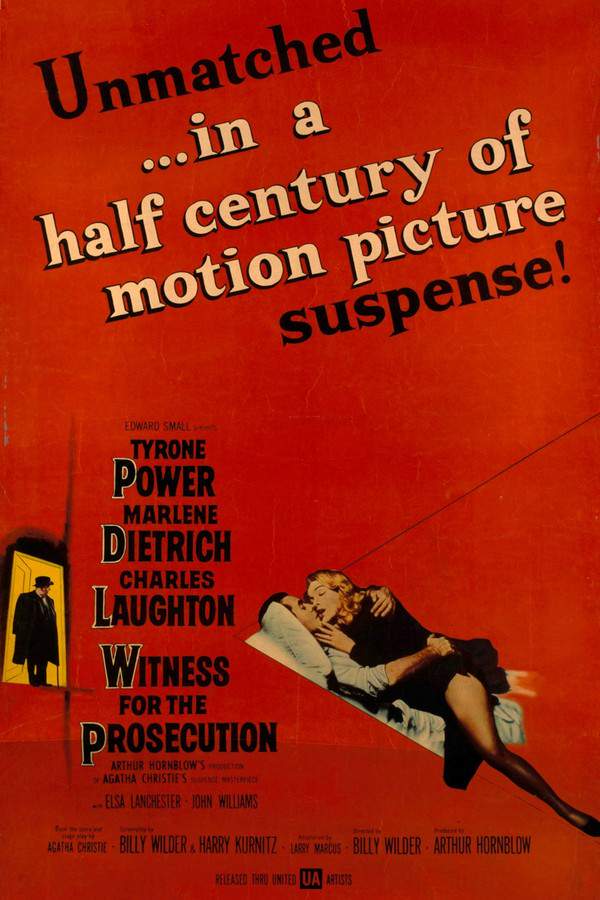
Year: 1958
Runtime: 116 min
Language: English
Director: Billy Wilder
Charismatic lawyer Sir Wilfrid Robarts takes on the defense of Leonard Vole, who is accused of murder. As the trial progresses, Vole’s seemingly solid alibi begins to unravel. The situation becomes even more complicated when his estranged wife, Christine, testifies, exposing a tangled history of secrets and lies. Robarts must navigate a complex web of conflicting accounts to uncover the truth and determine whether his client is truly innocent.
Warning: spoilers below!
Haven’t seen Witness for the Prosecution yet? This summary contains major spoilers. Bookmark the page, watch the movie, and come back for the full breakdown. If you're ready, scroll on and relive the story!
Read the complete plot breakdown of Witness for the Prosecution (1958), including all key story events, major twists, and the ending explained in detail. Discover what really happened—and what it all means.
A few years after the end of World War II, in the heart of London, Leonard Vole, portrayed by Tyrone Power, finds himself at the center of a murder accusation involving a wealthy widow named Emily French, played by Norma Varden. Emily has recently altered her will, leaving Leonard a significant inheritance, which raises suspicions about his motives.
To defend him, Sir Wilfred Robarts, expertly brought to life by Charles Laughton, a distinguished lawyer fresh from recovery in the hospital, is pulled into the case. Despite his doctor’s orders to avoid excitement, and the concerns of his dedicated nurse, Elsa Lanchester, Sir Wilfred decides to personally represent Leonard after his replacement barrister expresses doubt over the accused’s innocence.
The plot thickens when Sir Wilfred meets Mrs. Christine Vole, outstandingly depicted by Marlene Dietrich. After evaluating her demeanor, he resolves not to call her as a witness for her husband. However, in a stunning turn of events, Christine unexpectedly takes the stand for the prosecution, presenting a series of circumstantial evidence that reinforces Leonard’s guilt. Her testimony fails to provide him with an alibi, leaving the defense in dire straits.
As the case nears its conclusion, hope seems lost for Leonard. Yet, a late-night phone call introduces shocking new evidence: Christine had penned letters to a secret lover named Max, articulating her intention to deny Leonard an alibi, thereby seeking her own liberation. This revelation sways the jury’s perspective, leading to Leonard’s acquittal. Nevertheless, Sir Wilfred harbors suspicions about the timing and nature of this newfound evidence.
In a gripping climax during the final court scene, the truth unravels as Christine confesses to sabotaging her own credibility to exonerate her guilty husband. However, just as the narrative twists again, Leonard reveals his plans to abandon Christine for a younger woman, illustrating his true colors. In a moment of desperation, Christine grabs the knife submitted as evidence of Leonard’s supposed accidental injury and, dramatically, stabs him in front of the courtroom, killing him.
In the aftermath, Miss Plimsoll, Sir Wilfred’s nurse, promptly cancels his anticipated trip to Bermuda and declares her intent to assist in defending Christine Vole against the murder charge, setting the stage for another intense legal battle.
Last Updated: November 07, 2024 at 23:41
Discover curated groups of movies connected by mood, themes, and story style. Browse collections built around emotion, atmosphere, and narrative focus to easily find films that match what you feel like watching right now.
Legal battles where the truth is a labyrinth of lies and surprise revelations.For viewers who enjoyed the intricate lies and dramatic surprises of Witness for the Prosecution. This section features movies like it, focusing on tense legal thrillers and crime stories where the truth is elusive and the final revelation is both shocking and emotionally potent.
Stories in this thread are built around a central legal conflict, often a murder trial, where testimonies and evidence are deliberately misleading. The plot methodically unravels a web of deception, placing the audience in a position of uncertainty, and typically concludes with a major twist that recontextualizes the entire narrative, often with tragic or bittersweet consequences.
These movies are grouped by their shared focus on the courtroom as a stage for manipulation, their complex narrative structures that withhold key information, and their ability to deliver a powerful, surprising climax that challenges perceptions of guilt and innocence.
Stories where profound deception leads to inescapable, sorrowful endings.If you were moved by the heavy emotional weight and tragic conclusion of Witness for the Prosecution, explore these similar movies. They share themes of deep betrayal, complex character motives, and endings that are profoundly sad, focusing on the dark consequences of human deception.
The narrative pattern follows characters navigating a world poisoned by lies, often within intimate relationships. The central conflict arises from a betrayal that unravels a carefully constructed reality, leading to a climax where moral boundaries collapse. The ending is typically sad or bleak, emphasizing the irreversible damage caused by the deception.
These films are united by their heavy emotional weight, exploration of dark themes like betrayal and manipulation, and their commitment to endings that are tragic rather than triumphant. They share a tense, dramatic tone and a focus on the psychological devastation of their characters.
Don't stop at just watching — explore Witness for the Prosecution in full detail. From the complete plot summary and scene-by-scene timeline to character breakdowns, thematic analysis, and a deep dive into the ending — every page helps you truly understand what Witness for the Prosecution is all about. Plus, discover what's next after the movie.
Track the full timeline of Witness for the Prosecution with every major event arranged chronologically. Perfect for decoding non-linear storytelling, flashbacks, or parallel narratives with a clear scene-by-scene breakdown.
Discover the characters, locations, and core themes that shape Witness for the Prosecution. Get insights into symbolic elements, setting significance, and deeper narrative meaning — ideal for thematic analysis and movie breakdowns.
Get a quick, spoiler-free overview of Witness for the Prosecution that covers the main plot points and key details without revealing any major twists or spoilers. Perfect for those who want to know what to expect before diving in.
Visit What's After the Movie to explore more about Witness for the Prosecution: box office results, cast and crew info, production details, post-credit scenes, and external links — all in one place for movie fans and researchers.
Discover movies like Witness for the Prosecution that share similar genres, themes, and storytelling elements. Whether you’re drawn to the atmosphere, character arcs, or plot structure, these curated recommendations will help you explore more films you’ll love.
Witness for the Prosecution (1958) Scene-by-Scene Movie Timeline
Witness for the Prosecution (1958) Movie Characters, Themes & Settings
Witness for the Prosecution (1958) Spoiler-Free Summary & Key Flow
Movies Like Witness for the Prosecution – Similar Titles You’ll Enjoy
The Witness (2016) Story Summary & Characters
The Client (1994) Spoiler-Packed Plot Recap
Suspect (1987) Full Summary & Key Details
Witness for the Prosecution (1982) Plot Summary & Ending Explained
The Verdict (1946) Story Summary & Characters
The Witness (1978) Story Summary & Characters
On Trial (1954) Movie Recap & Themes
Your Witness (1950) Movie Recap & Themes
Witness to Murder (1954) Full Summary & Key Details
Witness for the Prosecution (1949) Movie Recap & Themes
The Lawyer (1970) Story Summary & Characters
The Fatal Witness (1945) Detailed Story Recap
Witness in the City (1959) Full Movie Breakdown
Inquest (1939) Film Overview & Timeline
Cross-Examination (1932) Detailed Story Recap