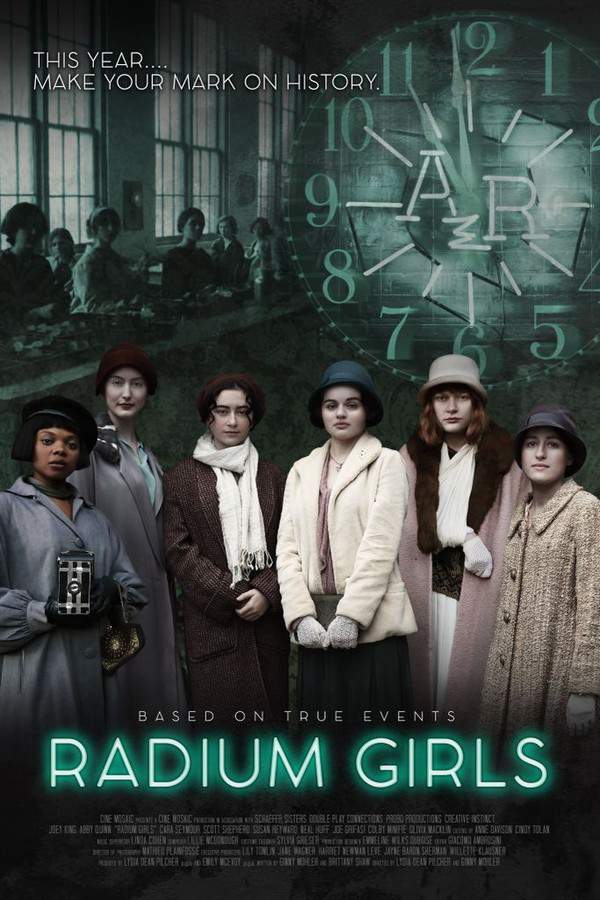
Bessie Bessie Cavallo and her sister Josephine Cavallo Josephine Cavallo live with their grandfather in New Jersey, painting luminous watch dials at American Radium. Life at the factory brings them into contact with a broader world when Bessie meets Walter White, a young communist and photographer, who arrives to document the workers. The two quickly fall for each other, drawing one another deeper into their respective lives. Walter guides Bessie into a circle of counterculture and political thought, eventually pointing her toward Katherine Wiley, the leader of the Consumer’s League of New Jersey, whom the sisters come to rely on for support and information.
When Jo becomes seriously ill, the sisters seek medical help. The company foreman, Arthur Roeder, sends the factory doctor, Dr. Flint, who initially finds no obvious problem. After insisting on more tests, Dr. Flint delivers a grim-diagnosis: syphilis—the same diagnosis said to have afflicted their eldest sister Mary before she died two years earlier. The Cavallos refuse to accept this explanation, especially Jo, who is a virgin. They turn to Wiley for help, aware the path ahead will be difficult but hopeful that she can counter American Radium’s hold over the plant and its workers.
Bessie attempts a broader warning to the other dial painters, urging them to get tested for radium poisoning and to consider quitting the job. Wiley agrees to challenge the company, but she cautions that the road to justice will be arduous. The sisters uncover further evidence when Mary’s body is exhumed and found to contain radioactive bones, a finding that strengthens the case against American Radium. Two more girls join the Cavallos as potential plaintiffs, yet the company fights back by coercion and intimidation, shadowing the workers and trying to suppress dissent.
A pivotal turn comes when Henry Berry agrees to represent the dial painters in court. The trial begins with cautious optimism, but Bessie senses a need for stronger testimony. She locates Mr. Leech, the branch supervisor who once had a secret relationship with Mary, in the hospital and persuades him to testify about the dangers of radium. Leech eventually agrees, drawn by deep affection for Mary, but on the stand he collapses under pressure and lies about the relationship and his warnings.
As the case unfolds, the state judge grants American Radium a long extension, and a federal judge who takes a personal interest in the matter helps broker a deal for the victims, now dubbed the “Radium Girls.” The settlement offers $10,000 to each plaintiff and closes the New Jersey plant. The outcome is bittersweet for Bessie: while the settlement marks a major victory and a step toward reform, she feels the fight is not complete. Katherine Wiley reinforces the idea that the struggle is ongoing, telling her, “It is never over.” Despite her doubts, all the girls sign the agreement.
The epilogue places the events in a broader historical frame: radium was used to paint luminous clock faces up until the 1970s, and a judge who helped negotiate the settlement had been a stockholder in American Radium. The Radium Girls case leaves a lasting imprint on U.S. labor law, and a Geiger counter placed over the grave of a Radium Girl would click for more than a thousand years, a stark reminder of the long shadow cast by these events.