Plot Explained Spoilers guaranteed!
Plot Explained

Browse by genre

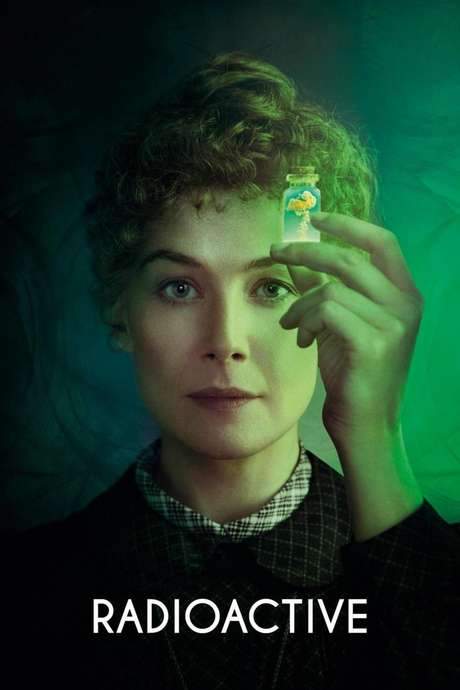
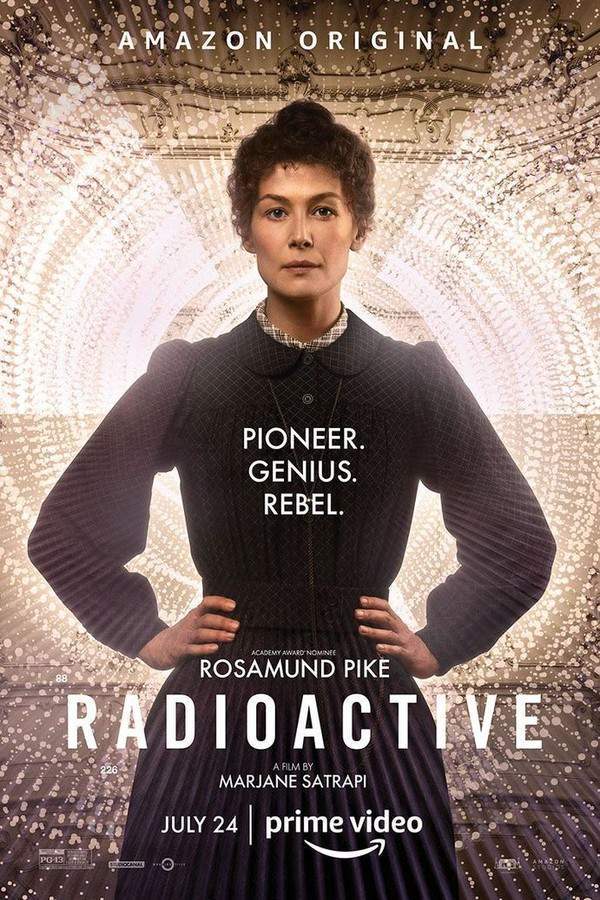
Radioactive (2020) movie poster

Plot Summary

Radioactive (2020) Plot Summary Explained

Release, runtime and language
2020 · 109 min · English
Echo score 55
JustWatch #3,620
Directed by
Marjane Satrapi
Starring
Corey Johnson, Aneurin Barnard, Sam Riley, Anya Taylor-Joy, Simon Russell Beale, Rosamund Pike
Budget
$20M

The story follows Marie Curie as she pursues groundbreaking scientific research, forming a strong partnership with her husband, Pierre. Their shared passion leads to revolutionary discoveries and a profound love story. Together, they challenge established norms and are jointly awarded the Nobel Prize in 1903, marking a historic moment as the first woman to receive the prestigious honor. The film explores her determination and the impact of her work.

On this page (7)
  1. 1 Where to watch
  2. 2 What happens: full plot
  3. 3 Plot questions answered
  4. 4 The book behind the movie
  5. 5 Movie threads
  6. 6 Movies like Radioactive
  7. 7 Every angle

Where to watch

Where to Watch Radioactive (2020)

Where can you watch Radioactive? Stream, rent or buy it in the US, including on Amazon Prime Video, Amazon MX Player and Amazon Prime Video Free: current JustWatch availability with up-to-date prices.

Streaming availability powered by JustWatch

Full plot summary · contains spoilers

What Happens in Radioactive: Full Plot Summary

The whole story of Radioactive (2020) explained, from the opening scene to the final frame: every key event, every twist and what it all adds up to. Read it as a quick recap before the sequel, to check a scene you missed, or to finally understand what really happened.

As the year 1934 dawned in Paris, a frail Marie Curie (Rosamund Pike) found herself in a hospital, with fragments of her past swirling around her like smoke. Her mind drifted back to the streets of 1893, where she first encountered Pierre Curie (Sam Riley), a fortuitous meeting that would irrevocably change her life. During this earlier period, Marie Sklodowska, struggling against the harsh realities of being a woman in a male-dominated scientific realm, confronted Professor Lippmann (Simon Russell Beale), passionately defending her research against his blatant disregard. Despite his condescending attitude, Marie stood firm, sharing her frustrations with her sister Bronia (Sian Brooke). However, the persistent rejections threatened to extinguish her determination.

Fate shifted in a promising direction when she reconnected with Pierre, an academic who not only recognized her name but also revered her work. He extended his hand in collaboration, offering her shared lab space, which Marie initially rejected, only to reconsider after a fire sparked at home due to a careless mistake. Their burgeoning collaboration yielded surprising insights, revealing that uranium, once believed to be reliant on external factors for radiation, was intriguing in its own right, hinting at the existence of an undiscovered element.

Supported by Pierre, who realized the inadequacies of their current equipment, they set out to create a quadrant electrometer to measure electrical potential. Over dinner with friends Paul Langevin and his wife, Pierre recounted their quest to isolate elements from ore, while Marie emphasized that the reactions of uranium stemmed solely from the element itself.

As their professional bond deepened, Pierre’s affection for Marie blossomed; though hesitant at first, she eventually accepted his proposal, leading to a swift wedding ceremony. Shortly after their honeymoon, Pierre disclosed their future collaboration with Paul in a cutting-edge research facility. Over the years, they welcomed their daughter Irène and made monumental discoveries, unearthing two new elements: polonium and radium. Their groundbreaking findings reverberated through the scientific community, with Marie coining the term "radioactivity," a word that would become widely recognized and revered, paving the way for their Nobel Prize nomination.

As Pierre ascended to a professorship, Marie prepared for the birth of their second child, while the world began to realize the transformative potential of radioactivity. Amidst the enthusiasm, Pierre was elated to learn of radium's application in cancer treatment, believing their work could fundamentally alter human history.

Fast-forward to 1957 in Cleveland, a doctor employs radioactive technology to treat a young cancer patient, a powerful illustration of the far-reaching influence of their discovery. Complications arose when Pierre became captivated by a mystic claiming the ability to channel spirits through radioactivity, a development that troubled Marie. Upon the birth of their second daughter, Eve, Pierre shared with her the exciting news: their research had been acknowledged by the Nobel Committee—yet only under his name.

Determined to correct this injustice, Pierre humbly accepted the award alongside Marie in Stockholm in 1903, cautioning against the potential dangers of their discovery falling into unworthy hands. As he delivered his acceptance speech, he pondered if humanity was ready for the ramifications that would follow, foreshadowing the grave moment when the atomic bomb would be dropped on Hiroshima in 1945.

As Pierre returned home, grappling with the fallout of his success, he was faced with Marie’s fury for his perceived overshadowing of her contributions, a confrontation culminating in her striking him. The film then leads to the tragic moment when Pierre suffers a fateful mishap on his journey home, crushed by a horse and cart in a heart-wrenching twist of fate, forever altering Marie’s world and plunging her into a cycle of despair haunted by nightmares.

In the aftermath, Professor Lippmann offered Marie a path back to prominence by inviting her to succeed Pierre at the prestigious Sorbonne. Initially hesitant, Marie’s resilience ultimately prevailed, and she took on the role, driven by her passion for science. While navigating this new phase, Paul, who attempted to offer comfort, failed to alleviate her pain as she contended with an onslaught of public scrutiny following the rumors swirling around her.

The gossip turned cruel when the wife of Paul labeled her a "dirty pole," asserting she had unleashed a toxic legacy upon the world. During this turbulence, Marie’s daughters witnessed their mother's struggles and were met with resistance as Marie endeavored to shield them from the harsh reality surrounding her.

In a poignant search for peace, Marie consulted with a mystic to commune with the spirit of Pierre, grappling with the incessant loss. A mystic's revelation to her about her own fading vitality served to heighten her longing for connection, as her assistant pleaded for the spirit world to grant her reprieve from the burdens of grief.

Fragments of her past intertwined with 1986’s catastrophic Chernobyl meltdown, highlighting Bronia’s decision to retreat amidst public vitriol directed at Marie. However, her tenacity to prioritize her work over personal safety kept her grounded.

Years later, Marie’s unparalleled dedication culminated in a second Nobel Prize, although she paid little heed to warnings against stirring the pot. Instead, upon attending the ceremony, she discovered encouragement from a burgeoning women’s movement, leading to a spontaneous ovation from the assembled crowd.

In the present, adult Irène (Anya Taylor-Joy) encouraged Marie to contribute to the war effort, yet Marie remained steadfast against entering combat, instead, agreeing to assist by providing equipment. As Irène introduced Frederic, a passionate young researcher, into their lives, Marie felt torn between cautioning her against the dangers of radiation while appreciating Frederic's fervor.

Together, they approached Alexandre Millerand, the war minister, lobbying for mobile x-ray units to assist frontline medical treatment. Initially met with reluctance from Millerand and Professor Lippmann due to budget constraints, Marie’s unwavering resolve led her to propose melting down her Nobel Prize medals, emphasizing her sacrifice for progress in medical treatment. Ultimately, her efforts bore fruit, securing the deployment of crucial units to battlefield.

As Marie and Irène ventured into war-torn territory, the dire reality of their mission contrasted starkly with the optimism of their laboratory days. While attending to the wounded, Marie fell into a reverie, blending past and present, as an older Marie lay in a hospital bed surrounded by echoes of moments both significant and tender with Pierre. His encouragement underscored her tremendous contributions, culminating in a heartfelt kiss that solidified their legacy.

The narrative chimes forward, revealing that upon Marie’s passing, she was interred beside Pierre, a lasting homage to their shared journey. In a closing chapter, Irene and Frederic’s collaboration resulted in a Nobel Prize for their groundbreaking discovery of artificial radioactivity, a profound achievement mirroring Marie’s relentless spirit. The legacy endures as the Curie discoveries continue to aid in the fight against cancer, affirming that Marie Curie’s unwavering dedication profoundly shaped the future of science and human compassion.
Last updated: November 17, 2024 at 14:00

Was this helpful?

Plot questions answered

Radioactive Plot Explained: Your Questions Answered

The questions people ask most about Radioactive (2020): what happens in the confusing scenes, why the characters do what they do, the twists, hidden details and what the ending means. Each answer contains spoilers.

Q1

Why did Marie initially reject Pierre's collaboration offer?

Marie initially rejected Pierre's offer because she was determined to maintain her independence as a researcher in a male-dominated field. She had already faced numerous rejections from academics like Professor Lippmann and wanted to prove she could succeed on her own. She only reconsidered after a fire broke out at her home due to a careless mistake, making her situation desperate enough to accept help.

Foreshadowing: Earlier in the film, Marie's struggle against gender discrimination is established through her confrontations with Professor Lippmann.

  • marie curie
  • pierre curie
  • collaboration
  • scientific research
  • independence
Q2

How did Marie and Pierre discover polonium and radium?

Through their research with the quadrant electrometer, Marie and Pierre discovered that uranium emitted radiation independently, contradicting the belief that it required external factors. They systematically tested various ore samples and found that pitchblende produced stronger radiation than pure uranium alone. This led them to isolate two new elements: polonium (named after Marie's homeland) and radium.

  • polonium
  • radium
  • discovery
  • elements
  • radiation
  • scientific breakthrough
Q3

Why was the Nobel Prize initially awarded only to Pierre?

The Nobel Committee originally intended to recognize only Pierre for the discovery of radioactivity. At the time, the committee rarely credited women in scientific fields, and the nomination reflected the gender biases of the era. Pierre was outraged by this oversight and insisted that Marie be included alongside him as a co-recipient.

Foreshadowing: Earlier scenes show Marie facing discrimination from Professor Lippmann and other male academics.

  • nobel prize
  • 1903
  • gender discrimination
  • award
  • pierre curie
  • marie curie
Q4

How did Pierre Curie die?

Pierre Curie was killed in a tragic accident when he was struck by a horse and cart while returning home from work in Paris. The accident occurred shortly after he and Marie had a confrontation about his acceptance speech at the Nobel ceremony, where he appeared to take credit for their joint discoveries. Marie was devastated by this loss, which plunged her into deep grief and nightmares.

Foreshadowing: Pierre's acceptance speech foreshadows danger, as he warned about the discovery falling into unworthy hands.

  • pierre curie
  • death
  • accident
  • horse
  • cart
  • paris
  • tragedy
Q5

Why did Marie face public scrutiny after Pierre's death?

After Pierre's death, Marie became the target of vicious gossip and public scrutiny. Paul Langevin's wife publicly called her a "dirty pole," accusing her of unleashing a toxic legacy upon the world. The rumors and hostility intensified as Marie struggled to protect her daughters from the harsh realities of the attacks on her character and scientific reputation.

  • public scrutiny
  • gossip
  • paul langevin
  • marie curie
  • reputation
  • scandal
Q6

Why did Marie consult a mystic to contact Pierre's spirit?

After Pierre's death, Marie was consumed by grief and sought solace through a mystic who claimed to channel spirits through radioactivity. She hoped to reconnect with Pierre's spirit, desperate for relief from her overwhelming loss. The mystic revealed that Marie herself was fading, which intensified her longing for connection to her deceased husband.

  • mystic
  • spirit
  • pierre curie
  • grief
  • supernatural
  • radioactivity
Q7

How did Marie contribute to World War I?

During World War I, Marie Curie contributed by providing mobile X-ray units (called "petites Curies") to help locate bullets and shrapnel in wounded soldiers on the battlefield. When War Minister Alexandre Millerand and Professor Lippmann resisted due to budget constraints, Marie offered to melt down her Nobel Prize medals to fund the equipment, demonstrating her immense sacrifice for medical progress.

  • world war 1
  • x-ray
  • medical equipment
  • battlefield
  • marie curie
  • irene
  • frederic
Q8

Why did Marie Curie melt down her Nobel Prize medals?

Marie melted down her Nobel Prize medals to fund mobile X-ray units for World War I battlefield medicine. When the war minister rejected her proposal due to budget constraints, Marie sacrificed her most prestigious possessions, proving her commitment to using science for saving lives rather than personal glory.

  • nobel medal
  • melted
  • funding
  • world war 1
  • x-ray units
  • sacrifice
  • marie curie
Q9

What happened to Marie's daughter Irène and Frederic?

Marie Curie's daughter Irène Joliot-Curie and her partner Frédéric Joliot continued her scientific legacy. Together, they won the Nobel Prize in Chemistry for their discovery of artificial radioactivity, a groundbreaking achievement that built upon Marie's original work. This success demonstrated how the Curie family's contributions to science spanned generations.

Foreshadowing: Earlier scenes show Irène introducing Frederic to Marie and encouraging her mother to contribute to the war effort.

  • irene joliot-curie
  • frederic joliot
  • nobel prize
  • artificial radioactivity
  • legacy
  • curie family
Q10

Why is Marie Curie's legacy described as both beneficial and harmful?

Marie Curie's discoveries led to revolutionary medical treatments like radiation therapy for cancer, demonstrated in the film when a doctor in 1957 uses radioactive technology to treat a young patient. However, Pierre warned in his Nobel speech about the dangers of their discovery falling into unworthy hands, foreshadowing the atomic bomb dropped on Hiroshima in 1945. The legacy is dual-edged, saving lives through medicine while also enabling destruction.

Foreshadowing: Pierre's acceptance speech explicitly cautions about the destructive potential of radioactivity.

  • legacy
  • atomic bomb
  • hibakusha
  • radiation therapy
  • cancer treatment
  • curie discovery
  • dual-edged
Q11

Why did Marie accept the position at the Sorbonne after Pierre's death?

After Pierre's death, Professor Lippmann offered Marie the prestigious position to succeed Pierre at the Sorbonne, the first time a woman would hold that chair. Initially hesitant due to the immense pressure and her grief, Marie ultimately accepted, driven by her passion for science and her desire to honor Pierre's legacy by continuing their work.

  • sorbonne
  • professor
  • lippmann
  • marie curie
  • academic position
  • legacy
Q12

How does the Chernobyl disaster connect to Marie Curie's story?

The film connects Chernobyl to Marie's story by showing her sister Bronia retreating from public life during the 1986 meltdown, as the public vitriol against radioactivity scapegoated the Curie legacy. However, Marie's determination to prioritize her work over personal safety is contrasted with the catastrophic misuse of nuclear technology, reinforcing the film's theme about scientific responsibility.

  • chernobyl
  • 1986
  • nuclear disaster
  • bronka
  • marie curie
  • radiation
  • radioactivity

Movie threads

More Movies Like Radioactive, by Mood & Story

Curated lists built around what makes Radioactive tick: the same mood, the same kind of story or the same emotional payoff. Each list explains why these movies belong together.

Bittersweet Biographical Journeys like in Radioactive

Life stories that weave profound triumphs with deep personal loss. For viewers who liked the emotional depth of Radioactive, this collection features movies like it: biographical dramas that balance groundbreaking achievements with personal tragedy. These similar stories explore the complex legacies of historical figures, blending love, loss, and world-changing impact.

  • somber
  • inspiring
  • tragic
  • romantic
  • melancholic
  • reflective
  • Tone: bittersweet, reflective
  • Pacing: variable, reflective
Why these movies?

The story pattern: Stories in this thread follow a biographical structure, often non-linear, highlighting key moments of discovery or acclaim alongside pivotal personal losses. The narrative juxtaposes public victory with private grief, creating a reflective rhythm that mines deep meaning from the contrast between accomplishment and sacrifice.

Why they belong together: These movies are grouped by their shared bittersweet tone and heavy emotional weight. They focus on real-life figures whose monumental contributions came with significant personal cost, resulting in a viewing experience that is both inspiring and somber.

Movies about Scientific Discovery and its Moral Weight like Radioactive

Stories where groundbreaking discoveries carry a heavy, double-edged legacy. If you liked how Radioactive grappled with the dual legacy of Curie's work, from medical miracles to atomic bombs, these movies explore similar themes. Find films like this about scientific pioneers facing the unforeseen and heavy consequences of their world-changing ideas.

  • scientific
  • somber
  • thought-provoking
  • tragic
  • reflective
  • ethical dilemma
  • Tone: bittersweet, melancholic
  • Pacing: variable, deliberate
Why these movies?

The story pattern: The narrative pattern involves a passionate pursuit of knowledge that leads to a revolutionary—but ethically ambiguous—discovery. The second half of the story deals with the fallout: the creator's struggle with guilt, responsibility, and the unintended destructive applications of their work, creating a theme of brilliant innovation shadowed by doom.

Why they belong together: These films share a focus on the moral and emotional burden of scientific progress. They are united by a complex, reflective tone that questions the price of knowledge and explores the duality of creation and destruction, resulting in a thought-provoking and heavy viewing experience.

If you liked this

Movies Like Radioactive

Similar movies to Radioactive: the same genre, themes or kind of story. Each one comes with its own plot summary, timeline and ending explained.

Browse all movie summaries

Every angle

Radioactive (2020) Explained: Plot, Timeline & Characters

Everything about Radioactive in one place: what happens in the plot summary, the timeline in chronological order, the characters and meaning and a spoiler-free summary. What's After the Movie adds the cast, box office and post-credit scenes.

Coming soon on iOS and Android

The Plot Explained Movie Summary App

Plot summaries, endings explained and timelines on your phone. Catch up on any movie in minutes, save your favorites and never miss a twist again.

Be the first to know when we launch. Your email stays private, always.

Learn more about the app