Plot Explained Spoilers guaranteed!
Plot Explained

Browse by genre

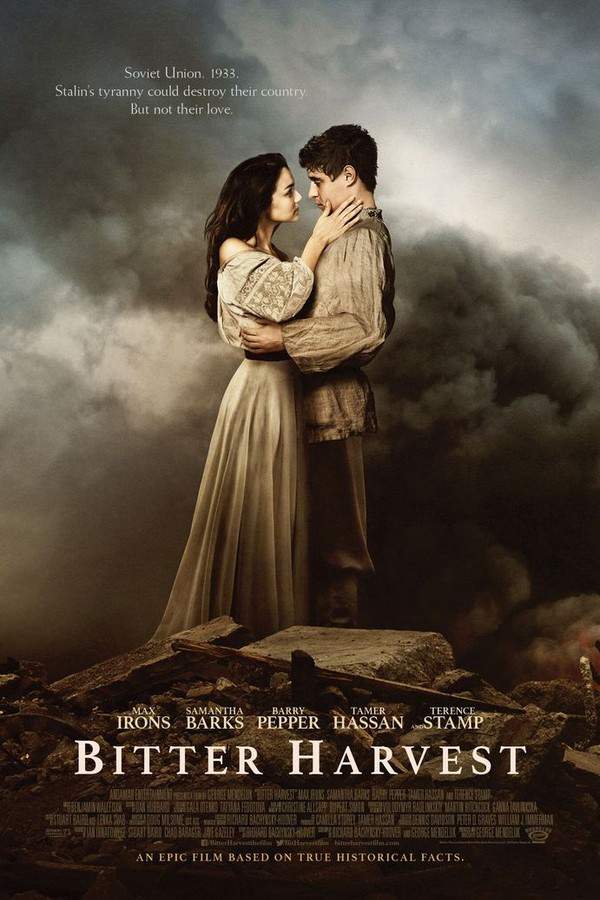
Bitter Harvest (2017) movie poster

Plot Summary

Bitter Harvest (2017) Plot Summary Explained

Release, runtime and language
2017 · 103 min · English
JustWatch #23,329 8
Directed by
George Mendeluk
Starring
Terence Stamp, Barry Pepper, Samantha Barks, Max Irons

During the 1930s in Ukraine, a devastating famine known as the Holodomor sweeps across the land, leading to immense suffering and loss of life. Amidst this tragedy, artist Yuri strives to rescue his childhood sweetheart, Natalka, risking everything in a desperate fight for survival. Their perilous journey becomes a poignant symbol of hope and resistance against the oppressive policies that threaten to destroy their world and their people.

On this page (6)
  1. 1 Where to watch
  2. 2 What happens: full plot
  3. 3 Plot questions answered
  4. 4 Movie threads
  5. 5 Movies like Bitter Harvest
  6. 6 Every angle

Where to watch

Where to Watch Bitter Harvest (2017)

Where can you watch Bitter Harvest? Stream, rent or buy it in the US, including on Kanopy, Amazon MX Player and Amazon Prime Video Free: current JustWatch availability with up-to-date prices.

Streaming availability powered by JustWatch

Full plot summary · contains spoilers

What Happens in Bitter Harvest: Full Plot Summary

The whole story of Bitter Harvest (2017) explained, from the opening scene to the final frame: every key event, every twist and what it all adds up to. Read it as a quick recap before the sequel, to check a scene you missed, or to finally understand what really happened.

Ivan Kachaniuk, Terence Stamp, a Ukrainian Cossack, defends his family in Central Ukraine's wheat- and sunflower-farming outskirts of Smila.

Years later, in 1932, Yuriy, Max Irons, the artist grandson of Ivan, marries his childhood sweetheart, Natalka, Samantha Barks, and studies at the Kyiv Art Academy. His family are independent Cossack farmers, "kurkuli," living off grain, sunflowers, and other crops until Joseph Stalin's collectivization campaign orders the Bolshevik Red Army to requisition 90% of Ukraine's harvest.

The State Art Institute is forced to replace art instructors with communist voices who censor Yuriy's work, condemning its expression of Ukrainian cultural identity as anti-Soviet. Yuriy storms out in disgust.

During a memorial in a pub for a friend who took his own life, a half-drunk aggressive Soviet captain insults Ukrainian folklore, music, songs, and dance, sparking a fight in which Yuriy stabs the captain in self-defense. He is then imprisoned in a brutal Soviet jail that houses scores of Ukrainian kurkuli—alongside Ukrainian nationalists and others Stalin deems Enemies of the Soviet state. From his cell Yuriy witnesses daily mass executions.

A sadistic prison commissar, Director Medvedev, demands Yuriy paint his portrait in exchange for more food and for his life, with Yuriy sensing that execution will follow as soon as the portrait is complete. In their second sitting, Yuriy kills the director by stabbing him in the throat with a paintbrush, then changes into the commissar's Russian uniform, seizes his pistol, and escapes during a blizzard while guards hunt him.

Back in Smila, Yuriy's wife Natalka and their family endure the terror of farm director Commissar Sergei Koltsov, who tries to rape her and wields food as a weapon. Natalka poisons his borscht with wild mushrooms and joins other peasant women in a Babsi revolt. Sergei survives and orders his Bolshevik troops to crush the uprising. Yuriy's family and the villagers are imprisoned in the church, now a torture chamber and prison cell.

In the northern Kyivan forests Yuriy meets Lubko, a desperately hungry boy, and the two help each other reach a cattle train stop toward Smila. That night they are joined by the Kholodnyi Yar (Cold Ravine) Ukrainian Cossack detachment. The next morning they wage a bloody battle as Bolshevik Gatling guns mow down the uprising, leaving heavy casualties on both sides.

Yuriy and Lubko slip aboard a cattle train filled with starving Ukrainian corpses and bear witness to mass starvation and death along roadsides and in pits. Nearing Smila they hijack a Soviet grain truck; a sympathetic Bolshevik soldier drives the truck and joins Yuriy's rescue mission, delivering grain to the hungry villagers. Yuriy, Natalka, and Lubko escape, while others in the family starve or are murdered by Koltsov's forces.

Chased onto another cattle train of Ukrainian corpses bound for fire pits, they race toward the Soviet border and the icy Zbruch River. They dive underwater to dodge bullets and cross into Polish-controlled West Ukraine, aiming for the city of Lviv and hoping for help from the priest Andrey Sheptytsky to trade Ukraine's vast pastures for the prairies of Manitoba, Canada.
Last updated: October 09, 2025 at 16:18

Was this helpful?

Plot questions answered

Bitter Harvest Plot Explained: Your Questions Answered

The questions people ask most about Bitter Harvest (2017): what happens in the confusing scenes, why the characters do what they do, the twists, hidden details and what the ending means. Each answer contains spoilers.

Q1

Why does Yuriy stab the Soviet captain in the pub?

Yuriy stabs the Soviet captain in self-defense during a confrontation at a memorial pub. The half-drunk captain had been insulting Ukrainian folklore, music, songs, and dance, provoking the gathering. When the confrontation turns physical and Yuriy is attacked, he defends himself by stabbing the officer, which leads to his arrest and imprisonment.

Foreshadowing: Earlier scenes establish the regime's hostility toward Ukrainian cultural expression, making this confrontation inevitable.

  • yuriy
  • soviet captain
  • self-defense
  • pub fight
  • arrest
  • ukrainian culture
Q2

Why does Yuriy kill the prison director Medvedev?

Yuriy realizes the portrait commission is a death trap. Commissar Medvedev promises food and survival in exchange for painting his portrait, but Yuriy understands that once the portrait is finished, he will be executed. During the second sitting, Yuriy kills Medvedev by stabbing him with a paintbrush, steals his uniform and pistol, and escapes during a blizzard.

Foreshadowing: Medvedev's demands for a portrait, combined with Yuriy witnessing daily mass executions from his cell, foreshadows his inevitable fate if he complies.

  • yuriy
  • medvedev
  • prison escape
  • portrait
  • kill
  • soviet jail
Q3

Why does Natalka poison Commissar Koltsov's borscht?

Natalka poisons Koltsov's borscht with wild mushrooms because he attempted to rape her and uses food as a weapon to control the starving villagers. Her act of resistance marks the beginning of the Babsi revolt, where peasant women rise up against the Soviet oppressors.

Foreshadowing: Koltsov's role as farm director who wields food as leverage establishes his threat to the entire village before Natalka's desperate action.

  • natalka
  • koltsov
  • poison
  • borscht
  • mushrooms
  • rape attempt
  • babsi revolt
Q4

What is the Holodomor and why does it happen?

The Holodomor was a devastating famine in 1932-1933 orchestrated by Stalin's Soviet regime through forced collectivization. The Bolshevik Red Army requisitioned 90% of Ukraine's harvest, leaving the population to starve. The famine was a deliberate policy to crush Ukrainian independence and cultural identity, resulting in millions of deaths.

Foreshadowing: The film opens with Ivan Kachaniuk defending his family against outside threats, establishing the pattern of resistance that continues under Soviet rule.

  • holodomor
  • famine
  • stalin
  • collectivization
  • starvation
  • ukraine
  • 1932
Q5

Why does Yuriy leave the State Art Institute?

Yuriy leaves the State Art Institute because communist censors replace the art instructors and condemn his work as anti-Soviet. His art expresses Ukrainian cultural identity, which the regime views as a threat. Yuriy storms out in disgust, choosing artistic integrity over compliance with Soviet ideology.

Foreshadowing: This moment establishes Yuriy as a defender of Ukrainian culture, setting up his later resistance activities.

  • yuriy
  • art institute
  • censorship
  • ukrainian identity
  • communism
  • kyiv
Q6

Why do Yuriy and Lubko join the Kholodnyi Yar detachment?

Yuriy and Lubko meet in the northern Kyivan forests while trying to reach Smila. They encounter the Kholodnyi Yar (Cold Ravine) Ukrainian Cossack detachment, a resistance group fighting against Soviet forces. Joining them represents a united front of resistance against the Bolshevik occupation.

Foreshadowing: Earlier scenes show Yuriy transitioning from artist to active resistance fighter, making his choice to join the Cossack detachment a natural progression.

  • yuriy
  • lubko
  • kholodnyi Yar
  • cossack detachment
  • resistance
  • ukrainian rebels
Q7

Why is the church turned into a prison in Smila?

After the Babsi revolt is crushed by Koltsov's Bolshevik forces, the church in Smila becomes a torture chamber and prison cell. The Soviets desecrate the sacred space to imprison Yuriy's family and the villagers, using terror and religious defilement as tools of control.

Foreshadowing: The church's transformation reflects the broader Soviet campaign to destroy Ukrainian culture and resistance.

  • church
  • smila
  • torture
  • prison
  • koltsov
  • babsi revolt
  • revolt crushed
Q8

Why do Yuriy and Natalka cross the Zbruch River?

Yuriy, Natalka, and Lubko flee toward the Soviet border and dive underwater to cross the Zbruch River into Polish-controlled West Ukraine. They are escaping certain death from Koltsov's forces and the mass executions. From there, they hope to reach Lviv and ultimately find help from priest Andrey Sheptytsky to emigrate to Canada.

Foreshadowing: The escape follows the pattern of constant pursuit established throughout the film.
  • zbruch river
  • poland
  • escape
  • lviv
  • sheptytsky
  • canada
  • border crossing
Q9

What do Yuriy and Lubko witness on the cattle trains?

Yuriy and Lubko slip aboard cattle trains filled with starving Ukrainian corpses, witnessing mass starvation along roadsides and in pits. The trains transport the dead to mass graves or fire pits. This horrific journey underscores the scale of the Holodomor genocide and the regime's method of disposing of victims.

Foreshadowing: Earlier scenes establish the famine as a weapon of mass destruction, making the cattle train imagery a visceral realization of that policy.

  • cattle train
  • starvation
  • corpses
  • holodomor
  • famine
  • death train
Q10

Why do Yuriy and Lubko hijack a Soviet grain truck?

Near Smila, Yuriy and Lubko hijack a Soviet grain truck to bring relief to the starving villagers. A sympathetic Bolshevik soldier agrees to drive the truck, joining their rescue mission. The grain represents survival for the village against the regime's deliberate starvation policy.

Foreshadowing: This act of resistance directly challenges the Soviet requisition policy that caused the famine.

  • grain truck
  • hijack
  • smila
  • starving villagers
  • rescue mission
  • bribed soldier
Q11

Why does the film's ending feel bittersweet?

The ending is bittersweet because while Yuriy, Natalka, and Lubko successfully escape to West Ukraine, their victory is shadowed by immense loss. Many family members have starved or been murdered by Koltsov's forces. They escape to Poland, hoping for help from priest Sheptytsky to reach Canada, but their homeland remains devastated and millions have died in the genocide.

Foreshadowing: The film's persistent tone of dark tragedy, combined with the love story as a fragile thread of hope, sets up this bittersweet resolution.

  • ending
  • bittersweet
  • escape
  • family death
  • holodomor
  • loss
  • canada emigration
Q12

What are kurkuli in the film?

Kurkuli are independent Cossack farmers who live off their own land, growing grain, sunflowers, and other crops. Yuriy's family are kurkuli, maintaining their autonomy and traditional farming lifestyle until Stalin's collectivization campaign threatens to strip them of their land and harvest. The Soviet regime views these independent farmers as enemies of the state.

Foreshadowing: The film opens with Ivan Kachaniuk, a Cossack defender of his family, establishing the kurkuli tradition of resistance.

  • kurkuli
  • cossack farmers
  • independent
  • collectivization
  • stalin
  • ukraine

Movie threads

More Movies Like Bitter Harvest, by Mood & Story

Curated lists built around what makes Bitter Harvest tick: the same mood, the same kind of story or the same emotional payoff. Each list explains why these movies belong together.

Movies about love and survival in historical tragedies like Bitter Harvest

Intimate love stories set against the backdrop of immense historical suffering. If you were moved by the love story in Bitter Harvest set against the Holodomor, you'll find similar powerful films here. These movies feature romantic devotion tested by war, genocide, or political oppression, offering emotionally heavy dramas about hope amidst historical suffering.

  • desperate
  • hopeful
  • somber
  • tragic
  • romantic
  • anxious
  • Tone: dark, bittersweet, hopeful
  • Pacing: steady, deliberate
Why these movies?

The story pattern: Stories in this thread follow a linear, character-driven path where protagonists must navigate a large-scale historical catastrophe. The narrative thrust often comes from a desperate personal quest—to save a loved one or preserve a relationship—which serves as an emotional anchor and a symbol of defiance against systemic brutality.

Why they belong together: These films are grouped by their shared structure of placing a poignant, high-stakes romance at the center of a grim historical setting. They share a heavy emotional weight, a dark yet hopeful tone, and a focus on how human connection endures even in the face of unimaginable oppression.

Grim survival and resistance dramas like Bitter Harvest

Stories of ordinary people pushed to the brink by oppressive regimes. For viewers seeking more movies like Bitter Harvest about fighting for survival against a brutal political system. These films feature high-intensity stories of resistance, imprisonment, and escape, often based on true historical events of oppression and genocide.

  • oppressive
  • desperate
  • anxious
  • grim
  • tense
  • somber
  • Tone: dark, grim, tense
  • Pacing: steady, escalating dread
Why these movies?

The story pattern: The narrative pattern follows a protagonist or group whose world is systematically destroyed by an authoritarian power. The journey is a linear escalation of survival challenges, from evasion to active resistance, often culminating in a perilous escape that comes at a great personal cost.

Why they belong together: Movies in this thread are united by their high-intensity, oppressive mood and focus on the physical and psychological toll of resisting a genocidal regime. They share a straightforward narrative complexity, a steady pace that builds dread, and a central theme of resilience in the face of certain doom.

If you liked this

Movies Like Bitter Harvest

Similar movies to Bitter Harvest: the same genre, themes or kind of story. Each one comes with its own plot summary, timeline and ending explained.

Browse all movie summaries

Every angle

Bitter Harvest (2017) Explained: Plot, Timeline & Characters

Everything about Bitter Harvest in one place: what happens in the plot summary, the timeline in chronological order, the characters and meaning and a spoiler-free summary. What's After the Movie adds the cast, box office and post-credit scenes.

Coming soon on iOS and Android

The Plot Explained Movie Summary App

Plot summaries, endings explained and timelines on your phone. Catch up on any movie in minutes, save your favorites and never miss a twist again.

Be the first to know when we launch. Your email stays private, always.

Learn more about the app