Plot Explained Spoilers guaranteed!
Plot Explained

Browse by genre

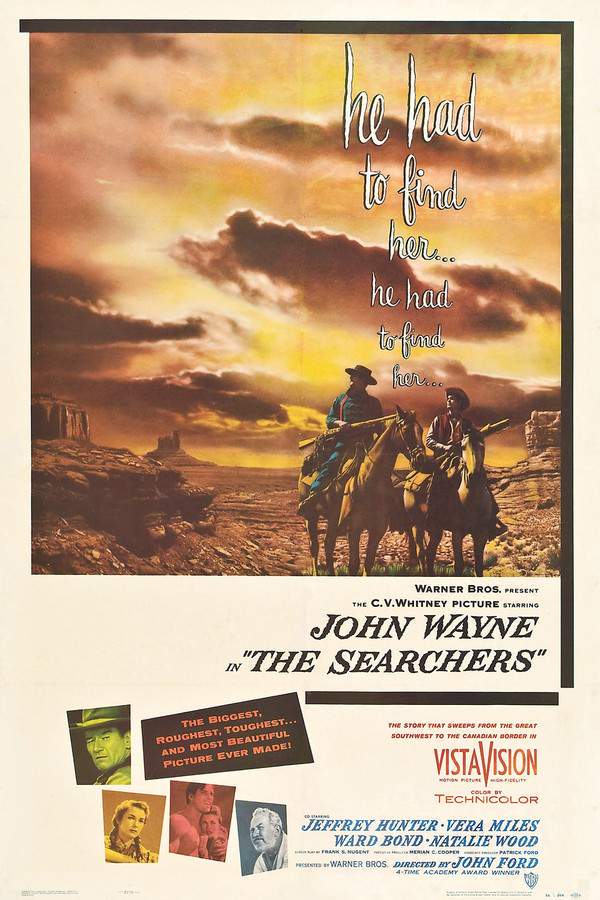
The Searchers (1956) movie poster

Plot Summary

The Searchers (1956) Plot Summary Explained

Release, runtime and language
1956 · 119 min · English
JustWatch #1,710 11
Directed by
John Ford
Starring
John Wayne, Ward Bond, Harry Carey Jr., John Qualen, Vera Miles, Natalie Wood
Budget
$3.8M

Following the Civil War, Ethan Edwards embarks on a relentless search for his brother’s family after a brutal Comanche raid. Driven by a desire for vengeance, he journeys across vast and unforgiving landscapes to find his niece Debbie and her adopted brother Martin, who were abducted during the attack. Accompanied by a diverse group of companions, Ethan confronts not only the dangers of the wilderness but also his own prejudices and the complex realities of the American West as he strives to bring them home.

On this page (6)
  1. 1 Where to watch
  2. 2 What happens: full plot
  3. 3 Plot questions answered
  4. 4 Movie threads
  5. 5 Movies like The Searchers
  6. 6 Every angle

Where to watch

Where to Watch The Searchers (1956)

Where can you watch The Searchers? Stream, rent or buy it in the US, including on fuboTV, YouTube TV and Fawesome: current JustWatch availability with up-to-date prices.

Streaming availability powered by JustWatch

Full plot summary · contains spoilers

What Happens in The Searchers: Full Plot Summary

The whole story of The Searchers (1956) explained, from the opening scene to the final frame: every key event, every twist and what it all adds up to. Read it as a quick recap before the sequel, to check a scene you missed, or to finally understand what really happened.

In the wake of World War II, as Allied forces take hold of Germany, trains rumble across the devastated landscape, transporting a heartrending cargo: countless orphaned children, known collectively as Displaced Persons. Within this somber journey, dedicated UNRRA workers like the compassionate Mrs. Murray strive to provide these children with nourishment and shelter while they reside in transit camps, where they can find a semblance of comfort following the unspeakable horrors they have faced.

Among these children is a young boy named Karel, whose life has been marred by tragedy and profound loss. The devastation wrought by the Nazis has left indelible marks on him, having deported his beloved sister and father, a doctor. Karel and his mother found themselves in the grip of a concentration camp, where the haunting mark of Auschwitz—tattooed on Karel’s arm as "A24328"—serves as a constant reminder of the agony he endured.

As the group prepares for their next leg of their arduous journey, anxiety fills the air. The sound of ambulances and trucks starting up rekindles harrowing memories of Nazi brutality, when these very vehicles played a role in silencing countless victims with poison gas. Panic sweeps through the group as they are herded into the vehicles, the acrid smell of exhaust fumes evoking a chilling reminder of their past traumas.

In a frantic bid for freedom, Karel and his friend Raoul make a courageous attempt to escape by forcing open the back door of their transport. As chaos ensues and the children disperse in every direction, Karel and Raoul make a desperate dash across a river, but tragedy strikes as Raoul loses his life, leaving Karel to seek refuge in the tall reeds.

Simultaneously, Karel’s mother, Mrs. Malik, embarks on a relentless quest to find her long-lost child. Her journey leads her to various camps, where she encounters what she believes to be her beloved Karel—only to find that the child is, in reality, a Jewish boy who adopted Karel's name during roll call, fearing retribution. Undeterred, Mrs. Malik continues her search, ultimately arriving at Mrs. Murray's camp, where she is delivered the crushing news that her son has drowned.

As Karel wades through this perilous landscape, unexpected solace comes from a compassionate individual: Steve, a United States Army engineer, who takes Karel under his wing. Steve teaches him English and begins the long process of helping the young boy transition to life in America. Memories of his absent mother flood Karel’s thoughts, transporting him to moments of desperation behind a concentration camp fence, yearning for just a glimpse of her familiar face. In a flicker of hope, Karel sets out one evening to retrace the debilitating steps he’s taken to this lonely place. He ultimately arrives at a factory, where a fence cruelly reminds him of all he has lost, yet his heart insists he must continue seeking the faintest glimmer of hope.

When Steve finally tracks Karel down, his expression carries the weight of devastating news: Karel’s mother has succumbed to the atrocities at Auschwitz. With empathetic words, Steve offers Karel a chance at a new beginning in America, inviting him to leave behind the sorrows of his past.

Meanwhile, Mrs. Malik finds temporary reprieve in her work at the UNRRA camp, becoming an integral figure in the community. Despite the desolation surrounding her relentless search for Karel, she resigns from her position to devote herself fully to locating any sign of her son. Moved by her dedication, Mrs. Murray encourages her to remain, acknowledging the profound impact Mrs. Malik has on the children in their care.

As fate would have it, Steve prepares to journey to America with Karel, eager to finalize the adoption process and begin anew. Little do they know that a life-altering discovery awaits Mrs. Murray at the train station. She catches sight of Mrs. Malik among the throngs of displaced children arriving at the camp, her heart racing with the realization that a family reunion may still be possible.

As the day unfolds, Steve offers Karel the chance to join the other new arrivals at the UNRRA camp. At the same time, Mrs. Malik has called upon the children to gather around her, blissfully unaware that her son is only steps away. As Karel walks past, they initially fail to recognize each other’s presence—until Mrs. Malik spins around, her voice resonating with longing, “Karel!” In that moment, the boy and his mother lock eyes in a deeply emotional reconnection while Mrs. Murray and Steve look on, their expressions a mixture of joy and sorrow as they witness this poignant reunion.
Last updated: November 21, 2024 at 10:42

Was this helpful?

Plot questions answered

The Searchers Plot Explained: Your Questions Answered

The questions people ask most about The Searchers (1956): what happens in the confusing scenes, why the characters do what they do, the twists, hidden details and what the ending means. Each answer contains spoilers.

Q1

Why do the children panic when being loaded onto the vehicles?

The children panic because the ambulances and trucks remind them of the Nazi vehicles used during the war to transport victims to concentration camps. The sound of engines starting triggers traumatic memories of poison gas and mass killings, causing panic as they fear being subjected to the same brutality they previously endured.

Foreshadowing: Earlier scenes establish the children's extreme sensitivity to war-related stimuli, hinting at the depth of their trauma.

  • children panic
  • trucks
  • nazi vehicles
  • trauma
  • displaced persons
Q2

How does Raoul die during the escape attempt?

Raoul dies while attempting to cross the river with Karel during their desperate escape from the transport vehicle. As they flee through the water, Raoul loses his life, leaving Karel to continue alone and seek refuge in the tall reeds by the riverbank.

Foreshadowing: The escape attempt is presented as a dangerous, high-stakes moment that foreshadows the tragic outcome for Raoul.

  • raoul death
  • escape attempt
  • river
  • karel
Q3

Why does Mrs. Murray tell Mrs. Malik that Karel has drowned?

Mrs. Murray delivers the devastating news that Karel drowned because she believes this to be true based on the information available at the time. The chaos of the escape, the loss of Raoul, and Karel's subsequent disappearance lead authorities to assume the boy perished. This crushing misinformation drives Mrs. Malik to abandon her work at the UNRRA camp to continue her search elsewhere.

Foreshadowing: The false report of drowning creates the central misunderstanding that keeps mother and son apart for much of the film.

  • mrs murray
  • mrs malik
  • karel drowned
  • false report
Q4

How does Steve help Karel adjust to life after the concentration camp?

Steve, a U.S. Army engineer, takes Karel under his wing and helps the boy by teaching him English, providing emotional support, and offering him a chance at adoption and a new life in America. Steve becomes a crucial bridge for Karel between his traumatic past and a potential future, helping him navigate the transition from survivor to someone able to build a new life.

Foreshadowing: Steve's early involvement with Karel sets up his role as Karel's protector and pathway to America.

  • steve
  • karel
  • adoption
  • america
  • english lessons
Q5

Why does Mrs. Malik continue searching after being told Karel drowned?

Despite the devastating news of Karel's supposed death, Mrs. Malik cannot accept this outcome and continues her relentless search across various camps. Her maternal love compels her to keep looking, driven by an unshakeable hope that her son might still be alive. This determination leads her to eventually return to Mrs. Murray's camp, where fate ultimately brings her back to Karel.

Foreshadowing: Mrs. Malik's persistent refusal to accept Karel's death plants the seeds for the eventual reunion.

  • mrs malik
  • search
  • karel
  • mother
  • refuses to accept death
Q6

What does Karel's tattoo A24328 represent?

The tattoo A24328 on Karel's arm is the identification number from Auschwitz, serving as a permanent physical reminder of the concentration camp horrors he endured. This tattoo becomes a symbol of his traumatic past and the millions of children who suffered under the Nazi regime. It marks him as a survivor of one of history's greatest atrocities.

Foreshadowing: The tattoo is mentioned early as a haunting reminder, establishing its significance throughout the narrative.

  • tattoo
  • auschwitz
  • a24328
  • concentration camp
  • karel
Q7

Why does Mrs. Malik work at the UNRRA camp despite searching for her son?

Mrs. Malik becomes an integral figure at the UNRRA camp, dedicating herself to caring for other displaced children while still searching for Karel. Her work provides her with a sense of purpose amidst her grief, and Mrs. Murray encourages her to stay, recognizing the positive impact she has on the traumatized children. Her dual role as caregiver and grieving mother defines her character arc.

Foreshadowing: Mrs. Malik's dedication to the camp children establishes her as someone who helps others, which ultimately leads her back to her own child.

  • mrs malik
  • unrra camp
  • displaced children
  • caregiver
Q8

How do Karel and Mrs. Malik finally reunite at the train station?

The reunion occurs when Mrs. Murray spots Mrs. Malik among newly arrived displaced children at the train station. Meanwhile, Steve brings Karel to the same location. As Mrs. Malik calls children around her, unaware that Karel is nearby, he walks past. They finally lock eyes and she calls his name. Despite the passage of time and his changed appearance, recognition occurs, leading to an emotional reunion witnessed by Mrs. Murray and Steve.

Foreshadowing: The parallel preparation scenes at the train station build toward this convergence of mother and son.

  • reunion
  • train station
  • mrs malik
  • karel
  • final scene
Q9

Why does Karel try to return to the concentration camp site?

Karel makes a desperate journey back to the area near the former concentration camp because he hopes to find some trace of his mother, clinging to the possibility that she might have survived. The factory and fence he encounters serve as painful reminders of his loss, yet his heart compels him to continue searching for any sign of hope, demonstrating the powerful pull of familial connection even after profound trauma.

Foreshadowing: This journey shows Karel's unresolved grief and his inability to fully leave his past behind.

  • karel
  • concentration camp
  • factory
  • search for mother
Q10

Why is the reunion described as bittersweet?

The reunion is bittersweet because while Karel and Mrs. Malik are joyfully reunited, this happiness is overshadowed by the knowledge that Karel's father and sister were deported and killed at Auschwitz, and Mrs. Malik believes her husband did not survive. The immense suffering they endured cannot be undone, and their reunion occurs against the backdrop of irreversible loss.

Foreshadowing: Earlier references to the deportation of Karel's father and sister establish the tragedy that lingers.

  • bittersweet
  • reunion
  • joy
  • sorrow
  • family loss
  • auschwitz

Movie threads

More Movies Like The Searchers, by Mood & Story

Curated lists built around what makes The Searchers tick: the same mood, the same kind of story or the same emotional payoff. Each list explains why these movies belong together.

Epic journey movies like The Searchers

Quest-driven stories across unforgiving environments where the journey itself is the antagonist. If you liked The Searchers for its epic trek across the American West, explore other films featuring relentless journeys through harsh landscapes. This thread gathers movies where characters are tested by vast deserts, mountains, or wilderness, driven by a singular, often personal goal.

  • epic
  • grueling
  • determined
  • survival
  • obsessive
  • vast
  • Tone: dark, gritty, determined
  • Pacing: steady, deliberate, epic
Why these movies?

The story pattern: The narrative follows a linear, goal-oriented quest across a difficult environment. The story is propelled by the physical and psychological challenges of the journey itself, with setbacks and encounters along the way deepening the characters' resolve or revealing their flaws. The pacing is often steady, building tension through the accumulation of miles and obstacles.

Why they belong together: Movies are grouped here for their shared focus on the epic journey as a central narrative device. They share a high intensity born from survival stakes, a steady pacing that mimics a long trek, and a tone that ranges from dark to bittersweet, reflecting the harsh realities of the quest.

Bittersweet reunion stories like The Searchers

Stories where a hard-won reunion is shadowed by the trauma and loss endured to achieve it. Fans of The Searchers' emotionally complex ending will appreciate these movies about searches that end in bittersweet reunions. These films explore the heavy cost of finding lost family or friends, where joy is tempered by overwhelming grief and trauma.

  • bittersweet
  • grieving
  • traumatic
  • hopeful
  • melancholic
  • somber
  • Tone: dark, bittersweet, melancholic
  • Pacing: steady, urgent, character-driven
Why these movies?

The story pattern: The plot is driven by a clear, urgent goal: find the missing person. The journey is fraught with danger and reveals the depths of the characters' dedication and scars. The climax is the reunion itself, but the resolution acknowledges that the trauma of the separation and the losses suffered have permanently altered the characters, making a purely happy ending impossible.

Why they belong together: These films are connected by their specific emotional arc: a heavy, traumatic search culminating in a reunion that feels bittersweet rather than purely triumphant. They share a dark tone, high emotional weight, and a focus on the lasting impact of grief and loss even in moments of hope.

If you liked this

Movies Like The Searchers

Similar movies to The Searchers: the same genre, themes or kind of story. Each one comes with its own plot summary, timeline and ending explained.

Browse all movie summaries

Every angle

The Searchers (1956) Explained: Plot, Timeline & Characters

Everything about The Searchers in one place: what happens in the plot summary, the timeline in chronological order, the characters and meaning and a spoiler-free summary. What's After the Movie adds the cast, box office and post-credit scenes.

Coming soon on iOS and Android

The Plot Explained Movie Summary App

Plot summaries, endings explained and timelines on your phone. Catch up on any movie in minutes, save your favorites and never miss a twist again.

Be the first to know when we launch. Your email stays private, always.

Learn more about the app