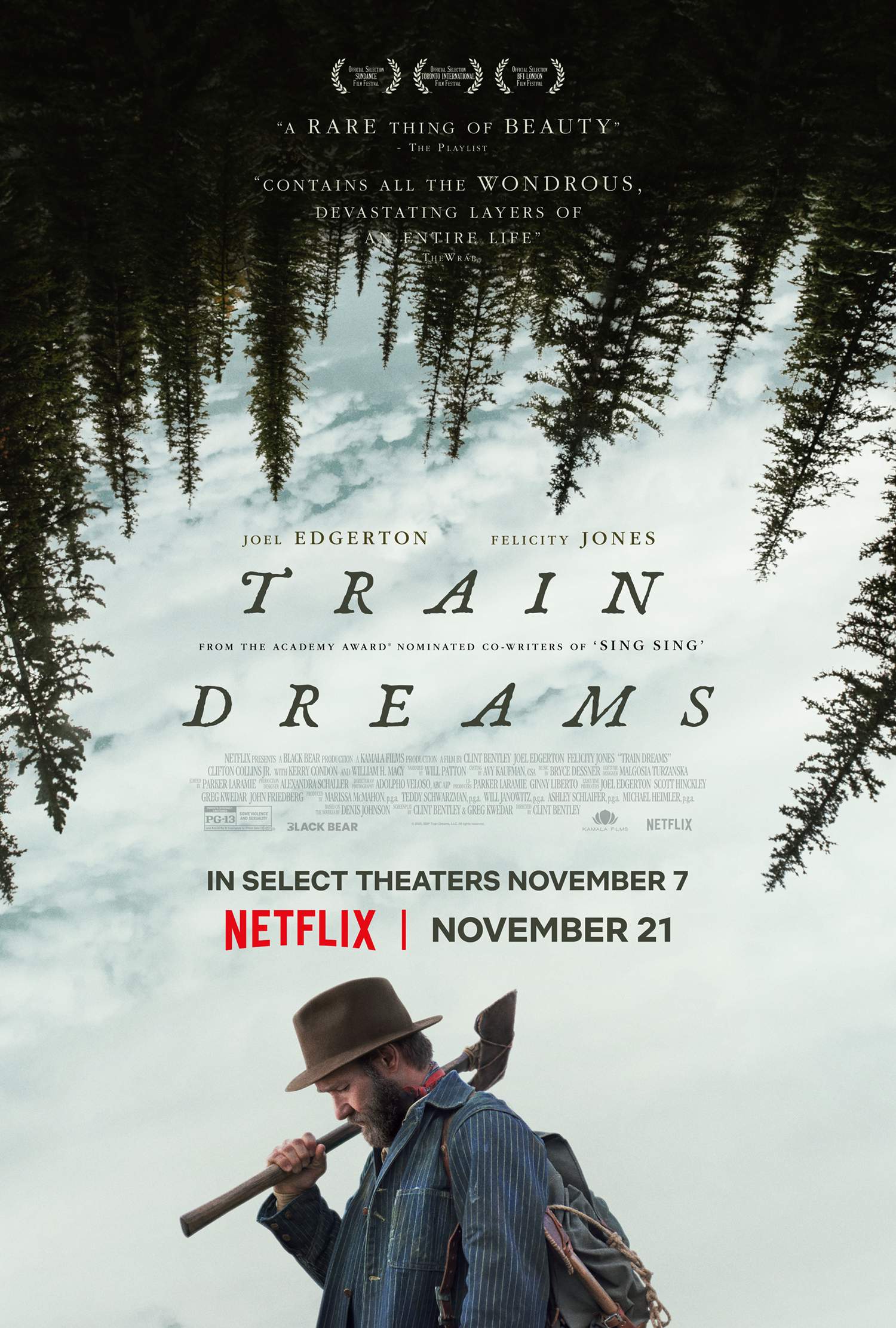
The film opens with a quiet narrator reflecting on a life that spans eight decades, inviting us into the world of Robert Grainier, a man who grows up largely without knowing his real family. As a child, he bears witness to sweeping historical moments, from the harsh upheavals of the era to the tense presence of violence, including the mass deportation of Chinese immigrants in Idaho. Early on, he crosses paths with a troubled man named Boomer, who has just been shot and left for dead, a moment that foreshadows the haunting images that will shadow Robert for years to come.
Without a clear path or direction after leaving school, Robert’s life begins to shift when he meets his future wife, Gladys Olding. The two start a family, welcoming their daughter Kate, and they carve out a life together by building a log cabin along the Moyie River. This intimate domestic dream stands in contrast to the economic forces around them, offering Robert a sense of purpose even as the world outside grows more complex.
Work calls him to the Spokane International Railroad, and there he witnesses a brutal act: some of the men grab an Asian man named Fu Sheng and push him from a bridge to his death. The image sears itself into Robert’s memory, and he is left with persistent visions of the man that linger through the years. When his job is eventually rendered obsolete, Robert returns home, seeking to spend more time with Gladys and Kate, trying to hold on to a sense of stability.
Another season of logging draws him away from home again, and this time he meets new men who will leave an impression on him. Among them is Arn Peeples, whose presence will prove to be “useful in specific ways” for Robert. A colorful, talkative logger known as “Apostle Frank” and the stranger Elijah Brown introduce a darker thread to the story: Elijah accuses Frank (whose real name is Sam Loving) of killing his black brother, prompting Frank to flee. Elijah shoots him dead, and the other loggers do not intervene. In the aftermath, Robert forms a quiet bond with Arn, a companionship born out of shared labor and survival in a harsh, unforgiving environment.
Tragedy strikes when a rolling tree sends three men to their deaths, and the crew buries them together. Robert considers joining Gladys and Kate to keep them from danger, but he fears the risks of a life spent apart from his work and the world. He tries to find work closer to home, but the post-World War I economy makes that difficult. The loss of Arn comes when a falling branch collapses him, and the story carries the weight of that moment for Robert as he mourns his friend years later.
The end of a season brings a devastating wildfire that destroys the cabin and all that Robert has built. When the smoke clears, Gladys and Kate are missing, and he faces the most painful possibility: they may be gone. He is joined by his Indigenous friend Ignatius Jack, and together they walk through the charred landscape. In the wake of the loss, Robert rebuilds the cabin, clinging to a fragile hope that his family might someday return. Yet the brutal truth of his aging body makes it clear that he cannot master the tools of modern lumbering, like the chainsaw, as easily as in his youth. He meets with a former coworker, Billy, who seems to be losing his memory about Arn’s death, and Robert tells him he hasn’t seen Arn either. Eventually, Robert decides to retire from logging.
A new life awaits as he becomes a carriage driver, a role that brings him closer to the townsfolk while gently underscoring his isolation. On one ride, he picks up Claire Thompson, a woman from the United States Forest Service, and their conversations reveal their shared feelings of loneliness and the sense that the world has moved on without them. He often wanders the forest, hoping for a sign of Gladys and Kate, even as the years press on.
One night, Robert encounters an injured young girl who might be Kate. He brings her to the cabin, tends to her wounds, and falls asleep beside her. He dreams of baby Kate playing by the river, a memory that feels more real than the present. When he wakes, the girl is gone and the window stands open. He vows to stay by the cabin in case she returns, clinging to the possibility of reunion.
Time marches forward and the world continues to evolve around him: televisions appear, the moon landing happens, a theater becomes a place of spectacle, and Robert even sees his own aging reflection for the first time in years. He takes a plane ride, a moment of scale and perspective that becomes a turning point in the narrative. The film’s voiceover summarizes his journey: he dies alone in his cabin in November 1968, never remarrying and having no children, yet in the moment he soars through the sky, he feels “at last, connected to it all.”
Rooted in quiet resilience and the passage of time, the story traces how a man who started with little by way of family or direction finds connections to people, memories, and the wider world—connections that arrive, sometimes slowly, sometimes suddenly, and sometimes only in the moments when he finally looks up and sees the expanse around him. The result is a reflective meditation on loss, endurance, and the quiet ways a life can touch others even when one remains alone.