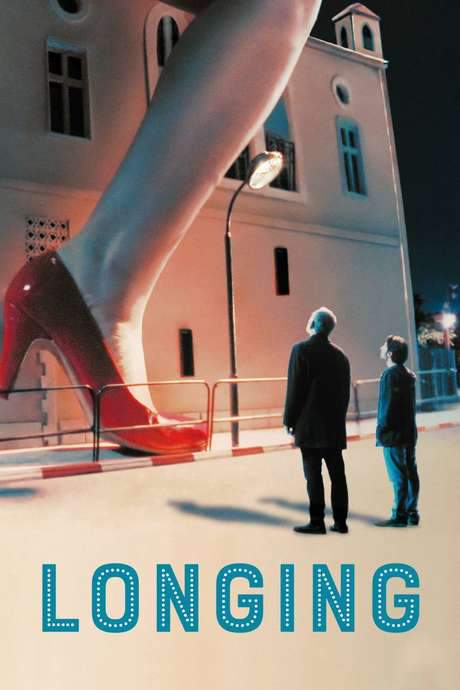
Ariel [Shai Avivi] meets with his ex-partner Ronit Hilou [Assi Levy] at a restaurant about twenty years after they broke up. She reveals a long-buried truth: when they separated, she was pregnant with his child, and their son, Adam (Adam Gabay), died in a car accident two weeks earlier. Ariel, a successful industrialist living in Tel Aviv, travels to Acre, the town where Ronit and Adam once lived, and he spends several days there, slowly stepping into the rhythms of Adam’s world. He is drawn into a search that grows deeper and more intimate with every conversation, and he begins to uncover the layers of a life that he never truly knew.
In his first meetings, he encounters Miki [Ori Laizerouvich], a friend of Adam’s, who reveals a rougher side of their late friend: the two had once bought a kilogram of hashish to start a small, precarious business, and the substance disappeared in the car accident that claimed Adam’s life. Miki also points Ariel toward Adam’s school, and this leads him into a new circle of people who shaped Adam’s days. The principal, Amnon, explains that Adam was expelled after scribbling an obscene poem about the French teacher on a wall near the building, a detail that adds a troubling shade to the boy’s story. In the schoolyard, a teenage girl named Lilia approaches and shares that Adam had been living with her due to conflicts with his stepfather, yet there is a deeper truth: Adam’s true love was the French teacher, Yael.
At the end of the school day, Ariel waits by the gate and finally sees Yael leaving. Their conversation unfolds with careful, aching honesty. Yael reveals that Adam was, indeed, in love with her, but she refused to pursue anything romantic because of the teacher-student dynamic. The moment is charged with unspoken possibilities and regrets, and it reframes the way Ariel sees his son’s short life.
Ariel’s journey continues as he visits Adam’s grave. There, at the cemetery, he befriends Gideon [Yoram Toledano], the father of Abigail, a young woman who battled depression and took her own life at 18. The encounter with Gideon introduces a surprising and unsettling idea: inspired by a Chinese custom, Gideon suggests a way to honor both Adam and Abigail by arranging a union between them. The proposal resonates with Ariel, who sees in it a chance to give meaning to a life that felt incomplete and to bridge the gaps that grief has carved between families. As the days pass, Ariel confronts questions of legacy, memory, and the possibility of reconciliation across generations, choosing to pursue a path that honors the complexities of Adam’s life and the people who shaped it.
Through quiet discoveries and patient conversations, the narrative threads together a portrait of a boy whose relationships—love, friendship, and the pain of family conflict—echo in the decisions his father makes after his death. The film crafts a patient, observational tone as Ariel moves between present and memory, charting how a single loss can ripple outward, guiding a father toward unconventional solutions in an effort to keep Adam’s memory alive. The result is a slow-burn meditation on parenthood, memory, and the ethical borrowings of grief, delivered with restrained power and a sense of unresolved longing that lingers beyond the final scene.