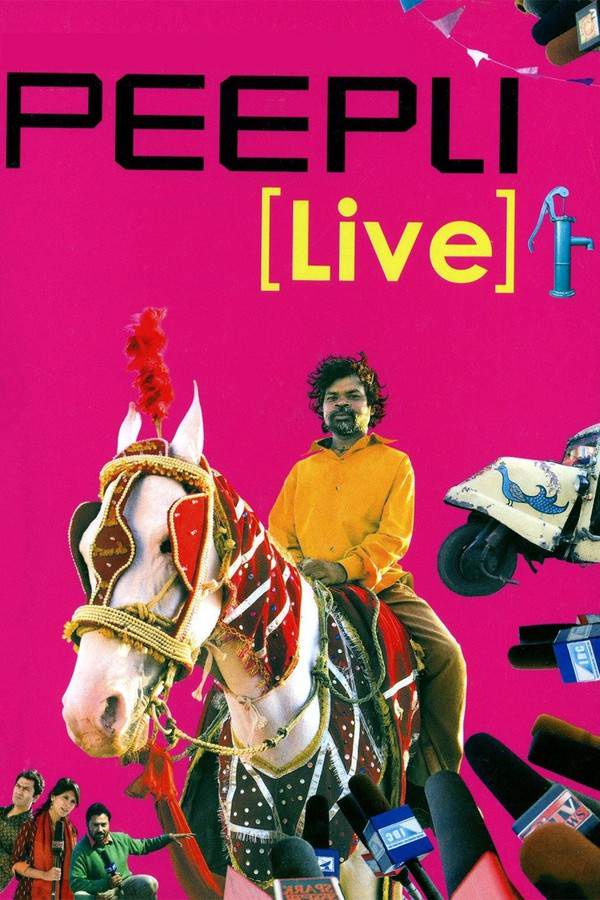
Peepli Live
Year: 2010
Language: Hindi
Directors: Anusha Rizvi, Mahmood Farooqui
On the eve of national elections, a family in the small Indian village of Peepli faces financial ruin due to an unpaid government loan. As they struggle to save their land, a calculating politician sees an opportunity and suggests a drastic measure that quickly attracts media attention. The ensuing situation creates a tense standoff, forcing the family to confront difficult choices and raising questions about truth, sacrifice, and the pressures of rural life.
Where to Watch Peepli Live?
Find where to stream, rent, or buy Peepli Live (2010) in the US with current JustWatch availability, up-to-date pricing, and platform listings for subscription, rental, and digital purchase options.


Streaming availability powered by 
Warning: spoilers below!
Haven’t seen Peepli Live yet? This summary contains major spoilers. Bookmark the page, watch the movie, and come back for the full breakdown. If you're ready, scroll on and relive the story!
Peepli Live (2010) – Full Plot Summary & Ending Explained
Read the complete plot breakdown of Peepli Live (2010), including all key story events, major twists, and the ending explained in detail. Discover what really happened, and what it all means.
Natha Das ManikPuri, known simply as Natha (played by Omkar Das Manikpuri), is a struggling farmer from the humble village of Peepli in Mukhya Pradesh. His life is consumed by the necessity to provide for his family, which includes his elder brother, Budhia Das Manikpuri (Raghuvir Yadav), his wife, Dhaniya (Shalini Vatsa), their three young children, and their ailing mother, Amma. Amma primarily spends her days lying down and frequently scolding both Natha and Dhaniya, adding to the family’s burdens.
Natha and Budhia often feign farming activities, but in reality, they squander their meager resources on alcohol, leaving their family to face dire hunger. As pressure mounts from the banks for loan repayments, which threatens their land and home, an unexpected political twist arises. The Mukhya Pradesh Government is called to action due to growing scrutiny over the entrenched poverty endemic in the region. The ruling Sammaan party, led by district head Bhai Thakur, is under fire, while the opposition, Apna Dal Party, senses an opportunity to unseat them.
In a desperate bid to protect his family’s future, Natha is persuaded by his brother to contemplate suicide after Bhai Thakur insinuates that such a tragic event could result in a hefty compensation of Rs 1 Lakh for his family. While discussing their dark plot at a local tea stall, their conversation is overheard and reported by a local journalist, Rakesh. This catch of a story causes a ripple effect, prompting the Chief Minister to intervene, and Natha is soon enveloped in a media frenzy.
With national news outlets swooping in to cover the anticipated sensationalism of Natha’s potential suicide, the situation escalates. One particular reporter, Daytime Presenter Nandita Malik, is determined to secure an interview with Natha and his family. Meanwhile, rival channel Bharat Live, represented by Deepak, is also racing against time to capture the unfolding drama, each vying for a greater narrative.
As the community of Peepli transforms into a chaotic spectacle attracted by media attention, Natha finds himself ensnared between the political machinations of both local and national figures. The Sammaan Party seeks to mitigate damage by offering sops to deter Natha from taking his life, while opposition figures plot to leverage Natha’s plight for electoral gain.
Despite the escalating political circus, Natha remains alive and refuses to go through with his intentions. Tensions rise as Bhai Thakur breaks from the Chief Minister’s good graces and threatens Natha with death to prompt action. Natha becomes the focal point of a power play, with each party seeking to claim him as their own narrative.
Amidst all the turmoil, a shocking turn of events leads to Rakesh’s tragic death during a fire accident sparked by a chaotic media rush. In the aftermath, the government capitulates, mistaking Rakesh’s demise for Natha’s, resulting in the denial of compensation to Natha’s family. Ultimately, Natha escapes the suffocating grasp of his circumstances to become a laborer in Gurgaon, while his family loses their ancestral land to the banks, leaving them stranded in despair.
Last updated: November 03, 2024 at 14:26
Peepli Live (2010) Plot Questions Answered – Summary FAQ
Explore frequently asked questions about Peepli Live (2010) with spoiler-rich answers covering the full plot summary, major story beats, character motivations, hidden details, and ending meaning. This movie summary FAQ helps explain confusing scenes, plot twists, and narrative decisions in clear, searchable detail.
Why does Bhai Thakur suggest suicide to Natha?
Bhai Thakur, the district head of the ruling Sammaan party, suggests that Natha commit suicide as a political strategy. With national elections approaching and the region under scrutiny for extreme poverty, Thakur knows that a farmer's suicide would generate massive media attention and political pressure. He calculatingly hints that Natha's family would receive Rs 1 Lakh in compensation, essentially viewing Natha's potential death as a tool to either help the government appear compassionate or hurt them by exposing the poverty crisis.
The region's endemic poverty and the ruling party's vulnerability to criticism are established early in the film.
How does the journalist find out about Natha's plan?
Natha and his brother Buchsia discuss their desperate plan at a local tea stall. Their conversation is overheard by Rakesh, a local journalist, who recognizes the story's potential impact. Rakesh reports on Natha's contemplation of suicide, which triggers the chain reaction of media attention and political intervention that dominates the rest of the film.
Why does the government deny compensation to Natha's family?
After Rakesh dies in a fire accident caused by the chaotic media rush, the government mistakenly believes that Natha has also perished in the incident. This confusion leads authorities to assume the family has already received compensation or that the situation is resolved. As a result, the government retracts all promises of financial assistance, leaving Natha's family with nothing despite their suffering.
The chaotic media frenzy around Natha's story creates the conditions for the deadly fire accident.
Why does Natha leave for Gurgaon?
After the government denies compensation, the family loses their ancestral land to the banks due to unpaid loans. With no home, no money, and no hope of redress, Natha makes the painful decision to abandon his family and migrate to Gurgaon as a laborer. This represents his final escape from the suffocating political manipulation and systemic failure that destroyed his life in Peepli.
The persistent bank pressure for loan repayment and the threat of land seizure are established early in the narrative.
What happens to Natha's family land?
Natha's family loses their ancestral land to the banks due to unpaid government loans. Despite the media attention and political promises, the family receives no compensation. The land seizure represents the ultimate failure of the system they tried to work within, leaving Natha's wife Dhaniya, their three children, and his ailing mother Amma homeless and desperate.
The bank's repeated threats of land seizure due to unpaid loans create constant tension throughout the film.
Why does Bhai Thakur threaten Natha with death?
Bhai Thakur threatens Natha because the ongoing media attention and political crisis are damaging the ruling Sammaan party's electoral prospects. As the Chief Minister puts pressure on Thakur to resolve the situation, Thakur loses patience and resorts to intimidation. He wants Natha to either go through with the suicide or disappear, so the political embarrassment ends and the narrative can be controlled.
Thakur's initial suggestion of suicide was already a manipulative tactic to serve political interests.
How do political parties use Natha's situation?
Both the ruling Sammaan party and the opposition Apna Dal Party attempt to exploit Natha's plight for electoral gain. The Sammaan party offers sops and incentives to deter Natha from suicide, hoping to control the narrative. The opposition seizes the opportunity to attack the ruling party by highlighting the poverty that drove Natha to desperation. Natha becomes a political pawn, caught between parties seeking to claim his story as their own.
The political rivalry between Sammaan party and Apna Dal is established when the opposition senses an opportunity to unseat the ruling party.
Why does Natha refuse to go through with suicide?
Despite overwhelming desperation and political pressure from multiple sides, Natha ultimately chooses not to commit suicide. This decision puts him at the center of an even bigger political tug-of-war, as both parties try to claim his life story for their narratives. His refusal highlights the moral complexity of his situation, he wants to live but sees no viable path forward within the broken system.
The family's struggle and Natha's conversations about desperation establish his internal conflict throughout the narrative.
What causes the media frenzy in Peepli?
Rakesh's report on Natha's suicidal contemplation triggers national news outlets to descend on Peepli. Both Daytime Presenter Nandita Malik and rival reporter Deepak from Bharat Live race to secure interviews with Natha and his family. The competition between these media outlets transforms the quiet village into a chaotic spectacle, with multiple news teams vying for the most sensational coverage of the story.
The initial journalist Rakesh recognizes the story's national news potential.
How does Rakesh die in the fire accident?
Rakesh, the journalist who first exposed Natha's story, dies during a chaotic rush of media vehicles and crowd panic. As news teams scramble to cover the unfolding drama in Peepli, a fire accident occurs, likely triggered by the disorder and overloaded equipment. His death becomes a tragic consequence of the media circus that his original story set in motion.
The competitive race for coverage between Nandita Malik and Deepak intensifies the chaos in the village.

Explore Movie Threads
Discover curated groups of movies connected by mood, themes, and story style. Browse collections built around emotion, atmosphere, and narrative focus to easily find films that match what you feel like watching right now.
Media Circus Satires like Peepli Live
Stories where a personal crisis becomes a chaotic media spectacle.Discover movies like Peepli Live, where a serious personal issue becomes a media frenzy. These films combine biting satire with chaotic pacing to critique sensationalist journalism, political opportunism, and societal indifference, offering a grim look at exploitation in the public eye.

S.F.W.
1994

S.O.B.
1981

Triangle of Sadness
2022

The Last Circus
2011

Movie 43
2013
Southland Tales
2007

I Love Your Work
2005

End of the Road
1970

Bad Luck Banging or Loony Porn
2021
Street Trash
2024

The Day Shall Come
2019

Kinds of Kindness
2024

Saturday Morning Massacre
2012
White Noise
2022

Terrorizers
1986
Narrative Summary
Narratives typically begin with a single, often desperate, individual or event that catches the attention of the media. This triggers a rapid escalation, drawing in various self-interested parties like politicians, activists, and competing news networks. The story juggles multiple perspectives to show how the original human truth is lost in a storm of exploitation, commentary, and public spectacle, often ending with the individual consumed by the chaos.
Why These Movies?
They are grouped together by their shared chaotic, fast-paced energy that mimics a media storm. The tone is darkly satirical, using absurdity and humor to underscore a bleak message about societal failures. The experience is defined by an anxious, oppressive mood as characters are crushed by forces beyond their control.
Grim Social Realism Dramas like Peepli Live
Hard-hitting dramas exposing the human cost of broken systems.If you liked the heavy emotional weight of Peepli Live, explore these grim social realism dramas. They depict the desperate struggles of ordinary people against overwhelming systemic forces like poverty and corruption, often leading to bleak, emotionally resonant conclusions that critique societal structures.

City of Hope
1991

Brooklyn's Finest
2010

The Hoodlum
1951

System Crasher
2020

Elisa Before the End of the World
1997

Night and the City
1950

Knock on Any Door
1949

Crimson Gold
2003
Vassa
1983

The Robbers
2023
Storytelling
2002

Stoic
2009

The Wasted Times
2016
Cities of Last Things
2019

Los olvidados
2014
Narrative Summary
Stories follow protagonists trapped in impossible situations created by systemic injustice, such as debt, bureaucratic red tape, or political corruption. The narrative is a slow-build descent into desperation, highlighting the protagonist's powerlessness. The conflict is not against a single villain but against an impersonal, uncaring system, typically concluding with a bleak outcome that reinforces the film's critical message.
Why These Movies?
They share a heavy emotional weight, an oppressive mood, and a bleak tone. The pacing is often variable, building tension slowly before events accelerate towards an inevitable, grim conclusion. The core similarity is their unflinching focus on the human suffering caused by societal and economic failures.
Unlock the Full Story of Peepli Live
Don't stop at just watching - explore Peepli Live in full detail. From the complete plot summary and scene-by-scene timeline to character breakdowns, thematic analysis, and a deep dive into the ending - every page helps you truly understand what Peepli Live is all about. Plus, discover what's next after the movie.
Peepli Live Timeline
Track the full timeline of Peepli Live with every major event arranged chronologically. Perfect for decoding non-linear storytelling, flashbacks, or parallel narratives with a clear scene-by-scene breakdown.

Characters, Settings & Themes in Peepli Live
Discover the characters, locations, and core themes that shape Peepli Live. Get insights into symbolic elements, setting significance, and deeper narrative meaning - ideal for thematic analysis and movie breakdowns.


Similar Movies to Peepli Live
Discover movies like Peepli Live that share similar genres, themes, and storytelling elements. Whether you’re drawn to the atmosphere, character arcs, or plot structure, these curated recommendations will help you explore more films you’ll love.







Explore More About Movie Peepli Live
Peepli Live (2010) Scene-by-Scene Movie Timeline
Peepli Live (2010) Movie Characters, Themes & Settings
Peepli Live (2010) Spoiler-Free Summary & Key Flow
Movies Like Peepli Live – Similar Titles You’ll Enjoy
Monsoon Wedding (2002) Story Summary & Characters
Parched (2016) Detailed Story Recap
PK (2014) Film Overview & Timeline
Piku (2015) Full Movie Breakdown
Toilet: Ek Prem Katha (2017) Detailed Story Recap
Toilet: A Love Story (2017) Movie Recap & Themes
Sheeple (2018) Complete Plot Breakdown
Ghulami (1985) Full Movie Breakdown
Pestonjee (1988) Complete Plot Breakdown
Piravi (1989) Ending Explained & Film Insights
Cheeni (2020) Detailed Story Recap
Bheed (2023) Spoiler-Packed Plot Recap
Laadla (1994) Ending Explained & Film Insights
Mere Apne (1971) Full Movie Breakdown
Mother India (1957) Story Summary & Characters