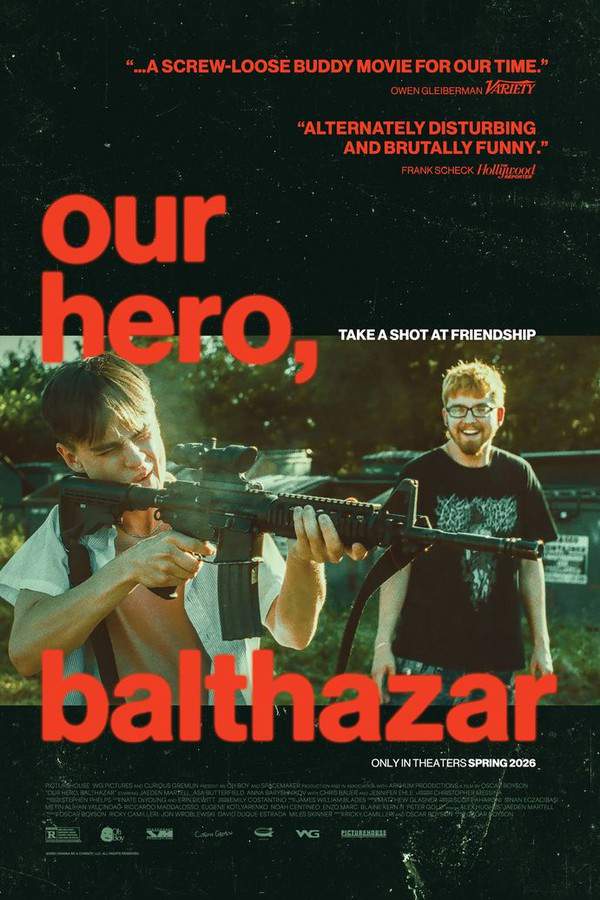
Our Hero, Balthazar

Our Hero, Balthazar

Year: 2025

Runtime: 91 mins

Language: English

Director: Oscar Boyson

ThrillerComedyDrama

A wealthy teenager from New York City tries to win over his activist crush by traveling to Texas and befriending a would-be mass shooter.

Where to Watch Our Hero, Balthazar?

Find where to stream, rent, or buy Our Hero, Balthazar (2025) in the US with current JustWatch availability, up-to-date pricing, and platform listings for subscription, rental, and digital purchase options.

Warning: spoilers below!

Haven’t seen Our Hero, Balthazar yet? This summary contains major spoilers. Bookmark the page, watch the movie, and come back for the full breakdown. If you're ready, scroll on and relive the story!

Our Hero, Balthazar (2025) – Full Plot Summary & Ending Explained

Read the complete plot breakdown of Our Hero, Balthazar (2025), including all key story events, major twists, and the ending explained in detail. Discover what really happened, and what it all means.

Balthazar Malone, Avan Jogia, is the teenage scion of a wealthy, politically connected New York City family. He spends his evenings producing social media videos that dramatize the fear surrounding gun violence in schools, a topic he treats with a performative intensity designed to draw views and reactions. When one of his posts receives a sharply sardonic reply from a user named “deathdealer_16,” he escalates his online activity by sending direct messages in hopes of uncovering who the person might be. His search becomes personal when he grows convinced that this anonymous user is planning a school shooting, a fear that threads through his every action and social circle.

Meanwhile, Balthazar’s world is thrown into sharper relief during a private company–run, hyper-controlled school shooting drill. As his classmates participate, he becomes increasingly fixated on Eleanor, a vociferous student activist who bluntly rejects America’s gun culture. To impress her, he shows her his inflammatory posts, the suspicious messages from “deathdealer_16,” and even footage said to be from a real Arkansas school shooting. A moment of intimate connection is attempted when Balthazar leans in to kiss her, only to be met with Eleanor’s chilly rebuke and a firm exit. He then tries to trap the person behind the threat by feigning openness and curiosity, aligning himself with a dangerous path of deception that will pull others into his orbit.

The story widens as the online persona “deathdealer_16” turns out to be Solomon Jackson, a troubled young man living in a Texas trailer park with his disabled grandmother. Solomon is portrayed as a maladjusted loner, socially offputting and quick to temper. He has just reconnected with his absent father, Beaver, a drug addict who previously worked in the adult industry and who now ropes Solomon into a pyramid scheme selling testosterone supplements. After paying for a trial supply, Solomon’s hopes to prove himself fall flat when he cannot sell any product. His circumstances grow tougher: rent rises in the trailer park, and he is fired from a gas station job after a confrontation with a female coworker. Yet his online chats with the Terra persona kindle a dangerous sense of possibility, especially when he believes Terra intends to meet him in person.

When Balthazar reappears in Solomon’s life in Texas, both are drawn into a fragile, coercive bond. Solomon presents a packed room of guns and a scrapbook of past ideological “phases,” showing off his weaponry and his father’s supplement business as a way to lure Balthazar into collaboration. He pressures Balthazar to sign for an order, insinuating that failure to do so would endanger others, a tactic that reveals how fear and manipulation intertwine in his world. The two men wander into a dangerous dynamic, with Solomon asking Balthazar to cry as he does in his videos, trying to train him to mimic the performance that has kept Solomon’s own life afloat in social and economic terms. The plan to demonstrate a shooting at a local school becomes a shared fantasy, a chance to prove their power to themselves and to the people they watch online.

The pair’s journey takes them to a gas station and later to a school, where the supposed plan is pitched as a practical demonstration. Balthazar—carried along by Solomon’s insistence that he has friends and influence—begins to understand the gravity of what is being discussed, even as he toys with the idea of violent posturing. When Taylor, Solomon’s coworker, ridicules their efforts, the facade begins to crumble. A trip to meet Beaver in a bar follows, where Balthazar starts to see the real danger: Solomon’s grandiose ambitions are a fragile front for the deeper, more coercive needs of a desperate man trying to secure a sense of belonging and control.

The tension culminates when Beaver’s grip tightens and the two boys return to the trailer for one final confrontation. Solomon wants to demonstrate his control and test Balthazar’s loyalty, but the tension erupts into violence that spills beyond the room. A stray shot mortally wounds Solomon’s grandmother, intensifying the stakes and pushing both boys toward a terrifying final act. The chase through the trailer park ends when Balthazar, forced into a corner, shoots Solomon in the head as police close in. With the scene resolved, authorities gather the evidence and the narrative’s truth becomes a matter of perspective. The aftermath sees Balthazar back in New York City, where he gives a television interview about his experience, projecting a carefully curated version of events that frames it as part of the ongoing struggle in which young people are asked to fight for their lives.

Across these parallel arcs, the film examines how online personas, real-life traumas, and the impulse to seek validation in dangerous ways can collide with the responsibilities we owe one another. It questions the line between performance and reality, and it challenges viewers to consider how easily fear can be weaponized when access to information, influence, and personal connections becomes a form of power. The characters’ journeys—one through the glitter and peril of urban privilege, the other through a harsh, marginalized existence—intersect in ways that reveal both vulnerability and volatility, ending with a reckoning that reverberates far beyond the trailer park and the city’s glittering towers.


Last updated: August 28, 2026 at 07:33

Was this helpful?

Our Hero, Balthazar (2025) Plot Questions Answered – Summary FAQ

Explore frequently asked questions about Our Hero, Balthazar (2025) with spoiler-rich answers covering the full plot summary, major story beats, character motivations, hidden details, and ending meaning. This movie summary FAQ helps explain confusing scenes, plot twists, and narrative decisions in clear, searchable detail.

Q1

Why does Balthazar travel to Texas to find deathdealer_16?

A.

Balthazar's trip to Texas is driven by two overlapping motivations. He is infatuated with Eleanor, a student activist at his school, and wants to prove he is personally confronting the gun violence he dramatizes online. He has also become genuinely convinced that the anonymous user "deathdealer_16" is planning a real school shooting and sees himself as the only person positioned to stop it. The journey lets him perform bravery for Eleanor while also feeding his obsession with the threat, and the film frames both impulses as inseparable.

Balthazar's first reaction to the sardonic reply from deathdealer_16 is to escalate by sending direct messages, establishing his compulsion to chase the danger rather than disengage from it.

balthazar texas tripdeathdealer_16eleanorschool shooting plotperformative activism
Q2

Who is "Terra" and why does Balthazar pretend to be her?

A.

"Terra" is a fictional persona that Balthazar invents to catfish Solomon Jackson, the real person behind "deathdealer_16." Once Solomon arranges to meet the person he has been chatting with in person, Balthazar creates "Terra" so he can keep the dangerous dynamic going and keep gathering supposed evidence of a shooting plot. The deception escalates quickly when Balthazar uses AI tools to send sexually explicit messages, blurring the line between an investigation and outright manipulation of a vulnerable young man.

terra personabalthazar catfishingsolomon jacksonai generated messagesdeathdealer_16
Q3

What does the ending of Our Hero, Balthazar mean?

A.

The ending of Our Hero, Balthazar works as a cynical commentary on performative activism and media culture. By letting Balthazar walk free and rewarding himself with a televised performance of victimhood, the film argues that society is willing to accept any story that confirms its preferred narratives about guns and youth, no matter how hollow. The fact that Balthazar's own deceptions, false accusations, and manipulation of Solomon are never exposed implies that a well-crafted persona can override the truth, and that the "hero" of the title is really a sociopath being rewarded for his performance.

ending explainedour hero balthazar meaningperformative activismmedia performancecynical ending
Q4

How does Solomon's grandmother end up getting shot?

A.

Solomon's grandmother is mortally wounded during a chaotic struggle back at the trailer after Balthazar and Solomon return from their confrontation with Beaver. A fight between the two boys leads to an accidental rifle discharge, and a stray bullet hits the grandmother, who is in the room. The killing is not intentional on either boy's part, but it transforms the situation from a volatile standoff into a fatal tragedy and triggers the final chase through the trailer park.

grandmother killedstray bullettrailer parkaccidental shootingbalthazar solomon fight
Q5

Why does Balthazar shoot and kill Solomon?

A.

After the grandmother is hit, Balthazar grabs his pistol and flees while Solomon pursues him through the trailer park firing shots. Cornered with police closing in, Balthazar fires back and kills Solomon with a shot to the head. The shooting is presented as self-defense, and because Solomon's room is full of weapons, ideological notebooks, and other evidence that supports Balthazar's account, authorities accept his version of events without exposing his own role in catfishing and manipulating Solomon.

The school shooting drill earlier in Our Hero, Balthazar trains Balthazar to imagine a school under attack as a kind of theater, and the final shooting plays out almost like the drill he never took seriously.

balthazar kills solomonfinal confrontationself defensetrailer park chaseshooting scene
Q6

Who is Solomon Jackson and what pushes him toward violence?

A.

Solomon is a maladjusted young man living in a Texas trailer park with his disabled grandmother. He has just reconnected with his absent father Beaver, a former adult-film star now running a pyramid scheme selling testosterone supplements, and the relationship makes Solomon feel both drawn to and humiliated by him. After being fired from a gas station job, priced out by rising rent, and unable to sell any product for his father, Solomon feels invisible and trapped, which is why the attention he gets from "Terra" online gives him a dangerous sense of power. His collection of guns and ideological notebooks becomes a way to project the control he cannot find in his real life.

solomon jacksontexas trailer parkbeaver fatherpyramid schemeviolent fantasies
Q7

What happens to Balthazar after he returns to New York?

A.

Balthazar is brought back to New York City where the evidence recovered from Solomon's trailer, including weapons, notebooks, and recordings, is presented as supporting his story. He gives a televised interview in which he performs grief and frames the experience as part of a broader national fight for young people's lives against gun violence. Our Hero, Balthazar shows him carefully curating his image, feigning tears, and casting himself as a hero rather than acknowledging his own role in catfishing Solomon, pressuring him, and lying to the adults around him.

balthazar interviewnew york returnmedia performancefeigned tearsaccountability
Q8

Why do Balthazar and Solomon visit a local school in Texas?

A.

Solomon pitches the school visit as a practical "rehearsal" of the mass shooting he has been fantasizing about, and Balthazar goes along because he is still half-invested in the performance of danger. At the school, Balthazar holds Solomon's rifle and even muses about killing a janitor, but the reality of the space unsettles him. Solomon ultimately stops the act himself, admitting the fantasies are mostly posturing, and Balthazar calls Eleanor to say he has been dissuaded, though she urges him to cut contact entirely.

The earlier school shooting drill Balthazar goes through in New York primes him to treat the idea of a real school shooting as exciting theater rather than genuine horror.

school rehearsaltexas school visitsolomon planbalthazar rifleeleanor phone call
Q9

How does Balthazar manipulate Solomon once they meet in person?

A.

Balthazar keeps feeding Solomon the illusion that "Terra" is a real, separate person who believes in him, which gives Solomon a sense of being seen and valued. He plays along with Solomon's fantasies about a shooting demonstration and pretends to be afraid and impressed, even when Solomon pressures him to sign for a supplement order under threat. Balthazar also borrows the performative crying from his own social media videos and mirrors what Solomon wants to see, essentially training himself to feed Solomon's need for an audience and keep the dynamic going.

balthazar manipulationterra illusionperformative cryingsolomon audiencecoercive bond
Q10

Why does Balthazar falsely accuse his life coach of molestation?

A.

When life coach Anthony tries to stop Balthazar from leaving for Texas, Balthazar panics because the trip depends on him being free to continue his dangerous online interaction. He fabricates a childhood molestation accusation against Anthony, knowing the claim will be explosive enough to derail any intervention and discredit Anthony in the eyes of the adults around him. The lie buys Balthazar the time and space he needs to pursue Solomon, but it also marks his descent into using real-world harm as a tool for personal convenience.

balthazar false accusationlife coach anthonyfabricated molestationmanipulationintervention
Q11

Why does Eleanor reject Balthazar at the school drill?

A.

Eleanor is a serious student activist who has dedicated herself to challenging America's gun culture, and she quickly sees through Balthazar's performative intensity. When he shows her his inflammatory social media posts, the suspicious messages from "deathdealer_16," and graphic Arkansas shooting footage, he is trying to prove he is on her side, but she reads it as self-serving theater. His attempt to kiss her right after confirming her impression that he is using the cause and the threat as tools for personal validation is what makes her cut him off coldly.

eleanor rejectionstudent activistgun cultureperformative intensityarkansas footage
Q12

How does Beaver's pyramid scheme connect to the shooting plan?

A.

Beaver's testosterone supplement business is a pyramid scheme that Solomon was pulled into, and it deepens his financial desperation and resentment toward his father. When Solomon cannot sell any product, he owes money and feels like a failure in Beaver's eyes, which makes him more receptive to alternative ways of proving his worth. The grift also introduces him to people like Supes and a cousin of an Arkansas shooting victim, keeping him steeped in grievance culture. The scheme does not directly cause the violence, but it feeds the humiliation and instability that make the shooting fantasy feel appealing to Solomon.

beaver pyramid schemetestosterone supplementssolomon debtgrievance culturesupes
Q13

Why does Solomon pressure Balthazar to sign for the supplement order?

A.

Solomon is under pressure from Beaver to make the pyramid scheme work, and he needs Balthazar to commit to the order so he can prove his value to his father. When Balthazar hesitates, Solomon escalates by insinuating that refusal could put others at risk, weaponizing the school shooting threat as leverage. The tactic reveals how Solomon blends salesmanship, family obligation, and violent fantasy to control people who enter his orbit, and it is the clearest sign that the supposed shooting plan is tied up with his need to feel powerful through his father's grift.

supplement ordersolomon pressurebeaver griftcoercionsigning for products
Mobile App Preview

Coming soon on iOS and Android

The Plot Explained Mobile App

From blockbusters to hidden gems - dive into movie stories anytime, anywhere. Save your favorites, discover plots faster, and never miss a twist again.

Sign up to be the first to know when we launch. Your email stays private, always.

Explore Movie Threads

Discover curated groups of movies connected by mood, themes, and story style. Browse collections built around emotion, atmosphere, and narrative focus to easily find films that match what you feel like watching right now.

Dark social satire like Our Hero, Balthazar

Cynical comedies that skewer hypocrisy, privilege, and the performances people put on to survive.Movies like Our Hero, Balthazar that weaponize dark comedy to dissect contemporary issues. Expect biting satire, cynical social commentary, and bleak outcomes that hold a mirror up to privilege, performative morality, and the cultural contradictions of modern life.

cynicalsatiricaluncomfortableprovocativesocially awaredarkly funnybleak

Narrative Summary

These films introduce a protagonist whose worldview, social position, or personal pathology exposes a broader sickness in the culture around them. Through escalating behavior, ironic twists, and an unflinching ending, the story forces viewers to confront uncomfortable truths about class, power, or identity. The humor is a delivery system for the critique, and the bleakness is the point.

Why These Movies?

They share a DARK tone that allows dark humor to coexist with genuine dread, a VARIABLE pacing that alternates between slow social observation and sudden violent or emotional spikes, and a COMPLEX narrative structure that rewards close attention. The endings refuse easy resolution, leaving the audience implicated rather than comforted.

Manipulation and false heroism like Our Hero, Balthazar

Charming predators who build personas, manufacture crises, and escape accountability by playing the victim.If you liked Our Hero, Balthazar, explore similar thrillers and dramas where characters construct false identities, catfish, weaponize activism, or perform victimhood to escape accountability. Expect complex antiheroes, chilling psychological portraits, and endings where the manipulator often wins.

manipulativechillingpsychologicaldisturbingunreliablesociopathictense

Narrative Summary

A charismatic or seemingly sympathetic figure engineers a relationship, identity, or moral crisis to serve private ends. The narrative tracks the slow reveal of the manipulation, often through a mark or an observer, while the manipulator keeps adjusting their performance to fit the audience. The climax typically exposes the scheme, but the resolution frequently rewards the performer with the very sympathy or status they were faking, leaving the audience furious and complicit.

Why These Movies?

They share a COMPLEX narrative structure built around unreliable behavior and dual protagonist dynamics, a DARK tone that treats manipulation without romanticizing it, and HEAVY emotional stakes involving real harm, deception, or violence. The pacing tends to be VARIABLE as quiet grooming gives way to sudden violent or emotional escalation.

Unlock the Full Story of Our Hero, Balthazar

Don't stop at just watching - explore Our Hero, Balthazar in full detail. From the complete plot summary and scene-by-scene timeline to character breakdowns, thematic analysis, and a deep dive into the ending - every page helps you truly understand what Our Hero, Balthazar is all about. Plus, discover what's next after the movie.

Our Hero, Balthazar Timeline

Track the full timeline of Our Hero, Balthazar with every major event arranged chronologically. Perfect for decoding non-linear storytelling, flashbacks, or parallel narratives with a clear scene-by-scene breakdown.

Our Hero, Balthazar Timeline

Characters, Settings & Themes in Our Hero, Balthazar

Discover the characters, locations, and core themes that shape Our Hero, Balthazar. Get insights into symbolic elements, setting significance, and deeper narrative meaning - ideal for thematic analysis and movie breakdowns.

Characters, Settings & Themes in Our Hero, Balthazar

Our Hero, Balthazar Spoiler-Free Summary

Get a quick, spoiler-free overview of Our Hero, Balthazar that covers the main plot points and key details without revealing any major twists or spoilers. Perfect for those who want to know what to expect before diving in.

Our Hero, Balthazar Spoiler-Free Summary

More About Our Hero, Balthazar

Visit What's After the Movie to explore more about Our Hero, Balthazar: box office results, cast and crew info, production details, post-credit scenes, and external links - all in one place for movie fans and researchers.

More About Our Hero, Balthazar