Plot Explained Spoilers guaranteed!
Plot Explained

Browse by genre

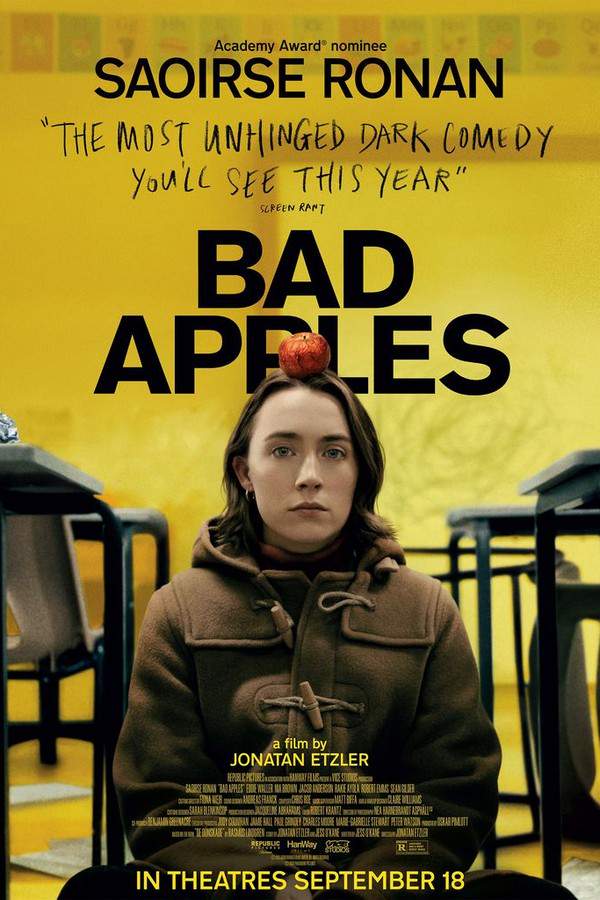
Bad Apples (2026) movie poster

Plot Summary

Bad Apples (2026) Plot Summary & Ending Explained

Release, runtime and language
2026 · 1 h 40 m · English
Echo score 71
Loading streaming availability…
Directed by
Jonatan Etzler
Starring
Saoirse Ronan, Sean Gilder, Eva Tennear, Jack Ashton, Danny Iqbal, Eddie Waller

When a primary‑school teacher (Saoirse Ronan) is forced to confront a foul‑mouthed, violent student, she resorts to drastic measures. In doing so, she discovers that the town’s residents deliberately ignore escalating atrocities, choosing the illusion of harmony and a false sense of safety over confronting the truth.

On this page (6)
  1. 1 Where to watch
  2. 2 What happens: full plot
  3. 3 Plot questions answered
  4. 4 How it ends
  5. 5 Movie threads
  6. 6 Every angle
Loading streaming availability…

Full plot summary · contains spoilers

What Happens in Bad Apples: Full Plot Summary

The whole story of Bad Apples (2026) explained, from the opening scene to the final frame: every key event, every twist and what it all adds up to. Read it as a quick recap before the sequel, to check a scene you missed, or to finally understand what really happened.

Maria Spencer, portrayed by Saoirse Ronan, serves as a Year 5 teacher at a primary school located in Somerset, England. Her professional life is plagued by the constant disruptions caused by one of her students, Danny (Eddie Waller), whose behavioral issues create a chaotic classroom environment. The situation reaches a breaking point when Danny pushes a fellow student, Pauline, down a flight of stairs, resulting in a broken arm for the girl and an immediate suspension for Danny.

In an effort to address the boy's behavior, Maria attempts to coordinate with Danny's father, Josh, a delivery driver. However, Josh is completely dismissive of Maria's concerns and brushes off any attempts to discuss his son's welfare or conduct. Shortly thereafter, Maria encounters Danny in a car park where he is actively vandalizing vehicles, including her own. In the heat of the confrontation, Maria intervenes, but the encounter takes a dark turn when she accidentally knocks him unconscious.

Panic sets in as Maria drives the unconscious boy to a hospital. However, upon waking, Danny threatens to report her for attacking him, ignoring her pleas that the incident was a mere accident. Overwhelmed by fear and desperation, Maria abruptly leaves the hospital with him and drives him to her own home. Once inside, Danny's destructive tendencies resurface; after he begins wreaking havoc throughout the house, Maria makes the drastic decision to lock him inside her basement.

The following morning, Maria returns to her teaching duties. With the disruptive influence of Danny gone, her classroom transforms. During an official Ofsted inspection, the students perform exceptionally well, and Maria receives significant praise for the sudden and dramatic improvement in her teaching results.

As the days pass, Maria continues to keep Danny confined in the basement. Upon discovering that the boy is completely illiterate, she begins to privately tutor him in reading and writing. To make his captivity more bearable, she furnishes the basement with video games and beanbag furniture, and provides him with new clothes. To maintain total control over him, she utilizes a harness—ironically delivered to the house by a distraught Josh—to keep him restrained.

This arrangement leads to a period of unprecedented professional success for Maria. Her class continues to thrive, and her standing at the school improves her relationship with Sam, the school's deputy headteacher and her former romantic partner.

However, the secret is threatened when Pauline, who has become increasingly attached to Maria, visits her home. Pauline discovers that Danny is being held captive in the basement, but instead of reporting the crime, she uses this knowledge as leverage to receive special treatment from Maria. The tension peaks during one visit when Pauline insults Danny, cruelly telling him that no one misses him. This triggers a violent outburst from Danny, forcing Maria to flee the room and hold the door shut until Pauline eventually exits the house.

The facade finally crumbles during a parents' evening. Pauline interrupts the event with a public performance that reveals the horrifying truth about Danny's imprisonment. While Maria breaks down and admits to the kidnapping, the reaction from the parents is unexpected. Because their own children's grades have improved and the school's atmosphere has stabilized since Danny disappeared, the parents decide not to report Maria. Instead, they begin bringing food for Danny, essentially collaborating in his captivity to ensure their children's continued academic progress.

In the aftermath, the headteacher, Sylvia, resigns due to the scandal, leading to Sam being promoted to the position of headteacher. Maria returns home and coldly informs Danny that he will never be released from the basement.

Months later, Maria is honored at a large school assembly for her perceived success as an educator. During the event, the school announces a scholarship established in honor of the still-missing Danny. However, unknown to Maria, Danny has been working tirelessly. Using nothing more than an electric toothbrush, he gradually digs through the basement wall. The film concludes with Danny finally breaking through and running freely along a road, having escaped his captor.

Last updated: October 18, 2026 at 17:31

Was this helpful?

Plot questions answered

Bad Apples Plot Explained: Your Questions Answered

The questions people ask most about Bad Apples (2026): what happens in the confusing scenes, why the characters do what they do, the twists, hidden details and what the ending means. Each answer contains spoilers.

Q1

Why did Maria decide to keep Danny locked in her basement instead of taking him to the police?

In Bad Apples, Maria's decision stems from a panic spiral that begins in the car park. After she accidentally knocks Danny unconscious, she drives him to a hospital, but the boy wakes up and threatens to report her for attacking him, even though it was unintentional. With her career and reputation on the line, Maria drives him to her home instead, and when Danny begins destroying her house, locking him in the basement feels like the only way to contain the situation and protect her secret.

Foreshadowing: Maria's instinct to hide the accident rather than call for help foreshadows her willingness to escalate her cover-up.

  • maria spencer
  • basement
  • kidnapping
  • panic
  • car park
  • hospital
Q2

Why did the parents decide to protect Maria after learning the truth about Danny at the parents' evening?

The parents' refusal to report Maria exposes the central theme of collective complicity in Bad Apples. With Danny gone, their children's grades had dramatically improved and the school's atmosphere had stabilized, and the parents were not willing to sacrifice those gains for a child they viewed as violent and disruptive. By bringing food for Danny and actively participating in his captivity, they prioritize the illusion of harmony and their children's academic progress over basic morality.

  • parents evening
  • collective complicity
  • academic success
  • community cover-up
Q3

How was Danny able to dig through the basement wall using only an electric toothbrush?

Over the months of captivity in Bad Apples, Danny patiently repurposed an electric toothbrush as an improvised tool, using its vibrating bristles to slowly grind away at the basement masonry. The process required extraordinary persistence, but the rotating head was abrasive enough to chip concrete and plaster bit by bit. The escape rewards Danny's quiet resilience and provides the film's only note of hope.

  • danny escape
  • electric toothbrush
  • basement wall
  • improvised tool
Q4

Why was Maria honored at a school assembly while Danny was still being held captive in her basement?

Maria's public honor in Bad Apples is the film's darkest satirical moment, since the community celebrates her precisely because their children's academic success depended on Danny's removal. The assembly even announces a scholarship in Danny's name, effectively turning the kidnapped boy into a symbol of educational excellence. The scene highlights how institutions reward outcomes without ever questioning the moral cost of achieving them.

  • school assembly
  • scholarship
  • institutional complicity
  • satire
Q5

What did Maria mean when she coldly told Danny that he would never be released from the basement?

After learning the parents were protecting her secret, Maria felt completely shielded from consequences and decided to make Danny's captivity permanent. The promise marks a psychological turning point in which she moves from desperate improvisation to deliberate, calculated cruelty. Her statement shows she now believes the community's complicity has made her untouchable.

  • maria spencer
  • never released
  • psychological escalation
  • captivity
Q6

Why did Pauline choose to use the secret of Danny's captivity as leverage rather than reporting Maria?

Pauline had become deeply attached to Maria after breaking her arm because of Danny's earlier violence, and Maria represented safety and stability in contrast to the chaos Danny had caused. When she discovered Danny locked in the basement, Pauline leveraged that knowledge to extract special treatment and preferential attention rather than alerting authorities. Her choice mirrors the moral compromise the adults later make, putting personal gain above the welfare of a kidnapped child.

Foreshadowing: Pauline's earlier crush on Maria foreshadows how her loyalty could be turned into quiet coercion.

  • pauline
  • leverage
  • complicity
  • special treatment
  • manipulation
Q7

What is the significance of the scholarship created in Danny's name while he is still being held captive?

The scholarship in Bad Apples is the film's most biting satirical gesture: the very child being imprisoned in a basement is publicly honored as a symbol of educational success. It demonstrates how institutions can co-opt a victim into a triumphant narrative when that narrative serves their interests. The contrast between the public tribute and the hidden abuse underscores the depth of the community's moral failure.

  • scholarship
  • danny
  • public tribute
  • moral failure
  • satire
Q8

Why did Maria start secretly tutoring Danny while keeping him locked in the basement?

Once Maria realized Danny was completely illiterate, tutoring him became a way to rationalize his captivity and reframe herself as a caregiver rather than a kidnapper. Teaching him reading and writing allowed her to feel she was providing value while also reinforcing her sense of control. The act mirrors her professional identity as a teacher and helps justify an arrangement that is otherwise indefensible.

Foreshadowing: Maria's instinct to educate, even in impossible circumstances, foreshadows how her teacher identity will rationalize the worst of her choices.

  • maria spencer
  • tutoring
  • literacy
  • justification
  • caregiver
Q9

Why did Maria return to teaching the next morning as if nothing had happened?

Maria's immediate return to school reflects deep denial and the psychological comfort of routine. By throwing herself into her professional role, where she felt valued and competent, she could avoid confronting the enormity of what she had done. The contrast between her composed classroom persona and the hidden child in her basement is the core horror of the early middle act of Bad Apples.

  • maria spencer
  • denial
  • routine
  • classroom
  • psychological coping
Q10

Why did the school's academic performance improve so dramatically after Danny disappeared?

Without Danny's constant disruptions, violence, and ability to destabilize the classroom, Maria could teach properly and her students could finally focus on their work. Danny's behavior had been so extreme that his presence alone had been suppressing the learning environment for everyone else. The sudden improvement also reveals how one disruptive child had been carrying the blame for a much broader systemic failure the adults were willing to exploit.

  • academic performance
  • classroom disruption
  • danny
  • systemic failure
Q11

Why did Maria use a harness delivered by Danny's own father to restrain him in the basement?

The harness is a darkly ironic plot point in Bad Apples: Josh, the father who had refused to engage with Danny's behavior, unknowingly delivered the very tool used to imprison his son. Maria repurposes the harness as a restraint to keep Danny under control, and the detail underscores how parental neglect created the conditions for Danny's disappearance. Josh's disengagement indirectly enables the captivity without him ever realizing it.

Foreshadowing: Josh's earlier delivery of supplies hints at how easily he can be used without knowing the truth.

  • josh
  • harness
  • parental neglect
  • restraint
  • irony
Q12

Why was Danny's father Josh so dismissive of Maria's concerns about his son's behavior?

Josh's dismissal in Bad Apples reflects a broader pattern of parental neglect that the film uses to set up Maria's growing desperation. As a delivery driver constantly busy and seemingly disengaged, he refuses to engage with reports about Danny's escalating violence. This lack of support leaves Maria feeling isolated and ultimately pushes her toward taking matters into her own hands.

  • josh
  • parental neglect
  • delivery driver
  • dismissal
  • isolation
Q13

Why did Maria's relationship with Sam improve while Danny was confined in the basement?

With her professional standing restored and her daily stress dramatically reduced, Maria became more confident and emotionally available, which rekindled her connection with Sam. As her career flourished thanks to the improved class results, Sam, the deputy headteacher, came to see her as a successful colleague and partner rather than a struggling teacher. Their relationship improved as a direct consequence of the false stability created by Danny's absence.

  • sam
  • deputy headteacher
  • relationship
  • professional success

Ending explained

What Happens at the End of Bad Apples?

How Bad Apples (2026) ends, in short: the final scene, the last twist and what it means for the characters. The full ending explained, with every spoiler, lives on its own page.

Read the full ending explained

Pauline exposes Danny's imprisonment through her performance at the parents' evening, but the revelation does not produce the rescue Maria fears. The parents prefer keeping him confined because their own children's results have improved. Sylvia leaves, Sam and Maria become head and deputy head, and the former couple reunite. Their later celebration of the school's success is intercut with Danny finally escaping and running beside a busy road. He is free of the immediate prison, but the film does not show the school's complicity being formally punished.

The reversal shifts the blame from one panicked teacher to a community willing to benefit from a child's disappearance. Educational success becomes the excuse for treating Danny as expendable, even while his father has suffered suspicion over the missing boy. Maria's professional and romantic rewards reveal how easily wrongdoing can become normal when it serves shared interests. Danny's escape interrupts that comfortable settlement, suggesting that the person excluded from the system may return to expose it. His precise destination and the eventual consequences remain uncertain, leaving the celebration morally hollow.

Bad Apples ending explained in full

Movie threads

More Movies Like Bad Apples, by Mood & Story

Curated lists built around what makes Bad Apples tick: the same mood, the same kind of story or the same emotional payoff. Each list explains why these movies belong together.

Movies like Bad Apples about communities that enable abuse

Stories where ordinary communities choose comfortable silence over uncomfortable truth. If you liked Bad Apples, these movies explore the same chilling theme of collective complicity, where an entire town or social group turns a blind eye to atrocities to preserve a comfortable illusion. These dark, morally complex thrillers show how ordinary people rationalize the unthinkable, making the community itself the true villain. Perfect for fans of unsettling social commentary and shared silence.

  • collective complicity
  • claustrophobic
  • morally ambiguous
  • dark satire
  • social commentary
  • oppressive
  • Tone: dark, morally ambiguous
  • Pacing: steady, escalating
Why these movies?

The story pattern: These stories typically begin with an outwardly harmonious community, then gradually reveal a festering secret that everyone has agreed not to see. A protagonist who refuses to look away forces the issue, exposing how thin the veneer of civility really is. The climax rarely offers clean justice; instead, it lays bare how complicity becomes a shared identity, with characters choosing comfort, reputation, or normalcy over moral action. The journey is less about catching a villain than about diagnosing a sickness in the social fabric.

Why they belong together: Movies in this thread share an unsettling commitment to portraying collective moral failure rather than individual evil. They use slow escalation, dark satire, and claustrophobic community settings to show how ordinary people make monstrous choices feel reasonable. The pacing tends to be steady and suffocating, the tone dark and morally ambiguous, and the endings often leave audiences squirming with mixed feelings rather than catharsis, exactly the discomfort Bad Apples trades in.

Dark satirical thrillers like Bad Apples that leave you disturbed

Unsettling stories where wicked humor collides with deeply disturbing truths. If Bad Apples kept you unsettled, these dark satirical thrillers deliver a similar mix of wicked humor, psychological tension, and disturbing themes. Each film uses sharp social commentary to skewer the polite fictions communities tell themselves, mixing uncomfortable comedy with thriller mechanics. Perfect for viewers who want their satire with teeth and a lingering sense of moral unease.

  • dark satire
  • morally ambiguous
  • uncomfortable humor
  • chilling
  • grim
  • psychological
  • Tone: dark, satirical, grim
  • Pacing: steady, deliberate
Why these movies?

The story pattern: Stories in this thread typically frame a horrifying premise through an ironic, darkly comic lens, giving the audience critical distance even as the content grows grimmer. A flawed protagonist, often a professional, parent, or institutional figure, slides into an escalating moral compromise justified by the logic of their environment. Satirical framing, tonal whiplash, and uncomfortable humor punctuate the dread, and resolutions tend to be morally mixed rather than clean, forcing viewers to confront complicity in themselves and their world.

Why they belong together: Movies in this thread share a commitment to using dark humor as a scalpel for uncomfortable subjects like childhood, institutions, power, and normalized cruelty. They tend to be moderately complex, steady paced, and heavy in emotional weight, with tones that braid satire, tension, and grimness. They often feature morally compromised narrators and endings that refuse easy moral closure, mirroring Bad Apples' refusal to let the audience off the hook.

Every angle

Bad Apples (2026) Explained: Plot, Ending, Timeline & Characters

Everything about Bad Apples in one place: what happens in the plot summary, the timeline in chronological order, the characters and meaning, the ending explained and a spoiler-free summary. What's After the Movie adds the cast, box office and post-credit scenes.

Coming soon on iOS and Android

The Plot Explained Movie Summary App

Plot summaries, endings explained and timelines on your phone. Catch up on any movie in minutes, save your favorites and never miss a twist again.

Be the first to know when we launch. Your email stays private, always.

Learn more about the app