Plot Explained Spoilers guaranteed!
Plot Explained

Browse by genre

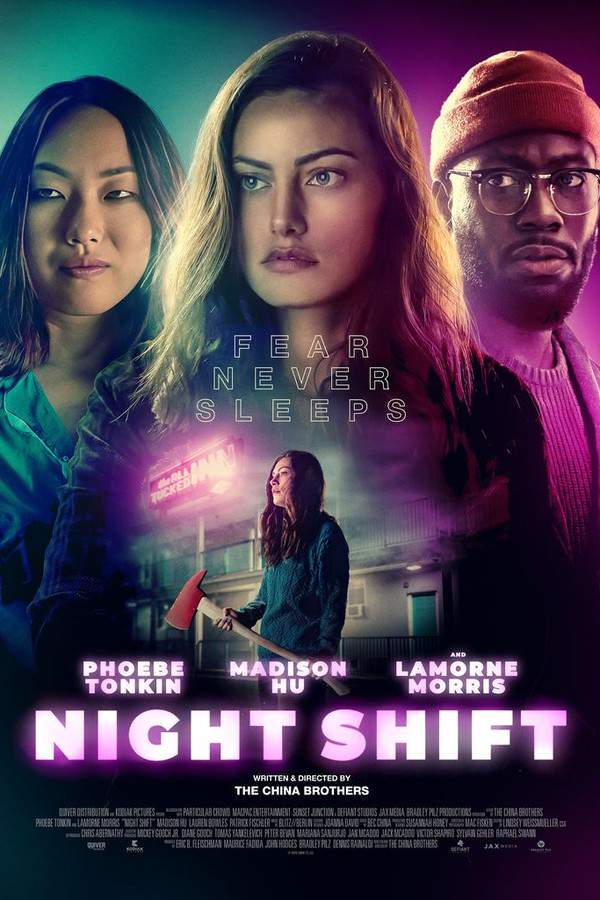
Night Shift (2024) movie poster

Plot Summary

Night Shift (2024) Plot Summary & Ending Explained

Release, runtime and language
2024 · 1 h 22 m · English
Echo score 63
Loading streaming availability…
Directed by
Benjamin China, Paul China
Starring
Madison Hu, Lamorne Morris, Patrick Fischler, Christopher Denham, Lauren Bowles, Tom Dang

A woman seeking refuge at a secluded motel finds her sense of security shattered when a figure from her past reappears. As her isolation intensifies, she must confront the unsettling atmosphere of the motel and the lingering trauma that haunts her.

On this page (7)
  1. 1 Where to watch
  2. 2 What happens: full plot
  3. 3 Plot questions answered
  4. 4 How it ends
  5. 5 Movie threads
  6. 6 Movies like Night Shift
  7. 7 Every angle
Loading streaming availability…

Full plot summary · contains spoilers

What Happens in Night Shift: Full Plot Summary

The whole story of Night Shift (2024) explained, from the opening scene to the final frame: every key event, every twist and what it all adds up to. Read it as a quick recap before the sequel, to check a scene you missed, or to finally understand what really happened.

Gwen Taylor [Phoebe Tonkin] takes a job working her first overnight shift at the remote All Tucked Inn motel, stepping into a quiet, isolated night that quickly feels unsettling. The motel’s owner, Teddy Miles [Lamorne Morris], offers a brief tour and bluntly warns that the corridors can stretch endlessly when the world is asleep. Right away, Gwen starts to notice things that don’t add up: lights that flicker without reason, doors that swing open on their own, and faint noises that travel the empty halls as if the building itself is listening.

She soon crosses paths with Alice Marsh [Madison Hu], a teenage guest who ran away from her mother and now hides in the motel’s shadowy corners. Alice insists she’s seen people walking the halls who vanish when they’re approached, turning the quiet place into a stage for something unseen. The two form a wary bond as Gwen tries to stay professional and calm, even as the night grows stranger by the hour.

As the hours pass, Gwen feels watched. A static-laden phone rings with whispers, and a shadowy man appears to be tailing her in a car that never seems to leave the lot. These visions mirror a part of Gwen’s own past, a memory she’s tried to bury. Her attempts to seek reassurance from Teddy are met with evasions about the motel’s history, creating a growing sense of isolation and creeping paranoia. Alice, increasingly frightened, pushes back on the idea that the place is merely haunted, insisting that something malevolent does not want them there.

Over dinner, Gwen opens up about the man she believes killed her family, Walton Grey [Christopher Denham], and she clings to the possibility that he has escaped from prison. The idea that a real threat could be stalking the motel sits beside the more troubling notion that her past might be catching up to her in the present. The atmosphere becomes almost tactile: the air grows cold, the walls seem to breathe, and the boundary between the living and the dead blurs with each passing moment.

Disturbances intensify into genuine apparitions. Ghostly figures drift through the hallways, and Gwen experiences vivid visions—like a figure emerging from a sinkhole in the empty pool—that challenge her grip on reality. Is she witnessing true supernatural activity, or is she being hunted by a human threat, or simply unraveling under the weight of trauma she has carried for years?

The tension spills into real danger when a middle-aged man arrives to check in. Gwen recognizes him as the man convicted of killing her family, recently reported as having escaped custody. She stalls, pretending to verify a room while quietly arming herself with a makeshift weapon from the office. She leads him to his room and, in a brutal moment, stabs him with a pair of scissors. The supposed killer’s admission shatters the line between legend and reality: he reveals that Walton Grey is not real, but a figment of Gwen’s imagination—the name an anagram of her own. He also reveals the devastating truth that Gwen herself was the one who killed her family. Reeling from the confession, Gwen eliminates the doctor who has been treating her paranoia, cutting out his tongue, and leaving a trail of blood and silence in the room.

Outside, two orderlies from the mental hospital arrive to check on the unstable psychiatrist, unaware of the horrors inside. Gwen meets them with blood on her hands, offering to show them inside, and then systematically murders both. Inside her own room, Alice, drawn by the sounds of the chaos, opens the door to a grisly scene: one dead worker and another in the process of being finished off by Gwen. Alice flees, and Gwen pursues, catching her in a brutal confrontation and stabbing her in the stomach with an axe as the motel seems to close in around them.

Teddy returns to the scene, drawn by the earlier call, and finds Gwen standing by the pool in a moment of eerie stillness. He steps closer, and the film fades to black, leaving the question of their fates hanging in the night air—with the implication that Gwen might have murdered him as well.

A year later, the motel has been given new life. Gwen has washed away the old trauma with paint, repaired the sinkhole, and flooded the pool with renewed purpose. Cole [Connor Price], driving to college, stops by for a night and admires the renovated pool. Gwen materializes to check him in, and as he pays, the ghosts of her murdered family loom behind him, with Alice’s ghost also present. When she asks if he’s okay, she offers to guide him to his room, leaving Cole to wonder what other truths might be waiting in the shadows of All Tucked Inn.
Last updated: October 09, 2025 at 16:13

Was this helpful?

Plot questions answered

Night Shift Plot Explained: Your Questions Answered

The questions people ask most about Night Shift (2024): what happens in the confusing scenes, why the characters do what they do, the twists, hidden details and what the ending means. Each answer contains spoilers.

Q1

Why does Gwen believe Walton Grey killed her family?

Gwen has constructed a false memory of a man named Walton Grey as the killer of her family. This is actually a psychological defense mechanism - her mind created an external villain to avoid confronting the unbearable truth that she herself murdered them. The name 'Walton Grey' is later revealed to be an anagram of 'Gwen Taylor,' making it a dissociative identity construct she created to distance herself from her own crime.

Foreshadowing: Early in the film, Gwen mentions the man she believes killed her family, and the motel owner Teddy deflects when she asks about the motel's history, hinting that something is being hidden.

  • walton grey
  • gwen taylor
  • false memory
  • psychological trauma
  • anagram
Q2

What is Walton Grey?

Walton Grey is not a real person - he is a figment of Gwen's imagination. His name is an anagram of 'Gwen Taylor,' created by her subconscious to embody the killer she projected onto an external entity. The man Gwen confronts at the motel is actually her own psychiatrist who has been treating her for paranoid delusions.

  • walton grey
  • anagram
  • gwen taylor
  • imaginary character
  • psychiatrist
Q3

Did Gwen actually kill her family?

Yes. The devastating revelation is that Gwen Taylor herself murdered her own family. The man she believed was Walton Grey - the supposed escaped convict - was actually her psychiatrist who revealed that there was no such person. Gwen created the narrative of an external killer to cope with the guilt of her own actions.

Foreshadowing: Gwen's extreme paranoia, her belief that someone is after her, and her violent breakdown all hint at deep-seated trauma that she refuses to confront.

  • gwen taylor
  • family murder
  • revelation
  • mental breakdown
  • guilt
Q4

Was the motel really haunted or was it all in Gwen's mind?

The supernatural phenomena at the motel are ambiguous throughout the film, but the ending reveals they were manifestations of Gwen's guilt and mental state. The apparitions she saw were real to her perception, but rooted in her psychological trauma rather than actual ghosts. The final scene confirms the supernatural elements are real when the ghosts of her murdered family and Alice appear behind Cole at the renovated motel.

Foreshadowing: The ghostly figures Gwen sees are never clearly explained as supernatural until the ending, and her psychiatrist notes she has trouble distinguishing reality from her delusions.

  • supernatural
  • haunting
  • mental illness
  • delusion
  • ghosts
Q5

Who was the man Gwen attacked thinking he was Walton Grey?

The middle-aged man Gwen attacks is her own psychiatrist who has been treating her for paranoid delusions. He arrives at the motel to check on her, having been concerned about her mental state. When she confronts him as 'Walton Grey,' he tries to explain that he is her doctor and that Walton Grey doesn't exist - which triggers her violent response.

Foreshadowing: The mysterious phone calls, Gwen's paranoia about being watched, and Teddy's evasiveness about the motel's history all build toward this confrontation.

  • psychiatrist
  • doctor
  • walton grey
  • treatment
  • delusion
Q6

Why does Gwen kill Alice?

By this point in the film, Gwen has fully descended into violent psychosis. After murdering her psychiatrist and the orderlies, Alice stumbles upon the carnage and tries to flee. Gwen, now completely unchecked and acting on pure survival instinct, pursues and kills Alice to eliminate witnesses. Her grip on reality has completely broken, making any person who discovers her crimes a perceived threat.

Foreshadowing: Alice's warnings about 'something malevolent' that doesn't want them there become ironic - the true threat was always Gwen herself.

  • alice marsh
  • murder
  • psychosis
  • witness
  • violence
Q7

What happens to Teddy at the end?

Teddy returns to the motel after receiving Gwen's earlier call and finds her standing eerily by the pool. The film cuts to black as he approaches, strongly implying that Gwen has killed him as well, just as she eliminated everyone else who discovered her crimes. The scene mirrors her pattern of eliminating anyone who gets too close to her secrets.

Foreshadowing: Teddy's earlier warnings about the 'endless corridors' take on sinister meaning, and his evasion about the motel's history suggests he knew more than he let on.

  • teddy miles
  • death
  • pool
  • ending
  • implication
Q8

What does the ending with Cole mean?

One year later, Gwen has taken over running the renovated All Tucked Inn motel after presumably killing Teddy. The ending reveals she has fully embraced her psychosis - she's painted over the trauma, repaired the sinkhole and pool, and now operates the motel as if nothing happened. When Cole arrives, the ghosts of her murdered family and Alice appear behind him, confirming the supernatural elements are real and that Gwen continues to exist in a world where her victims haunt her.

Foreshadowing: The earlier sinkhole vision of a figure emerging foreshadows the pool's restoration and the return of ghostly presences.

  • cole
  • ending
  • ghosts
  • motel
  • one year later
  • haunting
Q9

Why does Gwen cut out her psychiatrist's tongue?

After stabbing the psychiatrist, Gwen cuts out his tongue to silence him - literally preventing him from revealing the truth that would expose her delusion. This brutal act represents her final rejection of reality and her commitment to her constructed narrative. It's also a symbolic act of control - she cannot face the truth about herself, so she removes the ability of others to speak it.

  • psychiatrist
  • tongue
  • silencing
  • truth
  • brutal act
Q10

What was the sinkhole vision Gwen saw?

Gwen's vision of a spectral figure emerging from the sinkhole in the empty pool was a manifestation of her guilt and a precursor to the ending. The empty pool with the sinkhole represents the void left by her family's deaths and the trauma she's buried. In the ending, Gwen repairs the sinkhole and floods the pool - attempting to 'fix' her past - but the ghosts remain, showing that physical restoration cannot erase spiritual guilt.

Foreshadowing: The sinkhole appears as a visual representation of Gwen's buried trauma that eventually consumes her.

  • sinkhole
  • pool
  • vision
  • ghost
  • emergence
  • psychological symbolism

Ending explained

What Happens at the End of Night Shift?

How Night Shift (2024) ends, in short: the final scene, the last twist and what it means for the characters. The full ending explained, with every spoiler, lives on its own page.

Read the full ending explained

In the final act Gwen discovers that the “dangerous” guest she has just checked into Room 8 is not the escaped killer she feared, but her own psychiatrist, Dr Raymond, who has come with two assistants to take her back to the hospital. The truth shatters everything she thought she knew: she is not a victim of a haunted motel, but the murderer herself. After a night of confinement for killing her mother and sisters, she escaped two days earlier, took the night‑shift job under a false name, and has been haunted by the butterfly locket he stole that night.

In a desperate, panic‑driven frenzy, Gwen grabs a pair of scissors, slashes Raymond’s throat, then turns the same weapon on the two men, killing them as well. When Alice bursts in, drawn by the screams, Gwen seizes an axe and murders her too, dragging the bodies to the sink‑hole‑filled pool and tossing them in. The motel’s clueless manager, Teddy, arrives moments later; seeing the chaos, he is pulled into the same abyss. Gwen remains standing, bloodied but alive, the only survivor of the night’s carnage.

Continue reading the ending (1 more paragraphs)

The film then jumps a year forward. Gwen has taken over the All Tucked Inn, rebranding it with bright pink décor and flamboyant flamingo statues. She greets a new guest with a cheery smile, leads him past the now‑dormant sinkhole, and jokes that the “best room” is the very same Room 8 where the murders occurred. The camera lingers on her light‑hearted banter, leaving the audience with a lingering unease: the horrors of the past are hidden behind a glossy façade, and Gwen’s calm façade masks a lingering, murderous madness that may never truly be buried.

Night Shift ending explained in full

Movie threads

More Movies Like Night Shift, by Mood & Story

Curated lists built around what makes Night Shift tick: the same mood, the same kind of story or the same emotional payoff. Each list explains why these movies belong together.

Claustrophobic Psychological Thrillers like Night Shift

Stories of intense paranoia and fear within confined, inescapable spaces. If the suffocating tension and confined setting of Night Shift captivated you, explore more movies like it. These films use isolated locations to masterfully build psychological terror, creating a similar feeling of inescapable dread and paranoia for fans of the genre.

  • claustrophobic
  • paranoid
  • unsettling
  • suspenseful
  • oppressive
  • isolated
  • Tone: dark, tense, paranoid
  • Pacing: steady, escalating
Why these movies?

The story pattern: Narratives in this thread typically trap a vulnerable protagonist in a limited space, forcing a confrontation with either an external threat or their own crumbling sanity. The plot unfolds as a tightening spiral of fear, where the environment itself is antagonistic, and escape seems perpetually out of reach.

Why they belong together: Movies are grouped here for their shared commitment to a claustrophobic atmosphere, a steady-to-fast pacing that builds unbearable tension, and a focus on psychological fragility. They deliver a specific, intense viewing experience defined by spatial confinement and deep-seated anxiety.

Bleak Horror Movies about Trauma like Night Shift

Where supernatural terror is a manifestation of unresolved past trauma. For viewers who appreciated how Night Shift wove deep psychological trauma into its supernatural horror, this list curates similar movies. Discover stories where the real horror stems from a character's haunted past, culminating in bleak and emotionally heavy endings.

  • unsettling
  • bleak
  • heavy
  • psychological
  • traumatic
  • suspenseful
  • Tone: dark, bleak, heavy
  • Pacing: steady, atmospheric build
Why these movies?

The story pattern: These narratives follow a character grappling with severe past trauma—often involving loss or violence—which begins to manifest as a supernatural or psychological menace. The story's central mystery is whether the horror is real or a psychotic break, typically resolved in a way that confirms the devastating power of guilt and memory, often ending in tragedy.

Why they belong together: These films are united by their heavy emotional weight, dark tone, and exploration of trauma as a source of horror. They share a bleak outlook and a narrative complexity that hinges on the ambiguity between psychological and supernatural explanations, delivering a profoundly unsettling experience.

If you liked this

Movies Like Night Shift

Similar movies to Night Shift: the same genre, themes or kind of story. Each one comes with its own plot summary, timeline and ending explained.

Browse all movie summaries

Every angle

Night Shift (2024) Explained: Plot, Ending, Timeline & Characters

Everything about Night Shift in one place: what happens in the plot summary, the timeline in chronological order, the characters and meaning, the ending explained and a spoiler-free summary. What's After the Movie adds the cast, box office and post-credit scenes.

Coming soon on iOS and Android

The Plot Explained Movie Summary App

Plot summaries, endings explained and timelines on your phone. Catch up on any movie in minutes, save your favorites and never miss a twist again.

Be the first to know when we launch. Your email stays private, always.

Learn more about the app