Plot Explained Spoilers guaranteed!
Plot Explained

Browse by genre

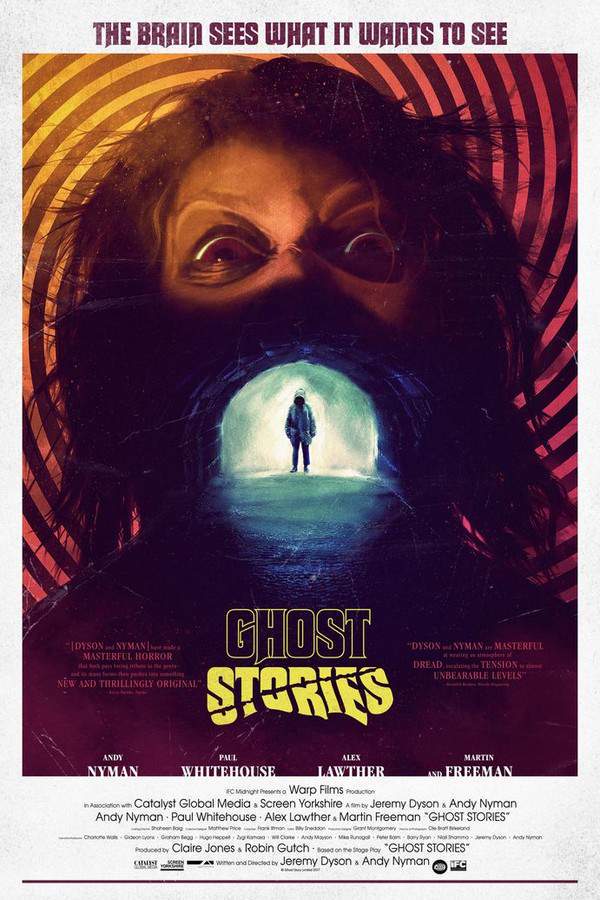
Ghost Stories (2019) movie poster

Plot Summary

Ghost Stories (2019) Plot Summary & Ending Explained

Release, runtime and language
2019 · 144 min · English
Echo score 65
JustWatch #4,791 66
Directed by
Anurag Kashyap, Dibakar Banerjee, Karan Johar, Zoya Akhtar
Starring
Aditi Bhatia, Avinash Tiwary, Bidita Bag, Janhvi Kapoor, Mrunal Thakur, Pavail Gulati

Four unsettling stories explore the nature of fear, as accomplished filmmakers blend horror with dark humor. Each segment delivers a descent into the unknown, blurring the line between reality and nightmare. The anthology showcases a variety of chilling experiences and unsettling visuals, offering a unique and thought-provoking exploration of terror.

On this page (7)
  1. 1 Where to watch
  2. 2 What happens: full plot
  3. 3 Plot questions answered
  4. 4 How it ends
  5. 5 Movie threads
  6. 6 Movies like Ghost Stories
  7. 7 Every angle

Where to watch

Where to Watch Ghost Stories (2019)

Where can you watch Ghost Stories? Stream, rent or buy it in the US, including on AMC+, Philo and Shudder: current JustWatch availability with up-to-date prices.

Streaming availability powered by JustWatch

Full plot summary · contains spoilers

What Happens in Ghost Stories: Full Plot Summary

The whole story of Ghost Stories (2019) explained, from the opening scene to the final frame: every key event, every twist and what it all adds up to. Read it as a quick recap before the sequel, to check a scene you missed, or to finally understand what really happened.

For his television series "Psychic Cheats," the skeptical Professor Philip Goodman publicly exposes the deceptions of celebrity psychic Mark Van Rhys during a live performance. Following the show, Philip recounts his admiration for Charles Cameron, a psychologist who dedicated his life to debunking paranormal claims but mysteriously vanished.

Shortly after, a surprise package arrives for Philip, containing an audiotape from Cameron, inviting him to his trailer. When they meet, an elderly Charles candidly reveals his past arrogance in dismissing the supernatural. He accuses Philip of being a "conceited coward" for the same reasons, subsequently presenting him with three intriguing case files. Charles challenges Philip to disprove these accounts of purported supernatural events. However, as Philip departs, he experiences a chilling vision of a strange presence looming behind Charles.

Case 1 - Tony Matthews: Philip's investigation begins with Tony Matthews, a former night security guard whose daughter Marnie suffers from locked-in syndrome. Tony recounts a harrowing night in a deserted asylum where he encountered a ghostly girl clad in yellow who called him "dada." To further explore this phenomenon, Philip consults Father Richard Emery, the parish priest, who describes how Marnie showed a visceral reaction to her father's voice in her hospital room. Encouraged by this connection, Philip is prompted to visit his own unresponsive father.

Case 2 - Simon Rifkind: Continuing his investigation, Philip meets teenager Simon Rifkind. Upon entering Simon’s home, Philip witnesses his parents seemingly enchanted in their own world. Climbing the stairs, he discerns a spooky photograph depicting a hooded figure. Simon shares a terrifying experience involving a collision with an unknown creature while driving unsupervised, which resulted in an uncanny encounter with a menacing entity that commanded him to "stay" before he fled into the forest.

Philip later visits the location of Simon's frightful incident, where a quick glimpse of his own ghostly reflection in his car's window leaves him rattled.

Case 3 - Mike Priddle: In a remote countryside setting, Philip meets Mike Priddle, who shares his unsettling experiences while his pregnant wife, Maria, was hospitalized. As Mike recounts his encounters with a terrifying poltergeist, Philip momentarily sees the hooded figure. Mike’s story culminates in a haunting vision of his monstrous wife claiming that the real Maria had perished, a revelation tragically confirmed by hospital news of her death during childbirth. Haunted by despair, Mike shockingly takes his own life with a shotgun.

Returning to confront Charles, Philip dismisses all he has witnessed as a ruse. In a surreal twist, Charles reveals himself to be Mike Priddle, stating, "the brain sees what it wants to see," before opening a rift in reality and guiding Philip through it.

In the eerie landscape of a tunnel by a stream, Philip reflects on being bullied as a child. Here, the identity of the hooded figure becomes clear; it is Desmond Callahan, known as 'Kojak,' who tragically meets a grim fate at the hands of the bullies. Confronted by his own guilt, Philip struggles with his inaction that led to Kojak's death.

As the narrative unfolds, the consequences of Philip’s past decisions come crashing down upon him. A crib materializes, and a harrowing encounter with the ghastly Kojak ensues, leading Philip to a crisis point of terror. Ultimately, it is revealed that Philip exists in a catatonic state following a botched suicide, monitored by doctors Mike Priddle and Simon Rifkind, while Tony Matthews assumes the role of a custodian, cleaning Philip's room in a twisted irony of his life's circumstances.

Last updated: November 15, 2024 at 16:48

Was this helpful?

Plot questions answered

Ghost Stories Plot Explained: Your Questions Answered

The questions people ask most about Ghost Stories (2019): what happens in the confusing scenes, why the characters do what they do, the twists, hidden details and what the ending means. Each answer contains spoilers.

Q1

Why does Charles Cameron invite Philip to investigate the cases?

Charles Cameron invites Philip because he wants to challenge his extreme skepticism about the supernatural. Having once been a hardcore debunker himself, Charles sees Philip as a younger version of his former arrogant self. However, the twist reveals Charles doesn't actually exist as a separate person, Philip was confronting his own subconscious, using the name of the psychologist he admired to force himself to face the suppressed trauma he had run from his entire life.

Foreshadowing: Earlier, Philip mentions how Cameron's disappearance haunted him, setting up the psychological importance of this figure.

  • charles cameron
  • invitation
  • psychological challenge
  • skepticism
Q2

What is the hooded figure that appears throughout the film?

The hooded figure is Desmond Callahan, known as 'Kojak', who was Philip's childhood friend. Years ago, Philip witnessed Kojak being beaten by bullies but did nothing to intervene, he simply watched. Kojak died as a result of the attack, and Philip's guilt manifested the hooded figure throughout his catatonic mind, representing the traumatic memory he suppressed.

Foreshadowing: Philip sees glimpses of the hooded figure throughout his investigations, and his own reflection appears ghostly at the forest location.

  • hooded figure
  • Kojak
  • desmond callahan
  • childhood trauma
  • guilt
Q3

What is the twist ending of Ghost Stories about?

The twist reveals that Philip has been in a catatonic state in a hospital following a botched suicide attempt. The entire investigation, meeting Charles Cameron and the three case subjects, was a delusion occurring within his subconscious mind. The characters he thought he was investigating were actually his real-life medical team: Mike Priddle and Simon Rifkind were his doctors, while Tony Matthews was his hospital custodian. The film was Philip's mind processing his guilt over Kojak's death before he essentially trapped himself in his own consciousness.

Foreshadowing: Subtle clues like Philip's ghostly reflection and Charles's cryptic statement that 'the brain sees what it wants to see' hint at the unreality of his experience.

  • twist ending
  • catatonic state
  • hospital
  • reality vs illusion
  • suicide attempt
Q4

Why does Mike Priddle commit suicide in his story?

In Mike's narrative, after his wife Maria dies during childbirth, he experiences a vision of a monstrous version of her telling him the real Maria is dead. Overwhelmed by grief and horror at losing both his wife and potentially his child, Mike tragically takes his own life with a shotgun. This reflects Philip's own despair and self-destructive impulses, as the stories represent different facets of his guilt-ridden psyche.

Foreshadowing: Mike's escalating poltergeist encounters and the ominous presence throughout his story build toward this tragic conclusion.

  • mike priddle
  • suicide
  • wife maria
  • childbirth death
  • grief
Q5

What did Philip do to Kojak as a child?

As a child, Philip witnessed his friend Kojak being attacked by bullies. Rather than helping or seeking help, Philip did nothing, he froze and watched, paralyzed by fear and cowardice. Kojak died from the attack, and Philip's lifelong denial and suppression of this traumatic memory drove him to become an extreme skeptic of the supernatural, using rationality as a defense mechanism to avoid confronting emotional truth.
Foreshadowing: The film hints at Philip's dark childhood past when he reflects on being bullied, but it's actually his guilt about witnessing Kojak's death.

  • kojak
  • childhood
  • bullying
  • witness
  • death
  • inaction
Q6

Why is Philip in a catatonic state in the hospital?

Philip attempted suicide and ended up in a catatonic state in the hospital. His doctors, Mike Priddle and Simon Rifkind, along with custodian Tony Matthews, have been monitoring him while he remains unconscious. The entire narrative of the film takes place within Philip's mind as he processes the guilt from his childhood trauma, with the three 'cases' representing his medical team whom his subconscious has transformed into the subjects of his psychological investigation.
Foreshadowing: The film's opening establishes Philip as someone who dismisses the paranormal entirely, reflecting a person who has built intellectual walls around deep emotional wounds.

  • catatonic
  • hospital
  • suicide attempt
  • doctors
  • tony matthews
  • mike priddle
  • simon rifkind
Q7

Why is Philip so determined to disprove the supernatural cases?

Philip's extreme skepticism stems from psychological defense mechanisms. Having witnessed Kojak's death and done nothing, Philip rejected anything he couldn't rationally explain because confronting the supernatural would mean confronting his own guilt and the traumatic memory he had suppressed. His career as a debunker was essentially a way to maintain control and deny the emotional truths he couldn't face.

Foreshadowing: Philip's admiration for Charles Cameron, another debunker, hints at a deeper psychological pattern of using rationality to avoid emotional processing.

  • skepticism
  • supernatural
  • denial
  • psychological defense
  • rationality
Q8

Why is Tony Matthews the custodian in the twist?

The ironic twist reveals that Tony Matthews, whom Philip investigated as a security guard claiming to see a ghost, is actually Philip's hospital custodian in real life. This completes the psychological循环 of the film, Philip's mind transformed the people around him in his catatonic state into the subjects of his investigation, with Tony representing the lowest position in the hospital hierarchy, echoing how his story about a lowly night guard reflected Philip's own feelings of worthlessness.

Foreshadowing: Tony's profession as a night security guard in his story mirrors the real-world fact that he works in the hospital at night.

  • tony matthews
  • custodian
  • hospital
  • irony
  • transformation
Q9

What is the significance of the three cases Philip investigates?

The three cases, Tony Matthews, Simon Rifkind, and Mike Priddle, are not separate stories but psychological constructs within Philip's catatonic mind. Each case represents different aspects of his guilt and trauma: Tony's story deals with unresponsive communication (like Philip's relationship with his father), Simon's involves a hit-and-run (inaction leading to harm), and Mike's culminates in suicide (Philip's own attempt). The cases allow Philip's subconscious to externalize and process his deepest fears about his past.

Foreshadowing: Each case progressively brings Philip closer to confronting his own guilt, with the hooded figure appearing in all three narratives.

  • three cases
  • psychological construct
  • trauma
  • subconscious
  • guilt processing
Q10

What is Philip's relationship with his father in the film?

Philip's father is in an unresponsive state in a hospital, similar to Philip's own catatonic condition at the film's end. Father Richard Emery's observation that Marnie responded to her father's voice prompts Philip to visit his own father, but Philip finds no response. This reflects Philip's inability to connect emotionally, both with his father and with his own suppressed trauma, paralleling how he couldn't respond to Kojak's cry for help as a child.

Foreshadowing: Father Emery mentions Marnie's reaction to her father's voice, which specifically triggers Philip's decision to visit his own father.

  • father
  • hospital
  • unresponsive
  • emotional disconnection
  • family
Q11

What does Charles mean when he says 'the brain sees what it wants to see'?

This statement is the key to understanding the film's reality. Charles reveals this as he transforms into Mike Priddle, explaining that Philip's mind has constructed the entire investigation to avoid confronting the painful truth about his past. The phrase encapsulates how Philip's brain created an elaborate fantasy of investigating supernatural cases as a way to process guilt without actually facing the simple, devastating reality: he witnessed a friend's death through his own inaction.

Foreshadowing: This line comes during Philip's confrontation with Charles in the tunnel, just before the ultimate revelation.

  • perception
  • reality
  • brain
  • self-deception
  • psychological truth
Q12

Who is Kojak in relation to Philip?

Kojak (Desmond Callahan) was Philip's childhood friend who was beaten by bullies while Philip watched and did nothing. Kojak died from the attack, and Philip's guilt over his inaction has haunted him his entire life. In the film's climax within Philip's subconscious, the hooded figure is finally revealed as Kojak, and Philip must confront the trauma he has spent decades running from.

Foreshadowing: Philip's childhood memory of being bullied is revealed to actually be his memory of witnessing Kojak's attack.

  • desmond callahan
  • kojak
  • childhood friend
  • bullies
  • death
  • witness

Ending explained

What Happens at the End of Ghost Stories?

How Ghost Stories (2019) ends, in short: the final scene, the last twist and what it means for the characters. The full ending explained, with every spoiler, lives on its own page.

Read the full ending explained

The ending of Ghost Stories reveals a shocking twist that completely changes the viewer's understanding of the film. Throughout the story, things feel surreal and unsettling, with hints that all may not be as they seem. As the narrative unfolds, Goodman, the main character, begins to realize that the supernatural cases he’s investigating are actually manifestations of his own guilt and trauma. The breakthrough comes when Goodman follows the clues into his own past and uncovers that the bizarre phenomena are not paranormal at all but are rooted in his repressed memories.

In a deeply unsettling climax, Goodman’s reality begins to crumble. It’s revealed that he is in a coma following a suicide attempt, and everything he has experienced— the ghostly encounters and the sinister revelations—are his subconscious mind’s way of processing his guilt. The moment when Goodman’s finger is forced into Callahan’s mouth turns out to be a hallucination; the "corpse" of Callahan is really a breathing tube, symbolizing Goodman’s unconscious pleas for help. The final scene shows Goodman in the hospital, with Callahan's finger as a breathing tube—making it clear that everything was a mental construct, a manifestation of his remorse and unresolved feelings.

Continue reading the ending (1 more paragraphs)

The film emphasizes that Goodman’s three stories—about regret, fear of vulnerability, and failure to confront painful truths—are metaphors for internal struggles men often find difficult to express. The theme explores how toxic masculinity and suppressed emotions can lead to internal suffering and even self-destruction. The twist underscores that the true horror is not supernatural, but the mental anguish driven by the inability to face and articulate one’s feelings, which ultimately led Goodman to attempt to take his own life. The reveal invites viewers to reflect on the importance of emotional honesty and the devastating consequences of emotional repression.

Ghost Stories ending explained in full

Movie threads

More Movies Like Ghost Stories, by Mood & Story

Curated lists built around what makes Ghost Stories tick: the same mood, the same kind of story or the same emotional payoff. Each list explains why these movies belong together.

Psychological Horror where Reality Unravels like in Ghost Stories

Stories where the mind fractures, blurring the line between nightmare and reality. If you liked the mind-bending horror of Ghost Stories, explore more movies where reality is not what it seems. This list features films with a similar focus on psychological unraveling, existential terror, and narratives that challenge perception, perfect for fans of thought-provoking and unsettling horror.

  • psychological
  • mind-bending
  • existential dread
  • unreliable narrator
  • claustrophobic
  • thought-provoking
  • Tone: dark, bleak, psychologically tense
  • Pacing: steady, methodical build
Why these movies?

The story pattern: Narratives in this thread often follow a character's descent into madness, frequently triggered by trauma or guilt. The plot structure is typically complex, employing unreliable narrators, nested stories, or shocking reveals that re-contextualize everything the viewer has seen. The journey is less about surviving a threat and more about confronting the horrifying truth of one's own mind.

Why they belong together: These films are grouped together because they share a core focus on psychological disintegration as the primary source of horror. They favor a steady, deliberate pacing to build existential dread, feature a dark and bleak tone, and deliver a heavy emotional impact through themes of guilt, trauma, and the unreliability of perception.

Bleak Horror Anthologies similar to Ghost Stories

Collections of chilling tales linked by a dark, overarching theme of despair. Fans of the anthology structure and bleak themes in Ghost Stories will find more to explore here. Discover movies that use interconnected short stories to deliver a powerful, cumulative punch of existential horror and psychological terror, perfect for viewers who appreciate complex, thought-provoking narratives.

  • anthology
  • existential horror
  • interconnected stories
  • bleak
  • unsettling
  • thought-provoking
  • Tone: dark, bleak, existential
  • Pacing: steady, episodic build
Why these movies?

The story pattern: The narrative pattern involves a frame story that introduces and ultimately connects several distinct tales of horror. The individual stories often explore different facets of a central theme (e.g., guilt, fear, cosmic indifference), and the frame narrative provides a unifying context that is frequently revealed to be the most horrifying element of all. The ending is typically hopeless, emphasizing the inescapable nature of the central theme.

Why they belong together: These movies are united by their anthology format and their commitment to a consistently dark and bleak tone. They share a methodical pacing that allows each story to contribute to a larger, more devastating whole. The emotional weight is heavy, driven by existential themes and a structure that prioritizes thematic cohesion over conventional plot resolution.

If you liked this

Movies Like Ghost Stories

Similar movies to Ghost Stories: the same genre, themes or kind of story. Each one comes with its own plot summary, timeline and ending explained.

Browse all movie summaries

Every angle

Ghost Stories (2019) Explained: Plot, Ending, Timeline & Characters

Everything about Ghost Stories in one place: what happens in the plot summary, the timeline in chronological order, the characters and meaning, the ending explained and a spoiler-free summary. What's After the Movie adds the cast, box office and post-credit scenes.

Coming soon on iOS and Android

The Plot Explained Movie Summary App

Plot summaries, endings explained and timelines on your phone. Catch up on any movie in minutes, save your favorites and never miss a twist again.

Be the first to know when we launch. Your email stays private, always.

Learn more about the app