




Plot Explained Spoilers guaranteed!
Plot Explained

Browse by genre

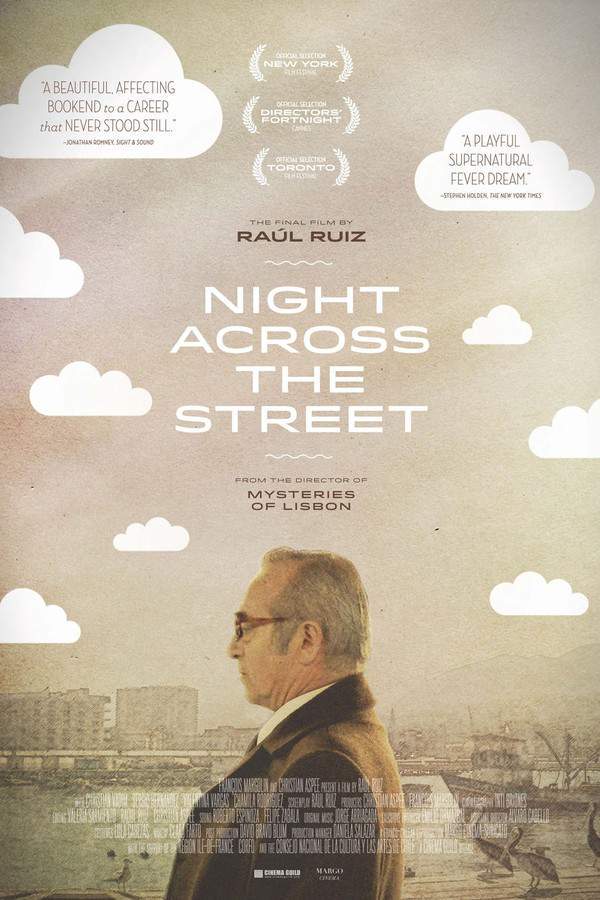
Night Across the Street (2013) movie poster

Timeline

Night Across the Street (2013) Timeline Explained – Every Event in Order

Release, runtime and language
2013 · 110 min · Spanish
Directed by
Raoul Ruiz

An elderly office worker experiences a blurring of memories and fantasies, causing the lines between reality and imagination to dissolve. This mesmerizing film follows a journey of personal remembrance, exploring a rich tapestry of interwoven stories. The narrative masterfully blends fiction, history, and life, revealing the complexities of a life lived and remembered.

On this page (6)
  1. 1 Where to watch
  2. 2 Events in order (13)
  3. 3 Timeline questions answered
  4. 4 Movie threads
  5. 5 Movies like Night Across the Street
  6. 6 Every angle

Where to watch

Where to Watch Night Across the Street (2013)

Where can you watch Night Across the Street? Stream, rent or buy it in the US, including on MUBI, Kanopy and Apple TV Store: current JustWatch availability with up-to-date prices.

Streaming availability powered by JustWatch

13 events in order · contains spoilers

Night Across the Street Timeline: Events in Chronological Order

Every key event of Night Across the Street (2013) in order, scene by scene, with when and where it takes place. Use it to untangle flashbacks, time jumps and parallel storylines, to refresh your memory before the sequel or to find the exact scene you are thinking of.

  1. Don Celso's Class

    The film opens with Don Celso attending a class led by Jean Giono. An alarm from his pocket interrupts their discussion about the passage of time, a theme that resonates throughout the film.

  2. Don Celso's Reflection

    While engaging in his office job, Don Celso reflects on his earlier conversation with Jean Giono. His thoughts reveal a peculiarity as he reenacts their discussion, signifying deep contemplation about his life.

    When
    Present
    Where
    Office
  3. Retirement Party Reminder

    Don Celso's boss interrupts him to remind him of his upcoming retirement party. This moment serves as a crucial turning point, marking the transition into a new chapter in his life.

    When
    Present
    Where
    Office
  4. Rodo's Encounter

    In a fascinating shift to the past, young Rodo meets Long John Silver, whom he recognizes as a historical figure. This encounter highlights the blend of fantasy and memory central to the film's narrative.

  5. Rodo's Fascination with Beethoven

    Rodo declares Beethoven as his favorite figure in a comedic dialogue with him. This interaction humorously critiques the conventional cinematic experience, exploring deeper themes of perception and reality.

  6. The Murder Plot

    Transitioning to Rolo Pedro, he devises a deceitful plan to murder Don Celso for his wealth. This plot intertwines the fates of the characters while underscoring the film's thematic tension.

  7. The Boarding Home Tragedy

    Tragedy strikes at Don Celso's boarding home, leaving him as the sole survivor. This event significantly impacts Don Celso's journey and adds emotional weight to the storyline.

    Where
    Boarding Home
  8. Rodo and Don Celso's Conversation

    A poignant conversation unfolds between the past and present selves of Rodo and Don Celso. This dialogue raises essential questions about identity, memory, and reality, essential themes in the film.

  9. Climactic Confrontation

    The narrative reaches a climax when Rodo shoots Don Celso in a shocking confrontation. This act propels Don Celso into an ethereal realm that further explores the existential themes of the film.

  10. Exploration of Existence

    In the ethereal realm, Don Celso seeks to understand the nature of existence. He encounters deceased figures from his life, leading to profound realizations about the connections between life and death.

  11. Funeral Assembly

    The story culminates in a funeral-like assembly where co-workers deliver heartfelt eulogies for Don Celso. This poignant moment acknowledges the legacy and essence of Ruiz's cinematic creations.

  12. The Essence of Time

    Throughout the film, the metaphor of time as marbles is revisited, representing the infinite experiences of life. This creative concept emphasizes the diverse perspectives of time through memories and fantasies.

  13. Blurring of Reality

    The narrative intricately blurs the lines between imagination and reality at various points. Don Celso's interactions with figures from his past reveal the complexity of human consciousness and memory.

Last updated: November 15, 2024 at 19:39

Was this helpful?

Timeline questions answered

Night Across the Street Timeline Explained: Your Questions Answered

When does it happen, and why in that order? The questions people ask about the chronology of Night Across the Street (2013): time jumps, flashbacks, cause and effect between scenes and the correct order of events, each answered with spoilers.

Q1

Why does Don Celso believe time can be perceived through memories and fantasies?

Don Celception that time can be viewed through the lens of memories and fantasies because he has lived long enough to experience how the past, present, and imagination blur together. In his class discussion with Jean Giono, he explains that both adults and children can perceive time this way, adults through accumulated memories and children through vivid imagination. This belief becomes the foundation for the film's three-dimensional structure, where past and present seamlessly intersect.

Foreshadowing: Earlier in the film, Don Celso's alarm interrupts the class about time, signaling his awareness of mortality even during philosophical discussions.

  • don celso
  • time perception
  • memory
  • fantasy
  • jean giono
Q2

What is the significance of Rodo's encounter with Long John Silver?

Rodo's meeting with Long John Silver represents how the young boy blurs the line between fiction and reality, perceiving the pirate from Robert Louis Stevenson's Treasure Island as an actual historical figure. This encounter establishes the film's central theme of imagination and memory intertwining, showing how Rodo (young Don Celso) constructs separate worlds filled with characters from his fantasies. The meeting foreshadows the adult Don Celso's own inability to clearly distinguish between reality and his inner world.

Foreshadowing: The encounter occurs early in Rodo's timeline, establishing the pattern of fantasy-reality blending that will define the entire narrative.

  • rodo
  • long john silver
  • treasure island
  • imagination
  • memory
Q3

Why does Rolo Pedro want to kill Don Celso?

Rolo Pedro devises a plot to murder Don Celso for his riches, driven by greed and deceit. Don Celso repeatedly invokes Rolo Pedro's name throughout the film, humorously miscalling him Rhododendron, which intertwines their fates and emphasizes the looming threat. The murder plot serves as a source of tension in the second dimension of the narrative, representing the darker aspects of human nature that exist alongside the film's more whimsical elements.

Foreshadowing: Don Celso's mispronunciation of Rolo Pedro's name creates a running thread that binds the characters together before the threat becomes explicit.

  • rolo pedro
  • murder plot
  • riches
  • don celso
Q4

What happens at Don Celso's boarding home?

Tragedy strikes at Don Celso's boarding home, leaving him as the sole survivor of some catastrophic event. This event occurs during the film's exploration of the second dimension and significantly impacts Don Celso's psychological journey. The solitude that results from being the only survivor becomes a pivotal moment that contributes to his reflective state as he approaches death.

Foreshadowing: The boarding home tragedy represents a turning point where Don Celso begins to fully confront his mortality and isolation.

  • boarding home
  • tragedy
  • don celso
  • survivor
Q5

Why does Rodo shoot Don Celso in the climax?

In the film's climactic confrontation, Rodo shoots Don Celso, propelling him into an ethereal realm inhabited by the deceased. This shocking act represents the ultimate blurring of the three time dimensions, where the young and old selves of the same person intersect. The shooting serves as a metaphorical gateway between life and death, allowing Don Celso to transition into the afterlife dimension where he can explore existence beyond mortal boundaries.

Foreshadowing: The rapid cuts between dimensions throughout the film build toward this convergence of past and present selves.

  • rodo shooting
  • climax
  • death
  • ethereal realm
  • transition
Q6

What is the ethereal realm Don Celso enters after dying?

After being shot by Rodo, Don Celso enters an ethereal realm where deceased figures from his life dwell, representing the film's interpretation of the afterlife. In this space, he seeks to grasp the nature of existence and ultimately reunites with significant people from his past, including those who have died. The realm is not depicted as frightening but rather as a peaceful transition, culminating in a funeral-like assembly where co-workers deliver heartfelt eulogies.

Foreshadowing: Don Celso earlier confides that he is awaiting his own death, preparing both himself and the viewer for this transition.

  • afterlife
  • ethereal realm
  • existence
  • reunion
  • funeral
Q7

How do the three time dimensions in the film connect?

The film weaves through three distinct temporal dimensions: the present (elderly Don Celso at work), the past (young Rodo's adventures), and a supernatural realm after death. These dimensions connect through Don Celso's memories and fantasies, which blur reality as he approaches death. The time as marbles metaphor suggests an infinite chain of experiences that can be worn as a necklace, representing how all moments, past, present, and future, exist simultaneously in memory. Characters like Rodo and Don Celso eventually intersect within these dimensions.

Foreshadowing: The class discussion about the passage of time early in the film establishes the conceptual framework for how these dimensions operate.

  • time dimensions
  • memories
  • fantasy
  • marbles
  • three dimensions
Q8

What does the time as marbles metaphor mean?

The film uses the metaphor of time as marbles to suggest an infinite chain of experiences that can be adorned as a unique necklace. This metaphor represents how each moment of life is a distinct, collectible experience that, when strung together, forms the complete story of one's existence. The film suggests that through memories and fantasies, individuals can access these marbles from different times, creating a non-linear perception of time where past, present, and imagined moments coexist.

Foreshadowing: Don Celso introduces this concept during his class with Jean Giono, and it resurfaces throughout the narrative as a unifying thematic element.

  • time marbles
  • metaphor
  • memories
  • experience
  • necklace
Q9

Why does Rodo declare Beethoven as his favorite historical figure?

Rodo declares Beethoven as his favorite historical figure during a comedic dialogue with the composer himself, showcasing the film's playful blending of reality and imagination. This interaction allows the film to humorously critique conventional cinema, with Rodo noting that "people go to the movies for fun, not to learn anything." The encounter also introduces 20th-century inventions, exploring the contrast between intelligence and reality while establishing Rodo's whimsical nature.

Foreshadowing: This scene occurs shortly after Rodo's meeting with Long John Silver, reinforcing his tendency to interact with famous figures from history and fiction.

  • rodo
  • beethoven
  • comedy
  • cinema critique
  • historical figures
Q10

What is the significance of Don Celso's retirement party?

Don Celso's boss interrupts his thoughts to remind him about his upcoming retirement party, marking a critical transition in his life. This moment serves as a catalyst that foretells the events to come, symbolizing the end of his working life and the beginning of his final journey toward death. The retirement party represents a threshold between his active life and his contemplation of mortality, becoming a pivotal narrative turning point.

Foreshadowing: The reminder comes immediately after Don Celso reenacts his conversation with Jean Giono, connecting his philosophical thoughts about time to his concrete life events.

  • retirement party
  • don celso
  • transition
  • work
  • life chapter

Movie threads

More Movies Like Night Across the Street, by Mood & Story

Curated lists built around what makes Night Across the Street tick: the same mood, the same kind of story or the same emotional payoff. Each list explains why these movies belong together.

Dreamlike memory journeys like in Night Across the Street

Films where the boundaries between memory, fantasy, and reality dissolve. For viewers seeking movies like Night Across the Street, this collection features contemplative dramas where reality blurs with fantasy. These films explore the nature of memory and the passage of time through surreal, non-linear narratives, offering a similar quiet and meditative viewing experience.

  • dreamlike
  • contemplative
  • nostalgic
  • surreal
  • reflective
  • metaphysical
  • Tone: melancholic, reflective, contemplative
  • Pacing: slow, deliberate, meditative
Why these movies?

The story pattern: The narrative structure typically abandons a straightforward timeline, weaving together past memories, present moments, and imagined scenarios. The central conflict is often internal—a character's existential reckoning with their life, regrets, and mortality—rather than driven by external events.

Why they belong together: Movies are grouped here based on their shared focus on the subjective nature of memory, their dreamlike or surreal atmosphere, and their complex, introspective narrative structures that challenge the viewer's perception of reality.
Bittersweet life reviews like in Night Across the Street

Quiet stories about elderly characters reviewing their lives and accepting mortality. If you liked the reflective and melancholic atmosphere of Night Across the Street, this list features similar films about aging and mortality. These movies follow elderly protagonists on a quiet, introspective journey through their memories, leading to a bittersweet and emotionally resonant conclusion.

  • melancholic
  • reflective
  • poignant
  • contemplative
  • nostalgic
  • quiet
  • Tone: melancholic, bittersweet, poignant
  • Pacing: slow, reflective, character-driven
Why these movies?

The story pattern: The journey is primarily internal, following an elderly protagonist as they sift through key moments of their life. The plot is character-driven and introspective, building towards an acceptance of mortality that is typically portrayed as bittersweet rather than purely tragic, finding peace or meaning in the summation of a life.

Why they belong together: This thread connects films that share a central theme of aging and a life review narrative arc. They are united by a quiet, melancholic tone, a slow, contemplative pacing, and a heavy emotional weight focused on existential questions about a life lived.

If you liked this

Movies Like Night Across the Street

Similar movies to Night Across the Street: the same genre, themes or kind of story. Each one comes with its own plot summary, timeline and ending explained.

Browse all movie summaries

Every angle

Night Across the Street (2013) Explained: Plot, Timeline & Characters

Everything about Night Across the Street in one place: what happens in the plot summary, the timeline in chronological order, the characters and meaning and a spoiler-free summary. What's After the Movie adds the cast, box office and post-credit scenes.

Coming soon on iOS and Android

The Plot Explained Movie Summary App

Plot summaries, endings explained and timelines on your phone. Catch up on any movie in minutes, save your favorites and never miss a twist again.

Be the first to know when we launch. Your email stays private, always.

Learn more about the app