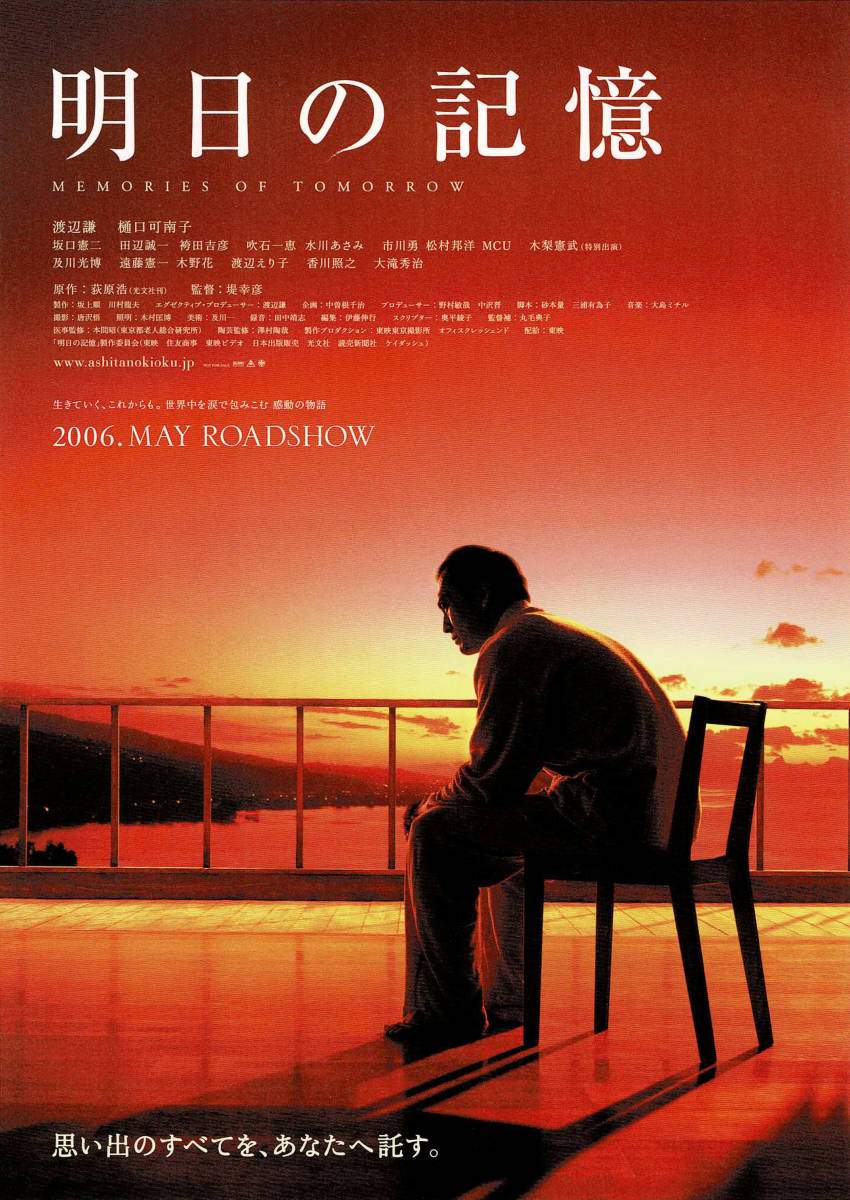
Year: 2007
Runtime: 122 min
Language: Japanese
Director: Yukihiko Tsutsumi
A successful executive finds his life and relationships unraveling as he struggles with a mysterious condition causing memory loss. He must face the heartbreaking consequences of his fading recollections and confront the unsettling prospect of his own mortality, desperately trying to piece together the fragments of his past before they disappear completely.
Warning: spoilers below!
Haven’t seen Memories of Tomorrow yet? This summary contains major spoilers. Bookmark the page, watch the movie, and come back for the full breakdown. If you're ready, scroll on and relive the story!
Read the complete plot breakdown of Memories of Tomorrow (2007), including all key story events, major twists, and the ending explained in detail. Discover what really happened, and what it all means.
The film opens with a poignant glimpse into the future, revealing the heartbreaking condition of a man afflicted by Alzheimer’s disease, set against the backdrop of 2010. The narrative then shifts back to 2004, unveiling the earlier life of Masayuki Saeki, a distinguished and prosperous executive in the advertising industry. Masayuki epitomizes the ideal Japanese white-collar worker: meticulous, well-organized, and industrious. He is deeply dedicated to his profession and enforces high expectations for himself and his team.
However, Masayuki’s world shatters when he begins to experience unexplained memory lapses—struggling to recall appointments, crucial work details, and even the intricate layout of Tokyo that he once navigated with ease. The shocking diagnosis of Alzheimer’s disease sends him spiraling into anger, disbelief, and despair. The film tenderly chronicles the tragic decline of this once-empowered individual as he regresses into a state reminiscent of a second childhood, confronting the harsh realities of his deteriorating condition.
As time progresses, Masayuki’s memory continues to fail him, forcing him to leave his job and stay at home. Here, he receives unwavering care from his loving wife, Emiko. Yet, the strain of this situation starts to fray relationships at home, culminating in emotional tensions between Masayuki and his family. As Emiko’s life becomes increasingly entwined with her husband’s care needs, the film powerfully explores the profound impact of the disease on their lives, depicting a deeply emotional and human struggle against an unyielding adversary.
Last updated: November 08, 2024 at 01:44
Explore frequently asked questions about Memories of Tomorrow (2007) with spoiler-rich answers covering the full plot summary, major story beats, character motivations, hidden details, and ending meaning. This movie summary FAQ helps explain confusing scenes, plot twists, and narrative decisions in clear, searchable detail.
Masayuki had to leave his advertising executive position because his Alzheimer's disease progressively impaired his ability to perform his work duties. As his memory deteriorated, he could no longer remember crucial appointments, workplace details, or navigate the Tokyo business environment he once mastered. His meticulous nature and high standards made it impossible for him to continue working when he could no longer meet his own expectations or deliver the quality of work that had defined his career.
His early memory lapses at work, where he struggled to recall crucial meetings and details, foreshadowed his eventual inability to function in his professional role.
The disease fundamentally shifted their relationship dynamic, transforming an equal partnership into a caregiver-patient relationship. Emiko took on the demanding role of Masayuki's primary caregiver at home, which created increasing emotional tension and strain. While her love remained unwavering, the physical and emotional burden of constant care-giving began to fray their connection, leaving both struggling to cope with the changing nature of their bond.
The shift from equal partners to caregiver and patient was hinted at when Masayuki began staying home and Emiko assumed responsibility for his daily care needs.
The opening scene serves as a heartbreaking preview of Masayuki's condition at the film's end, showing a man whose life has been devastated by advanced Alzheimer's. This glimpse establishes the emotional weight of the story from the start, letting viewers understand the tragic trajectory they are about to witness as the narrative shifts back to 2004 when Masayuki was still a thriving, meticulous executive.
The 2010 opening directly foreshadows the 'second childhood' state that Masayuki will regress to as the disease runs its course.
As Alzheimer's progressively destroyed Masayuki's memories and cognitive abilities, he regressed to a state resembling childhood, struggling with basic comprehension, requiring help with daily tasks, and losing the sophisticated mental faculties that had defined his adult life. This poignant metaphor captures how the disease stripped away his hard-earned professional identity, leaving him dependent on others for basic care, much like a child depends on parents.
This regression was foreshadowed by his increasing inability to perform simple tasks and his growing confusion about even familiar surroundings.
Alzheimer's disease is a progressive neurodegenerative condition that causes memory deterioration over time. In Masayuki's case, he experienced sudden onset of memory lapses, struggling to recall appointments, work details, and familiar Tokyo streets. The film's narrative shows this decline accelerating from troubling forgetfulness to complete inability to function independently, reflecting the devastating nature of early-onset Alzheimer's.
His initial memory lapses at work, where he forgot crucial appointments and details, marked the beginning of this irreversible progression.
Masayuki's meticulous, well-organized nature makes his decline particularly tragic because he was defined by his intellectual excellence and professional competence. The contrast between who he once was, a detail-oriented executive who set high standards for himself and his team, and who he becomes as the disease progresses creates profound emotional impact. His inability to accept his diminishing capabilities likely intensified his anger and despair after diagnosis.
The film establishes his meticulous character in 2004 specifically to highlight the devastating contrast when he loses those same cognitive abilities.
The non-linear structure serves to heighten the emotional impact by showing viewers the tragic endpoint first. Opening in 2010 with Masayuki's advanced condition establishes the devastating outcome, then shifting to 2004 allows audiences to witness his decline unfold while already knowing its destination. This technique creates a bittersweet viewing experience, knowing that every successful moment is leading toward inevitable loss.
The structure itself foreshadows the finality of Alzheimer's, there is no recovery or reversal shown in the 2010 timeline.
Following his Alzheimer's diagnosis, Masayuki experiences a turbulent emotional progression: initial shock and disbelief at the shocking news, followed by intense anger at his fate, then deep despair as he confronts the reality of his deteriorating condition. This emotional arc reflects the psychological burden of confronting one's own mortality and the loss of identity that comes with memory deterioration.
The timeline shows his emotional state shifting from anger and disbelief in the early stages to the more passive acceptance required to survive the disease's progression.
Emiko's life becomes increasingly centered around her husband's care needs as his condition worsens. The strain of constant caregiving manifests in growing emotional tensions at home. While her love remains steadfast, the physical exhaustion and emotional burden of watching her husband regress while managing his daily needs takes a profound toll on her own well-being and life prospects.
The shift in their relationship dynamics, with Emiko taking on primary caregiving responsibilities, was established early once Masayuki stopped working.
By the film's conclusion, Masayuki has regressed into what the narrative describes as a 'second childhood,' requiring full-time care from his wife Emiko. The ending is definitively sad, showing no recovery or hope, only the continued progression of his Alzheimer's into its most advanced stages, where he has lost nearly all memory of his former life and independence.
The 2010 opening already revealed this endpoint, confirming the film's sad conclusion reflects the inevitable progression of his disease.
Discover curated groups of movies connected by mood, themes, and story style. Browse collections built around emotion, atmosphere, and narrative focus to easily find films that match what you feel like watching right now.
Intimate portrayals of a character's psyche and memories fading away.This collection gathers movies like Memories of Tomorrow that explore the tragic theme of cognitive decline. If you were moved by the portrayal of memory loss and its impact on identity, these similar dramas about deteriorating health and the fragility of the mind will resonate with you.
Stories in this thread follow a linear or episodic descent as a central character loses their grip on reality, memories, or their own identity. The conflict is often internal, pitting the character against their own fading consciousness, while external relationships strain under the weight of their decline.
These movies are grouped by their somber, reflective tone and their shared focus on the devastating psychological and emotional impact of a character's mental deterioration, creating a consistently heavy and melancholic viewing experience.
Stories about the emotional toll of caring for a loved one in decline.For viewers who appreciated the marital strain and caregiving aspects of Memories of Tomorrow, this list features similar heavy dramas. These films focus on the emotional journey of families supporting a loved one through a difficult illness, capturing the heartbreaking sacrifices and relationship challenges.
The narrative pattern centers on a family unit grappling with the prolonged illness or disability of one of its members. The journey is not just about the patient's suffering but equally about the caregiver's emotional exhaustion, shifting roles, and the bittersweet acts of love that define their new reality.
These films are connected by their intense focus on the caregiver's perspective, the heavy emotional weight of the subject matter, and the realistic portrayal of how a health crisis can test and transform the closest of relationships.
Don't stop at just watching - explore Memories of Tomorrow in full detail. From the complete plot summary and scene-by-scene timeline to character breakdowns, thematic analysis, and a deep dive into the ending - every page helps you truly understand what Memories of Tomorrow is all about. Plus, discover what's next after the movie.
Track the full timeline of Memories of Tomorrow with every major event arranged chronologically. Perfect for decoding non-linear storytelling, flashbacks, or parallel narratives with a clear scene-by-scene breakdown.
Discover the characters, locations, and core themes that shape Memories of Tomorrow. Get insights into symbolic elements, setting significance, and deeper narrative meaning - ideal for thematic analysis and movie breakdowns.
Discover movies like Memories of Tomorrow that share similar genres, themes, and storytelling elements. Whether you’re drawn to the atmosphere, character arcs, or plot structure, these curated recommendations will help you explore more films you’ll love.
Memories of Tomorrow (2007) Scene-by-Scene Movie Timeline
Memories of Tomorrow (2007) Movie Characters, Themes & Settings
Memories of Tomorrow (2007) Spoiler-Free Summary & Key Flow
Movies Like Memories of Tomorrow – Similar Titles You’ll Enjoy
One Second (2022) Story Summary & Characters
Memories Look at Me (2013) Full Movie Breakdown
Found Memories (2012) Ending Explained & Film Insights
Rememory (2017) Detailed Story Recap
Remember Me (2017) Plot Summary & Ending Explained
Memories of Me (1988) Detailed Story Recap
Memories to Choke On, Drinks to Wash Them Down (2019) Full Movie Breakdown
The Memory (2006) Full Summary & Key Details
Memories of Murder (1990) Ending Explained & Film Insights
Happy Memories (1981) Ending Explained & Film Insights
Memories of Matsuko (2006) Film Overview & Timeline
Memory (2006) Story Summary & Characters
Memories of Midnight (1000) Ending Explained & Film Insights
Memory Holograph (2023) Full Movie Breakdown
Memory Dealers (2024) Film Overview & Timeline