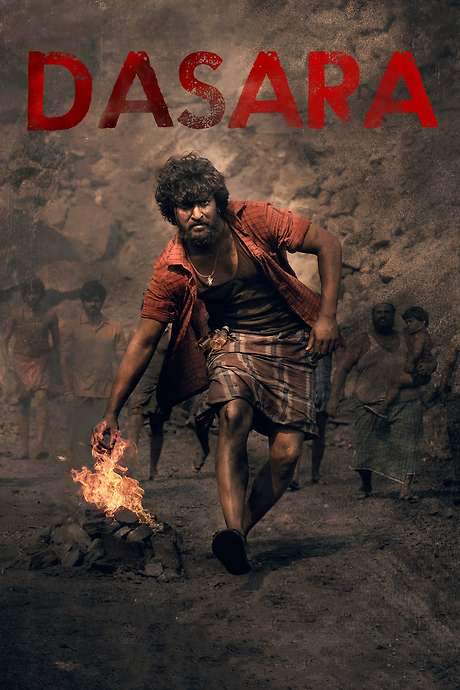
In the wake of the 18th century conflicts that followed the Battle of Bobbili in 1757, the land of South India finds itself roiled by political chaos and the encroaching influence of distant powers. At the heart of this turmoil lies a legendary treasure of the Amaraveedu dynasty, hidden away in a cave behind five sturdy doors and secured by five keys. To keep the wealth from falling into the hands of the British, two steadfast friends, Daanaala Dharmayya and Pagadaala Subbayya, split the keys and scatter the treasure far and wide. Dharmayya flees to Kurnool, while Subbayya seeks refuge in Gadwal, each guarding a different piece of the puzzle to ensure the riches stay out of reach.
Enter Krishna Prasad, a reform-minded social advocate who raises his voice for the poor as the town’s new government asserts itself. When a notorious highway robber, Nakkajittula Naaganna, is captured and offered a hefty reward, Krishna sees an opportunity not just to profit but to assist the needy. He captures Naaganna, binds him with ropes, and hands him over for the bounty. Yet in a quiet twist of conscience, Krishna secretly frees the robber and shares the loot, using the money to uplift the marginalized. This cunning move earns him broad support from the people and a growing reputation as someone who stands for justice—even if his methods are unorthodox.
A pivotal turn comes when a blind old man, once a servant of the Amaraveedu court, unwittingly reveals the treasure’s keys to a tavern crowd. The information leaks to Sathyam, a rival with designs on the fortune. Sathyam tortures the blind man to extract more details, learns that Dharmayya is in Kurnool, and acts with ruthless haste, killing Dharmayya on the road. Radha, Dharmayya’s daughter, arrives to witness her father’s dying moments. Misled into believing that Subbayya is responsible for the murder, she vows revenge and sets out on a path of vengeance that will entangle many lives.
On his deathbed, Subbayya confides in his son, revealing the treasure’s location and noting that a crucial key had already passed through the hands of Komarayya, a retired constable in Kurnool. Meanwhile, Krishna Prasad keeps adding to his earnings through schemes tied to Naaganna, but his attention also turns to love. He falls for Radha and decides to train her as a sharpshooter to help her seek retribution. Radha’s pledge to avenge her father’s death becomes a guiding force, shaping her every move.
Radha’s pursuit of vengeance brings her into conflict with Bijili, a rival cowgirl who is not immune to the charms of Krishna. Naaganna, still smarting from old grievances, seizes an opportunity to steal Krishna’s loot and is left stranded in the desert after a brutal punishment. Consumed by spite, Naaganna teams up with Bijili to torment Krishna. In a brutal desert showdown, Naaganna and Bijili capture and torture Krishna. They uncover a cart of corpses—among them the son of Pagadaala Subbayya—who, in his last breath, discloses a crucial detail about the treasure.
Greed drives Naaganna to impersonate Pagadaala Subbayya, a ruse that helps Krishna recover from his injuries. The two escape together, while Naaganna, now in Subbayya’s disguise, is eventually captured by Sathyam’s gang. Krishna rescues him, and Naaganna reopens his alliance with Krishna in a fight against those who would claim the treasure for themselves. Radha then reveals that her father once worked for Komarayya, the man who had received one of the keys, hinting at old loyalties that still influence new choices.
The trio—Krishna Prasad, Radha, and Naaganna—press on toward the legendary cave. A violent clash erupts as rival robbers converge, each seeking the five sacks of wealth. After a fierce battle, Krishna and Radha triumph and stand before the treasure: five sacks of gold and wealth, the culmination of their arduous journey. In a moment of justice earned through courage, cooperation, and sacrifice, Krishna and Radha share the treasure, restoring a measure of balance and sowing the seeds for a future where the poor might finally reap the rewards of their labor.