Plot Explained Spoilers guaranteed!
Plot Explained

Browse by genre

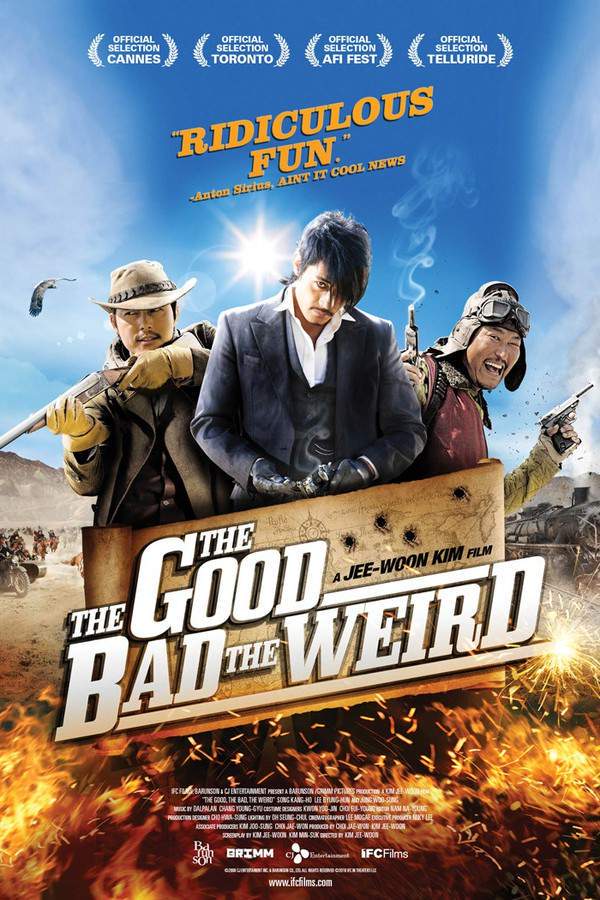
The Good, the Bad, the Weird (2010) movie poster

Plot Summary

The Good, the Bad, the Weird (2010) Plot Summary Explained

Release, runtime and language
2010 · 130 min · Japanese
JustWatch #33,843 2
Directed by
Ji-woon Kim
Starring
Kang-ho Song, Byung-hun Lee, Woo-sung Jung

In the 1930s Manchurian desert, a ruthless bounty hunter, a cunning bandit leader, and a charismatic thief find themselves united on a train. They are drawn together by the pursuit of a valuable map, leading them through dangerous terrain. Their quest is complicated by rival factions, including the Japanese army and powerful Asian gangsters, all vying for the map’s secrets. The journey tests their alliances and forces them to confront their own motivations in this lawless land.

On this page (6)
  1. 1 Where to watch
  2. 2 What happens: full plot
  3. 3 Plot questions answered
  4. 4 Movie threads
  5. 5 Movies like The Good, the Bad, the Weird
  6. 6 Every angle

Where to watch

Where to Watch The Good, the Bad, the Weird (2010)

Where can you watch The Good, the Bad, the Weird? Stream, rent or buy it in the US, including on AMC+, Philo and Sundance Now: current JustWatch availability with up-to-date prices.

Streaming availability powered by JustWatch

Full plot summary · contains spoilers

What Happens in The Good, the Bad, the Weird: Full Plot Summary

The whole story of The Good, the Bad, the Weird (2010) explained, from the opening scene to the final frame: every key event, every twist and what it all adds up to. Read it as a quick recap before the sequel, to check a scene you missed, or to finally understand what really happened.

In the arid expanse of Manchuria in 1939, just prior to the onset of the Second World War, a thrilling adventure unfolds. Park Chang-yi, also known as The Bad and portrayed by Lee Byung-hun, is a notorious bandit and hitman tasked with obtaining a treasure map from a Japanese official aboard a train. However, he is blindsided when Yoon Tae-goo, dubbed The Weird and played by Kang-ho Song, cleverly snatches the map first, embroiling himself in the chaos of Chang-yi's derailment scheme that leads to a brutal massacre of Japanese and Manchurian guards, alongside innocent civilians.

Enter Park Do-won, or The Good, a sharp-shooting bounty hunter portrayed by Woo-sung Jung, who arrives on the scene to claim the lucrative bounty on Chang-yi’s head. Amidst the carnage, Tae-goo cunningly manages to escape, narrowly evading both the Good and the Bad. Meanwhile, a violent undercurrent stirs as a faction of Manchurian bandits seeks to seize the coveted map for sale at the infamous Ghost Market. Tae-goo dreams of unraveling the map's hidden treasures, which he believes leads to a stash of gold and riches left behind by the Qing dynasty just before its demise.

As tensions rise, a ferocious battle ensues for control of the map, with bounty hunters tracking their targets and the Imperial Japanese Army racing to reclaim the artifact that could supposedly "save the Japanese Empire." The ensuing chaos leads to a series of intense shootouts and high-octane chases, culminating in a colossal final confrontation where the Japanese army, Manchurian bandits, Do-won, Chang-yi, and his crew are all in relentless pursuit of Tae-goo.

In the fray, the Japanese army decimates most of the bandits. Do-won emerges as a fierce adversary, taking down numerous soldiers and igniting an explosion that scatters the enemy forces. As Chang-yi’s gang begins to dwindle, he ruthlessly eliminates those who attempt to abandon the chase. The climax sees only Chang-yi, Tae-goo, and Do-won reach the supposed "treasure," which turns out to be a mere boarded-over pit in the desert.

In a tense standoff, deep-seated grudges surface as Chang-yi realizes that Tae-goo is the "Finger Chopper," a notorious criminal responsible for a past injury during a knife fight five years prior. With rage consuming them, the three men retaliate against one another in a fierce showdown, ultimately leading to their downfall. As they collapse in the sand, lifeless and forsaken, the "worthless hole" they fought over erupts unexpectedly, releasing a geyser of crude oil. Miraculously, Do-won and Tae-goo manage to survive, but with a freshly inflated bounty on Tae-goo's head, a new pursuit begins as he races across the desolate Manchurian landscape.
Last updated: November 15, 2024 at 19:02

Was this helpful?

Plot questions answered

The Good, the Bad, the Weird Plot Explained: Your Questions Answered

The questions people ask most about The Good, the Bad, the Weird (2010): what happens in the confusing scenes, why the characters do what they do, the twists, hidden details and what the ending means. Each answer contains spoilers.

Q1

Why does the treasure turn out to be an empty pit?

The treasure map leads Chang-yi, Tae-goo, and Do-won to a boarded-over pit in the Manchurian desert. When they finally reach what they believe is the Qing dynasty gold stash, they discover there is nothing there, just a worthless hole in the ground. This is the film's cynical twist, revealing that all the violence and pursuit was for nothing tangible.

Foreshadowing: Earlier mentions of the map's treasure are vague and based on legend rather than verified fact, setting up the disappointment.

  • treasure map
  • pit
  • desert
  • empty
  • gold
  • Qing dynasty
Q2

Who is the Finger Chopper that Chang-yi mentions?

During the final standoff, Chang-yi recognizes Tae-goo as the Finger Chopper, a notorious criminal who injured Chang-yi during a knife fight five years prior. This old grudge is what drives Chang-yi to attack Tae-goo in the climactic confrontation, revealing that their conflict is personal beyond just the map.

Foreshadowing: The film establishes Chang-yi as someone with a violent past and a reputation that precedes him.

  • finger chopper
  • Chang-yi
  • Tae-goo
  • knife fight
  • grudge
Q3

What do the Japanese army want with the treasure map?

The Imperial Japanese Army believes the treasure map could "save the Japanese Empire." They pursue it aggressively, viewing the Qing dynasty's hidden gold as a strategic asset that could bolster their military efforts during this pre-WWII period. Their involvement escalates the conflict significantly.

Foreshadowing: The map is introduced as an artifact of immense political and strategic value from the start.

  • Japanese army
  • treasure map
  • empire
  • Qing dynasty
  • WWII
Q4

How do Do-won and Tae-goo survive at the end?

After the three men collapse from their injuries, the supposedly empty pit unexpectedly erupts into a geyser of crude oil. This violent eruption somehow leaves both Do-won and Tae-goo alive, while Chang-yi remains lifeless in the sand. The oil effectively "resurrects" them by covering their bodies and perhaps providing some form of protection or shock.

Foreshadowing: The pit's sudden eruption is completely unexpected, as the characters believed it was empty.

  • oil geyser
  • Do-won
  • Tae-goo
  • survival
  • desert
  • explosion
Q5

Why does Chang-yi eliminate his own crew?

As Chang-yi's gang dwindles during the relentless pursuit, he ruthlessly kills any of his men who attempt to abandon the chase. This demonstrates his cold, pragmatic nature, he sees weakness as a threat and values the map's potential reward over loyalty to his followers.

Foreshadowing: Chang-yi is established as a cold-hearted bandit and hitman from the start.

  • Chang-yi
  • gang
  • loyalty
  • killings
  • pursuit
Q6

What is the Ghost Market in the movie?

The Ghost Market is an infamous black market location where the Manchurian bandits plan to sell the stolen treasure map. It represents the underground criminal network operating in 1930s Manchuria and adds another layer of competing interests beyond just the three main characters.

Foreshadowing: The bandits' plan to sell the map at the Ghost Market introduces the secondary conflict that brings more factions into the hunt.

  • Ghost Market
  • bandits
  • black market
  • Manchuria
Q7

Why does Tae-goo want to find the Qing dynasty treasure?

Tae-goo dreams of uncovering the hidden treasures left behind by the Qing dynasty just before its fall. He believes the map leads to a stash of gold and riches that would transform his life, which is why he risks everything to steal it from Chang-yi in the first place.

Foreshadowing: Tae-goo's motivation is established early when he escapes with the map and expresses his dreams of finding the treasure.

  • Tae-goo
  • treasure
  • Qing dynasty
  • gold
  • riches
  • dream
Q8

How does the train derailment lead to the massacre?

Chang-yi plans to derail the train to create chaos and kill the Japanese official holding the map. However, his scheme goes wrong, resulting in a brutal massacre of Japanese and Manchurian guards along with innocent civilians. This mass killing is what brings Do-won to the scene and sets the entire pursuit in motion.

Foreshadowing: Chang-yi's violent plan is introduced as a risky mission that quickly spirals out of control.

  • train
  • derailment
  • massacre
  • Japanese guards
  • civilians
Q9

Why does Tae-goo end up with a new bounty on his head?

After surviving the oil geyser, Tae-goo finds himself with a freshly inflated bounty on his head. This likely results from the chaos he caused, the many enemies he made during the pursuit, and possibly the Japanese army or other factions wanting him dead. The ending sets up a new chase as Tae-goo must run from yet another bounty.

Foreshadowing: The film closes with Tae-goo racing across the desert, suggesting his troubles are far from over.

  • bounty
  • Tae-goo
  • Manchuria
  • new pursuit
  • running
Q10

Why do the three main characters fight each other at the end?

The final showdown erupts from accumulated grudges and the desperation of having fought for a worthless prize. Chang-yi specifically targets Tae-goo upon recognizing him as the Finger Chopper, while Do-won and Tae-goo also turn on each other. The three men, exhausted and enraged, unleash their pent-up rage in a violent three-way confrontation that leaves all three dead or dying.

Foreshadowing: Tensions between the three rivals build throughout the film, with Trust constantly wavering between them.

  • final fight
  • Chang-yi
  • Tae-goo
  • Do-won
  • confrontation
  • grudges

Movie threads

More Movies Like The Good, the Bad, the Weird, by Mood & Story

Curated lists built around what makes The Good, the Bad, the Weird tick: the same mood, the same kind of story or the same emotional payoff. Each list explains why these movies belong together.

Movies about chaotic rivalries in lawless lands like The Good, the Bad, the Weird

Competitive anti-heroes clash in a dangerous, morally grey world. If you liked the competitive chase and tense standoffs between The Good, the Bad, and the Weird, explore more movies featuring ruthless anti-heroes vying for a prize in dangerous, ungoverned territories. These films capture the gritty humor and high-energy action of survivalist rivalries.

  • competitive
  • ruthless
  • action-packed
  • tense
  • desolate
  • high-energy
  • Tone: tense, gritty, humorous
  • Pacing: fast, chaotic
Why these movies?

The story pattern: Stories typically follow a group of morally ambiguous characters—bounty hunters, thieves, or mercenaries—whose paths converge in pursuit of a common goal, such as a treasure or bounty. The plot unfolds as a series of chases, double-crosses, and explosive confrontations, testing their fragile truces and individual greed.

Why they belong together: Movies are grouped here for their shared focus on competitive dynamics in anarchic settings, a mix of high-intensity action and dark humor, and the central theme of self-interest clashing with temporary cooperation.

Fast-paced chaotic chase movies similar to The Good, the Bad, the Weird

Explosive action and humor fuel a relentless, multi-party pursuit. Fans of The Good, the Bad, the Weird who loved its high-octane desert chase and explosive shootouts will enjoy these films. Discover more action-comedies and adventures where a frantic pursuit drives the narrative, blending relentless action with charismatic, competing characters.

  • chaotic
  • high-energy
  • action-packed
  • humorous
  • tense
  • fast-paced
  • Tone: tense, humorous, high-energy
  • Pacing: fast, relentless
Why these movies?

The story pattern: The narrative is a linear, propulsive pursuit of a MacGuffin or goal, often involving several competing parties. The structure is a series of escalating set pieces—chases, heists, and showdowns—with minimal downtime, emphasizing survival, wit, and spectacle over deep character introspection.

Why they belong together: These movies share a core identity defined by a fast pace, a high degree of chaotic action, a blend of tension and comedy, and a straightforward plot centered around a relentless chase that engages multiple rivals.

If you liked this

Movies Like The Good, the Bad, the Weird

Similar movies to The Good, the Bad, the Weird: the same genre, themes or kind of story. Each one comes with its own plot summary, timeline and ending explained.

Browse all movie summaries

Every angle

The Good, the Bad, the Weird (2010) Explained: Plot, Timeline & Characters

Everything about The Good, the Bad, the Weird in one place: what happens in the plot summary, the timeline in chronological order, the characters and meaning and a spoiler-free summary. What's After the Movie adds the cast, box office and post-credit scenes.

Coming soon on iOS and Android

The Plot Explained Movie Summary App

Plot summaries, endings explained and timelines on your phone. Catch up on any movie in minutes, save your favorites and never miss a twist again.

Be the first to know when we launch. Your email stays private, always.

Learn more about the app