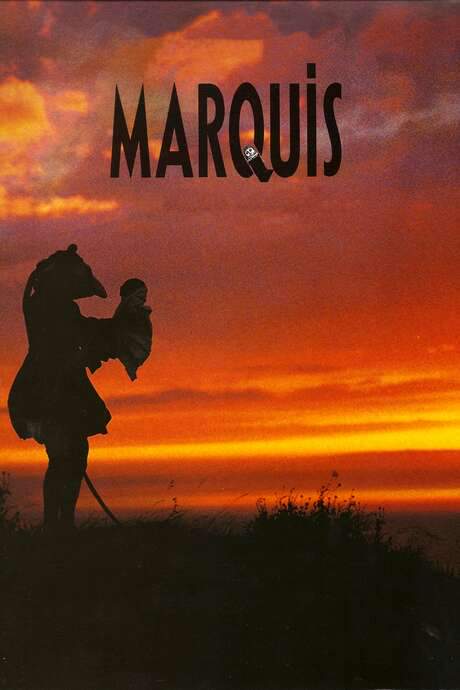
Marquis

Marquis

Year: 1989

Runtime: 83 mins

Language: French

Director: Henri Xhonneux

AnimationComedy

On the brink of revolution, French activist‑author Marquis and his talking penis, Colin, await trial in the Bastille for alleged conspiracy against the state. As Marquis immerses himself in his art while Colin seeks action, the pair draw the attention of rival ideological factions, setting the stage for a clash of mind and desire.

Warning: spoilers below!

Haven’t seen Marquis yet? This summary contains major spoilers. Bookmark the page, watch the movie, and come back for the full breakdown. If you're ready, scroll on and relive the story!

Marquis (1989) – Full Plot Summary & Ending Explained

Read the complete plot breakdown of Marquis (1989), including all key story events, major twists, and the ending explained in detail. Discover what really happened, and what it all means.

In a pre-revolutionary France setting, the Marquis de Sade sits in a dim jail, drafting his thoughts and trading barbs with his own sentient penis, a cheeky companion named Colin. Colin often whines about stimulation and hurls impulsive philosophies, yet he also acts as a storyteller who spins tales that feed the Marquis’s writings, some of which come to life through clay-animated visuals that punctuate the narrative with a playful, dreamlike quality.

The Marquis’ confinement carries a tangled web of accusations: he is said to have defecated on a cross, and there are charges involving a bovine named Justine who is alleged to have been raped and impregnated. A wily camel-headed priest, Don Pompero, together with the cocky Gaëtan de Preaubois, schemes to keep secret the truth that Justine’s rapist was not an ordinary foe but the King of France, complicating the case and casting the inmates’ fate into deeper political shadows.

Beyond the cell walls, revolutionaries prepare to stage a coup to dethrone the king, with leadership coming from Juliette de Titane, a formidable equine noble who embodies the uprising’s daring spirit. The prison crowd is not merely a backdrop but a chorus of political prisoners and would-be escapees, whose attempts to break free repeatedly falter, only to be ultimately set free by the advancing revolutionaries. The Bastille becomes both a symbol and a stage for restless energies, as alliances form and fractures emerge under pressure.

Amid the chaos, Colin finds an unexpected connection with Juliette, and the two flee together to push the revolution forward, leaving the Marquis to his desk, where he continues to write and to muse on his life in relative solitude. The story intertwines dark humor, political satire, and surreal romance, painting a world where art, power, and desire collide in unusual, thought-provoking ways. The film’s distinctive voice comes through in its blend of dialogue-driven scenes and imaginative visuals, inviting viewers to reflect on how storytelling can shape history and personal destiny.

Ultimately, the tale invites you to witness a strange, provocative journey through ambition and rebellion, where a jailed writer, a talking companion, and a cast of eccentric figures navigate a landscape hammered by revolution, secrecy, and the odd tenderness that emerges when unlikely partners find common ground on the road to change.
Last updated: February 18, 2026 at 23:43

Was this helpful?

Marquis (1989) Plot Questions Answered – Summary FAQ

Explore frequently asked questions about Marquis (1989) with spoiler-rich answers covering the full plot summary, major story beats, character motivations, hidden details, and ending meaning. This movie summary FAQ helps explain confusing scenes, plot twists, and narrative decisions in clear, searchable detail.

Q1

Why is Marquis de Sade imprisoned in the film?

A.

Marquis de Sade is imprisoned on multiple charges: allegedly defecating on a cross and being accused of raping and impregnating Justine, a bovine. However, these charges are politically motivated, as the real rapist is the King of France himself, and the conspiracy to hide this truth drives much of the film's court intrigue.

The charges are introduced early, establishing the political corruption that surrounds the Marquis throughout the film.

marquis de sade imprisonmentchargesjustinebastille
Q2

Who really raped Justine the cow?

A.

Justine was actually raped by the King of France, not by Marquis de Sade. Don Pompero (the camel-headed priest) and Gaëtan de Preaubois conspire to conceal this truth to protect the monarchy, casting the inmates' fates into deeper political shadows.

The conspiracy is hinted at when Don Pompero and Gaëtan first appear, as they manipulate information to shield royal reputations.

justineking of francerapecover-updon pompero
Q3

What is Colin and what role does he play?

A.

Colin is the Marquis de Sade's sentient penis, who acts as both a cheeky companion and storyteller. He interrupts the Marquis's writing with philosophical quips and spontaneous philosophies, and his imaginative tales become part of the Marquis's manuscript, some illustrated through clay animation.

Colin's storytelling begins immediately, establishing his role as the creative spark behind the Marquis's writing.

colintalking penisnarratorstorytelling
Q4

Why does Colin fall in love with Juliette de Titane?

A.

Colin develops an unexpected romantic connection with Juliette de Titane, the equine noble leading the revolutionary coup. Their bond represents a blending of romance and radical politics, with Colin choosing to flee with her to push the revolution forward rather than remain in the prison.

Their connection forms during the revolutionary buildup, as Juliette's presence in the prison crowd draws Colin's attention.

colinjuliette de titaneloveromancerevolution
Q5

Why does Don Pompero conspire to hide the king's crime?

A.

Don Pompero and Gaëtan de Preaubois work to conceal that the King of France raped Justine because exposing the monarch would destabilize the monarchy and threaten the existing power structure. Their conspiracy reveals how political power relies on silence and manipulation.

The priest's involvement is established early, showing his alignment with royal interests before the full scope of the cover-up is revealed.

don pomperokingconspiracycover-uproyal secrets
Q6

What happens when the revolutionaries storm the Bastille?

A.

The revolutionaries, led by Juliette de Titane, successfully storm the Bastille and free all the inmates. This event shifts the balance of power, accelerates the revolutionary movement, and changes the fates of everyone in the prison, including allowing Colin to flee with Juliette.

The buildup to the coup is shown throughout the film as revolutionaries prepare to depose the king.

bastillerevolutionliberationjuliette de titane
Q7

What is the purpose of the clay animation segments?

A.

The clay animation segments illustrate the stories that Colin tells, which become parts of the Marquis's manuscript. These stop-motion interludes bring the Marquis's bizarre narratives to life visually, creating a dreamlike, surreal quality that contrasts with the jailhouse conversations and blurs fiction with reality.

Colin's storytelling is established from the start, with the animation beginning as his tales take shape.

clay animationstop-motionsurrealstorytellingmanuscript
Q8

Why are some characters portrayed as animals?

A.

The film uses anthropomorphic animals as a satirical device: Marquis is a canine, Justine is a bovine, Don Pompero has a camel head, and Juliette de Titane is an equine noble. This surreal casting serves the dark comedy and political allegory, allowing the film to critique French aristocracy and the monarchy through metaphorical characters.

The animal characters are introduced in the opening scenes, immediately establishing the film's absurdist tone.

anthropomorphismanimalssatireallegorysurrealism
Q9

What happens to Marquis de Sade at the end of the film?

A.

After the Bastille is liberated and Colin leaves with Juliette, the Marquis returns to his writing desk in relative solitude. He continues to muse on his life, finding a strange peace within his own company as he contemplates power, art, and freedom.

The Marquis's preference for solitary writing is established early, as he spends most of his time at his desk regardless of external events.

marquis endingwritingsolitudepeace
Q10

Why do the revolutionaries free the prisoners?

A.

The revolutionaries storm the Bastille as part of their coup to dethrone the king, seeing the prison as a symbol of oppressive royal power. Freeing the political prisoners serves both a practical political goal and symbolizes the overthrow of the old regime's tyranny.

The revolutionary coup is planned from early in the film, with Juliette rallying support for the uprising.

revolutionariesprisonersfreedomcoupbastille
Q11

What is the political message of the film?

A.

The film uses the pre-revolutionary France setting as an allegory for how storytelling, power, and desire intersect. The cover-up of the king's crime illustrates how political power relies on manipulation, while the revolution represents the push for freedom. The Marquis's writing becomes both a personal act of defiance and a commentary on how narratives shape history.

The political themes are woven throughout, with the conspiracy and revolutionary plotlines running parallel to the Marquis's artistic journey.

politicsallegoryrevolutionpowerstorytellingfrance
Mobile App Preview

Coming soon on iOS and Android

The Plot Explained Mobile App

From blockbusters to hidden gems - dive into movie stories anytime, anywhere. Save your favorites, discover plots faster, and never miss a twist again.

Sign up to be the first to know when we launch. Your email stays private, always.

Explore Movie Threads

Discover curated groups of movies connected by mood, themes, and story style. Browse collections built around emotion, atmosphere, and narrative focus to easily find films that match what you feel like watching right now.

Surreal political satires like Marquis

Bizarre comedies that use absurdity to critique power structures and ideology.If you enjoyed the surreal political commentary in Marquis, explore these movies that use absurd humor and unconventional storytelling to critique power structures. These films blend dark comedy with political satire in imaginative ways.

surrealsatiricaldark humorpoliticalabsurdistsubversiveunsettling

Narrative Summary

Stories that juxtapose historical or political events with surreal, absurdist elements to critique authority, often featuring characters trapped within oppressive systems who use wit and subversion to challenge their circumstances.

Why These Movies?

These films share a commitment to using unconventional narrative techniques—whether through animation, absurdist dialogue, or surreal scenarios—to deliver sharp political critique while maintaining dark comedic undertones.

Movies about intellectual confinement like Marquis

Stories about creative minds trapped by ideological systems.Discover films that share Marquis's exploration of creative minds trapped by ideological systems. These stories examine the clash between artistic expression and political repression in confined settings.

claustrophobicphilosophicalideologicalconfinementintellectualrebelliouspsychological

Narrative Summary

Narratives centered on intellectuals, artists, or writers who find themselves physically or ideologically imprisoned, forcing them to confront the limits of their creative freedom against oppressive forces.

Why These Movies?

These movies unite around themes of artistic creation under constraint, featuring protagonists who must confront the relationship between their work and the political realities that seek to control or censor them.

Unlock the Full Story of Marquis

Don't stop at just watching - explore Marquis in full detail. From the complete plot summary and scene-by-scene timeline to character breakdowns, thematic analysis, and a deep dive into the ending - every page helps you truly understand what Marquis is all about. Plus, discover what's next after the movie.

Marquis Timeline

Track the full timeline of Marquis with every major event arranged chronologically. Perfect for decoding non-linear storytelling, flashbacks, or parallel narratives with a clear scene-by-scene breakdown.

Marquis Timeline

Characters, Settings & Themes in Marquis

Discover the characters, locations, and core themes that shape Marquis. Get insights into symbolic elements, setting significance, and deeper narrative meaning - ideal for thematic analysis and movie breakdowns.

Characters, Settings & Themes in Marquis

Marquis Spoiler-Free Summary

Get a quick, spoiler-free overview of Marquis that covers the main plot points and key details without revealing any major twists or spoilers. Perfect for those who want to know what to expect before diving in.

Marquis Spoiler-Free Summary

More About Marquis

Visit What's After the Movie to explore more about Marquis: box office results, cast and crew info, production details, post-credit scenes, and external links - all in one place for movie fans and researchers.

More About Marquis

Similar Movies to Marquis

Discover movies like Marquis that share similar genres, themes, and storytelling elements. Whether you’re drawn to the atmosphere, character arcs, or plot structure, these curated recommendations will help you explore more films you’ll love.