Plot Explained Spoilers guaranteed!
Plot Explained

Browse by genre

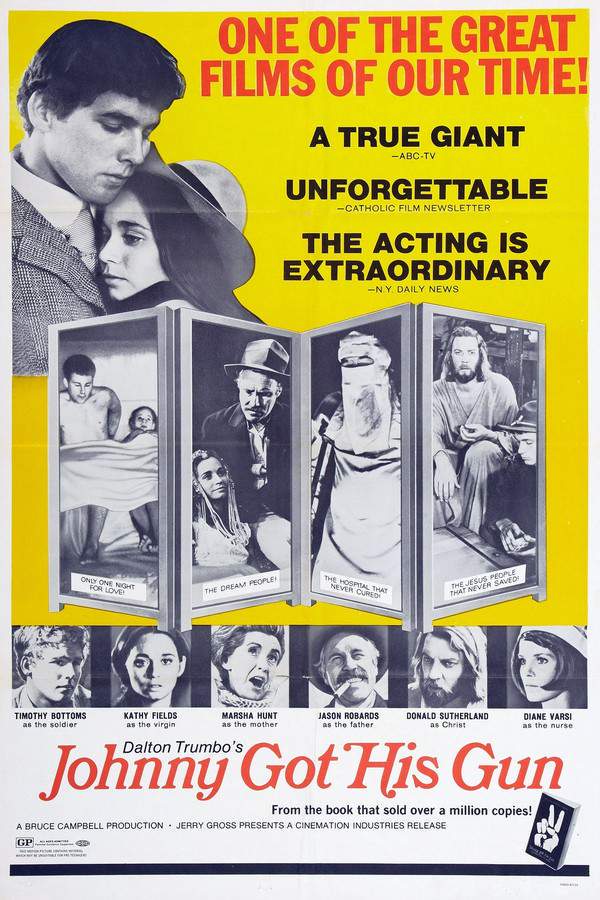
Johnny Got His Gun (2008) movie poster

Timeline

Johnny Got His Gun (2008) Timeline Explained – Every Event in Order

Release, runtime and language
2008 · 75 min · English
Loading streaming availability…
Directed by
Rowan Joseph

During wartime, a soldier named Joe Bonham suffers devastating injuries, leaving him a quadruple amputee with his mind intact. Isolated and unable to communicate, he exists within the confines of his own consciousness, desperately trying to connect with the outside world. Joe attempts to convey his thoughts and feelings, longing for an end to the conflict and a release from his suffering, ultimately using Morse code to reach out.

On this page (5)
  1. 1 Where to watch
  2. 2 Events in order (11)
  3. 3 Timeline questions answered
  4. 4 Movie threads
  5. 5 Every angle
Loading streaming availability…

11 events in order · contains spoilers

Johnny Got His Gun Timeline: Events in Chronological Order

Every key event of Johnny Got His Gun (2008) in order, scene by scene, with when and where it takes place. Use it to untangle flashbacks, time jumps and parallel storylines, to refresh your memory before the sequel or to find the exact scene you are thinking of.

  1. Joe Bonham's Injury

    Joe Bonham, a young American soldier, experiences a life-changing moment when he is struck by an artillery shell during World War I. This traumatic event leaves him severely injured, resulting in the loss of his eyes, ears, mouth, nose, and limbs.

  2. Awakening in the Hospital

    After the injury, Joe regains consciousness in a hospital bed. He finds himself trapped in his own body, unable to move or communicate, yet fully aware of his surroundings, making him feel like a prisoner in a living nightmare.

    Where
    Hospital
  3. Memories of the Past

    As Joe lies in his hospital bed, he drifts between reality and fantasy, reminiscing about his previous life. He reflects on his upbringing with his Christian Science family and cherishes memories with his girlfriend, Kareen.

  4. Connection with the Nurse

    In the midst of his suffering, Joe forms a subtle bond with a compassionate young nurse. Although the medical staff believes he is in a vegetative state, the nurse recognizes his distress and attempts to connect with him.

    Where
    Hospital
  5. Communicating in Morse Code

    Desperate to convey his consciousness, Joe starts banging his head against his pillow to communicate via Morse code. He spells out the word 'help,' which highlights his need for assistance and acknowledgment.

    Where
    Hospital
  6. Request for a Glass Coffin

    When Joe manages to get the attention of his doctors, he expresses a dark request for the Army to display him in a glass coffin as a freak show. This request serves as a haunting testament to the horrors of war that he has endured.

    Where
    Hospital
  7. Desperation for Euthanasia

    The response from the doctors to Joe's request is a firm denial, as it goes against military regulations. Overwhelmed by despair, Joe starts pleading for euthanasia, expressing his hopelessness in a world where he feels trapped.

    Where
    Hospital
  8. Nurse's Attempt to Help

    Moved by Joe's condition, the sympathetic nurse takes it upon herself to assist him by attempting to clamp his breathing tube for a quick end to his suffering. However, her attempt is halted by her supervisor, preventing Joe from escaping his misery.

    Where
    Hospital
  9. Realization of Living Death

    Joe comes to a heartbreaking realization that the U.S. Army will not fulfill either of his wishes. He understands that he is likely destined to live in a state of 'living death' for the remainder of his life, trapped in despair.

    Where
    Hospital
  10. Isolation in the Utility Room

    In the final stages of his ordeal, Joe finds himself isolated in a utility room at the hospital. This solitude reflects the ultimate abandonment he feels, as he is left alone to confront his tragic reality.

    Where
    Utility Room, Hospital
  11. Final Words of Despair

    Left to his thoughts, Joe begins weakly repeating the phrase 'S.O.S. Help me' to himself. This haunting repetition symbolizes his desperation and desire for escape from the unbearable pain of his existence.

Last updated: December 31, 2024 at 18:09

Was this helpful?

Timeline questions answered

Johnny Got His Gun Timeline Explained: Your Questions Answered

When does it happen, and why in that order? The questions people ask about the chronology of Johnny Got His Gun (2008): time jumps, flashbacks, cause and effect between scenes and the correct order of events, each answered with spoilers.

Q1

Why did Joe ask to be put on display in a glass coffin?

Joe's request to be displayed in a glass coffin was a desperate act of protest against the war. He wanted to become a living monument to the horrors of combat, allowing others to see what war truly does to young men. By becoming a 'freak show,' he believed he could force people to confront the reality of warfare and potentially prevent future casualties. This dark request reflected his belief that his suffering might have meaning if it could save others from the same fate.

  • glass coffin
  • war protest
  • joe bonham request
  • anti-war message
Q2

How was Joe able to communicate if he lost his mouth and nose?

Joe communicated by banging his head against his pillow in a rhythmic pattern that spelled out Morse code. He tapped out the word 'help,' which was the first message he successfully transmitted to the outside world. This method required tremendous effort from Joe, as he had to use the limited physical movement he had left in his head to create distinguishable sounds that the nurse could interpret.

  • morse code
  • communication
  • head banging
  • joe bonham
Q3

Why did the nurse try to clamp Joe's breathing tube?

The nurse attempted to end Joe's suffering by clamping his breathing tube because she recognized that he was fully conscious and in extreme agony, despite the medical staff believing he was in a vegetative state. Moved by compassion and unable to bear watching his constant torment, she chose to take direct action to release him from what she saw as an unbearable existence. However, her supervisor stopped her before she could complete the act, leaving Joe to continue living in his trapped state.

  • nurse
  • euthanasia
  • compassion
  • mercy killing
Q4

Why did the U.S. Army deny both of Joe's requests?

The Army denied Joe's requests because military regulations explicitly prohibited both actions. His request to be displayed as a living war monument would have required official Army authorization and contradicted their interest in maintaining public support for the war. Similarly, granting euthanasia to a soldier would have set a precedent and potentially violated military policy. The Army's rigid adherence to regulations trapped Joe in his suffering, leaving him with no legal avenue for either purpose or peace.

  • army regulations
  • denial
  • euthanasia
  • military policy
Q5

What did Joe mean by 'living death'?

Joe described his existence as a 'living death' because he was fully conscious but completely trapped in a non-functioning body with no way to interact with the world. He could think, feel, and remember, but he could not see, hear, speak, or move. This state represented the worst of both worlds, he was neither alive in any meaningful sense nor dead. The phrase captured his realization that he would be forced to exist in this nightmare indefinitely, with no hope of recovery or escape.

  • living death
  • trapped
  • consciousness
  • body
Q6

Why was Joe moved to the hospital's utility room?

Joe was moved to the utility room as the final act of abandonment by the military medical system. After his requests for a glass coffin and euthanasia were denied, the hospital had no further purpose for keeping him in a visible location. The utility room represented his complete isolation from society, a forgotten patient hidden away from view, left alone with only his thoughts and memories to sustain him in his eternal imprisonment.

  • utility room
  • abandonment
  • isolation
  • hospital
Q7

How did the nurse know Joe was conscious when doctors thought he was in a vegetative state?

The nurse perceived Joe's consciousness through careful observation and empathy. She noticed subtle signs that the other medical staff missed, perhaps in his eye movements, slight reactions, or an intuitive sense that his distress was too profound to be mindless. Her compassion allowed her to look beyond the standard medical assessment and recognize that the young soldier was fully aware of his horrifying condition, trapped inside a body that appeared lifeless to everyone else.

  • nurse
  • consciousness
  • vegetative state
  • perception
Q8

What was the significance of Joe's Christian Science background?

Joe's Christian Science upbringing added tragic irony to his situation. The religion traditionally rejects conventional medicine and believes prayer can heal physical ailments. Yet Joe's faith offered no protection from the devastating injuries he sustained, and he was left in a state that no prayer could fix. His memories of this upbringing and his girlfriend Kareen served as painful reminders of the life he lost, making his current state even more devastating.

  • christian science
  • memories
  • kareen
  • backstory
Q9

What did Joe's final words 'S.O.S. Help me' symbolize?

The repeated phrase 'S.O.S. Help me' represented Joe's final, desperate plea for escape from his unbearable existence. Using the international distress signal 'S.O.S.' combined with his simple request for help, Joe was reaching out one last time in whatever way he could. The weak, repetitive utterance in the darkness of the utility room symbolized his ongoing hope, however futile, that someone might hear him and respond, even as the world had abandoned him completely.

  • s o s
  • final words
  • desperation
  • plea
Q10

Why did Joe specifically ask for euthanasia as his only way out?

Joe pleaded for euthanasia because he saw it as the only dignified solution to his impossible situation. He could not see, hear, speak, or move, he could only think and feel. With no hope of recovery or meaningful existence, he wanted control over his own fate. Rather than spending decades trapped in his body, he wanted a compassionate end to his suffering. This request represented his final assertion of agency in a life where all other choices had been stripped away from him.

  • euthanasia
  • death wish
  • mercy
  • release

Movie threads

More Movies Like Johnny Got His Gun, by Mood & Story

Curated lists built around what makes Johnny Got His Gun tick: the same mood, the same kind of story or the same emotional payoff. Each list explains why these movies belong together.

Movies about existential isolation like Johnny Got His Gun

Characters trapped in psychological prisons, desperate to connect with an outside world. If you were captivated by the profound isolation in Johnny Got His Gun, you'll find similar experiences here. This list curates movies about characters trapped in extreme confinement, struggling to communicate and maintain their sanity, offering similarly intense and introspective viewing.

  • claustrophobic
  • isolated
  • desperate
  • agonizing
  • psychological
  • existential
  • Tone: bleak, agonizing, desperate
  • Pacing: slow, deliberate, introspective
Why these movies?

The story pattern: These narratives often follow a linear, focused descent into a single character's internal world. The plot is driven by their attempts to overcome a state of complete powerlessness, using memory, imagination, and sheer will as their only tools. The conflict is less external and more about the battle for selfhood in the face of annihilation.

Why they belong together: Movies in this thread are united by a core premise of extreme physical or mental confinement. They share a high-intensity, bleak tone and a slow, deliberate pacing that immerses the viewer in the protagonist's claustrophobic reality, exploring themes of communication, human spirit, and existential horror.


Movies about the human cost of war like Johnny Got His Gun

Stories that focus on the profound, lasting trauma inflicted by armed conflict. For viewers seeking more films like Johnny Got His Gun that explore war's devastating aftermath. These selections prioritize the physical and psychological trauma of soldiers and civilians, offering bleak, heavy dramas about the true price of conflict.

  • tragic
  • agonizing
  • melancholic
  • sobering
  • gritty
  • devastating
  • Tone: bleak, tragic, melancholic
  • Pacing: steady, deliberate, character-driven
Why these movies?

The story pattern: The narrative pattern often involves a character's life being irrevocably broken by war, focusing on their struggle to cope with severe injury, PTSD, or a fundamental loss of innocence. The journey is one of survival, but often devoid of triumph, emphasizing the enduring nature of the scars left behind.

Why they belong together: These films are grouped by their unflinching portrayal of war's consequences. They share a heavy emotional weight, a bleak or bittersweet tone, and a straightforward to moderate narrative complexity that keeps the focus squarely on the human suffering and ethical questions arising from conflict.

Every angle

Johnny Got His Gun (2008) Explained: Plot, Timeline & Characters

Everything about Johnny Got His Gun in one place: what happens in the plot summary, the timeline in chronological order, the characters and meaning and a spoiler-free summary. What's After the Movie adds the cast, box office and post-credit scenes.

Coming soon on iOS and Android

The Plot Explained Movie Summary App

Plot summaries, endings explained and timelines on your phone. Catch up on any movie in minutes, save your favorites and never miss a twist again.

Be the first to know when we launch. Your email stays private, always.

Learn more about the app