Plot Explained Spoilers guaranteed!
Plot Explained

Browse by genre

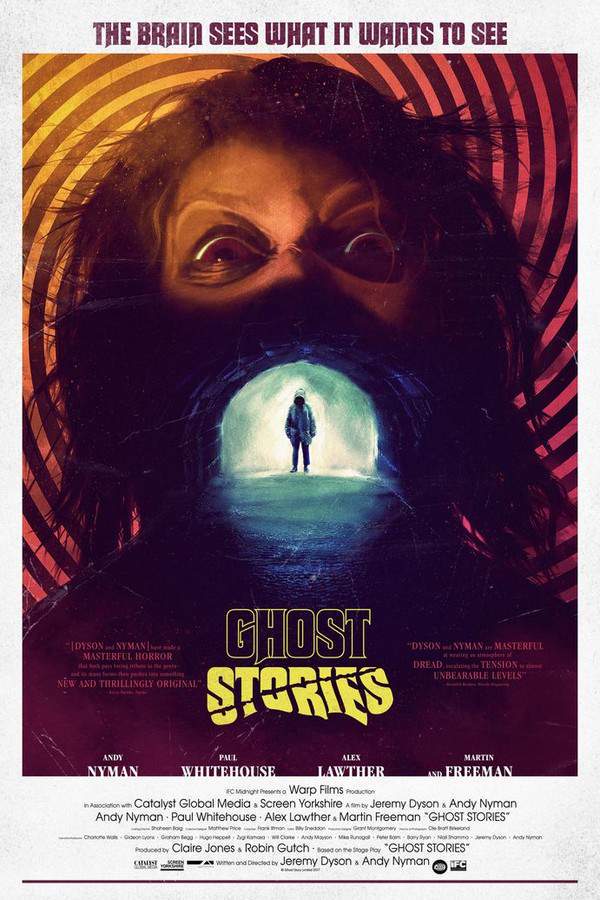
Ghost Stories (2018) movie poster

Timeline

Ghost Stories (2018) Timeline Explained – Every Event in Order

Release, runtime and language
2018 · 98 min · English
Echo score 55
Loading streaming availability…
Directed by
Jeremy Dyson
Starring
Martin Freeman, Andy Nyman, Alex Lawther, Nicholas Burns, Lesley Harcourt, Kobna Holdbrook-Smith

A skeptical professor of paranormal psychology investigates three separate cases that challenge his rational worldview. He examines a night watchman plagued by disturbing visions within a derelict asylum, a chilling incident involving a car accident, and a wealthy banker haunted by a dark secret from his past. As he delves deeper into each story, the lines between reality and horror become increasingly blurred, forcing him to confront the possibility that some experiences defy logical explanation.

On this page (6)
  1. 1 Where to watch
  2. 2 Events in order (13)
  3. 3 Timeline questions answered
  4. 4 Movie threads
  5. 5 Movies like Ghost Stories
  6. 6 Every angle
Loading streaming availability…

13 events in order · contains spoilers

Ghost Stories Timeline: Events in Chronological Order

Every key event of Ghost Stories (2018) in order, scene by scene, with when and where it takes place. Use it to untangle flashbacks, time jumps and parallel storylines, to refresh your memory before the sequel or to find the exact scene you are thinking of.

  1. Goodman receives an invitation to Cameron

    Professor Philip Goodman, renowned for debunking fraudulent psychics, receives an invitation to meet Charles Cameron, a famed paranormal investigator. The invitation promises a chance to revisit the supernatural through three real cases. He contemplates the possibility that his lifelong crusade may be tested by real-world investigation.

    When
    1979
    Where
    Goodman's office
  2. Goodman travels to Cameron's caravan to begin the assignment

    Goodman travels to Cameron's caravan and meets the aging investigator, who is now sick and impoverished and living in reduced circumstances. Cameron asks him to investigate three incidents that seem to be real supernatural events. The assignment draws Goodman into a world where belief and skepticism clash and blur.

    When
    late 1979
    Where
    Cameron's caravan
  3. Case 1: Tony Matthews in the disused asylum

    The first case follows Tony Matthews, a night watchman whose wife died of cancer and who regrets not visiting his daughter with locked-in syndrome. He is haunted by the spirit of a young girl while working in a disused asylum for women. Goodman believes the haunting will have a rational explanation rooted in the victim’s neuroses.

    When
    night
    Where
    Disused asylum for women
  4. Case 2: Simon Rifkind and the woods

    The second case centers on Simon Rifkind, a teenager obsessed with the occult with a troubled relationship with his parents. After his car breaks down, he runs over a creature in the woods and experiences unsettling phenomena. Goodman remains skeptical, thinking the victims likely imagined the hauntings due to their anxieties.

    When
    night
    Where
    Woods
  5. Case 3: Mike Priddle in the City and the poltergeist

    The third case concerns Mike Priddle, a financier in the City waiting for the birth of his child, tormented by a poltergeist. His wife appears dying as she gives birth to what is implied to be an inhuman child. The case escalates as the boundaries between reality and illusion begin to fracture.

    When
    during pregnancy/childbirth
    Where
    City (financial district)
  6. Priddle's suicide and the unraveling reality

    Driven by the escalating hauntings, Priddle shoots himself with a shotgun, ending the poltergeist’s influence and triggering a collapse of the apparent hauntings. Goodman starts to question whether what he witnesses is truly supernatural or a manipulation of reality. The line between the cases and the investigator’s life begins to fade.

    When
    immediately before death
    Where
    City
  7. Cameron is revealed to be Priddle

    Back at Cameron, the investigator tears off a latex mask to reveal himself as Priddle, the very man behind the earlier cases. Goodman is stunned as his supposed guide is actually a participant in the deception tied to his life. The revelation shifts the investigation from external hauntings to a manipulation tied to Goodman’s own past.

    When
    after the suicide
    Where
    Cameron's caravan
  8. A childhood memory surfaces: the drain incident

    Priddle, in his masked guise, leads Goodman back to a childhood memory where he witnessed two bullies lure a mentally disabled boy into a drain, where the boy dies of an asthma attack. Goodman has carried guilt for not rescuing the victim, a guilt that now threatens to consume him.

    When
    Goodman's childhood
    Where
    Childhood street/drain
  9. The memory becomes a nightmare in the hospital

    The decaying corpse of the bullied boy materializes, tormenting Goodman and guiding him toward a hospital bed where a ghoul lies atop him and forces his finger into his mouth, crying 'No, not again!' The sequence blurs the line between memory and a recurring nightmare.

    When
    memory
    Where
    Memory leading to hospital
  10. The real world: Goodman is in a hospital

    In the present reality, Goodman lies in a hospital bed with tubes in his mouth, having suffered a suicide attempt and entered a state of locked-in syndrome. The doctors and staff believe he is in a persistent vegetative state and show little belief in his awareness.

    When
    present
    Where
    Hospital room
  11. Medical misinterpretation and cold prognosis

    The junior doctor tells the senior colleague that Goodman is 'here for keeps,' presenting a bleak prognosis of recovery. The senior doctor adds a chilling remark about hoping his dreams are sweet, underscoring the gap between outward signs and inner consciousness.

    When
    present
    Where
    Hospital ward
  12. The cleaner offers a different view

    A hospital cleaner chats with Goodman and moves a mirror, offering him a different perspective on his surroundings and hinting that reality may extend beyond his restricted view. The simple act challenges the doctors’ assumptions about his state.

    When
    present
    Where
    Hospital room
  13. The twist: the experiences stem from the hospital

    It is revealed that all the cases and Cameron’s theatrics were inspired by the hospital staff, objects, and setting rather than genuine hauntings. The entire investigation collapses into the realization that Goodman’s experiences occurred within the hospital, shaping his fate and beliefs.

    When
    present
    Where
    Hospital room

Last updated: January 08, 2026 at 12:00

Was this helpful?

Timeline questions answered

Ghost Stories Timeline Explained: Your Questions Answered

When does it happen, and why in that order? The questions people ask about the chronology of Ghost Stories (2018): time jumps, flashbacks, cause and effect between scenes and the correct order of events, each answered with spoilers.

Q1

Why does Charles Cameron reveal himself as Mike Priddle?

Cameron tears off his latex mask to reveal he is actually Mike Priddle, the financier from the third case who committed suicide. The revelation shifts the entire investigation from external paranormal cases to a personal manipulation tied directly to Goodman's own past and guilt.

Foreshadowing: The third case ended with Priddle's suicide, which Goodman witnessed during his investigation.

  • charles cameron
  • mike priddle
  • reveal
  • twist
  • identity
Q2

What is the significance of the childhood drain incident?

As a child, Goodman witnessed two bullies lure a mentally disabled boy into a drain. The boy died from an asthma attack while Goodman did nothing to help. This traumatic memory has haunted him his entire life, creating deep guilt that manifests as the spectral tormentor in his hospital-induced hallucinations.

Foreshadowing: Goodman's profession of debunking psychics is revealed to be a coping mechanism for this childhood trauma.

  • drain
  • boy
  • childhood
  • trauma
  • guilt
  • bullies
  • asthma
Q3

Why did Mike Priddle commit suicide?

Priddle was tormented by a poltergeist while his wife died during childbirth, with暗示 the baby was inhuman. Driven to despair by the escalating supernatural horrors and the implied nature of his child, he shot himself with a shotgun to end the torment.

Foreshadowing: The poltergeist appeared to target Priddle specifically, and his wife warned about the baby before dying.

  • mike priddle
  • suicide
  • poltergeist
  • baby
  • death
Q4

What is locked-in syndrome and why is Goodman in the hospital?

Goodman lies in a hospital bed with tubes in his mouth after attempting suicide. He has locked-in syndrome, a condition where a person is fully conscious but cannot move or communicate. The doctors mistakenly believe he is in a persistent vegetative state with no hope of recovery.

Foreshadowing: The film's title 'Ghost Stories' takes on new meaning as the entire narrative is revealed to be his mental projection.

  • locked-in syndrome
  • hospital
  • suicide attempt
  • vegetative state
Q5

What does the ghoul forcing a finger into Goodman's mouth mean?

In the nightmare sequence, a ghoul forces its finger into Goodman's mouth while he cries 'No, not again!' This represents the traumatic repetition of guilt from his childhood, the moment he froze while the boy died in the drain. The finger symbolizes his inability to act or speak to help, a fear that replays endlessly in his subconscious.

Foreshadowing: This scene directly connects to the childhood memory of witnessing the boy being led into the drain.

  • ghoul
  • finger
  • mouth
  • nightmare
  • no not again
  • trauma
  • guilt
Q6

Why was Goodman's sister disowned by their father?

In 1979, Goodman's father, a stern and traditional man, drove his sister from the family after she began dating an Asian man. This family rejection and heartbreak is what drove Goodman to dedicate his career to exposing fraudulent psychics, he believed doing so could protect others from similar suffering.

Foreshadowing: This family trauma establishes Goodman's personal motivation for his career as a skeptic.

  • sister
  • father
  • family
  • disowned
  • asian man
  • relationship
Q7

How are the three paranormal cases connected to Philip Goodman?

All three cases, the night watchman, the teenager, and the financier, exist only in Goodman's mind while he lies in the hospital with locked-in syndrome. They were inspired by hospital staff, objects, and his own guilt-ridden subconscious. The cases are projections of his psychological state rather than real external investigations.

Foreshadowing: Each case involves guilt, family dysfunction, and unresolved trauma that mirrors Goodman's own experiences.

  • three cases
  • connection
  • projection
  • mind
  • hospital
  • staff
Q8

What happened to the boy in the drain?

When Goodman was a child, he witnessed two bullies lure a mentally disabled boy into a drain. Rather than intervening, Goodman froze and did nothing as the boy suffered an asthma attack and died. This guilt has haunted Goodman for decades, manifesting as the spectral figure that torments him in the film's climax.

Foreshadowing: The bullies' victim returns as a spectral figure in Goodman's hospital hallucinations.

  • boy
  • drain
  • death
  • asthma
  • bullies
  • witness
  • childhood
Q9

What is the meaning of the mirror scene at the end of the film?

A hospital cleaner moves a mirror to give Goodman a different view of his room. This simple act offers a glimmer of possible awareness within his trapped state. It suggests that despite the doctors' grim prognosis, there may be more to his consciousness than they realize, potentially hinting at hope or further psychological struggle.

Foreshadowing: The mirror provides the first visual indication that Goodman may still be aware despite his condition.

  • mirror
  • hospital
  • cleaner
  • view
  • awareness
  • consciousness
Q10

Why did Philip Goodman attempt suicide?

The film implies Goodman attempted suicide as a result of being consumed by guilt over his childhood trauma, the boy he failed to save in the drain. This unresolved trauma, combined with his isolation and the weight of his career built on confronting supernatural phenomena, led him to end his own life, resulting in his current hospitalized state.

Foreshadowing: The entire narrative structure suggests Goodman created elaborate ghost stories to process his own guilt before his suicide attempt.

  • suicide
  • attempt
  • reason
  • guilt
  • trauma
  • childhood

Movie threads

More Movies Like Ghost Stories, by Mood & Story

Curated lists built around what makes Ghost Stories tick: the same mood, the same kind of story or the same emotional payoff. Each list explains why these movies belong together.

Psychological Horror Movies Where Trauma Distorts Reality Like Ghost Stories

Psychological thrillers where reality is unreliable and trauma creates the monster. For viewers who appreciated the mind-bending horror of Ghost Stories, this section features movies with unreliable narrators, psychological breakdowns, and stories where trauma is the source of terror. If you liked the way Ghost Stories questioned what was real, you'll find similar unsettling experiences here.

  • unreliable narrator
  • psychological
  • disorienting
  • dreamlike
  • existential dread
  • guilt
  • Tone: dark, psychological, bleak
  • Pacing: variable, building to chaos
Why these movies?

The story pattern: These narratives typically follow a protagonist investigating a mystery or confronting a threat, only for the story to gradually reveal that the events are manifestations of their own repressed guilt, trauma, or mental illness. The plot structure often features twists that reframe the entire story as an internal struggle.

Why they belong together: Movies in this thread are united by their focus on internal horror over external threats. They share a dark, bleak tone, high psychological intensity, and a complex narrative structure that gradually subverts the audience's perception of reality, leading to a disturbing and emotionally heavy conclusion.
Anthology Horror Films with Interlocking Stories Like Ghost Stories

Anthology-style films where separate stories interconnect into a shocking whole. If you were captivated by the nested storytelling of Ghost Stories, this collection is for you. These movies present multiple horror tales that are cleverly linked by a central narrative, creating a complex and rewarding puzzle for viewers who enjoy intricate plot structures and shocking final revelations.

  • anthology
  • interlocking stories
  • mind-bending
  • puzzle
  • twist ending
  • unsettling
  • Tone: dark, unsettling, mind-bending
  • Pacing: variable, investigative build
Why these movies?

The story pattern: The narrative pattern involves a protagonist (often an investigator or skeptic) being introduced to a series of unexplained cases. As they explore each story, clues are subtly embedded that seem unrelated at first. The climax recontextualizes all the separate tales, showing they are fragments of a single, traumatic event or psychological state.

Why they belong together: These films are grouped by their unique storytelling mechanics. They share a variable pacing that accelerates towards the end, a high degree of narrative complexity, and a dark tone that culminates in a bleak, mind-bending twist connecting all the threads.

If you liked this

Movies Like Ghost Stories

Similar movies to Ghost Stories: the same genre, themes or kind of story. Each one comes with its own plot summary, timeline and ending explained.

Browse all movie summaries

Every angle

Ghost Stories (2018) Explained: Plot, Ending, Timeline & Characters

Everything about Ghost Stories in one place: what happens in the plot summary, the timeline in chronological order, the characters and meaning, the ending explained and a spoiler-free summary. What's After the Movie adds the cast, box office and post-credit scenes.

Coming soon on iOS and Android

The Plot Explained Movie Summary App

Plot summaries, endings explained and timelines on your phone. Catch up on any movie in minutes, save your favorites and never miss a twist again.

Be the first to know when we launch. Your email stays private, always.

Learn more about the app