
Plot Summary
Ghost Stories (2020) Plot Summary & Ending Explained
- Directed by
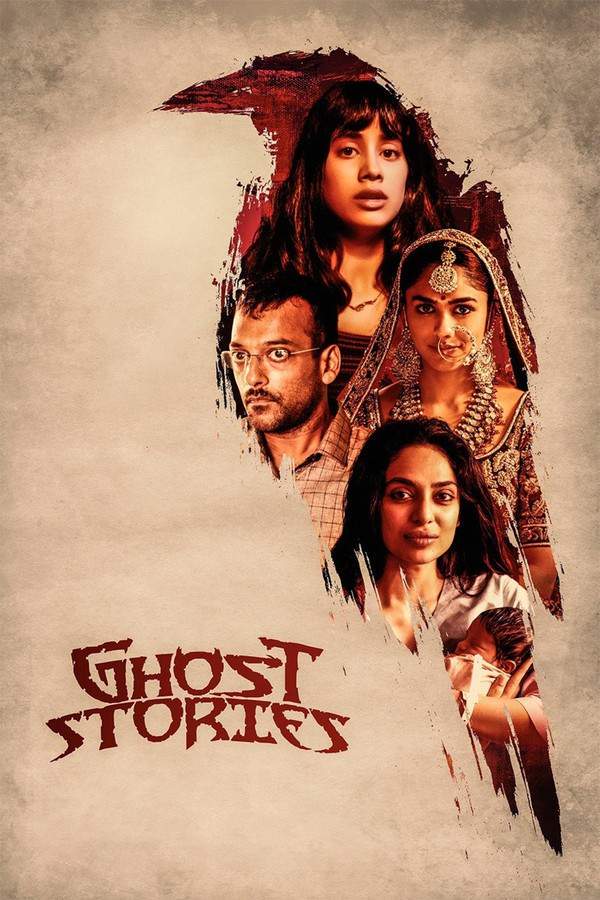
- Anurag Kashyap, Zoya Akhtar
- Starring
- Avinash Tiwary, Janhvi Kapoor, Mrunal Thakur, Pavail Gulati, Sobhita Dhulipala, Sukant Goel
Your fears will find you. An anthology of four short horror tales.
On this page (5)
Full plot summary · contains spoilers
What Happens in Ghost Stories: Full Plot Summary
The whole story of Ghost Stories (2020) explained, from the opening scene to the final frame: every key event, every twist and what it all adds up to. Read it as a quick recap before the sequel, to check a scene you missed, or to finally understand what really happened.
Sameera, a young nurse, arrives to take care of an ailing bedridden elderly lady, Mrs. Malik in a desolate house. The former is needy, clutching at a reluctant lover Guddu; the latter, a stunner in her time. The lady's son is supposed to be taking care of the old mother for the duration between the change of nurses, but he is not around. Mrs. Malik tells Sameera that her son is sleeping in the next room, but no one is there. Later, it is revealed that her son left her alone for five days and she died of starvation three days earlier. The camera moves away from a shocked Sameera.
The story revolves around a pregnant woman named Neha who babysits her late sister's child, Ansh. The obsessive affection of the boy and paranoia of a childless young woman assume terrifying proportions. Neha's mental illness begins to blur the line between delusion and reality.
A man arrives in a small town known as, Bees-ghara, to find it empty, except for a young boy and a girl. He is told that everyone has been eaten by the girl's father who is the councilman of Sau-ghara, the big town. At first, the man refuses to believe them, but when he tries to go out, he encounters a zombie woman who attacks him. The boy rescues him, and back in the safe house, he decides to save the children and alert the local authorities. When he gets out and enters a school, he sees the blind principal behaving strangely. The principal suddenly runs away. The children explain that some people, in order to save themselves from getting eaten, started eating others too as the creatures do not eat those who also eat human flesh. As the man watches, the school principal screams and convulses on the ground. The girl's father, who resembles a hairy humanoid creature enters the school room. The creature's poor vision makes it unable to detect the presence of the man and the children until the girl, overcome by love for her father, goes near him only to be killed and eaten by him. The other two, stunned, do not move for a day, and the monster leaves. The boy has an idea that they take the blood from the girl's remains and cover their faces with it so that the zombies will believe that they too are flesh-eaters and let them go. The entire town center is under surveillance by the girl's father and upon seeing the pair, he checks them personally. He grows suspicious of the boy, who in reaction, eats some of the flesh of the girl. The monster turns to the man, who remains still so as to be unseen, but gets scared and starts running, resulting in him being chased by the eaters. On his way, he falls into a pit trap. He is thrown the girl's hand so that he can demonstrate he is one of them. The man refuses to do so and screams as the girl's father pounces on him, only to wake up from what is supposedly a dream. The man is then confused as he wakes up in the same trap he fell into and runs towards Bees-ghara. Finding the place deserted and burning, he assumes the worst and cries that he failed to save the children. At the same time a car comes, full of people who bear a striking resemblance to the eaters. The man is then taken in a jeep by them, and they tell him that they are people of Sau-ghara and that nobody lives in Bees-ghara after they burned it down because it was a very inferior place.
Ira agrees to have an arranged marriage with the handsome and wealthy Dhruv who dwells in a house his grandmother built. On their wedding night, she sees her husband seemingly talking to the grandmother who died 20 years ago. Each night after that, the grandmother comes to bid good night to Dhruv, who seems to be the only one who can see her.
In spite of being an adult, he enjoys playing peek-a-boo with the dead grandmother. Ira questions the maid Shanti (Heeba Shah) and learns that Dhruv was once playing peek-a-boo with his grandmother and accidentally pushed her down the stairs. The grandmother was severely incapacitated and in terrible pain. Despite this, she would make it a point to visit Dhruv each night to wish him a good night. The conversation ends before Ira learns the circumstances of the grandmother's passing. One night, Ira gets tired of Dhruv's attachment to his dead grandmother and storms into her room, still preserved as a shrine to her and screams at the grandmother to leave them alone. The next day, at breakfast, Shanti helps Ira stir her oatmeal. Midway through breakfast, Ira starts having severe stomach cramps and is helped to her bed by Shanti. As Ira lies writhing in pain, Shanti completes their earlier conversation, telling Ira that the grandmother had begged Shanti to put an end to her pain. Being the obedient maid that she is, she mixed highly poisonous castor seeds into her breakfast; thereby, poisoning her to death. The viewer is led to understand that Shanti did the same for Ira. Ira wakes up in a brightly lit room and sees the grandmother hovering over her. Confused, Ira asks how it is that she can now see her. She lets Ira know that this is because Ira is now in her world, implying that Ira is dead. Ira then turns her head to see other human forms while the grandmother tells her that those are the others who, like Ira, did not believe in her presence.
Last updated: October 03, 2026 at 14:43
Plot questions answered
Ghost Stories Plot Explained: Your Questions Answered
The questions people ask most about Ghost Stories (2020): what happens in the confusing scenes, why the characters do what they do, the twists, hidden details and what the ending means. Each answer contains spoilers.
Q1 Why did Mrs. Malik tell Sameera her son was sleeping in the next room?
Mrs. Malik had already been dead for three days from starvation when Sameera arrived, so the statement was not a lie spoken by a living person but a chilling echo of her final delusion. Her son had abandoned her five days earlier, leaving her entirely alone, and her mind clung to the comfort of believing he was still nearby. In Ghost Stories, this line is the first hint that something is deeply wrong before the camera reveals the horrifying truth.
Foreshadowing: Sameera notices the house feels empty and that no nurse handover is actually taking place, which signals the situation is abnormal long before the reveal.
- mrs malik
- sameera
- ghost stories
- son sleeping
- starvation reveal
Q2 How did Mrs. Malik actually die in Ghost Stories?
Mrs. Malik died of starvation after her son abandoned her for five straight days with no nurse, no food, and no supervision during the handover period. She passed away three days before Sameera arrived, which means the woman lying in the bed was already a corpse. The horror of this segment comes from the slow, invisible nature of her death, as she was left to perish alone in a deserted house.
Foreshadowing: The son is mentioned as the one responsible for her care but is conspicuously absent from the very first scene, hinting at his negligence.
- mrs malik death
- starvation
- son abandoned
- ghost stories first story
Q3 What triggered Neha's mental breakdown while caring for Ansh?
Neha's psychological unraveling stems from a combination of pregnancy, childlessness, and the sudden responsibility of caring for her late sister's son, Ansh. Her obsessive attachment to the boy and her paranoia as a woman who cannot have her own child blur the line between protective love and dangerous possession. Ghost Stories uses this segment to show how grief, hormones, and mental illness can quietly curdle affection into something terrifying.
- neha
- ansh
- mental illness
- paranoia
- ghost stories second story
Q4 Why don't the flesh-eating creatures in Bees-ghara eat other flesh-eaters?
The cannibalistic humanoid creatures follow a survival rule: they only consume those who have not yet eaten human flesh themselves. Anyone who joins in the feeding is recognized as part of the predator group and is spared. This twisted logic is what allows the people of Sau-ghara to infiltrate and eventually destroy Bees-ghara, and it is also the rule the boy tries to exploit when he suggests smearing the dead girl's blood on their faces as a disguise.
Foreshadowing: The children explain this rule only after the school principal is attacked, meaning viewers learn the creature's behavior through escalating violence.
- bees-ghara
- flesh-eaters
- cannibalism rule
- zombies
- ghost stories
Q5 Why did the girl approach her monstrous father in the school?
Despite knowing her father had become a cannibal who had already eaten most of the town, the girl was overcome by love and longing for the parent she remembered before his transformation. She believed, or desperately hoped, that he would recognize her and spare her. Her impulse is the most human moment in the segment, and it is exactly what makes the horror hit harder, because Ghost Stories frames her death as a tragedy born from affection rather than stupidity.
Foreshadowing: The children mention the girl's father is the councilman of Sau-ghara, hinting at a deep emotional bond that will later override her survival instinct.
- girl
- father
- school
- bees-ghara
- love
- death
Q6 What actually happens at the end of the Bees-ghara segment?
The man wakes from what he believes is a nightmare, only to find himself still trapped in the same pit, meaning the entire ordeal may have been real or that he never escaped. When he stumbles back toward Bees-ghara, the town is deserted and burning, and a jeep arrives carrying people who look exactly like the eaters. They take him away, revealing that Sau-ghara burned Bees-ghara because it was considered an inferior place, and the man has been captured by the very creatures he tried to stop.
Foreshadowing: The creatures' poor vision, which earlier protected the man and the children, is subverted in the final chase when his panic betrays him.
- bees-ghara ending
- dream or real
- sau-ghara
- ghost stories explained
Q7 Why did the people of Sau-ghara burn down Bees-ghara?
The people of Sau-ghara decided to destroy Bees-ghara because they viewed it as an inferior, expendable settlement and saw no value in saving it from the cannibal outbreak. They disguised themselves as the eaters to infiltrate the town, then systematically killed and displaced its residents before burning what remained. This cold, calculated genocide reframes the entire segment, revealing that the man was not fighting monsters at all but stumbling into a deliberate extermination campaign.
Foreshadowing: The man notices the people in the arriving car bear a striking resemblance to the eaters, a visual cue that the two groups are not as distinct as they seem.
- sau-ghara
- bees-ghara
- burn town
- genocide
- ghost stories
Q8 Why did the man fail to save the children from Bees-ghara?
The man's failure is caused by a single moment of panic: after the girl's father, the monstrous councilman, turns his attention toward him, he breaks from stillness and runs. This running triggers a chase that ends with him falling into a pit trap, and although he is thrown the dead girl's hand to prove he is one of the flesh-eaters, he refuses to eat it. His refusal to embrace the town's cannibal logic seals his fate, and he wakes to find Bees-ghara already destroyed.
Foreshadowing: The boy warns him earlier that movement attracts the creatures, but the man still panics when confronted directly.
- man fails
- bees-ghara
- chase
- pit trap
- refused to eat
Q9 Why can only Dhruv see his dead grandmother in Ghost Stories?
Dhruv is the only one who can see the grandmother because he is the one who caused her death, and her nightly visits are tied to her unresolved attachment to him. As a child, he accidentally pushed her down the stairs while playing peek-a-boo, leaving her in severe pain, and she chose to keep visiting him every night despite her suffering. Her presence is essentially a haunting born of guilt, love, and her unfinished bond with the grandson who ended her life.
Foreshadowing: The fact that Dhruv still plays peek-a-boo with an invisible presence as an adult hints early on that he has a unique, ongoing relationship with something others cannot perceive.
- dhruv
- grandmother
- ghost
- peek-a-boo
- only one who sees
Q10 Why did Shanti poison Dhruv's grandmother?
Shanti poisoned the grandmother because the dying woman begged her to end the unbearable pain she had lived in since Dhruv's childhood accident pushed her down the stairs. As a deeply loyal and obedient maid, Shanti fulfilled that request by grinding highly poisonous castor seeds into the grandmother's breakfast. The horror in Ghost Stories comes from the reveal that this act of mercy was twisted into a precedent Shanti later applied to Ira for the same reason.
Foreshadowing: Shanti's quiet, attentive presence at every meal foreshadows her role as the one controlling what enters the household's food.
- shanti
- grandmother
- poison
- castor seeds
- mercy killing
Q11 How does Ira end up dead in Ghost Stories?
Ira dies because Shanti poisons her oatmeal with the same toxic castor seeds she once used on the grandmother, after Ira storms into the grandmother's shrine and demands the ghost leave her husband alone. Ira's stomach cramps begin midway through breakfast, and as she lies writhing in pain, Shanti calmly completes the story of the grandmother's death, confirming that Ira has been given the same fatal meal. Ira then wakes up in a brightly lit afterlife space, realizing she is no longer alive.
Foreshadowing: Shanti offers to stir Ira's oatmeal for her, mirroring the earlier arrangement with the grandmother and signaling that history is about to repeat.
- ira death
- shanti poison
- oatmeal
- castor seeds
- ghost stories
Q12 What is the grandmother's world that Ira enters at the end?
The grandmother's world is the afterlife realm where Ira finds herself after being poisoned, a bright, sterile space populated by other human forms who, like her, refused to believe the grandmother's ghost was real. The grandmother explains that Ira can now see her only because Ira has crossed into this realm herself. In Ghost Stories, this space functions as a final punishment for the skeptical, confirming that denying the supernatural carried real, fatal consequences.
Foreshadowing: The grandmother's shrine being kept perfectly preserved hints that her presence and her domain extend far beyond a single haunted house.
- grandmother world
- afterlife
- ira
- non-believers
- ghost stories ending
Q13 Was the man's experience in Bees-ghara real or a dream?
Ghost Stories deliberately blurs the line between dream and reality, but the ending strongly suggests the experience was real. The man wakes believing it was all a nightmare, only to find himself still in the same pit trap he fell into during the chase, which would be impossible if he had actually escaped. When he reaches Bees-ghara and sees it burning, and is then taken away by Sau-ghara's people, it becomes clear that the horror he tried to wake from was the world he actually lived in.
Foreshadowing: The boy's survival plan involving blood and cannibalism is too specific and violent to feel like invention, grounding the events in the story's reality.
- dream or real
- bees-ghara
- pit trap
- reality
- ghost stories explained
Ending explained
What Happens at the End of Ghost Stories?
How Ghost Stories (2020) ends, in short: the final scene, the last twist and what it means for the characters. The full ending explained, with every spoiler, lives on its own page.
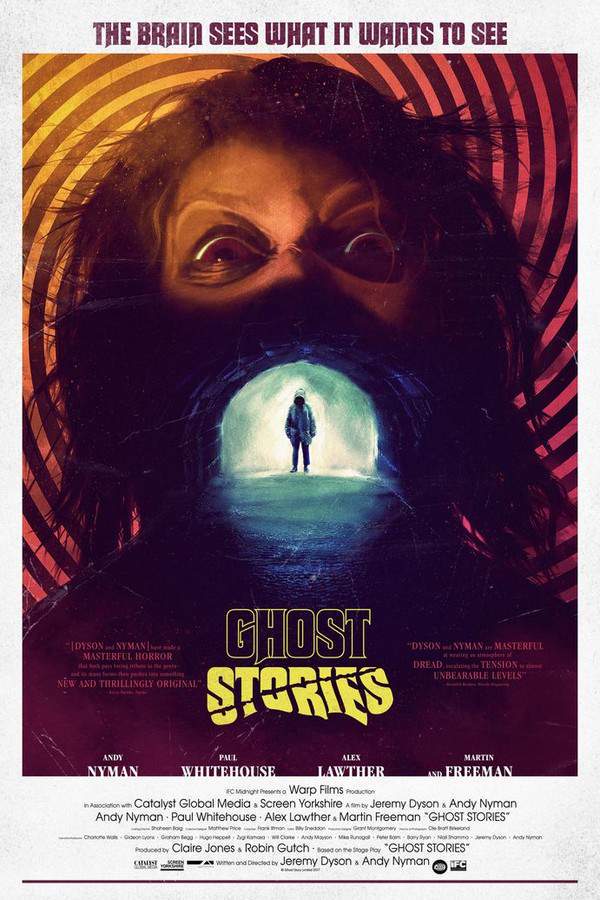
The ending of Ghost Stories delivers a harrowing twist that fundamentally recontextualizes the entire film, shifting the genre from paranormal investigation to a psychological study of guilt. After investigating three terrifying cases, Phillip Goodman confronts his idol, Charles Cameron, only to watch reality crumble around him. In a surreal transition, Cameron’s face morphs into that of Mike Priddle, one of the subjects Goodman interviewed, before the investigator is dragged back into the memory of a traumatic childhood incident. We learn that as a young man, Goodman stood by while bullies tormented a classmate named Desi Callahan, trapping him in a tunnel where he ultimately died of an asthma attack. Goodman never helped, never sought assistance, and never told anyone about the tragedy.
This repressed memory is the key to the film’s conclusion. The shocking reveal pulls back the curtain on Goodman's true reality: he is not a paranormal investigator at all, but a patient in a hospital bed, existing in a coma after a suicide attempt. The "ghosts" he encountered were merely the people in his immediate vicinity, woven into a narrative of supernatural horror by his subconscious. Tony Matthews, the first subject, is actually a hospital janitor; Simon Rifkind is a junior doctor; and Mike Priddle is the senior doctor overseeing his care. Even the disturbing image of Callahan’s corpse forcing a tube into Goodman's mouth is revealed to be a medical intervention—Callahan's finger is actually a breathing tube, and the "dead" boy is trying to save him, not hurt him.
Continue reading the ending (2 more paragraphs)
Throughout the film, Goodman prides himself on his skepticism, repeating the mantra that "the brain sees what it wants to see." Ironically, he fails to realize that his own brain is constructing a safe narrative to shield him from his darkest secret. The three cases he investigates are manifestations of his specific guilts: Tony's regret over his relationship with his father mirrors Goodman's inability to connect with his own heritage, Simon's secret about his driving license reflects Goodman's hidden shame, and Mike's tragic family life highlights Goodman's own lonely existence. The clues were present all along, from the numbers of the tunnel appearing on the walls to the dripping sounds of hospital machinery disguised as environmental noise.
Ultimately, the film serves as a somber commentary on toxic masculinity and the dangerous inability of men to articulate their feelings. Each character Goodman encounters struggles to communicate, using aggression, awkwardness, or humor to mask their pain, reflecting Goodman's own emotional suffocation. The film suggests that his suicide attempt was the result of a lifetime of suppressing the truth about Callahan's death. By confronting his past, Goodman is forced to face the physical and psychological toll of his silence, leaving him trapped in a state of limbo, forever haunted by the one ghost he could never debunk: himself.
If you liked this
Movies Like Ghost Stories
Similar movies to Ghost Stories: the same genre, themes or kind of story. Each one comes with its own plot summary, timeline and ending explained.


Every angle
Ghost Stories (2020) Explained: Plot, Ending, Timeline & Characters
Everything about Ghost Stories in one place: what happens in the plot summary, the timeline in chronological order, the characters and meaning, the ending explained and a spoiler-free summary. What's After the Movie adds the cast, box office and post-credit scenes.
- Ghost Stories Timeline Every key event in chronological order, ideal for flashbacks and time jumps.
- Ghost Stories Characters & Themes Who is who, where it takes place and what the movie really means.
- Ghost Stories Ending Explained What happens at the end, the final scene and what it means.
- Ghost Stories Spoiler-Free Summary What it is about and whether it is worth watching, without spoilers.
- Ghost Stories on What's After the Movie Cast and crew, box office, post-credit scenes and more.
Coming soon on iOS and Android
The Plot Explained Movie Summary App
Plot summaries, endings explained and timelines on your phone. Catch up on any movie in minutes, save your favorites and never miss a twist again.
Be the first to know when we launch. Your email stays private, always.
Learn more about the app