Plot Explained Spoilers guaranteed!
Plot Explained

Browse by genre

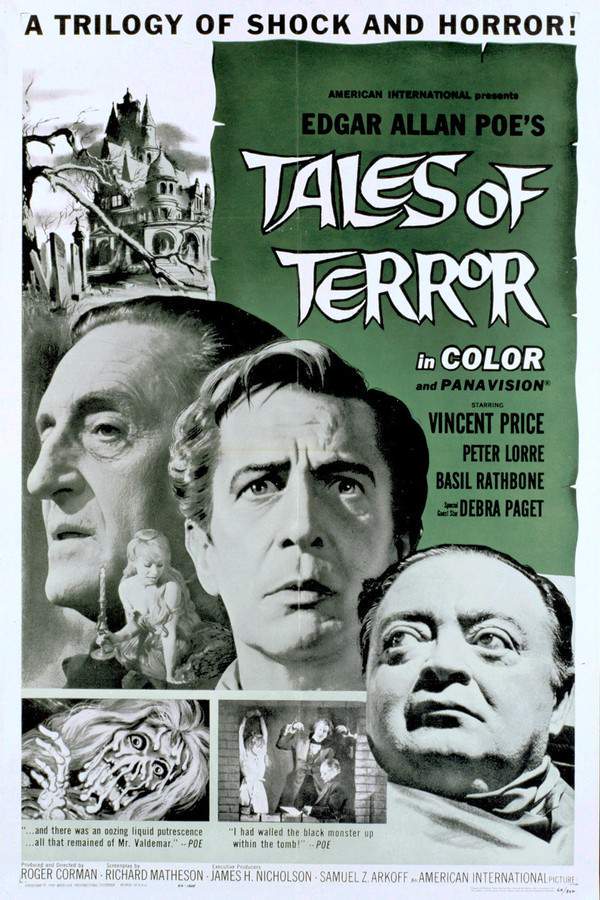
Tales of Terror (1962) movie poster

Plot Summary

Tales of Terror (1962) Plot Summary Explained

Release, runtime and language
1962 · 89 min · English
Loading streaming availability…
Starring
Vincent Price, Peter Lorre, Basil Rathbone, David Frankham, Debra Paget, Joyce Jameson

This macabre anthology features Vincent Price in three chilling tales exploring themes of revenge, obsession, and mortality. The stories include a grieving father consumed by malevolent wrath, a man's deadly fixation on a rival, and a dying man's desperate attempt to defy fate. Each dark vignette is filled with suspense and weaves together to create a twisted and unsettling atmosphere.

On this page (7)
  1. 1 Where to watch
  2. 2 What happens: full plot
  3. 3 Plot questions answered
  4. 4 The book behind the movie
  5. 5 Movie threads
  6. 6 Movies like Tales of Terror
  7. 7 Every angle
Loading streaming availability…

Full plot summary · contains spoilers

What Happens in Tales of Terror: Full Plot Summary

The whole story of Tales of Terror (1962) explained, from the opening scene to the final frame: every key event, every twist and what it all adds up to. Read it as a quick recap before the sequel, to check a scene you missed, or to finally understand what really happened.

In this unnerving adaptation of Edgar Allan Poe's classic stories, Vincent Price guides us through three chilling segments that delve into the darker corners of the human psyche. The initial tale centers around Lenora Locke, who makes a harrowing return to her father's dilapidated mansion, only to find him engulfed in sorrow and loss. His silence speaks volumes, hinting at a profound guilt he harbors, believing that Lenora is to blame for her mother's tragic demise, Morella.

As Lenora embarks on an unsettling journey to uncover the painful mysteries of her family's past, she is confronted by the horrifying sight of her mother's decaying body, forever arrested in a grotesque tableau. This revelation triggers a series of dreadful events that culminate in a spine-chilling encounter with the vengeful spirit of Morella. In a fantastical twist, Lenora's existence is extinguished while Morella's corpse is resurrected, reclaiming its former beauty. The horrific exchange of their bodies leaves Lenora’s father to confront his nightmarish fate amidst a consuming blaze.

The second tale spins around Montresor Herringbone, who is consumed by a profound loathing for his wife, Annabelle, and her mysterious black cat. His resentment grows fitfully as he grapples with his own feelings of inadequacy, turning increasingly to wine to dull the misery of his life. The arrival of Fortunato Luchresi serves as the catalyst for his downfall, leading Herringbone to entomb both his wife and her feline in an act of brutal desperation.

Within this self-imposed prison, Herringbone faces relentless torment from the apparition of the black cat alongside the shadow of his own guilt. As this segment concludes, the chilling sentiment from Poe resonates through the air: >"I had walled the black monster up within the tomb!" evoking a sense of suffocating dread that envelops the viewer.

In the final narrative, M. Ernest Valdemar battles against a debilitating illness, seeking the eccentric help of Mr. Carmichael, a hypnotist known for his mental manipulations. As Valdemar succumbs to a series of trance states, he becomes ensnared in a perilous limbo between life and death, his cries for release falling on deaf ears as Carmichael callously withholds the relief he yearns for.

As weeks of torment drag on, Valdemar's body begins to decay, yet Carmichael remains firmly in command, eagerly pursuing the affections of Valdemar's devoted wife, Helene. Despite his malevolent strategies, Helene fiercely resists Carmichael’s lewd advances. The tension escalates into brutal violence when Carmichael launches a savage attack on her. In a shocking twist, the decaying form of Valdemar rises from its grave, fueled by a furious vengeance directed at the tormentor who prolonged his anguish. As the physician, Dr. Elliot James, rushes to the chaos, he finds Helene narrowly escaping the terrifying horror that has been unleashed from the depths of death.
Last updated: November 22, 2024 at 18:56

Was this helpful?

Plot questions answered

Tales of Terror Plot Explained: Your Questions Answered

The questions people ask most about Tales of Terror (1962): what happens in the confusing scenes, why the characters do what they do, the twists, hidden details and what the ending means. Each answer contains spoilers.

Q1

How does the body swap between Lenora and Morella happen?

Lenora discovers her mother's decaying corpse hidden in the mansion. When Morella's vengeful spirit confronts Lenora, their bodies are exchanged, Lenora dies while Morella's corpse is resurrected and regains its former beauty. This supernatural exchange is the climax of the first tale, triggered by Lenora witnessing the grotesque remains and confronting the spirit's wrath.

Foreshadowing: The father's silence and guilt from the opening scenes hint at the supernatural consequences of his actions.

  • body swap
  • morella
  • lenora
  • resurrection
  • supernatural exchange
Q2

Why does Lenora's father blame her for Morella's death?

The father believes Lenora is responsible for her mother's demise, though the exact circumstances are left implied. His profound guilt manifests as silence and blame, creating the emotional tension that draws Lenora back to the mansion to uncover the truth.

Foreshadowing: His unspoken accusation establishes the family's dark secrets and sets Lenora's investigation in motion.

  • father blame
  • lenora
  • morella
  • guilt
  • family secrets
Q3

Why does Montresor Herringbone hate the black cat?

Montresor harbors deep-seated resentment toward his wife Annabelle and her black cat, which represents his feelings of inadequacy and jealousy. His hatred grows as he turns to wine to cope with his misery, and the arrival of Fortunato Luchresi intensifies his jealousy and sense of replacement.

Foreshadowing: His growing resentment is established early through his observations of the cat and his wife's affection for it.

  • montresor
  • black cat
  • hatred
  • annabelle
  • jealousy
Q4

What triggers Montresor to entomb his wife and her cat?

The arrival of Fortunato Luchresi serves as the catalyst, intensifying Montresor's feelings of inadequacy and jealousy to a boiling point. In a moment of reckless despair, he walls up both Annabelle and her black cat within his home, sealing their fates in a brutal act of passion.

Foreshadowing: The introduction of Fortunato Luchresi is explicitly noted as the turning point that spurs Montresor into violence.

  • entombment
  • annabelle
  • black cat
  • fortunato
  • murder
Q5

Why does Carmichael keep Valdemar trapped in a hypnotic trance?

Carmichael deliberately prolongs Valdemar's limbo state between life and death to exert control and pursue his own ambitions. As weeks pass, Valdemar's body decays while Carmichael attempts to seduce Helene, exploiting his position of power over the dying man.

Foreshadowing: Carmichael's initial role as a hypnotist establishes his willingness to manipulate minds for personal gain.

  • carmichael
  • valdemar
  • hypnosis
  • trance
  • control
Q6

What motivates Carmichael to attack Helene?

Carmichael becomes increasingly bold in his attempts to seduce Valdemar's devoted wife Helene. When she fiercely resists his advances and maintains her loyalty to her husband, the rejection triggers a violent confrontation, leading Carmichael to launch a savage attack on her.

Foreshadowing: His attempts to woo Helene escalate throughout the narrative, building tension before the violent climax.

  • carmichael
  • helene
  • attack
  • violence
  • seduction
Q7

How is Valdemar able to rise from the grave?

Valdemar returns as a decaying corpse driven by furious vengeance against Carmichael, who prolonged his anguish and attacked his wife. This shocking resurrection occurs after Valdemar dies while still trapped in the hypnotic trance, his corpse rising to unleashes chaos upon his tormentor.

Foreshadowing: The story's title and early focus on the limbo state between life and death foreshadow the defiance of natural death.

  • valdemar
  • resurrection
  • revenge
  • corpse
  • grave
Q8

Why does Valdemar seek revenge specifically on Carmichael?

Valdemar's fury is directed at Carmichael because the hypnotist callously withheld the release he desperately pleaded for, keeping him trapped in a perceptual limbo for weeks while his body decayed. Carmichael also attacked Helene, making the revenge both personal and retributive.

Foreshadowing: Valdemar's repeated cries for release throughout the narrative establish the depth of his suffering and his tormentor's cruelty.

  • revenge
  • carmichael
  • valdemar
  • torment
  • vengeance
Q9

What connects the three stories in Tales of Terror?

All three tales explore themes of revenge, obsession, and mortality through Poe's dark lens. Each features a protagonist consumed by guilt, obsession, or bitterness who faces horrific consequences, supernatural vengeance, self-destructive acts, and defying death itself. The connecting thread is the destructive nature of obsession and the supernatural retribution that follows.

Foreshadowing: Vincent Price's framing establishes the anthology's thematic unity from the opening.

  • anthology
  • connection
  • themes
  • revenge
  • obsession
Q10

What happens to Lenora's father after the body swap?

After Lenora is extinguished and Morella is resurrected, Lenora's father is left to confront his nightmarish fate as the mansion consumes itself in blaze. The fire serves as the closing image of the first tale, leaving him surrounded by the consequences of his guilt and the supernatural horror he unleashed.

Foreshadowing: The mounting tension throughout the first segment builds toward this tragic conclusion.

  • father
  • locke mansion
  • fire
  • ending
  • consequences

Movie threads

More Movies Like Tales of Terror, by Mood & Story

Curated lists built around what makes Tales of Terror tick: the same mood, the same kind of story or the same emotional payoff. Each list explains why these movies belong together.

Gothic Tales of Psychological Torment like in Tales of Terror

Stories steeped in gothic dread, where obsession and revenge consume the soul. If you enjoyed the gothic horror and psychological torment of Tales of Terror, you'll find more movies like it here. These films often feature Vincent Price or similar icons, exploring themes of revenge and decay in an unsettling, atmospheric style. Discover similar horror stories with bleak endings and a heavy emotional weight.

  • gothic
  • macabre
  • unsettling
  • oppressive
  • chilling
  • vengeful
  • Tone: dark, dreadful, melancholic
  • Pacing: steady, building suspense
Why these movies?

The story pattern: Narratives in this thread often follow characters whose sanity is unraveled by grief, obsession, or a supernatural curse. The journey is typically a downward spiral into madness or vengeance, set against a backdrop of decaying mansions and supernatural occurrences, leading to an inescapably bleak resolution.

Why they belong together: These movies are grouped by their shared commitment to a dark, gothic tone and their focus on intense psychological suffering. They create a cohesive experience through similar pacing that builds dread, high emotional intensity, and a preoccupation with themes like death, decay, and tragic revenge.

Anthology Horror Movies like Tales of Terror

Portmanteau films where separate tales weave a unified tapestry of terror. Looking for more horror anthologies like Tales of Terror? This collection features portmanteau films where multiple short stories create a chilling whole. These movies share a steady pace, dark tone, and often bleak conclusions, perfect for fans of Vincent Price's iconic anthology roles and similar creepy tales.

  • anthology
  • chilling
  • unsettling
  • suspenseful
  • macabre
  • thematic
  • Tone: dark, suspenseful, bleak
  • Pacing: steady, segmented
Why these movies?

The story pattern: The narrative pattern is defined by its structure: several self-contained stories that are thematically linked. Each segment builds its own tension and horror, but together they create a layered exploration of a central dark theme. The overall arc is one of accumulating unease rather than a traditional plot resolution.

Why they belong together: Movies are grouped here primarily by their anthology format and the specific mood it creates—a sustained, thematic dread. They share a similar pacing that allows each tale to breathe, a consistently dark tone across segments, and a complexity that arises from their interconnected vignettes.

If you liked this

Movies Like Tales of Terror

Similar movies to Tales of Terror: the same genre, themes or kind of story. Each one comes with its own plot summary, timeline and ending explained.

Browse all movie summaries

Every angle

Tales of Terror (1962) Explained: Plot, Timeline & Characters

Everything about Tales of Terror in one place: what happens in the plot summary, the timeline in chronological order, the characters and meaning and a spoiler-free summary. What's After the Movie adds the cast, box office and post-credit scenes.

Coming soon on iOS and Android

The Plot Explained Movie Summary App

Plot summaries, endings explained and timelines on your phone. Catch up on any movie in minutes, save your favorites and never miss a twist again.

Be the first to know when we launch. Your email stays private, always.

Learn more about the app