Plot Explained Spoilers guaranteed!
Plot Explained

Browse by genre

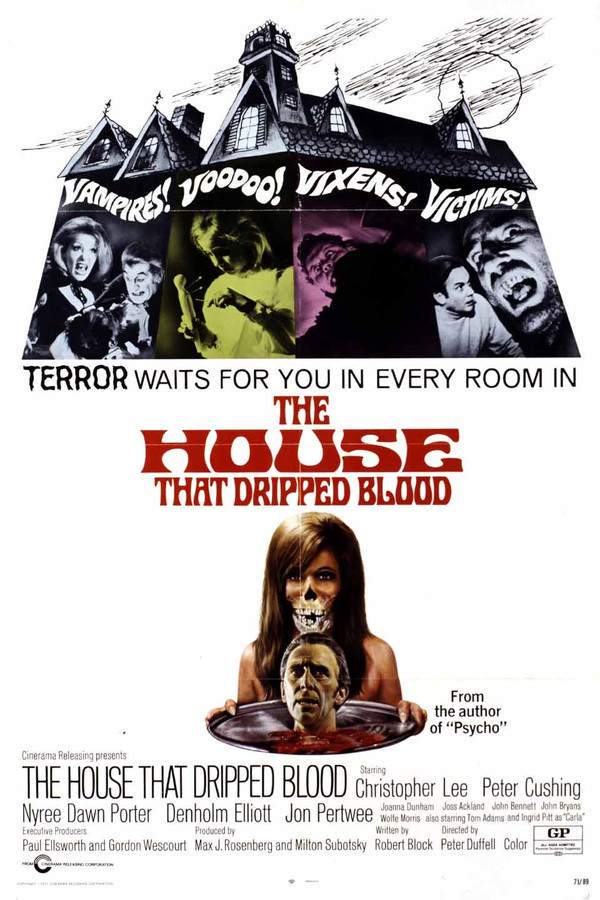
The House That Dripped Blood (1971) movie poster

Plot Summary

The House That Dripped Blood (1971) Plot Summary Explained

Release, runtime and language
1971 · 102 min · English
JustWatch #17,067 9
Directed by
Peter Duffell
Starring
Denholm Elliott, Peter Cushing, John Bennett, Joss Ackland, Joanna Dunham, John Bryans

A Scotland Yard detective investigates a remote country estate plagued by a series of disturbing and interconnected events. Each gruesome tale reveals a horrifying secret linked to the house’s dark history and its previous owners. As the detective delves deeper, he uncovers a pattern of violence and supernatural occurrences, realizing the estate holds a terrifying power.

On this page (6)
  1. 1 Where to watch
  2. 2 What happens: full plot
  3. 3 Plot questions answered
  4. 4 Movie threads
  5. 5 Movies like The House That Dripped Blood
  6. 6 Every angle

Where to watch

Where to Watch The House That Dripped Blood (1971)

Where can you watch The House That Dripped Blood? Stream, rent or buy it in the US, including on Amazon Prime Video, Night Flight Plus and Fawesome: current JustWatch availability with up-to-date prices.

Streaming availability powered by JustWatch

Full plot summary · contains spoilers

What Happens in The House That Dripped Blood: Full Plot Summary

The whole story of The House That Dripped Blood (1971) explained, from the opening scene to the final frame: every key event, every twist and what it all adds up to. Read it as a quick recap before the sequel, to check a scene you missed, or to finally understand what really happened.

The old country house might appear serene on the surface, yet hidden within its rustic charm are sinister undertones that tell a different story. It is within these walls that film star Paul Henderson mysteriously disappears, prompting the arrival of Inspector Holloway from Scotland Yard, tasked with unraveling the complex web of a perplexing investigation. As Holloway investigates, he uncovers a history steeped in darkness and despair that seems to haunt this very location.

Alongside him are Charles Hillyer, a struggling writer known for his horror tales, and his wife Alice, who unwittingly bring their own chaos to this already troubled house. Charles becomes fixated on writing a novel centered around a character named Dominic, a cold-hearted and sinister killer whose essence appears to seep into the reality around him. Delving deeper into the psyche of this terrifying persona, Charles finds himself experiencing life as Dominic, his perceptions increasingly twisted by his own disturbed mindset.

Seeking clarity, Charles consults the insightful Dr. Andrews, a psychologist who initially suggests that Dominic is simply a projection of Charles' suppressed desires and fears. However, as sessions unfold, a more sinister truth begins to surface. When Dominic physically manifests, murdering Dr. Andrews in a vicious act before evaporating into thin air, Charles struggles to comprehend the monstrous life he has inadvertently conjured.

Meanwhile, Alice reveals that her lover, an actor named Richard, has been masquerading as Dominic to drive Charles into madness and ultimately rob him of his writing profits. Their cunning scheme, however, spirals into chaos with the brutal slayings of both Dr. Andrews and Charles at the hands of Richard, embodying Dominic. The house appears to have a malevolent grip on its inhabitants, distorting their minds and spiraling them toward destruction.

As these tragic events unfold, Sergeant Martin recounts another chilling tale that emphasizes the evil forces operating within this cursed abode. Retired stockbroker Philip Grayson, seeking solace in his new home, initially enamored by his newfound hobbies, soon finds himself enveloped in a profound isolation. His flâneur exploits lead him to a grotesque wax museum, captivating him with a sculpture of Salome that hauntingly resembles his lost love.

The enigmatic proprietor of the museum, harboring disturbing secrets, reveals that the sculpture is based on his late wife, who met her end after committing a nefarious act—an unsettling revelation that drives Grayson away in disgust. Enter Neville Rogers, Grayson’s friend and former rival, who arrives seeking refuge from his own business woes. Grayson greets him with warmth, hoping to rekindle their friendship, but the museum's unsettling charm proves irresistible to Neville, leading him into dangerous obsession.

Ignoring Grayson's cautionary words, Neville dives deeper into this macabre intrigue, becoming convinced that the Salome sculpture conceals profound secrets. Ultimately, he leaves town only to return, urging Grayson to indulge his dark fascination. When Grayson visits the museum, he is horrified to discover Neville's severed head on display, a chilling indication of the proprietor's sinister motives.

As Grayson unravels the proprietor's malevolent intentions, he learns that the unfortunate man's wife was framed for her husband's murder, leading to a grotesque preservation of her corpse in wax. This perverse arrangement only ignites deadly desires within those who gaze upon her, sending them down a treacherous path. In a horrifying twist, Grayson himself falls victim to the proprietor’s grisly plot, ultimately meeting his demise as his head is added to the Salome exhibit—a grotesque testament to the underlying horrors residing within the museum.

Meanwhile, we follow John Reid, a grieving widower, and his pyrophobic daughter Jane as they try to settle into their new home, overshadowed by memories of his deceased wife. To assist Jane in overcoming her fears and learning to read, John hires Ann Norton, a dedicated former teacher. As Ann begins to involve herself in their lives, she detects signs of profound dysfunction—the isolation imposed by John sinks Jane into a joyless existence, devoid of any semblance of normal childhood.

When confronting John about his oppressive parenting, Ann suspects blame directed at Jane for the loss of his wife, but is instead struck by the darkness enveloping their family. In her quest for answers, Ann uncovers John's hidden motivations—his obsessive desire to protect Jane from a cursed inheritance of witchcraft. In a shocking twist, unbeknownst to Ann, Jane secretly explores the occult, igniting powers that frighten even her father.

During a blackout, John’s discovery of Jane’s candlelit sacred ritual sends him into a rage, further alienating her and driving Jane deeper into her dark fascination. As John's grip on reality slips and he finds himself bedridden, Ann must confront the escalating chaos as Jane embraces her hidden powers. In a gripping climax, Ann races to intervene as Jane employs a voodoo doll against John, igniting a catastrophic culmination of fire that consumes him, marking the devastating result of Jane's plunge into madness.

As the clock approaches midnight, Holloway’s doubt flares when faced with Stoker’s ominous warnings. Undeterred, he embarks on a journey into the house's depths, where shadows dance around him. Driven by a morbid curiosity, he breaks into a locked basement and stumbles upon Henderson's transformed body, a horrifying puppet of the supernatural. In a desperate battle for control, Holloway’s fragile humanity is extinguished by Carla, marking the tragic finale of the current saga.

Stoker emerges into the light of dawn, and with poised authority, he gathers the audience to share a secret—a profound warning: “Do you understand the essence of this house? It reflects the truth of its inhabitants—an unforgiving mirror to their very nature.” With a hint of mischief, he suggests that perhaps the audience itself could find a place within these walls, subtly challenging them with, “For if you are the ‘right sort of person,’ I assure you—there is nothing to fear.” The air thickens with a palpable tension, an invitation into the consuming darkness that lies beyond.
Last updated: November 19, 2024 at 16:02

Was this helpful?

Plot questions answered

The House That Dripped Blood Plot Explained: Your Questions Answered

The questions people ask most about The House That Dripped Blood (1971): what happens in the confusing scenes, why the characters do what they do, the twists, hidden details and what the ending means. Each answer contains spoilers.

Q1

Why does Charles Hillyer become obsessed with writing about Dominic?

Charles Hillyer, a horror writer struggling with his craft, becomes fixated on creating Dominic, a cold-hearted killer character, because he believes the character possesses a compelling darkness that will make his novel successful. As he delves deeper into Dominic's psyche, the line between fiction and reality blurs, and Dominic begins manifesting physically, suggesting the house amplified Charles's own suppressed violent impulses into something tangible.

Foreshadowing: Early in the film, Charles is established as a writer known for horror tales, indicating his natural gravitation toward dark subject matter.

  • charles hillyer
  • dominic
  • writer
  • obsession
  • horror novel
Q2

How does Dominic physically manifest from Charles's fiction?

Dominic manifests through the supernatural influence of the house itself. As Charles becomes increasingly obsessed with writing about Dominic, his perceptions warp until Dominic seemingly takes on physical form. The exact mechanism remains ambiguous, whether Dominic is a paranormal entity summoned by Charles's dark writings or a manifestation of Charles's own suppressed violent desires given shape by the house's malevolent power.

Foreshadowing: Dr. Andrews initially suggests Dominic is a psychological projection of Charles's suppressed desires, hinting that the character's emergence comes from within Charles himself.

  • dominic
  • manifestation
  • supernatural
  • charles hillyer
  • house curse
Q3

Why does Richard masquerade as Dominic to torment Charles?

Richard, who is Alice's lover, deliberately impersonates Dominic to drive Charles into madness and steal his writing profits. By making Charles believe his fictional killer has come to life, Richard hopes to either push Charles over the edge completely or convince others that Charles is insane, thereby securing control over his literary earnings.

Foreshadowing: Alice's later revelation exposes this scheme, showing Richard capitalized on the house's reputation for evil to execute his plan.

  • richard
  • alice
  • dominic
  • scheme
  • money
  • manipulation
Q4

What happened to film star Paul Henderson at the house?

Paul Henderson, a famous actor who mysteriously disappears at the beginning of the film, is later discovered by Inspector Holloway in the basement. Henderson has been transformed into a puppet-like figure, his body horrifically altered by the house's supernatural forces. He becomes another victim claimed by the estate's malevolent influence, serving as a warning of the house's deadly power.

Foreshadowing: Henderson's disappearance at the estate's outset establishes the house as a place where people vanish under sinister circumstances.

  • paul henderson
  • disappearance
  • transformed
  • basement
  • inspector holloway
Q5

Why does Jane Reid secretly explore the occult?

Jane Reid, a grieving daughter who lost her mother, secretly explores the occult as a way to cope with her profound loss and seek power she believes could protect her from further tragedy. Her father John isolates her and refuses to discuss her mother, leaving Jane to search for answers through forbidden knowledge. This secret exploration represents her rebellion against her father's oppressive control and her desperate attempt to gain agency in her life.

Foreshadowing: John's obsessive desire to protect Jane from a cursed inheritance of witchcraft suggests the family's supernatural susceptibility runs in their bloodline.

  • jane reid
  • occult
  • witchcraft
  • john reid
  • father daughter
Q6

How does John Reid die in the house?

John Reid dies when his daughter Jane uses a voodoo doll against him during a blackout, igniting a catastrophic fire that consumes him. John's strict control and refusal to acknowledge his daughter's grief or her emerging powers ultimately provoke Jane's violent reaction. Her descent into dark magic, combined with the house's corrupting influence, creates the tragic climax where the fire she feared most as a pyrophobic becomes the instrument of his death.

Foreshadowing: Jane's pyrophobia is established early, and her secret occult practices during a blackout directly mirror the circumstances of her mother's death.

  • john reid
  • jane
  • voodoo doll
  • fire
  • death
  • pyrophobia
Q7

Why does the wax museum proprietor kill his visitors?

The proprietor of the grotesque wax museum kills visitors who become obsessed with the Salome sculpture, which is actually his preserved wife. After she was framed for murdering him (a faked death), he killed her in rage and preserved her body in wax. Those who become fixated on Salome awaken the proprietor's murderous jealousy and protective obsession over his macabre creation, leading him to kill and add their heads to his collection.

Foreshadowing: The proprietor's disturbing secrets are revealed gradually as Grayson learns about his late wife's nefarious act and subsequent framed murder.

  • wax museum
  • proprietor
  • salome
  • grayson
  • neville rogers
  • murder
Q8

What happens to Inspector Holloway at the end of the movie?

Inspector Holloway meets his demise after descending into the house's basement, where he discovers Paul Henderson's transformed body. In the climactic confrontation, Holloway's humanity is extinguished by Carla, apparently another victim of the house's evil now serving it. This tragic ending subverts the typical detective role, as the investigator fails to solve the case and becomes the latest sacrifice to the house's malevolent presence.

Foreshadowing: Stoker's ominous warnings about the basement being forbidden foreshadow Holloway's fatal curiosity.

  • inspector holloway
  • carla
  • basement
  • death
  • paul henderson
Q9

What is the nature of the house's power in the film?

The house functions as a malevolent entity that preys on the psychological vulnerabilities and moral weaknesses of its inhabitants. It amplifies darkest desires, manifests fears into reality, and corrupts innocent intentions toward violence and madness. The house acts as a mirror reflecting each person's true nature, those with hidden sins or suppressed violent impulses become consumed by what they harbor within themselves.

Foreshadowing: Stoker's final warning explicitly states the house reflects the truth of its inhabitants, serving as an unforgiving mirror to their very nature.

  • house
  • power
  • evil
  • mirror
  • supernatural
  • stoker
  • reflection
Q10

Why does Neville Rogers become obsessed with the Salome sculpture?

Neville Rogers becomes entranced by the Salome wax sculpture because it awakens a dark obsession within him, much like it did with Philip Grayson. The sculpture possesses a supernatural quality that preys on those with hidden desires, driving them to become consumed by the need to uncover its secrets. Neville's obsession proves fatal, as the proprietor's murderous jealousy is triggered by anyone who covets his preserved wife.

Foreshadowing: Grayson's initial captivation with the sculpture and the proprietor's warning about its disturbing origins hint at its corrupting influence.

  • neville rogers
  • salome
  • wax museum
  • obsession
  • grayson
Q11

Who is Carla who kills Inspector Holloway?

Carla appears to be another victim of the house's supernatural influence, similar to the transformed Paul Henderson. Though her backstory is not fully explained within the narrative, she represents the house's ability to claimed victims and turn them into instruments of its evil. Her role in killing Holloway demonstrates how the house uses its survivors as guards and executioners.

Foreshadowing: The film's pattern of victims becoming part of the house's evil apparatus suggests Carla is another transformed soul.

  • carla
  • inspector holloway
  • victim
  • house
  • supernatural

Movie threads

More Movies Like The House That Dripped Blood, by Mood & Story

Curated lists built around what makes The House That Dripped Blood tick: the same mood, the same kind of story or the same emotional payoff. Each list explains why these movies belong together.

Anthologies of Overlapping Doom like The House That Dripped Blood

Multiple stories collide within a cursed location, revealing a shared sinister fate. If you liked the interconnected horror stories in 'The House That Dripped Blood', explore more movies where multiple narratives are linked by a cursed location or framing device. These films weave separate tales into a larger, more terrifying whole, perfect for fans of anthology horror with a dark, cohesive thread.
  • anthology
  • interconnected
  • cursed
  • ominous
  • atmospheric
  • unsettling
  • Tone: dark, ominous, bleak
  • Pacing: variable, with slow builds and sharp climaxes
Why these movies?

The story pattern: These films use an anthology structure, often with a framing narrative, to explore different perspectives tied to a central source of evil. The separate stories, while distinct, reinforce each other and build towards a climax that reveals the overarching malevolence, leaving little hope for escape.

Why they belong together: Movies are grouped here for their shared structure of interconnected tales that build a cumulative sense of dread. They share a focus on a central cursed element and a narrative pattern where individual fates contribute to a bleak, overarching conclusion.

Sentient Locations of Malevolence like The House That Dripped Blood

A building or place with a conscious, predatory evil that preys on its inhabitants. Fans of 'The House That Dripped Blood' will enjoy these movies about places with a conscious evil. Discover similar horror films where a house, hotel, or town is a predatory entity that warps reality and psychologically torments its inhabitants, leading to terrifying and bleak outcomes.

  • sentient house
  • oppressive
  • psychological horror
  • atmospheric
  • unraveling sanity
  • doom-laden
  • Tone: dark, oppressive, horrifying
  • Pacing: variable, often slow-burn leading to violent peaks
Why these movies?

The story pattern: The narrative follows characters who enter or investigate a location that possesses a will of its own. The conflict is not against ghosts or monsters, but against the environment itself, which manipulates events, perceptions, and sanity, leading to an inevitable and often gruesome conclusion for the protagonists.

Why they belong together: These films are united by the core concept of a sentient, evil location as the primary antagonist. They share a high-intensity, oppressive atmosphere where the setting is the active source of horror, creating a consistent mood of inescapable dread and psychological unraveling.

If you liked this

Movies Like The House That Dripped Blood

Similar movies to The House That Dripped Blood: the same genre, themes or kind of story. Each one comes with its own plot summary, timeline and ending explained.

Browse all movie summaries

Every angle

The House That Dripped Blood (1971) Explained: Plot, Timeline & Characters

Everything about The House That Dripped Blood in one place: what happens in the plot summary, the timeline in chronological order, the characters and meaning and a spoiler-free summary. What's After the Movie adds the cast, box office and post-credit scenes.

Coming soon on iOS and Android

The Plot Explained Movie Summary App

Plot summaries, endings explained and timelines on your phone. Catch up on any movie in minutes, save your favorites and never miss a twist again.

Be the first to know when we launch. Your email stays private, always.

Learn more about the app