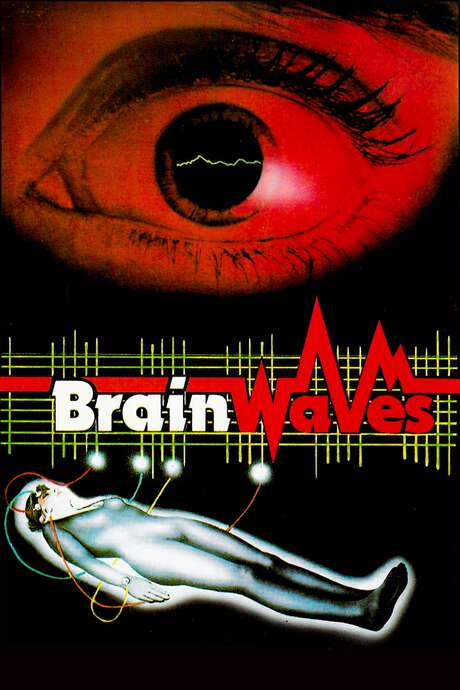
Dr. Rex Martin is a renowned neurosurgeon who dedicates his work to studying brain malfunctions that trigger mental illness. The film opens with him stepping into his laboratory, where the 8 on his instrument panel lies on its side, forming an ominous infinity symbol that hints at the endless loops of reality and perception the story will explore. His assistant, Berkovitch, toys with a removed brain attached to a disembodied face, mapping facial muscles as Rex takes over. A mishap sends Philip Montag’s brain tumbling through the air, and Rex quips that the place won’t be the same without him, a reminder of how fragile and unpredictable their experiments can be.
The plot thickens when Rex’s high school friend Jim Reston, a successful Eunice executive, arrives seeking help to reach the mind of John Halsey, a former mathematical genius who has slipped into paranoia at a nearby asylum. Halsey believes a man named Conklin is spying on him and intends to kill him. Rex agrees to push him through a rigorous battery of tests, and the patient’s genuine paranoia surfaces—Halsey is convinced he is under threat, a belief that appears to be more than mere delusion. Jim Reston pushes for surgery, arguing that Rex’s research is already under Eunice’s sponsorship and could finally unlock the corporate secrets buried in Halsey’s brain. The procedure’s aim is ambiguous and unsettling: to change Halsey’s mental attitude in a way that could either reveal critical information or render him unable to reveal anything at all.
The story collides with an unsettling real-world danger when Rex is ambushed on his way home with a jarred brain in hand. A homeless man attacks him, mistaking the brain for something menacing, and in the struggle, Rex loses his grip. A car—remarkably connected to the Conklin Mattress Company—strikes him, shattering the windshield and jolting him into a brutal awakening. When he comes to, the infinity symbol in the lab has been reset to its upright form, and Rex discovers his funding has vanished along with his lab’s stability. He is forced to eject the remaining researchers, only to see the jars mounted on the wall topple in a chaotic cascade that suggests a collapse of order and sense.
Soon the narrative centers on Halsey’s procedure conducted in a boardroom setting, a staged surreal sequence where each stimulation alters the patient’s experience—changing the location, the sounds, and the people involved—while still letting him communicate through the fog of his psychosis. The operation appears to succeed, restoring Halsey to a coherent sense of self as a mathematician, but the aftershocks of the procedure ripple through Rex’s life in startling, dreamlike ways. After the surgery, Rex begins to suffer the same paranoid visions as Halsey, haunted by the specter of Conklin in the surgical room and unable to distinguish whether he is the doctor or the patient in a collapsing loop of reality.
In the end, the film delivers a stark twist: Rex dies from injuries sustained in the car wreck, and his consciousness persists as a sentient brain kept alive in a jar. The story lingers on questions of identity, memory, and the moral cost of peering into minds beyond what one can safely control. Is the line between healer and wrecking ball ever truly clear when science pushes into the deepest corners of the human psyche? The final image leaves viewers pondering whether the mind survives the body, or if the act of healing leaves behind something unrepairable and uncanny.
Cast highlights
- George Kennedy, Bill Pullman, Bill Paxton, Bud Cort, Brian Brophy, Nicholas Pryor, Andy Wood, Patricia Charbonneau, David Sinaiko, Lee Arenberg.