Plot Explained Spoilers guaranteed!
Plot Explained

Browse by genre

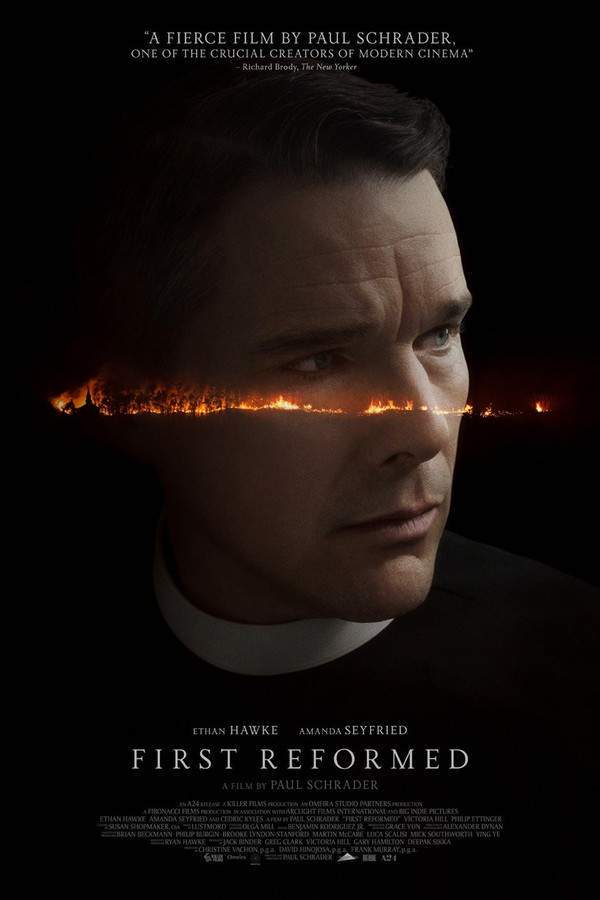
First Reformed (2018) movie poster

Plot Summary

First Reformed (2018) Plot Summary & Ending Explained

Release, runtime and language
2018 · 113 min · English
Echo score 88
JustWatch #2,075 27
Starring
Amanda Seyfried, Bill Hoag, Cedric the Entertainer, Elanna White
Budget
$3.5M

A reserved Dutch Reformed pastor, Reverend Ernst Toller, experiences a profound crisis of faith when a young parishioner and her family confide in him. Struggling with his own painful past and the looming threat of environmental disaster, he grapples with increasingly troubling questions about his faith and purpose. As he investigates the family's concerns, the reverend's internal turmoil intensifies, leading him down a path of moral questioning and a shocking confrontation.

On this page (7)
  1. 1 Where to watch
  2. 2 What happens: full plot
  3. 3 Plot questions answered
  4. 4 How it ends
  5. 5 Movie threads
  6. 6 Movies like First Reformed
  7. 7 Every angle

Where to watch

Where to Watch First Reformed (2018)

Where can you watch First Reformed? Stream, rent or buy it in the US, including on Netflix, Netflix Standard and Darkroom: current JustWatch availability with up-to-date prices.

Streaming availability powered by JustWatch

Full plot summary · contains spoilers

What Happens in First Reformed: Full Plot Summary

The whole story of First Reformed (2018) explained, from the opening scene to the final frame: every key event, every twist and what it all adds up to. Read it as a quick recap before the sequel, to check a scene you missed, or to finally understand what really happened.

Ernst Toller, portrayed by an unnamed actor, is the pastor of the historic First Reformed Church in Snowbridge, New York, grappling with a profound crisis of faith. The narrative begins with Toller documenting his thoughts in a journal, a project he intends to destroy after a year of reflection. This church, originally a pivotal stop on the Underground Railroad, now finds itself struggling with dwindling attendance under Toller's guidance, having veered away from its roots in Calvinist theology to become primarily a tourist destination.

Haunted by the loss of his son, Joseph, who was a casualty of the Iraq War, Toller also battles his own alcoholism. His journey toward deeper spiritual comprehension leads him to explore the writings of Roman Catholic authors like G. K. Chesterton and Thomas Merton, alongside mystical texts such as The Cloud of Unknowing. In search of solace, he reaches out to Abundant Life, a prominent evangelical megachurch in Albany that oversees First Reformed.

His life takes a pivotal turn when he is approached by Mary Mensana, who seeks guidance for her husband, Michael, a fervent environmentalist. Michael's radical views put Toller in a moral quandary as he reveals his desire for Mary to have an abortion, expressing his belief that bringing a child into a world devastated by climate change is cruel. When Mary finds a suicide vest belonging to Michael, Toller takes it, vowing to counsel him. Despite contemplating alerting the authorities, Toller hesitates, fearing it might exacerbate Michael's fragile mental state.

Tragically, before their next session, Toller discovers Michael has taken his own life with a shotgun. In line with Michael's last wishes, a memorial service is held at a local toxic-waste site, where his ashes are scattered. Meanwhile, preparations for First Reformed's 250th anniversary service—a significant event featuring local dignitaries and Edward Balq, a financial supporter of the church with a stake in climate pollution—are underway. Toller and Balq clash over their differing stances on climate change, Toller advocating for Christian stewardship while Balq dismisses it as overly complex.

In the midst of personal turmoil, Toller seeks medical attention due to recurring physical pain, and tests hint at possible stomach cancer. He discovers Michael's laptop, which he took to protect Mary from the consequences of Michael's radical beliefs, and dives into research concerning Michael’s fears about Balq’s factory. One evening, Mary visits Toller in the church's parsonage, where they share a moment of intimate connection reminiscent of Michael and Mary’s past.

As the anniversary service approaches, Toller implores Mary not to attend. In a drastic turn of events, he dons the explosive vest meant for Michael during the ceremony but ultimately substitutes it for barbed wire in a symbolic act of self-sacrifice. Just as he prepares to consume a glass of drain cleaner, a pivotal moment occurs—Mary interrupts him, and their passionate embrace leads to an abrupt and haunting conclusion as the screen fades to black.
Last updated: November 16, 2024 at 11:49

Was this helpful?

Plot questions answered

First Reformed Plot Explained: Your Questions Answered

The questions people ask most about First Reformed (2018): what happens in the confusing scenes, why the characters do what they do, the twists, hidden details and what the ending means. Each answer contains spoilers.

Q1

Why does Michael want Mary to have an abortion?

Michael believes it would be cruel to bring a child into a world devastated by climate change and environmental destruction. His radical environmentalism has led him to see no future for humanity, making parenthood seem pointless and morally wrong.

Foreshadowing: Earlier in the film, Michael expresses deep distress about the planet's ecological crisis, framing his views as a matter of moral responsibility.

  • michael mensana
  • abortion
  • climate change
  • environmentalism
  • radical beliefs
Q2

Why doesn't Toller report Michael's suicide vest to the authorities?

Toller fears that alerting authorities would worsen Michael's fragile mental state and potentially trigger the immediate use of the vest. He believes he can counsel Michael through his crisis and convince him to give up the device.

Foreshadowing: The film establishes Toller's tendency toward personal intervention rather than institutional solutions, as seen in his direct engagement with Mary's request for help.

  • suicide vest
  • police
  • authorities
  • intervention
  • michael mensana
Q3

Why does Michael commit suicide?

Michael's suicide stems from hopeless despair over climate change and his belief that humanity has no future. Unable to see meaning in bringing a child into a dying world, he sees death as the only logical escape from his anguish.

Foreshadowing: Michael's request for Mary to have an abortion reveals his profound nihilism and inability to envision any positive future.

  • michael mensana suicide
  • environmental despair
  • climate suicide
Q4

Why is Michael's memorial held at a toxic waste site?

Michael's memorial takes place at a local toxic-waste site to honor his environmental activism and his belief that industrial pollution is destroying the planet. The location reflects his passionate commitment to ecological issues even in death.

Foreshadowing: Earlier scenes establish Michael's intense focus on Balq's factory and his conviction that corporate pollution poses an existential threat.

  • memorial service
  • toxic waste
  • environmental activism
  • michael mensana
Q5

Why does Toller discover he might have stomach cancer?

Toller's medical tests reveal possible stomach cancer, adding to his existing psychological torment. This health crisis compounds his despair, representing another form of internal decay mirroring the moral and environmental corruption he obsesses over.

Foreshadowing: Toller experiences persistent physical pain throughout the film, which he initially ignores while focused on his spiritual and pastoral duties.

  • stomach cancer
  • health
  • illness
  • terminal diagnosis
Q6

Why does Toller plan to use the explosive vest at the anniversary service?

Toller intends to use Michael's vest during the church's 250th anniversary service to make a dramatic statement about climate change and corporate environmental destruction. He sees it as a sacrificial act that will force the congregation and dignitaries to confront the ecological crisis.

Foreshadowing: Toller's conflict with Balq, who dismisses environmental concerns, escalates his desperation to provoke meaningful action.

  • explosive vest
  • anniversary service
  • suicide bombing
  • climate protest
  • edward balq
Q7

Why does Toller substitute barbed wire for explosives in the vest?

Toller replaces the explosives with barbed wire as a symbolic act of self-sacrifice without causing mass casualties. He wants to draw attention to environmental issues through dramatic visual suffering rather than killing others, transforming the weapon into a statement of Christian martyrdom.

Foreshadowing: Toller's study of Christian mystics and his theological wrestling with faith suggest he views his act through a lens of redemptive suffering.

  • barbed wire
  • explosive vest
  • symbolic sacrifice
  • self-harm
  • martyrdom
Q8

Does Toller die at the end of the film?

The film ends ambiguously with Toller about to drink drain cleaner when Mary interrupts him. They share a passionate embrace as the screen fades to black, leaving whether Toller consumed the poison entirely uncertain. The interruption suggests possible survival, but the conclusion remains deliberately unresolved.

Foreshadowing: Toller's final journal entry references creation and new life, hinting at potential redemption or continuation rather than certain death.

  • ending
  • death
  • drain cleaner
  • ambiguous ending
  • toller fate
Q9

Why does Mary become intimate with Toller?

Mary seeks comfort in Toller after Michael's death, finding in him someone who understood her husband's anguish. Their intimacy represents shared grief and a desperate human connection amid their mutual despair, though it also reflects Toller's own loneliness and crisis of faith.

Foreshadowing: Earlier scenes establish their mutual emotional support as Toller tries to help Mary cope with Michael's radicalization and death.

  • mary mensana
  • intimacy
  • grief
  • relationship
  • emotional connection
Q10

What is the conflict between Toller and Edward Balq?

Balq, a wealthy financial supporter of the church, represents corporate interests behind environmental destruction through his factory. Toller confronts him about Christian stewardship of the Earth, while Balq dismisses climate concerns as overly complex. This clash intensifies Toller's conviction that radical action is necessary.

Foreshadowing: Balq's involvement in the anniversary service and his dismissive attitude toward environmental issues directly fuel Toller's desperation.

  • edward balq
  • conflict
  • factory
  • pollution
  • corporate
  • environmental
Q11

Why does Toller read Catholic and mystical texts?

Struggling with his Calvinist faith after his son's death in the Iraq War, Toller seeks answers beyond his tradition. He turns to Catholic authors like Chesterton and Merton, and mystical works like The Cloud of Unknowing, searching for a more compassionate spirituality that might address his grief and existential doubts.

Foreshadowing: Toller's journaling and theological searching reflect his dissatisfaction with his own church's diminished spiritual purpose.

  • chesterton
  • merton
  • cloud of unknowing
  • catholic
  • mysticism
  • theology
  • faith
Q12

Why is the church's 250th anniversary significant?

The 250th anniversary represents a pivotal moment where the church's historical significance as an Underground Railroad stop collides with its current state as a tourist attraction. Toller uses this gathering of dignitaries and Balq to stage his protest, turning the celebration into a platform for environmental condemnation.

Foreshadowing: The anniversary preparations throughout the film build tension, with Balq's financial stake and local political presence creating the perfect setting for Toller's planned confrontation.

  • anniversary
  • 250th
  • celebration
  • dignitaries
  • first reformed church

Ending explained

What Happens at the End of First Reformed?

How First Reformed (2018) ends, in short: the final scene, the last twist and what it means for the characters. The full ending explained, with every spoiler, lives on its own page.

Read the full ending explained

The ending of First Reformed deliberately shatters narrative convention, leaving the fate of Reverend Ernst Toller suspended in a moment of radical ambiguity. Just as Toller prepares to drink a glass of drain cleaner to end his suffering, Mary enters his room, and the two share a sudden, passionate embrace before the screen cuts to black. This abrupt shift forces the viewer to navigate two conflicting realities: one where Toller is physically saved by an act of grace or love, and another where the entire interaction is a dying hallucination—a final, comforting vision as the poison takes hold.
This duality is the very point of the finale, reflecting the film's earlier meditation on the nature of wisdom. Ethan Hawke has described the scene as a cinematic representation of holding two opposing thoughts at once, creating a "continuity of opposites" where life and death, or reality and illusion, exist simultaneously. Paul Schrader treats the ending not as a puzzle to be solved, but as a bell meant to vibrate within the audience long after the credits roll. Whether one interprets the finale as a literal miracle of survival or a spiritual transcendence through death, the power of the moment lies in its refusal to provide a definitive answer, ensuring the film’s themes of despair and redemption resonate with unanswerable intensity.

First Reformed ending explained in full

Movie threads

More Movies Like First Reformed, by Mood & Story

Curated lists built around what makes First Reformed tick: the same mood, the same kind of story or the same emotional payoff. Each list explains why these movies belong together.

Movies about clergy in crisis like First Reformed

Stories of religious figures grappling with profound doubt and moral collapse. If you were fascinated by the spiritual despair in First Reformed, explore more movies about clergy in crisis. These dramas feature pastors, priests, and religious figures whose faith is tested by personal tragedy, moral dilemmas, and existential dread, leading to heavy, introspective stories.

  • somber
  • meditative
  • despairing
  • morally ambiguous
  • introspective
  • heavy
  • Tone: dark, somber, morally ambiguous
  • Pacing: slow, deliberate, introspective
Why these movies?

The story pattern: Stories in this thread follow a religious protagonist whose stable worldview is shattered by an internal or external event. The narrative unfolds as a slow-burning internal conflict, often portrayed through journaling, prayer, and dialogue, building towards a climactic moment of moral choice or spiritual reckoning.

Why they belong together: Movies are grouped here for their shared focus on a clergy protagonist undergoing a severe test of faith. They share a somber, meditative tone, high emotional weight, and a preoccupation with themes like grief, doubt, and the search for meaning in a seemingly godless world.

Slow-burn eco-dread thrillers similar to First Reformed

Slow-burn thrillers where existential environmental threats fuel personal despair. For viewers who appreciated the environmental despair in First Reformed, this section highlights movies with a similar vibe of eco-dread. These are often slow-burning, psychologically intense films where characters confront the existential weight of environmental collapse, leading to heavy moral questions and a bleak atmosphere.

  • anxious
  • despairing
  • slow burn
  • claustrophobic
  • existential
  • somber
  • Tone: dark, anxious, despairing
  • Pacing: slow burn, deliberate
Why these movies?

The story pattern: The narrative pattern involves a protagonist becoming acutely aware of an unstoppable environmental disaster. This knowledge acts as a slow poison, corroding their mental state and motivating extreme actions. The plot is less about solving the problem and more about the psychological toll of facing an apocalyptic future.

Why they belong together: These films are united by the central theme of environmental activism or awareness leading to radical despair. They share a dark tone, slow pacing, and high intensity, blending the thriller genre with profound philosophical questions about purpose and nihilism in the face of planetary doom.

If you liked this

Movies Like First Reformed

Similar movies to First Reformed: the same genre, themes or kind of story. Each one comes with its own plot summary, timeline and ending explained.

Browse all movie summaries

Every angle

First Reformed (2018) Explained: Plot, Ending, Timeline & Characters

Everything about First Reformed in one place: what happens in the plot summary, the timeline in chronological order, the characters and meaning, the ending explained and a spoiler-free summary. What's After the Movie adds the cast, box office and post-credit scenes.

Coming soon on iOS and Android

The Plot Explained Movie Summary App

Plot summaries, endings explained and timelines on your phone. Catch up on any movie in minutes, save your favorites and never miss a twist again.

Be the first to know when we launch. Your email stays private, always.

Learn more about the app