






Plot Explained Spoilers guaranteed!
Plot Explained

Browse by genre

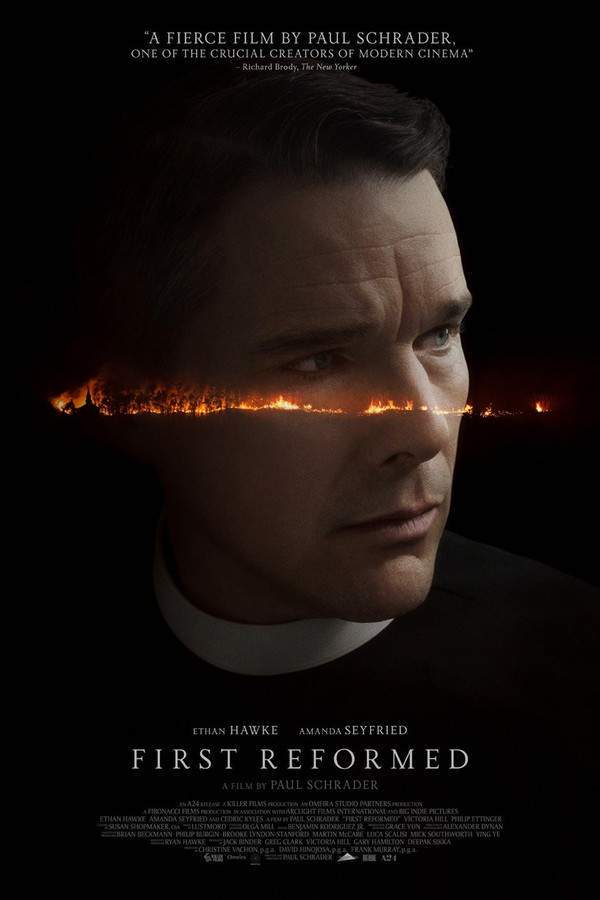
First Reformed (2018) movie poster

Ending Explained

First Reformed (2018) Ending Explained – Final Scene & Meaning

Release, runtime and language
2018 · 113 min · English
Echo score 88
Starring
Amanda Seyfried, Bill Hoag, Cedric the Entertainer, Elanna White
Budget
$3.5M

A reserved Dutch Reformed pastor, Reverend Ernst Toller, experiences a profound crisis of faith when a young parishioner and her family confide in him. Struggling with his own painful past and the looming threat of environmental disaster, he grapples with increasingly troubling questions about his faith and purpose. As he investigates the family's concerns, the reverend's internal turmoil intensifies, leading him down a path of moral questioning and a shocking confrontation.

On this page (7)
  1. 1 Where to watch
  2. 2 What happens at the end
  3. 3 Final events in order
  4. 4 Ending questions answered
  5. 5 Movie threads
  6. 6 Movies like First Reformed
  7. 7 Every angle

Where to watch

Where to Watch First Reformed (2018)

Where can you watch First Reformed? Stream, rent or buy it in the US, including on Darkroom, Amazon Video and Apple TV Store: current JustWatch availability with up-to-date prices.

Streaming availability powered by JustWatch

Ending explained · contains spoilers

What Happens at the End of First Reformed?

How First Reformed (2018) ends, what the final scene means, which earlier moments set it up and how to read the ending if the film leaves it open. The full ending explained, with every spoiler.

The ending of First Reformed deliberately shatters narrative convention, leaving the fate of Reverend Ernst Toller suspended in a moment of radical ambiguity. Just as Toller prepares to drink a glass of drain cleaner to end his suffering, Mary enters his room, and the two share a sudden, passionate embrace before the screen cuts to black. This abrupt shift forces the viewer to navigate two conflicting realities: one where Toller is physically saved by an act of grace or love, and another where the entire interaction is a dying hallucination—a final, comforting vision as the poison takes hold.

This duality is the very point of the finale, reflecting the film's earlier meditation on the nature of wisdom. Ethan Hawke has described the scene as a cinematic representation of holding two opposing thoughts at once, creating a "continuity of opposites" where life and death, or reality and illusion, exist simultaneously. Paul Schrader treats the ending not as a puzzle to be solved, but as a bell meant to vibrate within the audience long after the credits roll. Whether one interprets the finale as a literal miracle of survival or a spiritual transcendence through death, the power of the moment lies in its refusal to provide a definitive answer, ensuring the film’s themes of despair and redemption resonate with unanswerable intensity.

Last updated: March 30, 2026 at 17:09

Was this helpful?

The last 4 events

How First Reformed Ends: The Final Events in Order

The last events of First Reformed (2018) in chronological order, the run-up to the ending explained above. The complete timeline has all 14 events, scene by scene.

Open the full timeline
  1. Intimacy with Mary

    In a moment of vulnerability, Mary visits Toller, and they share a deep emotional connection, reminiscent of her bond with Michael. This meeting signifies the intertwining of loss and affection, revealing the complex relationships at play.

    Where
    Church's parsonage
  2. Contemplating a Dangerous Act

    As the anniversary service approaches, Toller grapples with his own despair, leading him to consider using the explosive vest meant for Michael. This drastic decision symbolizes his inner turmoil and desperation to make a statement.

    Where
    First Reformed Church
  3. Last Moment of Decision

    On the day of the anniversary service, Toller prepares to carry out his plan, but in a critical moment, he substitutes the vest for barbed wire. This act of self-sacrifice is laden with meaning, as he seeks to draw attention to the grave issues at hand.

    Where
    First Reformed Church
  4. A Haunting Conclusion

    Just as Toller is about to consume drain cleaner, a pivotal moment occurs when Mary interrupts him. Their passionate embrace prevents him from following through, culminating in an abrupt yet profound end to the film.

    Where
    First Reformed Church

Ending questions answered

First Reformed Ending: Your Questions Answered

The questions people ask most about the ending of First Reformed (2018): what the final scene means, how the twist works, what happens to each character and how to read the ending. Each answer contains spoilers.

Q1

Why does Reverend Toller decide to drink drain cleaner at the end?

Toller decides to end his life after months of spiritual crisis, grief over his son's death, and his mounting despair over humanity's environmental destruction. He sees suicide as a final act of protest and escape from a world he believes is beyond saving. His journal entries throughout the film reveal a man wrestling with whether he has the right to bring new life into a dying world, making his decision the culmination of his entire crisis of faith.

Foreshadowing: Earlier in the film, Toller writes in his journal that he must choose between 'the easy way' and 'the right way', hinting at his suicidal ideation.

  • suicide
  • drain cleaner
  • reverend toller
  • despair
  • crisis of faith
Q2

Does Mary actually save Toller, or is the embrace a hallucination?

The film deliberately leaves this ambiguous. The ending can be interpreted two ways: either Mary arrives in time to physically save Toller through their embrace, representing a literal act of grace and human connection, or the entire interaction is a dying hallucination, a comforting vision as the poison takes hold. Both interpretations are equally valid, and the film provides no definitive evidence to choose between them.

Foreshadowing: The film's earlier scenes blend reality and Toller's psychological state, making the audience question what is truly happening versus what Toller imagines.

  • mary
  • hallucination
  • ambiguous ending
  • salvation
  • embrace
Q3

Why does the movie cut to black during the embrace?

The cut to black is Paul Schrader's deliberate choice to refuse narrative closure. By cutting before we see whether Toller survives or dies, Schrader forces viewers to sit with the uncertainty rather than receive a tidy resolution. This technique reflects the film's broader themes, it asks the audience to hold two opposing truths simultaneously, just as Toller has struggled to do throughout the film.

  • cut to black
  • paul schrader
  • ambiguous ending
  • narrative closure
Q4

What did Ethan Hawke mean by 'continuity of opposites' in the ending?

Ethan Hawke described the ending as representing 'continuity of opposites', the idea that life and death, or reality and illusion, can exist simultaneously rather than as opposing forces. Rather than choosing between Toller being saved or dying, the film asks viewers to accept both possibilities as equally true. This reflects the film's exploration of faith itself: belief does not require certainty or proof.

Foreshadowing: This concept echoes earlier scenes where Toller struggles with paradoxes in his faith, particularly regarding creation and destruction.

  • continuity of opposites
  • ethan hawke
  • philosophy
  • duality
  • belief
Q5

Does First Reformed offer redemption or just more despair?

The film refuses to give a definitive answer. Whether Toller experiences redemption depends entirely on the viewer's interpretation: if the embrace is real, he is saved through human connection and grace; if it is a hallucination, he dies in despair but with a final moment of imagined peace. Paul Schrader designed the ending to 'vibrate' within the audience, leaving this question deliberately unanswerable so viewers must grapple with their own beliefs about salvation and despair.

  • redemption
  • despair
  • salvation
  • grace
  • interpretation
Q6

What happens to Toller after Mary enters his room?

The screen cuts to black immediately after Toller and Mary's passionate embrace begins, leaving their physical fate completely unknown. We never see whether Toller drinks the drain cleaner, whether Mary stops him, or what becomes of either of them. This abrupt cutoff is intentional, Schrader wants the audience to feel the same uncertainty Toller has lived with throughout the film.

  • toller fate
  • mary
  • ending scene
  • unknown outcome
Q7

Why did Paul Schrader make the ending so ambiguous?

Schrader intended the ambiguous ending to function like a bell that 'vibrates' within the audience long after the film ends. Rather than providing a puzzle to solve, he wanted viewers to sit with the tension of not knowing, to experience the same uncertainty that defines Toller's spiritual journey. The ambiguity is meant to be embraced rather than resolved, forcing each viewer to confront their own interpretation of faith, salvation, and human connection.

  • paul schrader
  • ambiguous ending
  • director intent
  • interpretation
Q8

Is Toller's planned suicide an act of protest or surrender?

The film presents Toller's suicide as both simultaneously, a protest against a dying world that he believes humans are destroying, yet also a surrender to overwhelming despair. His environmental activism and his faith have led him to a point where he sees death as the only logical response to unfixable suffering. The ambiguous ending prevents us from judging whether his choice represents cowardice, courage, or something else entirely.

Foreshadowing: Toller's conversations with Michael about climate change and his journal entries about bringing children into a doomed world establish his view that destruction is inevitable.

  • suicide protest
  • surrender
  • environmental despair
  • act of protest
Q9

What does the embrace between Toller and Mary represent?

The embrace represents the possibility of human connection as a form of salvation, even if that connection is only real in Toller's mind. Whether literal or imagined, the moment shows Toller accepting love and touch after months of isolation, a breakthrough in his spiritual isolation. It symbolizes the possibility of grace entering his life at the precise moment he had abandoned all hope, though the film leaves unclear whether this represents physical rescue or psychological release.

Foreshadowing: Throughout the film, Toller isolated himself, refusing to answer phone calls and keeping his distance from the congregation, making this embrace a dramatic break from his self-imposed solitude.

  • embrace
  • mary
  • connection
  • salvation
  • human touch
Q10

How does the ambiguous ending connect to the film's themes?

The ending ties directly to the film's central themes of faith versus despair, and the impossibility of certainty in matters of belief. Just as Toller could never prove whether God exists or if humanity deserves salvation, the audience can never prove whether he is saved or dies. The ending asks: Can faith exist without proof? Can redemption be real if it might be imagined? The ambiguity itself becomes the thematic answer, sometimes living requires holding contradictions.

  • themes
  • faith
  • despair
  • contradiction
  • belief
  • ambiguity

Movie threads

More Movies Like First Reformed, by Mood & Story

Curated lists built around what makes First Reformed tick: the same mood, the same kind of story or the same emotional payoff. Each list explains why these movies belong together.

Movies about clergy in crisis like First Reformed

Stories of religious figures grappling with profound doubt and moral collapse. If you were fascinated by the spiritual despair in First Reformed, explore more movies about clergy in crisis. These dramas feature pastors, priests, and religious figures whose faith is tested by personal tragedy, moral dilemmas, and existential dread, leading to heavy, introspective stories.

  • somber
  • meditative
  • despairing
  • morally ambiguous
  • introspective
  • heavy
  • Tone: dark, somber, morally ambiguous
  • Pacing: slow, deliberate, introspective
Why these movies?

The story pattern: Stories in this thread follow a religious protagonist whose stable worldview is shattered by an internal or external event. The narrative unfolds as a slow-burning internal conflict, often portrayed through journaling, prayer, and dialogue, building towards a climactic moment of moral choice or spiritual reckoning.

Why they belong together: Movies are grouped here for their shared focus on a clergy protagonist undergoing a severe test of faith. They share a somber, meditative tone, high emotional weight, and a preoccupation with themes like grief, doubt, and the search for meaning in a seemingly godless world.

Slow-burn eco-dread thrillers similar to First Reformed

Slow-burn thrillers where existential environmental threats fuel personal despair. For viewers who appreciated the environmental despair in First Reformed, this section highlights movies with a similar vibe of eco-dread. These are often slow-burning, psychologically intense films where characters confront the existential weight of environmental collapse, leading to heavy moral questions and a bleak atmosphere.

  • anxious
  • despairing
  • slow burn
  • claustrophobic
  • existential
  • somber
  • Tone: dark, anxious, despairing
  • Pacing: slow burn, deliberate
Why these movies?

The story pattern: The narrative pattern involves a protagonist becoming acutely aware of an unstoppable environmental disaster. This knowledge acts as a slow poison, corroding their mental state and motivating extreme actions. The plot is less about solving the problem and more about the psychological toll of facing an apocalyptic future.

Why they belong together: These films are united by the central theme of environmental activism or awareness leading to radical despair. They share a dark tone, slow pacing, and high intensity, blending the thriller genre with profound philosophical questions about purpose and nihilism in the face of planetary doom.

If you liked this

Movies Like First Reformed

Similar movies to First Reformed: the same genre, themes or kind of story. Each one comes with its own plot summary, timeline and ending explained.

Browse all movie summaries

Every angle

First Reformed (2018) Explained: Plot, Ending, Timeline & Characters

Everything about First Reformed in one place: what happens in the plot summary, the timeline in chronological order, the characters and meaning, the ending explained and a spoiler-free summary. What's After the Movie adds the cast, box office and post-credit scenes.

Coming soon on iOS and Android

The Plot Explained Movie Summary App

Plot summaries, endings explained and timelines on your phone. Catch up on any movie in minutes, save your favorites and never miss a twist again.

Be the first to know when we launch. Your email stays private, always.

Learn more about the app