Plot Explained Spoilers guaranteed!
Plot Explained

Browse by genre

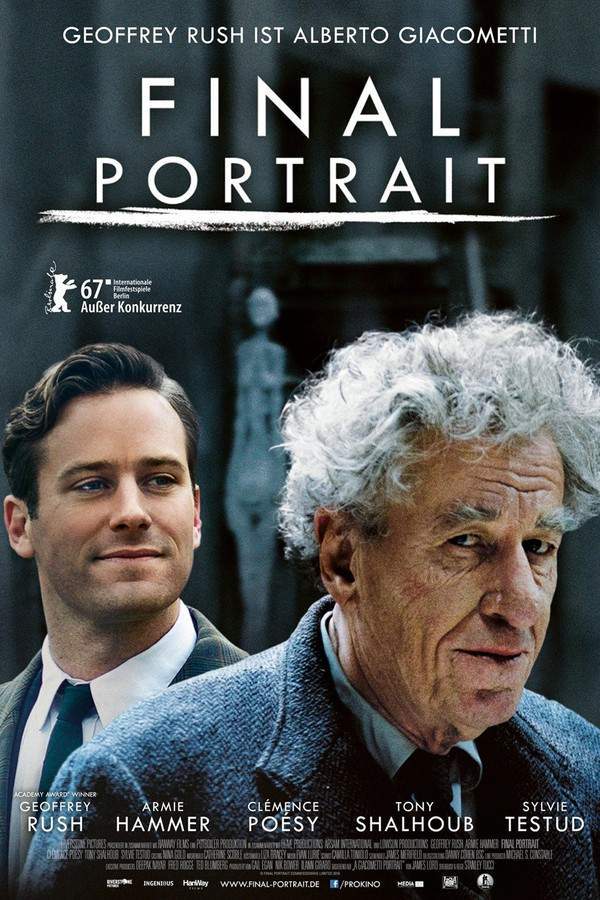
Final Portrait (2018) movie poster

Plot Summary

Final Portrait (2018) Plot Summary Explained

Release, runtime and language
2018 · 90 min · English
Echo score 63
Loading streaming availability…
Starring
Clémence Poésy, Armie Hammer, Tony Shalhoub, Kerry Shale, Dolly Jagdeo, Geoffrey Rush
Budget
$200

In 1964 Paris, American writer James Lord agrees to sit for a portrait by the renowned sculptor Alberto Giacometti. As the artistic process unfolds, an unusual friendship develops between the two men. Lord witnesses firsthand Giacometti’s unique and often chaotic approach to his work, which mirrors the complexities of life itself. The experience becomes a profound exploration of art, identity, and the challenges of the human condition, revealing both the brilliance and the struggles of a celebrated artist.

On this page (5)
  1. 1 Where to watch
  2. 2 What happens: full plot
  3. 3 Plot questions answered
  4. 4 Movie threads
  5. 5 Every angle
Loading streaming availability…

Full plot summary · contains spoilers

What Happens in Final Portrait: Full Plot Summary

The whole story of Final Portrait (2018) explained, from the opening scene to the final frame: every key event, every twist and what it all adds up to. Read it as a quick recap before the sequel, to check a scene you missed, or to finally understand what really happened.

In Paris, 1964, renowned sculptor Alberto Giacometti encounters his old acquaintance, James Lord, an American art critic. Giacometti asks Lord to model for his latest portrait in his studio, suggesting it will only require a couple of days. Flattered by the opportunity, Lord agrees, unaware that Giacometti’s creative process is anything but straightforward.

Giacometti shares the space with his wife, Annette Giacometti, and his brother Diego, but the dynamic is complicated by Giacometti's relationship with his favored muse, a part-time lover whose presence creates tension within his household.

As the promised two days turn into weeks, Giacometti repeatedly requests more time for the sittings, much to Lord's conflicted dismay. Despite needing to return to work, the allure of being captured by such a masterful artist keeps Lord in Paris, even as his writing assignments pile up. Throughout this period, Giacometti's progress is marked by fits of creativity wherein he often scrambles to start anew, occasionally erasing Lord's face entirely to refresh his vision.

The heart of Giacometti’s troubled marriage is laid bare as he oscillates between genuine affection and emotional distance. Annette grows increasingly frustrated with his lavish expenditures on models while neglecting her needs, leading to explosive confrontations. In one such moment, she confronts him about his perceived stinginess, especially when it comes to something as simple as a new coat. Giacometti, in an attempt to assert his generosity, impulsively tosses money at her, illustrating the growing disconnect in their relationship.

As the days merge into weeks, Giacometti's art continues to stagnate, albeit he decides to buy a convertible for his muse, further complicating his relationship with Annette. A night out with Lord and the muse leads to a shocking discovery—Giacometti’s studio has been ransacked. While the culprit is unclear, he quickly arranges a meeting with the manager of his muse, unwilling to let such incidents disrupt his life, paying fees upfront for her services.

With the portrait still unfinished and growing concern from Lord, he turns to Diego for help, but to no avail. As Giacometti's artistic genius slowly unfolds, Lord reflects on the profound experience of witnessing such creation, ultimately culminating in his own departure, the gravity of Giacometti's legacy lingering in the air.

Last updated: November 08, 2024 at 16:26

Was this helpful?

Plot questions answered

Final Portrait Plot Explained: Your Questions Answered

The questions people ask most about Final Portrait (2018): what happens in the confusing scenes, why the characters do what they do, the twists, hidden details and what the ending means. Each answer contains spoilers.

Q1

Why did James Lord agree to model for Alberto Giacometti?

James Lord agreed to model for Giacometti because he was flattered by the opportunity to be captured by such a renowned sculptor. Giacometti suggested the portrait would only take a couple of days, which made the commitment seem manageable. However, Lord was also genuinely fascinated by Giacometti's artistic reputation and wanted to witness his creative process firsthand, which kept him in Paris even as the sittings stretched far beyond the initial timeframe.

  • james lord
  • alberto giacometti
  • portrait
  • modeling
Q2

Why did the portrait sitting last so long?

The portrait took weeks because Giacometti's creative process was extremely meticulous and perfectionistic. He repeatedly erased and restarted the portrait, unable to capture what he envisioned. Additionally, Giacometti had a tendency to procrastinate and get distracted by other aspects of his life, including his complicated relationships. Lord remained in Paris partly out of respect for the artistic opportunity and partly because he was drawn into the unpredictable rhythm of Giacometti's work.

Foreshadowing: Giacometti mentions the portrait will take only a couple of days, establishing his tendency to underestimate the time needed for his work.

  • portrait
  • sitting
  • weeks
  • time
  • process
Q3

Why did Giacometti constantly erase and restart the portrait?

Giacometti erased and restarted the portrait repeatedly because he was never satisfied with his work. He had an extremely high standard for his art and felt he couldn't capture Lord's likeness as he envisioned it. This wasn't about Lord's appearance specifically, Giacometti struggled with his own artistic standards and would scrap entire sessions to refresh his vision, even erasing Lord's face entirely multiple times.

  • giacometti
  • portrait
  • erasing
  • art
  • perfectionism
Q4

Why did Annette confront Giacometti about money?

Annette confronted Giacometti about money because he was spending lavishly on his models and muse while neglecting her needs. She specifically accused him of being stingy about simple comforts like a new coat, highlighting the financial imbalance in their marriage. Giacometti responded impulsively by throwing money at her, which demonstrated both his attempt to assert generosity and the growing emotional distance between them.

Foreshadowing: The presence of the part-time lover as Giacometti's muse creates tension in the household from the beginning.

  • annette
  • giacometti
  • money
  • confrontation
  • marriage
Q5

Who was Giacometti's muse and what was her role?

Giacometti's muse was a part-time lover who served as his favored model. She was also referred to as his manager's client, which added a transactional element to their relationship. Her presence created significant tension in Giacometti's household, particularly with his wife Annette. Giacometti attempted to win her favor by buying her a convertible car, which further strained his marriage and exemplified his struggle to balance his personal and professional relationships.

Foreshadowing: The summary mentions a part-time lover whose presence creates tension within his household early on.

  • muse
  • lover
  • model
  • annette
  • relationship
Q6

What happened when Giacometti's studio was ransacked?

One night while Lord was out with Giacometti and his muse, Giacometti's studio was broken into and ransacked. The culprit was never identified or explained in the story. Rather than dwelling on the incident, Giacometti quickly arranged a meeting with his muse's manager to address the disruption and maintain control over his life, showing his ability to move past unexpected events without getting sidetracked.

  • studio
  • ransacked
  • theft
  • break-in
Q7

Why did James Lord finally leave Paris?

James Lord finally left Paris because he had been away from his work for too long and his writing assignments had piled up significantly. Despite his fascination with witnessing Giacometti's creative process, his professional obligations eventually required him to return. He departed with the portrait still unfinished, but with a profound appreciation for the experience of observing Giacometti's genius and struggle firsthand.

Foreshadowing: Throughout the summary, Lord is described as feeling conflicted about his growing professional commitments versus his desire to remain.

  • james lord
  • departure
  • paris
  • work
  • leaving
Q8

Was the portrait of James Lord ever completed?

The portrait was never completed by the time James Lord left Paris. Giacometti's relentless pursuit of perfection and his habit of constantly erasing and restarting the portrait prevented its finalization. The summary indicates that Lord departed with the experience completed, but the portrait itself remained unfinished, reflecting Giacometti's lifelong struggle with his artistic standards.

  • portrait
  • unfinished
  • completed
  • giacometti
Q9

Why did Giacometti buy a convertible for his muse?

Giacometti bought a convertible for his muse as an attempt to win her favor and strengthen their relationship. This purchase exemplified his tendency to pursue romantic relationships through grand gestures while simultaneously neglecting his marriage to Annette. The decision further complicated his already strained relationship with his wife, who was already frustrated by his spending on models.

  • convertible
  • muse
  • gift
  • spending
  • relationship
Q10

What was the relationship between Giacometti and James Lord like?

The relationship between Giacometti and James Lord evolved from a professional arrangement into an unusual friendship. Lord, an American art critic who was originally an acquaintance, came to witness firsthand Giacometti's chaotic creative process. Over the weeks of sittings, Lord developed a deep appreciation for Giacometti's artistic genius and the personal struggles behind it. The experience left a lasting impact on Lord, shaping his understanding of art and the creative struggle.

  • friendship
  • relationship
  • giacometti
  • james lord
  • connection

Movie threads

More Movies Like Final Portrait, by Mood & Story

Curated lists built around what makes Final Portrait tick: the same mood, the same kind of story or the same emotional payoff. Each list explains why these movies belong together.

Movies about observing the artistic process like Final Portrait

Movies about witnessing the intense, chaotic, and revealing process of artistic creation. If you liked the unique perspective of Final Portrait, you'll enjoy these films. This list features movies like Final Portrait that explore the act of creation from the viewpoint of an observer, capturing the tension, friendship, and revelations that unfold in the artist's studio.

  • observational
  • introspective
  • artistic
  • frustrated
  • contemplative
  • claustrophobic
  • Tone: melancholic, observational, introspective
  • Pacing: slow, deliberate
Why these movies?

The story pattern: These narratives often follow a simple premise: a person agrees to participate in an artist's project. As the process unfolds over time, the story delves into the artist's psychology, their personal conflicts, and the very nature of creativity, all filtered through the eyes of the observer who is both captivated and challenged by the experience.

Why they belong together: They are grouped by their shared focus on the creative act as the central drama. They share a contemplative mood, a slow pace that mirrors the artistic process, and a deep dive into themes of genius, identity, and the sacrifices made for art.

Slow, contemplative character studies like Final Portrait

Quiet dramas that prioritize mood and character depth over fast-paced plotting. Find movies similar to Final Portrait in their quiet, deliberate pacing and deep character focus. If you enjoyed the meditative, observational vibe of Final Portrait, this list recommends other straightforward but meaningful dramas that explore the human condition without rush.

  • contemplative
  • melancholic
  • introspective
  • observational
  • slow burn
  • thoughtful
  • Tone: melancholic, contemplative, introspective
  • Pacing: slow, meditative
Why these movies?

The story pattern: Stories in this thread unfold without urgency, often centered on a specific situation or relationship that serves as a lens to examine larger themes. The plot is secondary to capturing a mood and exploring the psychological landscape of the characters, often leading to ambiguous but resonant conclusions.

Why they belong together: They are united by a specific combination of slow pacing, low intensity, and a melancholic or contemplative tone. This creates a cohesive viewing experience for audiences seeking thoughtful, atmospheric films that feel more like a meditation than a traditional narrative.

Every angle

Final Portrait (2018) Explained: Plot, Timeline & Characters

Everything about Final Portrait in one place: what happens in the plot summary, the timeline in chronological order, the characters and meaning and a spoiler-free summary. What's After the Movie adds the cast, box office and post-credit scenes.

Coming soon on iOS and Android

The Plot Explained Movie Summary App

Plot summaries, endings explained and timelines on your phone. Catch up on any movie in minutes, save your favorites and never miss a twist again.

Be the first to know when we launch. Your email stays private, always.

Learn more about the app