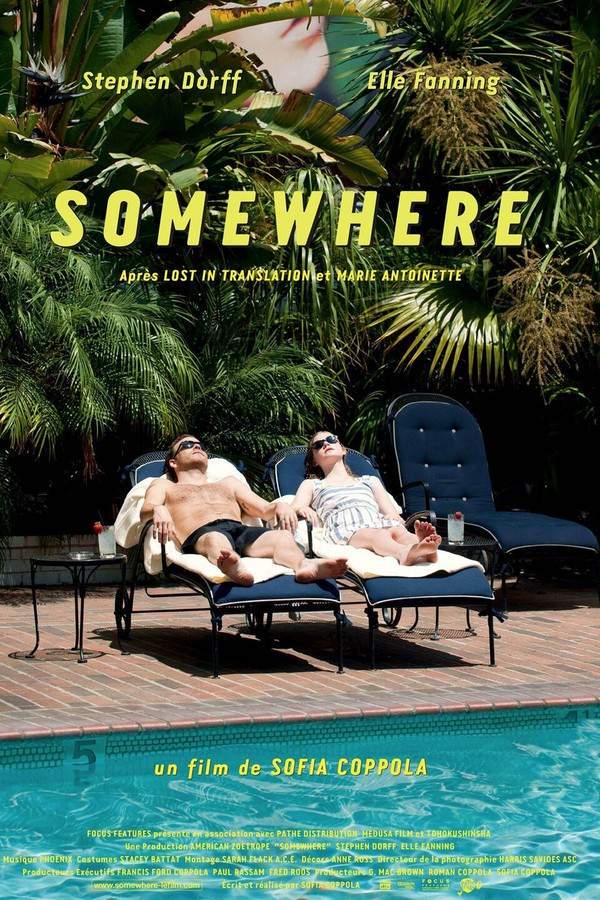
Johnny Marco, a recently divorced Hollywood actor, strides out of a black Ferrari that has just circled a desert race track, the roar of the engine fading as the scene settles. He is a man who rides high on fame but struggles to find real meaning in his daily life. Residing at the infamous Chateau Marmont in Los Angeles, he endures a plaster cast on a broken wrist and drifts through days marked by drinking, casual company, and a routine that mostly keeps him company when he’s alone. He spends hours behind the wheel, sips beer, takes pills, and? through the walls of his room, he watches a pair of pole-dancing twins perform, while he flirts with various women and aspiring stars, never quite filling the void that fame has created.
Into this carefully curated life arrives his 11-year-old daughter, Cleo, bringing a new kind of noise and a different kind of responsibility into his world. At first, Cleo’s visit barely nudges the balance of Johnny’s self-made existence, but their time together begins to chip away at the armor of his success. The two share moments inside his room, and the dynamic slowly shifts as they travel together for a publicity tour in Milan, where they stay in a lavish hotel suite and a blonde overnight guest adds a dash of complexity to Johnny’s carefully managed life.
On television, Johnny is a participant in a self-referential moment, being awarded a Telegatto as local celebrities play themselves, a small, almost ceremonial acknowledgment of his place in the celebrity machine. The interplay between his public obligations and his growing private concern for Cleo deepens as he tries to balance fatherly duties with the demands of his career. He helps Cleo prepare for summer camp, keeps her entertained on a gambling trip to Las Vegas, and even arranges a helicopter to drop her off at the camp, a sequence that underscores the disparity between his glamorous life and the more grounded responsibilities that are rising to the surface.
As their bond strengthens, Johnny experiences a genuine, if imperfect, surge of paternal feeling. He begins to reassess the life he’s built around fame, fortune, and a constant cycle of publicity. He reaches out to his ex-wife, tearfully admitting his inadequacies and unhappiness, hoping for some form of reconciliation or reassurance. But his ex-wife seems coolly indifferent and declines to visit him, leaving Johnny to confront the limits of what his fame can truly offer.
Ultimately, Johnny makes a decisive choice. He checks out of the hotel, promising not to return, and drives his Ferrari into the countryside, a symbolic retreat from the life he has known. He stops along a roadside, gets out, and walks away with a faint, almost hopeful smile, leaving behind the mirror of a life that looked perfect on the surface but felt hollow inside. The film closes on this quiet, ambiguous moment, a mix of release and uncertainty that invites viewers to read the same questions into Johnny’s future that he has learned to face in the present.