Year: 1982
Runtime: 115 mins
Language: Malayalam
Director: Adoor Gopalakrishnan
Unni, the final male heir of a crumbling feudal household in rural Kerala, clings to outdated customs. As the surrounding society modernizes, he cannot reconcile the changes, retreating deeper into his ancestral home. His resistance turns into growing isolation and mounting paranoia, casting the decaying estate as a symbolic rat‑trap.
Warning: spoilers below!
Haven’t seen Elippathayam yet? This summary contains major spoilers. Bookmark the page, watch the movie, and come back for the full breakdown. If you're ready, scroll on and relive the story!
Read the complete plot breakdown of Elippathayam (1982), including all key story events, major twists, and the ending explained in detail. Discover what really happened—and what it all means.
In Kerala, a middle-aged man Unni and his two sisters live in an aging tharavadu, a once-grand manor that has clearly seen better days, as the old feudal order quietly unravels around them.
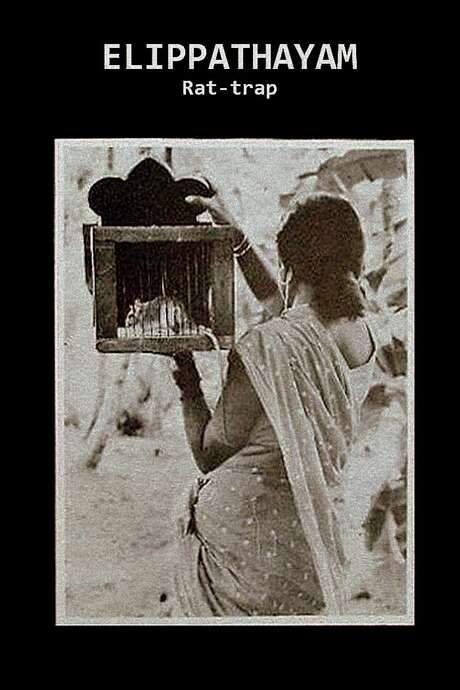
The film opens with a small but telling crisis: a rat problem that highlights the house’s stubborn logic and the people who try to manage it. Sreedevi takes the initiative to catch and drown the rats, a practical act that stands in contrast to the larger sense of helplessness that pervades the household. Unni, the patriarch, remains largely idle—even as thieves raid the crops—relying on his sisters and a neighbor caretaker to keep the estate afloat. His days are spent reading the newspaper, oiling his body, and accepting the status quo, while Scaria Mappila tends to the agricultural affairs and the family’s finances in a manner that clings to old feudal habits. He shows little interest in marriage prospects for his sisters and seems to fear any disruption to the fragile support system that still keeps him insulated from the outside world.
Rajamma, the middle sister, is deeply distressed by her brother’s silence and inaction when proposals for marriage come her way. Her distress grows as he refuses options deemed beneath the family’s prestige, and he remains unmoved even when she herself falls ill. This lack of intervention contributes to a slow, inexorable decline. Meanwhile, the youngest sister makes a bold break from tradition by eloping with a lover, a decision that the elder sister tries to formalize by pursuing her share of the property through court summons. The unresolved tensions within the family widen into a chasm that Unni cannot bridge, leaving him increasingly isolated in the mansion’s dark corners.
As the family frays, Unni’s grip on reality loosens—paranoia and delusions intensify, and he withdraws from any real support, feeling abandoned and misunderstood by the world outside. He becomes a solitary figure, haunted by the sense that he must defend a fading privilege against a changing society. The final act tightens the focus on his fragility: a group of people enters the house, and he bolts in fear, sustaining a blow that leaves him unconscious. They carry him toward the pond—an echo of Sreedevi’s earlier act of drowning rats—and toss him in, only for him to emerge from the water pale and chilled. Whether these intruders are real, imagined threats, robbers, or rivals seeking to seize the estate, remains ambiguous, and the ending leans into the ambiguity that suffuses his mind.
The film uses the metaphor of a “rat trap” to mirror a mind trapped in oblivion to the transforming world outside the manor walls. As the house decays, so too does the old order that Unni clings to, trapping him in a cycle of denial, fear, and isolation. The final image is not just of a man sinking or surviving a cold pond, but of a fading social structure that is unable to adapt, leaving behind a haunting question about who truly controls the fate of a family and its land.
Last Updated: October 09, 2025 at 14:56
Discover curated groups of movies connected by mood, themes, and story style. Browse collections built around emotion, atmosphere, and narrative focus to easily find films that match what you feel like watching right now.
Stories where a crumbling way of life consumes those who cling to it.Movies like Elippathayam that capture the slow, melancholic decay of traditional societies and the psychological toll on their inhabitants. If you were drawn to the atmosphere of a dying feudal world, these similar dramas explore themes of social obsolescence and emotional isolation.
Narratives in this thread typically follow a linear descent into decay, focusing on a protagonist's growing isolation and psychological breakdown as the world around them modernizes, leaving them behind. The story itself becomes a metaphor for irreversible loss and existential despair.
These films are grouped by their shared, heavy atmosphere of decline, a slow pacing that mirrors the gradual collapse, and a deep focus on the melancholic tone of a world and a mind succumbing to the weight of time and change.
Films where a character's own mind becomes their inescapable trap.If you liked the mounting paranoia and feeling of being trapped in Elippathayam, this list features similar slow-burn psychological dramas. These films explore characters whose mental state becomes a prison, creating a deeply atmospheric and unsettling viewing experience.
The narrative pattern involves a character retreating from external pressures into a confined space, which amplifies their internal fears and leads to a descent into paranoia. The plot is often minimal, serving to heighten the atmospheric unease and focus on the character's deteriorating mental state.
These films share a specific mood of claustrophobia and paranoia, achieved through slow pacing, a focus on a single setting, and a moderate narrative complexity that prioritizes psychological depth over external plot events, often leading to an ambiguous conclusion.
Don't stop at just watching — explore Elippathayam in full detail. From the complete plot summary and scene-by-scene timeline to character breakdowns, thematic analysis, and a deep dive into the ending — every page helps you truly understand what Elippathayam is all about. Plus, discover what's next after the movie.
Track the full timeline of Elippathayam with every major event arranged chronologically. Perfect for decoding non-linear storytelling, flashbacks, or parallel narratives with a clear scene-by-scene breakdown.
Discover the characters, locations, and core themes that shape Elippathayam. Get insights into symbolic elements, setting significance, and deeper narrative meaning — ideal for thematic analysis and movie breakdowns.
Get a quick, spoiler-free overview of Elippathayam that covers the main plot points and key details without revealing any major twists or spoilers. Perfect for those who want to know what to expect before diving in.
Visit What's After the Movie to explore more about Elippathayam: box office results, cast and crew info, production details, post-credit scenes, and external links — all in one place for movie fans and researchers.
Discover movies like Elippathayam that share similar genres, themes, and storytelling elements. Whether you’re drawn to the atmosphere, character arcs, or plot structure, these curated recommendations will help you explore more films you’ll love.
Elippathayam (1982) Scene-by-Scene Movie Timeline
Elippathayam (1982) Movie Characters, Themes & Settings
Elippathayam (1982) Spoiler-Free Summary & Key Flow
Movies Like Elippathayam – Similar Titles You’ll Enjoy
Ratsasan (2018) Complete Plot Breakdown
Thilakkam (2003) Full Movie Breakdown
Rappakal (2005) Story Summary & Characters
Paruthiveeran (2007) Full Summary & Key Details
Perumthachan (1991) Complete Plot Breakdown
Rangam (1985) Detailed Story Recap
Ulsavapittennu (1989) Spoiler-Packed Plot Recap
Rat in the Kitchen (2023) Ending Explained & Film Insights
Priyappettavar (2021) Movie Recap & Themes
Ellam Sheriyakum (2021) Movie Recap & Themes
Unelma karjamajalla (1940) Ending Explained & Film Insights
Uthiripookkal (1979) Film Overview & Timeline
Ethir Neechal (1968) Movie Recap & Themes
Ullasappoonkattu (1997) Plot Summary & Ending Explained
The Rats (1997) Story Summary & Characters