Plot Explained Spoilers guaranteed!
Plot Explained

Browse by genre

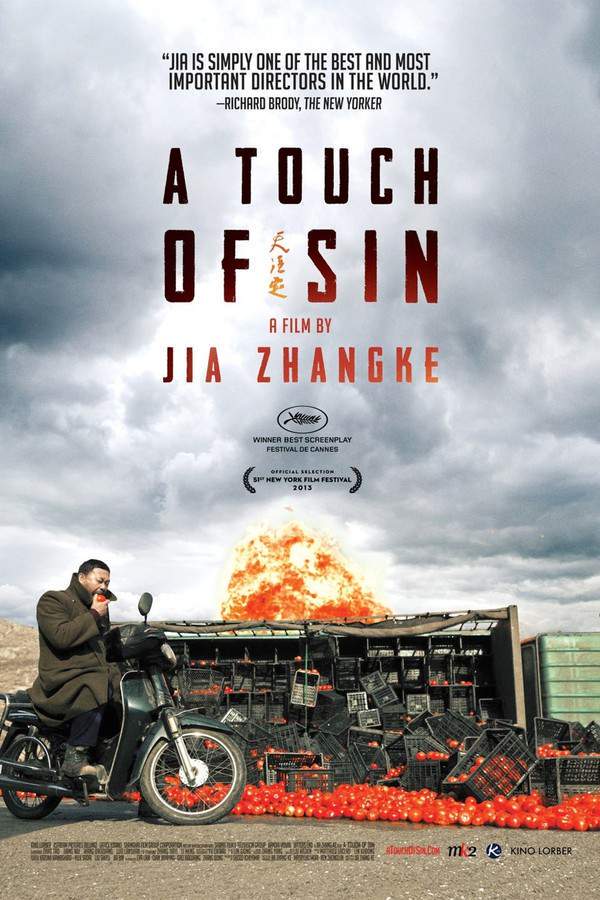
A Touch of Sin (2013) movie poster

Plot Summary

A Touch of Sin (2013) Plot Summary Explained

Release, runtime and language
2013 · 133 min · Chinese
JustWatch #10,958 15
Directed by
Zhang Ke Jia

This gripping drama explores the consequences of desperation and corruption. A miner's rage explodes against a corrupt system, while a wanderer discovers a sense of power through firearms. A sauna receptionist fights back against exploitative customers, and a factory worker struggles to survive degrading working conditions. Each individual's story reveals a disturbing glimpse into the darker aspects of human behavior and the lengths people will go to when pushed to their limits.

On this page (6)
  1. 1 Where to watch
  2. 2 What happens: full plot
  3. 3 Plot questions answered
  4. 4 Movie threads
  5. 5 Movies like A Touch of Sin
  6. 6 Every angle

Where to watch

Where to Watch A Touch of Sin (2013)

Where can you watch A Touch of Sin? Stream, rent or buy it in the US, including on Kino Film Collection, Kanopy and Apple TV Store: current JustWatch availability with up-to-date prices.

Streaming availability powered by JustWatch

Full plot summary · contains spoilers

What Happens in A Touch of Sin: Full Plot Summary

The whole story of A Touch of Sin (2013) explained, from the opening scene to the final frame: every key event, every twist and what it all adds up to. Read it as a quick recap before the sequel, to check a scene you missed, or to finally understand what really happened.

The cinematic tale unfolds through a series of vivid vignettes set against the colorful backdrop of China, inspired by real events that have left their mark on the nation. One storyline follows San'er, who sets out on a solo expedition across the picturesque landscapes of rural Shanxi with his motorbike as a steadfast companion. His journey is abruptly interrupted when he encounters three unscrupulous men attempting to steal from him. Undeterred, San'er reveals a pistol, taking decisive action to defend himself and expertly dispatches the would-be thieves.

In another thread of the narrative, we meet Dahai, who rises as the unofficial champion for laborers at a privatized coal mine situated in a small, struggling village. Fueled by his discontent over the bleak contrast between the villagers' dire poverty and the lavish lifestyles of the local officials—pillars of corruption sustained by deceit and fraud—he embarks on a mission to seek justice. Throughout his journey, Dahai faces both support and hostility from the community as his determination intensifies.

The climax of Dahai's quest leads to a dramatic confrontation with the mine's owners, the Jiaos, who respond to his pleas with mockery and dismissal. The villagers watch in despair as one of the Jiaos' henchmen brutally assaults Dahai, leaving him hospitalized. In a shocking attempt to silence him, the Jiaos' representatives approach his bedside, offering him silence through monetary compensation.

As he recuperates, Dahai pays a visit to his sister, renewing his vow for retribution against those who've caused his village great suffering. His path soon grows darker as he hunts for written confessions from the village accountant and his wife, who meet him with disdain. Consumed by rage, Dahai exacts a brutal revenge, shooting several who contributed to his pain, including the village chief and Mr. Jiao. As law enforcement closes in, he stands amidst the carnage, claiming a sinister victory.

This segment draws inspiration from the chilling true story of Hu Wenhai and his infamous actions in 2001.

Meanwhile, San'er returns to Chongqing for the Chinese New Year celebrations, coinciding with his mother's important birthday. As he prepares for the festivities, the origins of his newfound wealth begin to surface. His estranged wife questions the source of his affluence, while San'er finds fleeting joy in celebrating with his son during a midnight fireworks display. As the celebrations mellow, San'er purchases bus tickets to seemingly arbitrary locations, skillfully dodging his wife's scrutiny.

The grim reality behind San'er's riches gradually unfolds as he makes his way to town, methodically executing a couple and stealing from a bystander. San'er then departs Chongqing, leaving the audience to grapple with the unsettling remnants of his mental state.

The arc of Xiaoyu intertwines with San'er's story, her tumultuous affair with a married man named Youliang spiraling towards an ultimatum: he must choose to divorce his wife within six months or lose her forever. As their chaotic relationship unfurls, Xiaoyu faces increasing turmoil in her life. A chance encounter at the spa leads to a violent confrontation with Youliang's wife and her hired enforcers, plunging Xiaoyu into a chaotic series of events that culminates in her witnessing the brutality inflicted upon a co-worker by corrupt officials demanding exorbitant tolls.

As the night darkens, Xiaoyu herself becomes a target during an encounter with the same authorities, enduring a harrowing and violent experience. The breaking point arrives when they require her to barter sexual favors for their clemency. In an act of defiance and desperation, she retaliates against one official using a fruit knife abandoned by Youliang. Staggered by the ramifications of her actions, she reaches out to emergency services, confessing to her crime.

Inspired by the Deng Yujiao incident which reverberated throughout China in 2009, Xiaoyu's poignant journey leads her back to her hometown in Shanxi, where she finds herself before an old factory now overseen by the inscrutable Mrs. Jiao. Her past and present collide as she steps into an interview room, now tinged with unease and anticipation. Amidst this tension, she encounters a moving public opera performance that captivates her and resonates deeply within.

On stage, an eloquent opera performer poses a thought-provoking question to the audience: > "Do you understand your sin?" This query hangs heavily in the air, urging those present to confront their inner ethical dilemmas. As Xiaoyu watches, spellbound by the depth of the performance, she feels an uncanny bond with the profound question, igniting a contemplative fire within her soul.
Last updated: November 22, 2024 at 19:03

Was this helpful?

Plot questions answered

A Touch of Sin Plot Explained: Your Questions Answered

The questions people ask most about A Touch of Sin (2013): what happens in the confusing scenes, why the characters do what they do, the twists, hidden details and what the ending means. Each answer contains spoilers.

Q1

Why does San'er kill the three men who try to rob him?

San'er kills the three robbers in self-defense after they attempt to steal from him during his solo motorbike journey through rural Shanxi. When they surround him and try to take his belongings, he draws a pistol he has secretly obtained and shoots them all. This moment marks his first use of the gun, establishing the theme of how vulnerable people discover power through violence.

Foreshadowing: The pistol he carries foreshadows his later murders in Chongqing, showing how easily the tools of protection become tools of aggression.

  • san'er
  • thieves
  • self-defense
  • gun
  • robbery
  • shanxi
Q2

What causes San'er to start killing people and stealing?

After returning to Chongqing for Chinese New Year, San'er reveals that his sudden wealth comes from murdering a couple and stealing from a bystander. The film suggests his exposure to violence during the robbery attempt, combined with his marginal social position, triggers a transformation. He purchases bus tickets to seemingly random destinations, indicating his detachment from normal life and his growing lawlessness.

Foreshadowing: His possession of the pistol and his comfort with using it against the thieves set the groundwork for his later crimes.

  • san'er
  • murder
  • theft
  • chongqing
  • wealth
  • transformation
Q3

What drives Dahai to commit revenge killings?

Dahai's violent path stems from desperation after confronting corrupt mine owners, the Jiao family. After being mocked by the Jiaos, beaten by their henchman, and offered hush money in the hospital, his quest for justice turns to rage. He kills the village accountant, his wife, the village chief, and Mr. Jiao, believing these people have destroyed his village through corruption and exploitation.

Foreshadowing: His role as a champion for laborers establishes his moral compass, which breaks when the system crushes him.

  • dahai
  • revenge
  • corruption
  • jiao family
  • village
  • miners
Q4

What happens to Dahai after his revenge killing spree?

After shooting several people he holds responsible for his village's suffering, including the village chief and Mr. Jiao, Dahai is surrounded by law enforcement. The film ends with him standing amid the carnage, appearing to claim victory even as capture or death awaits him. His story draws from the real Hu Wenhai case of 2001.

Foreshadowing: His sister's warning and his increasingly obsessive behavior foreshadow his violent breakdown.

  • dahai
  • ending
  • police
  • hu wenhai
  • death
Q5

Why does Xiaoyu kill the corrupt official with a fruit knife?

Xiaoyu kills the official after he and other corrupt authorities demand she perform sexual favors in exchange for her release from custody. This follows her violent confrontation with Youliang's wife and her enforcers at the spa. Unable to bear the exploitation any longer, she grabs a fruit knife left by Youliang and attacks the official, then calls emergency services to confess.

Foreshadowing: Her history of being exploited throughout the film builds to this breaking point.

  • xiaoyu
  • official
  • fruit knife
  • sexual favors
  • corruption
  • defiance
Q6

What is the Deng Yujiao incident that inspired Xiaoyu's story?

Xiaoyu's storyline is inspired by the real 2009 Deng Yujiao case, where a woman killed a local official after being demanded sexual favors for her release. The film directly references this incident, showing how systemic abuse of power can drive desperate people to violent retaliation.

Foreshadowing: The repeated pattern of officials exploiting their power over vulnerable people connects to this real case.

  • deng yujiao
  • 2009
  • real event
  • xiaoyu
  • officials
Q7

Why does Xiaoyu return to her hometown at the end?

After killing the corrupt official, Xiaoyu returns to her hometown in Shanxi, where she is interviewed at what appears to be a police station or government building overseen by Mrs. Jiao (the wife of the mine owner from Dahai's story). She wanders through her old neighborhood and becomes captivated by a public opera performance, suggesting she is seeking answers about her own actions and moral state.

Foreshadowing: The themes of corruption and desperation that plagued her in the city follow her home.

  • xiaoyu
  • hometown
  • shanxi
  • return
  • opera
Q8

What does the opera question "Do you understand your sin?" mean?

The opera performer asks the audience if they understand their sin, and Xiaoyu watches transfixed. This moment serves as the film's thematic climax, asking viewers to contemplate moral responsibility. Each character has committed acts they might consider sinful, violence, murder, corruption, but the film suggests systemic injustice drives these actions. The ambiguous ending leaves whether Xiaoyu understands her own sin open to interpretation.

Foreshadowing: This question resonates with all four protagonists' choices throughout the film.

  • opera
  • sin
  • question
  • meaning
  • xiaoyu
  • theme
Q9

How are the four main characters' stories connected?

The four characters, San'er, Dahai, Xiaoyu, and a fourth unnamed worker, do not physically meet but are thematically connected through shared experiences of desperation, corruption, and violence. All four stories are inspired by real events in China and explore how ordinary people respond when pushed beyond their limits by systemic injustice. The film weaves between their separate narratives to show how corruption affects different aspects of Chinese society.

Foreshadowing: The opera scene at the end ties their stories together through the universal theme of sin.

  • characters
  • connection
  • thematic
  • vignettes
  • four stories
Q10

Why does San'er buy bus tickets to random locations after his crimes?

After committing murder in Chongqing, San'er purchases bus tickets to arbitrary destinations while avoiding his wife's questions about his wealth. This behavior suggests he has no real plan or destination, showing his psychological detachment from normal life. He appears to be wandering aimlessly, perhaps seeking his next adventure or simply escaping consequences.

Foreshadowing: His earlier solo journey across Shanxi established his pattern of aimless movement.

  • san'er
  • bus tickets
  • escape
  • wandering
  • chongqing
Q11

Why does Dahai target the village accountant and his wife?

Dahai hunts down the village accountant and his wife because he believes they have records of the corruption and fraud that have impoverished the village. When they refuse to give him the documents and treat him with disdain, his rage intensifies. He shoots them both as part of his broader revenge against those he holds responsible for his village's suffering.

Foreshadowing: His earlier attempts to seek justice through proper channels have failed, pushing him toward extra-legal violence.

  • dahai
  • accountant
  • documents
  • corruption
  • revenge

Movie threads

More Movies Like A Touch of Sin, by Mood & Story

Curated lists built around what makes A Touch of Sin tick: the same mood, the same kind of story or the same emotional payoff. Each list explains why these movies belong together.

Movies about desperate revenge like A Touch of Sin

Characters pushed to violent extremes by an unforgiving and corrupt system. For viewers seeking films like A Touch of Sin, this thread features gritty dramas where characters are driven to violence by a corrupt society. If you appreciated the themes of social injustice and personal retribution, you will find similar stories of moral decay and explosive desperation here.

  • angry
  • brutal
  • desperate
  • oppressive
  • gritty
  • unsettling
  • Tone: dark, confrontational
  • Pacing: steady, methodical
Why these movies?

The story pattern: Narratives in this thread often follow a clear downward trajectory: characters face mounting pressure from a corrupt or indifferent system, their frustration and desperation grow until a breaking point is reached, culminating in an act of violent retribution that challenges both the character's morality and the audience's sympathies.

Why they belong together: Movies are grouped here based on their shared exploration of societal breakdown as a catalyst for personal violence. They possess a dark, confrontational tone, heavy emotional weight, and a focus on the psychological toll of injustice, creating a cohesive experience of bleak, impactful cinema.

Anthology films of social decay like A Touch of Sin

Interwoven stories that paint a bleak portrait of a morally bankrupt society. If you liked the interconnected story structure of A Touch of Sin, this collection features similar movies that use multiple narratives to explore themes of corruption and desperation. Discover other complex dramas that build a larger, grim picture of society through separate but thematically linked vignettes.

  • unsettling
  • complex
  • gritty
  • oppressive
  • thought-provoking
  • bleak
  • Tone: dark, unsettling
  • Pacing: steady, deliberate
Why these movies?

The story pattern: These films feature several distinct storylines that run parallel, occasionally intersecting or simply echoing each other's themes. The narrative pattern avoids a single protagonist, instead building a cumulative argument or mood. The complexity arises from connecting the discrete threads into a cohesive, often damning, whole.

Why they belong together: These films are grouped by their shared multi-perspective structure and their thematic focus on the darker aspects of contemporary life. They deliver a complex, steady-paced viewing experience defined by a dark tone and an ambiguous, thought-provoking conclusion that asks the audience to synthesize the meaning.

If you liked this

Movies Like A Touch of Sin

Similar movies to A Touch of Sin: the same genre, themes or kind of story. Each one comes with its own plot summary, timeline and ending explained.

Browse all movie summaries

Every angle

A Touch of Sin (2013) Explained: Plot, Timeline & Characters

Everything about A Touch of Sin in one place: what happens in the plot summary, the timeline in chronological order, the characters and meaning and a spoiler-free summary. What's After the Movie adds the cast, box office and post-credit scenes.

Coming soon on iOS and Android

The Plot Explained Movie Summary App

Plot summaries, endings explained and timelines on your phone. Catch up on any movie in minutes, save your favorites and never miss a twist again.

Be the first to know when we launch. Your email stays private, always.

Learn more about the app