Plot Explained Spoilers guaranteed!
Plot Explained

Browse by genre

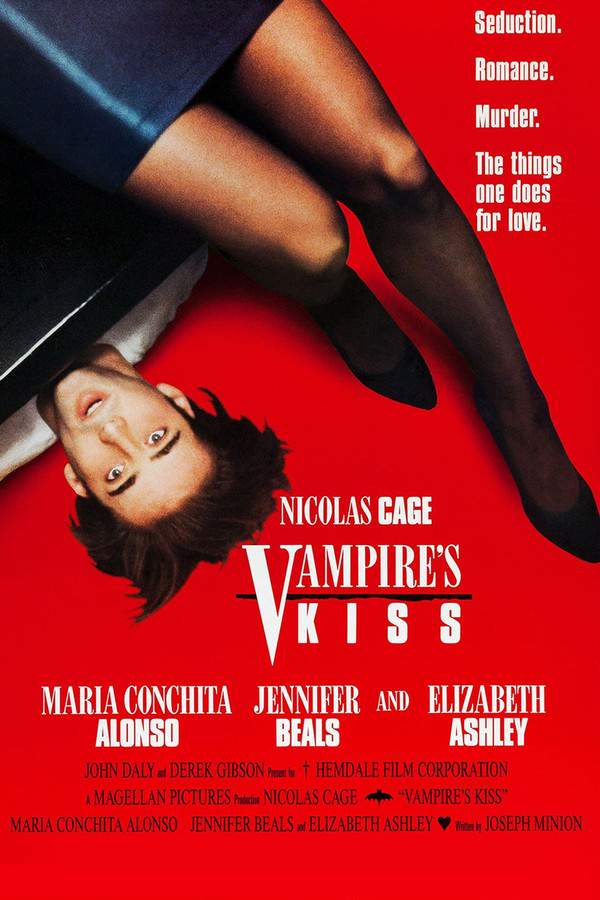
Vampire's Kiss (1989) movie poster

Plot Summary

Vampire's Kiss (1989) Plot Summary Explained

Release, runtime and language
1989 · 103 min · English
Directed by
Robert Bierman
Starring
Nicolas Cage, Maria Conchita Alonso

Literary editor Peter Loew finds himself drawn into a passionate and unsettling relationship with a mysterious woman. As their affair intensifies, she reveals a startling secret—she bites him. Convinced he is transforming into a vampire, Peter grapples with the bizarre experience, embracing a nocturnal existence while navigating the everyday realities of life in New York City, leading him down a path of chaos and self-discovery.

On this page (6)
  1. 1 Where to watch
  2. 2 What happens: full plot
  3. 3 Plot questions answered
  4. 4 Movie threads
  5. 5 Movies like Vampire's Kiss
  6. 6 Every angle

Where to watch

Where to Watch Vampire's Kiss (1989)

Where can you watch Vampire's Kiss? Stream, rent or buy it in the US, including on Hoopla, Kanopy and Fandango at Home Free: current JustWatch availability with up-to-date prices.

Streaming availability powered by JustWatch

Full plot summary · contains spoilers

What Happens in Vampire's Kiss: Full Plot Summary

The whole story of Vampire's Kiss (1989) explained, from the opening scene to the final frame: every key event, every twist and what it all adds up to. Read it as a quick recap before the sequel, to check a scene you missed, or to finally understand what really happened.

Peter Loew, portrayed by Nicolas Cage, is a literary agent driven by overwhelming ambition, relentlessly chasing after wealth and status. However, as he climbs the ladder of success, his mental health begins to deteriorate. His days are consumed by a tireless pursuit of accolades, while his nights are filled with the hedonistic pleasures of nightlife—where he finds momentary solace in the arms of various women and the intoxicating embrace of cocaine and alcohol. Despite attending regular therapy sessions, Peter's grasp on reality weakens, eliciting growing concern from his therapist over the bizarre and unnerving nature of his rants.

One fateful night, a bat unexpectedly swoops into his apartment, prompting panic and chaos as he seeks safety alongside a woman he had just brought home. Although initially rattled, Peter feels a strange rush of exhilaration that he eagerly shares with his therapist during their next meeting, claiming it has awakened something deep within him.

Yet, this brief flicker of excitement quickly fades, as Peter’s focus shifts upon meeting Rachel at a nightclub. The chemistry is electric as they leave together, but the night takes a darker twist when Rachel reveals her vampiric nature, sinking her fangs into Peter's neck. The following morning, despite appearing unscathed, Peter's belief in his own reality begins to unravel completely.

Days turn into nights, and Peter grows increasingly paranoid, convinced that he is metamorphosing into a vampire. His efforts to confirm this transformation through mirrors only fuel his delusions, leading him to wear dark sunglasses indoors and dress a non-existent wound on his neck. This fixation on Rachel's nightly visits heightens his anxiety, as he becomes consumed with the idea that she is draining his life force under the cover of darkness.

As Peter's erratic behavior escalates, it begins to impact his relationships, including with Jackie—who once reveled in the whirlwind of his lifestyle. When Peter reaches out to apologize and make amends, Rachel's sudden appearance at his doorstep casts a shadow over their already strained relationship. As Peter stumbles through the blurred lines of reality and fantasy, it becomes increasingly clear that his spiral into madness is just beginning.

In a chilling turn of events, Alva Restrepo finds herself caught in Peter's escalating sadism. Initially subjected to his endless demand for paperwork, she later endures a harrowing encounter at her home where he manipulates her to return to work. When she fails to produce the desired contract, Peter’s frustration boils into violence, leaving Alva shaken.

His descent into madness is further compounded by hallucinations of Rachel, who he believes is omnipresent. In a shocking moment of self-inflicted harm, he fires a blank gun into his mouth, feeling momentarily invulnerable. With a newfound obsession with vampiric aesthetics, Peter dons novelty fangs and attends a nightclub, imitating the ghastly movements of Orlok from "Nosferatu." His behavior deteriorates rapidly as he attempts, and fails, to seduce a woman, transforming his advances into aggression and resulting in a brutal assault.

The real Rachel makes an unexpected appearance at the nightclub, but her distant demeanor suggests she is consciously avoiding him. As Peter, now completely unhinged, tries to confront her, he is thwarted by her date, leading to security dragging him away from the escalating chaos.

Meanwhile, Alva, now disoriented and exposed, reflects on the possibility of her brutal assault. Her brother Emilio, fueled by rage, seeks revenge on Peter, while Alva grapples with the aftermath of the traumatic encounter. Peter, in a state of disarray, roams the streets, his business attire drenched in blood from previous violent incidents. He engages in a twisted monologue with his therapist, confessing to a slew of heinous acts, including rape and murder, as a newspaper headline ominously echoes the brutal reality of his actions.

Upon returning to the wreckage of his apartment, Alva identifies Peter to Emilio, who chases him down with a tire iron. Amidst a volatile confrontation with a figment of his imagination, Peter's mental state continues to disintegrate. Overcome with guilt and the blood he has consumed, he crawls beneath an overturned sofa, seeking solace like a coffin. Emilio confronts him, and in a fit of rage, plunges a makeshift stake into Peter, sealing his fate.

In his final moments, as life ebbs away, Peter is haunted by the spectral figure of Rachel, her gaze piercing into him as if beckoning him to join her in the shadows.

Last updated: November 19, 2024 at 16:56

Was this helpful?

Plot questions answered

Vampire's Kiss Plot Explained: Your Questions Answered

The questions people ask most about Vampire's Kiss (1989): what happens in the confusing scenes, why the characters do what they do, the twists, hidden details and what the ending means. Each answer contains spoilers.

Q1

Why does Peter become convinced he is turning into a vampire after Rachel bites him?

Peter's belief that he is transforming into a vampire stems from a combination of factors. Rachel actually bites him on the neck during their encounter, which gives him a real physical basis for his obsession. However, Peter's pre-existing mental instability, exacerbated by his cocaine use, alcohol consumption, and lack of sleep, causes him to catastrophically misinterpret this event. He becomes hyper-focused on the bite mark, convinced that Rachel is visiting him nightly to drain his life force, even though the audience never clearly sees these encounters occur. His paranoid delusions spiral outward from this central fear.

Foreshadowing: The bat that flies into Peter's apartment earlier serves as the initial trigger that awakens his obsession with the supernatural.

  • peter loew
  • vampire delusion
  • mental breakdown
  • rachel bite
  • paranoia
Q2

Is Rachel actually a vampire or just a figment of Peter's imagination?

The film deliberately leaves this ambiguous, never confirming whether Rachel is a real vampire or merely a woman Peter met who happened to bite him during a passionate encounter. What matters more than the literal truth is that Peter becomes completely consumed by the vampire narrative he constructs around her. He hallucinates her presence constantly, even when she is not there. The real Rachel eventually avoids him entirely when she sees him acting erratically at the nightclub, suggesting she was never the supernatural entity he imagined.

Foreshadowing: Peter's therapist grows increasingly concerned about the bizarre nature of his stories, hinting that his perception may be distorted.

  • rachel
  • vampire
  • real or imagined
  • delusion
  • ambiguity
Q3

Why does Peter become violent toward Alva Restrepo?

Peter's violence against Alva stems from his deteriorating mental state and displaced rage. As his grip on reality loosens, he channels his frustrations onto those he perceives as failures or obstacles. When Alva cannot produce the contract he demands, Peter's frustration explodes into physical assault. His violence is not strategic, it is impulsive, reflecting his complete collapse of impulse control and his twisted belief that he now has supernatural power and immunity from consequences.

Foreshadowing: Peter's escalating bizarre behavior and bizarre rants during therapy sessions foreshadow his willingness to act on his darkest impulses.

  • alva restrepo
  • violence
  • assault
  • mental deterioration
Q4

What triggers Peter's rapid mental deterioration?

Peter's breakdown is triggered by a combination of accumulated stressors rather than any single event. His relentless ambition has already compromised his mental health, and his hedonistic lifestyle of cocaine, alcohol, and casual sex has eroded his ability to cope. The bat incident and Rachel's bite provide the catalyst, a supernatural narrative that his unstable mind seizes upon and cannot release. Once he becomes convinced he is transforming into a vampire, his reality begins to fragment completely, accelerating into paranoia, hallucinations, and violent outbursts.

Foreshadowing: Peter's therapist notes concerning changes in his behavior well before the vampire obsession takes hold.

  • mental breakdown
  • delusion
  • cocaine
  • ambition
  • psychosis
Q5

Does Peter actually commit the crimes he confesses to?

The film never confirms whether Peter's confessions to his therapist regarding rape and murder are factual or delusional. Given his severe mental break and the unreliable narration throughout, the audience cannot verify his claims. He confesses in a dissociative state, possibly constructing a narrative that matches his vampire fantasy, he has convinced himself he is a monster, so he confesses to monstrous acts. Whether these crimes actually occurred remains intentionally unclear, adding to the film's unsettling ambiguity.

Foreshadowing: Peter's earlier delusion of invulnerability after putting a blank gun in his mouth suggests he has detached from reality.

  • confession
  • rape
  • murder
  • delusion
  • validity
Q6

What is the significance of the bat flying into Peter's apartment?

The bat incident serves as the psychological trigger for Peter's entire vampire obsession. When the bat enters his apartment and he panics alongside a woman he just met, he experiences an unexpected rush of exhilaration that he eagerly shares with his therapist. This moment plants the seed of supernatural thinking in his mind. The bat represents the collision of his mundane life with something dark and Other, which his unstable mind then fixates on after Rachel's bite.

Foreshadowing: The bat's intrusion disrupts Peter's ordinary reality, introducing an element of primal fear that becomes intertwined with his later delusions.

  • bat
  • supernatural
  • trigger
  • inciting incident
Q7

Why does Peter become obsessed with avoiding mirrors?

Peter avoids mirrors because he believes that as a vampire, he should have no reflection, a classic vampire lore element. This obsession reveals how completely he has internalized the vampire identity. He wears sunglasses indoors to avoid seeing his reflection and fixates on a non-existent wound on his neck. His avoidance of mirrors is both a symptom of his delusion and a physical manifestation of his refusal to confront who he is becoming.

Foreshadowing: This behavior directly follows his paranoid belief that Rachel is draining his life force each night.

  • mirrors
  • vampire lore
  • reflection
  • delusion
Q8

What triggers the final confrontation between Peter and Emilio?

The final confrontation is triggered by Alva identifying Peter to her brother Emilio after she has been assaulted and traumatized. Emilio, fueled by rage and a desire for revenge, tracks Peter down to his apartment. Peter, now completely unraveled and roaming the streets in blood-soaked clothes, returns to find Emilio waiting. The confrontation represents the inevitable consequences of Peter's violent actions catching up with him, as well as the external reality that intrudes on his delusional fantasy.

Foreshadowing: Alva's traumatic encounter with Peter and her brother's vow of revenge set the collision course for the film's climax.

  • emilio
  • confrontation
  • revenge
  • alva
  • finale
Q9

What happens to Peter at the end and what does his death symbolize?

Peter is killed when Emilio strikes him with a makeshift stake, mirroring the vampire death he perhaps imagined for himself. In his final moments, Peter crawls beneath an overturned sofa like a coffin, overwhelmed by guilt and the blood he has consumed, literal and symbolic. He sees Rachel's spectral figure, seemingly beckoning him into death. His death represents the ultimate consequence of his self-destruction: he became the monster he believed he was, and his fantasy of supernatural power leads to his violent, meaningless end.

Foreshadowing: Peter's earlier obsession with vampire aesthetics and his fantasy of invulnerability foreshadow this dark conclusion.

  • death
  • stake
  • emilio
  • rachel
  • ending
  • symbolism
Q10

Why does Peter fire a blank gun into his mouth?

Peter fires a blank gun into his mouth as an act of delusional bravado meant to prove his invulnerability as a vampire. He believes he has transcended mortality and wants to test whether he can survive a gunshot wound. This horrific moment demonstrates how completely Peter has lost touch with reality and how his vampire fantasy has warped his judgment. He feels momentarily powerful and invincible, a false triumph that intensifies his subsequent descent.

Foreshadowing: This act follows directly from Peter's belief that he has become invulnerable like a vampire.

  • blank gun
  • self-harm
  • invulnerability
  • delusion

Movie threads

More Movies Like Vampire's Kiss, by Mood & Story

Curated lists built around what makes Vampire's Kiss tick: the same mood, the same kind of story or the same emotional payoff. Each list explains why these movies belong together.

Urban Descent into Madness stories like Vampire's Kiss

Stories of characters unraveling psychologically within isolating city landscapes. Find movies like Vampire's Kiss that explore psychological breakdowns in urban isolation. If you enjoyed the chaotic unraveling of a mind against a bleak cityscape, these films feature similar themes of madness, alienation, and disturbing character studies set in metropolitan environments.

  • unhinged
  • paranoid
  • claustrophobic
  • disturbing
  • delusional
  • anxious
  • Tone: dark, paranoid, disturbing
  • Pacing: variable, building to chaotic outbursts
Why these movies?

The story pattern: These narratives typically follow a protagonist, often isolated or disillusioned, whose grip on reality weakens as they navigate the impersonal forces of a large city. The story is driven by their subjective and increasingly unreliable perspective, leading to escalating paranoia and often destructive behavior, culminating in a bleak or tragic endpoint with little hope of recovery.

Why they belong together: Movies are grouped here for their shared focus on a claustrophobic, first-person journey into psychosis, amplified by an urban setting. They create a similar vibe of anxiety and alienation through a combination of intense performances, chaotic pacing, and a dark, often bleak, emotional tone that leaves a heavy impact.

Unreliable Narrator Psychological Horrors similar to Vampire's Kiss

Horror films where the terror stems from a protagonist's fractured perception of reality. Discover psychological horror movies like Vampire's Kiss that use an unreliable narrator to blur reality. If you liked questioning the vampire delusion, these films feature characters whose perceptions are untrustworthy, creating surreal, disturbing, and intense horror experiences rooted in mental instability.

  • surreal
  • disturbing
  • delusional
  • psychological
  • unhinged
  • anxious
  • Tone: dark, surreal, disturbing
  • Pacing: variable, with slow builds and sudden chaos
Why these movies?

The story pattern: The narrative pattern hinges on the protagonist's subjective experience, which is presented as truth but is gradually revealed to be distorted by mental illness, addiction, or extreme stress. The plot unfolds as their delusions intensify, often incorporating supernatural or fantastical elements that may or may not be real, leading to a climax that confirms or deeply ambiguates the nature of the threat.

Why they belong together: These films are grouped together because they prioritize psychological terror over conventional scares, creating a uniquely unsettling and cerebral viewing experience. They share a dark tone, high intensity, and a heavy emotional weight by forcing the audience to intimately experience a character's crumbling sanity.

If you liked this

Movies Like Vampire's Kiss

Similar movies to Vampire's Kiss: the same genre, themes or kind of story. Each one comes with its own plot summary, timeline and ending explained.

Browse all movie summaries

Every angle

Vampire's Kiss (1989) Explained: Plot, Timeline & Characters

Everything about Vampire's Kiss in one place: what happens in the plot summary, the timeline in chronological order, the characters and meaning and a spoiler-free summary. What's After the Movie adds the cast, box office and post-credit scenes.

Coming soon on iOS and Android

The Plot Explained Movie Summary App

Plot summaries, endings explained and timelines on your phone. Catch up on any movie in minutes, save your favorites and never miss a twist again.

Be the first to know when we launch. Your email stays private, always.

Learn more about the app