Plot Explained Spoilers guaranteed!
Plot Explained

Browse by genre

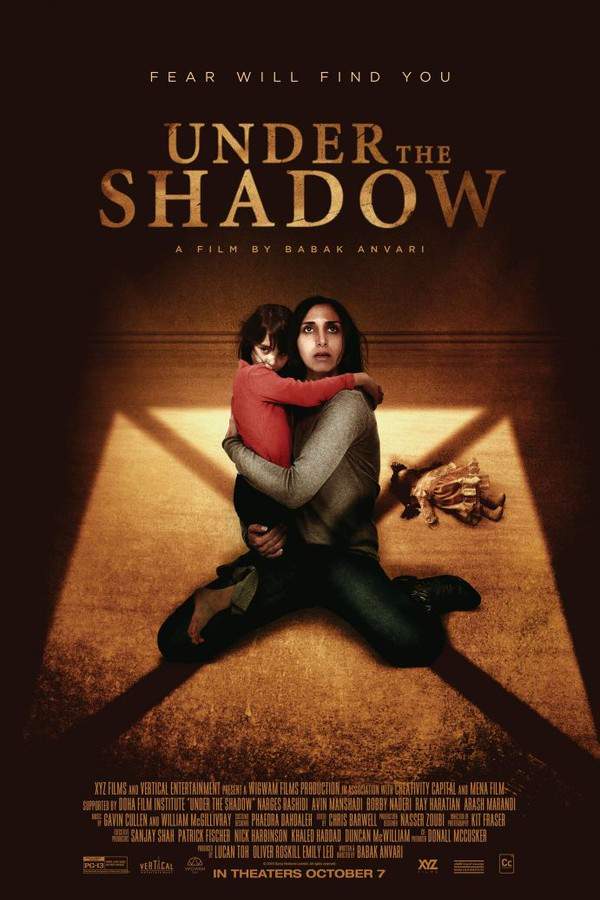
Under the Shadow (2016) movie poster

Plot Summary

Under the Shadow (2016) Plot Summary Explained

Release, runtime and language
2016 · 84 min · Persian
JustWatch #8,236 24
Directed by
Babak Anvari

During the Iran-Iraq war, a mother named Shideh is left to care for her young daughter, Dorsa, when her husband is conscripted. A terrifying missile attack unleashes supernatural forces, and Dorsa begins to exhibit disturbing behavior. As Shideh investigates, she suspects the presence of ancient Djinn spirits, and must fight to protect her daughter from a growing, sinister threat lurking within their Tehran apartment building.

On this page (6)
  1. 1 Where to watch
  2. 2 What happens: full plot
  3. 3 Plot questions answered
  4. 4 Movie threads
  5. 5 Movies like Under the Shadow
  6. 6 Every angle

Where to watch

Where to Watch Under the Shadow (2016)

Where can you watch Under the Shadow? Stream, rent or buy it in the US, including on Netflix, Netflix Standard and Hoopla: current JustWatch availability with up-to-date prices.

Streaming availability powered by JustWatch

Full plot summary · contains spoilers

What Happens in Under the Shadow: Full Plot Summary

The whole story of Under the Shadow (2016) explained, from the opening scene to the final frame: every key event, every twist and what it all adds up to. Read it as a quick recap before the sequel, to check a scene you missed, or to finally understand what really happened.

In the war-torn, post-revolutionary Tehran of the 1980s, Shideh, a former medical student, is prevented from continuing her education due to her association with leftist student groups. Although she discards her medical textbooks, she clings to a book on medical physiology that was gifted to her by her late mother. As conflict escalates, Shideh chooses to remain in the city with her daughter, Dorsa, despite her husband Iraj's pleas to take them to the safety of his parents' home. Iraj, a doctor summoned for military duty, assures Dorsa that her beloved doll, Kimia, will guard her.

Their lives become intertwined with that of a boy from the Ebrahimi family. This boy, who lost his parents in an attack, moves in with his cousins. During a shelling, he shares a secret with Dorsa, gifting her a charm intended to fend off evil spirits. Intrigued yet skeptical, Shideh dismisses the charm after Dorsa mentions the boy's tale of the Djinn. Later, she learns from Mrs. Ebrahimi that the boy has been mute since the tragedy.

As the war rages on, Dorsa falls ill and both mother and daughter are haunted by terrifying nightmares. The intensity of Shideh’s PTSD from living in this chaotic environment deepens, though she refuses to acknowledge it. A missile strike leads to the disappearance of Kimia amid the chaos, throwing Dorsa into a state of distress as she claims to sense a strange entity in their home, compelling her to seek Kimia on the upper floor.

With the neighboring families departing in search of refuge, Mrs. Ebrahimi warns Shideh about the dangerous nature of djinns, who are known to possess the unsuspecting and take cherished possessions. As the building grows emptier, Shideh finds her own belongings mysteriously vanishing, which amplifies her anxiety. Nightmares escalate into terrifying visions of a ghostly chador. Eventually, Dorsa confesses she sees these same spirits, which fuels Shideh's determination to leave. However, Dorsa refuses to abandon their home until Kimia is recovered.

Shideh receives a distressing call that appears to be from Iraj, only for the voice to verbally attack her for being a negligent mother. In her search for Kimia, Shideh succumbs to despair upon discovering the doll in a mutilated state; she painstakingly repairs it with tape. Just as they prepare to escape, an air raid alarm causes panic.

Rushing to the shelter, Shideh hears Dorsa scream, inciting a wild fear that she may have left behind a ghostly version of her. She frantically returns to their dwelling only to be confronted by a terrifying apparition beneath their bed. Ultimately, she finds the real Dorsa and they manage to flee from a sinister presence. Driving towards Iraj's parents, Shideh faces a grim realization: Kimia's head has been abandoned, and her medical textbook remains in the djinn’s grasp, hinting that their nightmare may not be over just yet.
Last updated: November 02, 2024 at 12:04

Was this helpful?

Plot questions answered

Under the Shadow Plot Explained: Your Questions Answered

The questions people ask most about Under the Shadow (2016): what happens in the confusing scenes, why the characters do what they do, the twists, hidden details and what the ending means. Each answer contains spoilers.

Q1

Why does Shideh refuse to leave Tehran with her daughter?

Shideh's refusal to leave stems from her deep-seated defiance and trauma from the political upheaval. After being prevented from completing her medical education due to her leftist student group affiliations, she feels defeated by the regime and refuses to be displaced again. Additionally, leaving would mean admitting failure and accepting the government's control over her life. Her attachment to the apartment, her claimed space in a city that has already taken so much from her, makes departure feel like another loss.

Foreshadowing: Earlier scenes show Shideh discarding her medical textbooks but clinging to her mother's gifted physiology book, indicating her complex relationship with both her past ambitions and maternal bonds.

  • shideh
  • tehran
  • iran-iraq war
  • daughter dorsa
  • refusal to leave
Q2

What is the djinn haunting Shideh and Dorsa?

The djinn is an ancient Middle Eastern supernatural entity described as a spirit that can possess people and steal cherished belongings. Mrs. Ebrahimi explains that djinns are drawn to vulnerable individuals during times of chaos and upheaval. In the film, the djinn appears to target the apartment building's remaining residents, particularly targeting Dorsa after she receives the protective charm from the boy. The entity seems to feed on loss and displacement, manifesting as a ghostly figure in a black chador.

Foreshadowing: The boy who lost his parents in an attack gives Dorsa a charm specifically designed to ward off evil spirits, establishing the djinn's presence early in the narrative.

  • djinn
  • supernatural
  • spirit
  • haunting
  • chador
  • iranian folklore
Q3

Why does Dorsa start seeing the spirits?

Dorsa begins seeing spirits after receiving the protective charm from the boy, which may have actually opened her perception to the supernatural world. Her illness and weakened state during the war make her more vulnerable to djinn influence. Additionally, the trauma of losing her doll Kimia during the missile attack creates an emotional opening for the entity to connect with her. The film suggests children are more sensitive to the djinn's presence, as Shideh initially cannot see what Dorsa sees.

Foreshadowing: The boy warns Dorsa about djinns and gives her the charm specifically because he understands the danger, hinting at his own traumatic encounter with these entities.

  • dorsa
  • spirits
  • visions
  • child
  • djinn
  • supernatural perception
Q4

What happened to the boy who gave Dorsa the protective charm?

The boy from the Ebrahimi family lost both his parents in a bombing attack, which is why he now lives with his cousins. The trauma of witnessing his parents' death has rendered him mute, he has not spoken since the tragedy. Despite his silence, he still possesses knowledge about djinns and how to protect against them, likely learned from his cultural background or perhaps from his own encounter with the supernatural. His gift of the charm to Dorsa is his way of sharing protection after experiencing loss himself.

Foreshadowing: Mrs. Ebrahimi reveals the boy's muteness as evidence of his traumatic experience, connecting the supernatural knowledge he shares with his personal tragedy.

  • ebrahimi boy
  • charm
  • muted
  • parents death
  • protective charm
Q5

Why does the phone call from Iraj turn into a voice attacking Shideh?

The phone call represents the djinn's ability to manipulate and weaponize Shideh's deepest fears and guilt. The entity intercepts or mimics Iraj's voice to psychologically attack Shideh about her perceived failures as a mother. This supernatural intrusion preys on her isolation and the constant worry about protecting Dorsa during the war. The call is not actually from Iraj, it's the djinn exploiting Shideh's internal monologue about her inadequacy, using her husband's voice as a psychological weapon.

Foreshadowing: Shideh's anxiety about being a good mother while trapped in a dangerous city has been building throughout the film, making her vulnerable to this type of psychological attack.

  • phone call
  • djinn
  • psychological attack
  • ijraj
  • shideh guilt
Q6

What does the ending mean with Kimia's head and the textbook?

The ending suggests that Shideh and Dorsa have not truly escaped the djinn's influence. The severed doll's head left behind serves as the entity's claim over them, while taking Shideh's medical textbook, her last connection to her mother and her abandoned medical career, indicates the djinn will continue to haunt them psychologically. The open ending implies their trauma and the supernatural threat will persist even in physical safety, leaving their fate ominously unresolved.

Foreshadowing: Shideh's attachment to the textbook symbolizes her unresolved past and lost identity, making it a meaningful object for the djinn to claim.

  • ending
  • kimia
  • doll
  • textbook
  • medical book
  • unresolved
  • cliffhanger
Q7

Why does the djinn specifically target Dorsa's doll Kimia?

The djinn targets Kimia because dolls represent vulnerable children, making them ideal vessels for supernatural entities. Djinns are said to take cherished possessions, and Kimia is Dorsa's most treasured item, her only comfort during wartime trauma. By taking Kimia, the djinn gains power over both the doll and Dorsa's emotional state. The entity seems to understand that attacking a child's beloved object causes maximum psychological damage to the family.

Foreshadowing: Iraj specifically tells Dorsa that Kimia will guard her, establishing the doll's protective significance before the djinn takes it.

  • kimia
  • doll
  • taken
  • cherished possession
  • djinn motive
Q8

What is the significance of Shideh's medical textbook?

Shideh's medical physiology textbook represents her lost identity, professional aspirations, and connection to her late mother who gifted it to her. She discarded her other medical books in resignation after being barred from completing her degree, but she kept this one as a tangible link to her mother and her former self. The djinn taking this specific book represents the entity's ability to strip away the last remnants of Shideh's identity and hope, deepening the psychological horror.

Foreshadowing: The opening scenes establish Shideh's difficult decision to abandon her medical career, making the retained textbook a symbol of what she has lost but cannot let go of.

  • textbook
  • medical book
  • mother
  • gift
  • identity loss
  • shideh
Q9

What is the ghostly figure in the chador that Shideh sees?

The ghostly figure in the black chador is the manifestation of the djinn, drawn from traditional Iranian folklore where djinns often appear as spectral figures. The chador, a traditional Iranian women's garment, makes the entity culturally authentic to the setting. This form represents the djinn's ability to appear as a familiar, domestic presence before revealing its malicious intent. The figure primarily targets Shideh during her most vulnerable moments, particularly when she is alone and exhausted.

Foreshadowing: Mrs. Ebrahimi's warnings about djinns taking the form of familiar figures establish the cultural context for this terrifying manifestation.

  • chador
  • ghost
  • figure
  • manifestation
  • djinn appearance
Q10

Why doesn't Shideh acknowledge her PTSD from the war?

Shideh refuses to acknowledge her PTSD because doing so would mean admitting she is breaking down under the pressure, something she cannot afford while solely responsible for Dorsa's safety. The film depicts how war trauma compounds with supernatural terror, but Shideh's survival depends on remaining functional and in control. Her denial also reflects the cultural stigma around mental health, especially for women expected to hold families together during crisis. This repression ultimately makes her more vulnerable to the djinn's psychological attacks.

Foreshadowing: The film opens with Shideh's backstory of political defeat and academic loss, establishing her pattern of suppressing trauma rather than processing it.

  • ptsd
  • trauma
  • denial
  • mental health
  • shideh
  • war trauma

Movie threads

More Movies Like Under the Shadow, by Mood & Story

Curated lists built around what makes Under the Shadow tick: the same mood, the same kind of story or the same emotional payoff. Each list explains why these movies belong together.

War-torn horror movies like Under the Shadow

Supernatural horror that manifests from the trauma of real-world conflict. If you liked the way Under the Shadow used the Iran-Iraq War as a backdrop for supernatural dread, explore these movies where conflict zones become stages for horror. These stories feature ghosts, monsters, or curses that are deeply intertwined with the trauma of war.

  • oppressive
  • anxious
  • historical horror
  • traumatic
  • desperate survival
  • claustrophobic
  • Tone: tense, bleak
  • Pacing: variable, atmospheric
Why these movies?

The story pattern: The narrative pattern involves characters trapped in a conflict zone who must confront a supernatural threat that feels like an extension or consequence of the surrounding violence. Their fight for survival becomes a dual battle against both human and inhuman forces of destruction.

Why they belong together: These films are grouped together because they share the unique premise of historical or wartime settings amplifying supernatural horror. They create a powerful, oppressive atmosphere where real and imagined fears collide, resulting in a high-intensity, emotionally heavy viewing experience.

Maternal horror thrillers similar to Under the Shadow

A mother's fierce love is tested against a terrifying supernatural threat. For viewers who enjoyed the mother-daughter dynamic in Under the Shadow, this collection features horror films driven by a parent's desperate fight to save their child. These movies are characterized by heavy emotional weight, high tension, and a focus on the bond between parent and child under extreme duress.

  • motherly protection
  • child endangerment
  • desperate
  • primal fear
  • emotional
  • paranoid
  • Tone: tense, heavy
  • Pacing: variable, slow burn
Why these movies?

The story pattern: The core journey follows a mother who discovers a supernatural danger targeting her child. As the threat escalates, she must unravel the mystery and confront the evil, often at great personal risk. The narrative is a straightforward but powerful arc of protection, sacrifice, and resilience.

Why they belong together: They are grouped by their central theme of motherhood as a source of strength in the face of horror. The shared emotional core is the overwhelming drive to protect a child, which creates a consistent tone of high-stakes tension and deep emotional investment for the viewer.

If you liked this

Movies Like Under the Shadow

Similar movies to Under the Shadow: the same genre, themes or kind of story. Each one comes with its own plot summary, timeline and ending explained.

Browse all movie summaries

Every angle

Under the Shadow (2016) Explained: Plot, Timeline & Characters

Everything about Under the Shadow in one place: what happens in the plot summary, the timeline in chronological order, the characters and meaning and a spoiler-free summary. What's After the Movie adds the cast, box office and post-credit scenes.

Coming soon on iOS and Android

The Plot Explained Movie Summary App

Plot summaries, endings explained and timelines on your phone. Catch up on any movie in minutes, save your favorites and never miss a twist again.

Be the first to know when we launch. Your email stays private, always.

Learn more about the app