





Plot Explained Spoilers guaranteed!
Plot Explained

Browse by genre

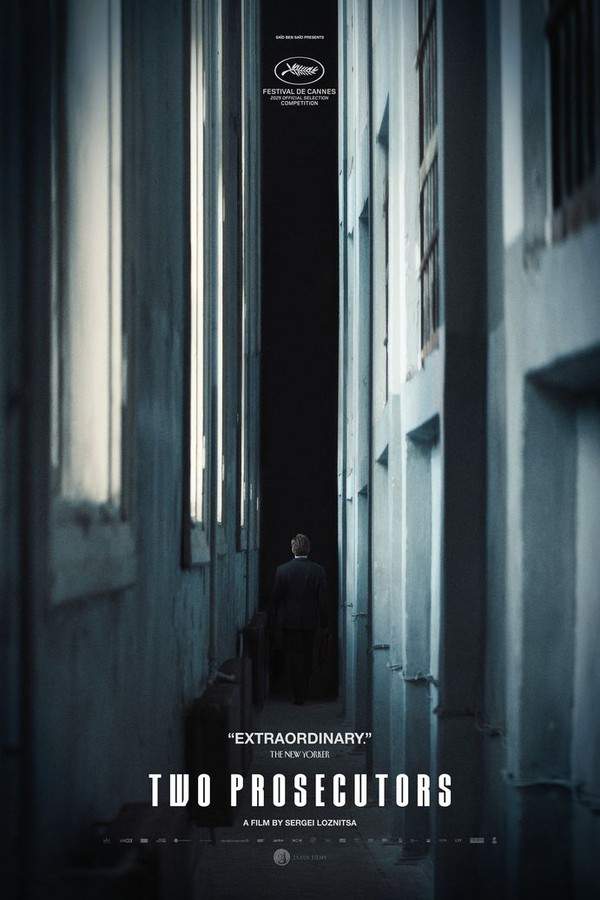
Two Prosecutors (2026) movie poster

Timeline

Two Prosecutors (2026) Timeline Explained – Every Event in Order

Release, runtime and language
2026 · 1 h 57 m · Russian
Echo score 80
Directed by
Sergey Loznitsa
Starring
Aleksandr Kuznetsov, Andris Keiss, Anatoliy Belyy, Valentin Novopolskij, Aleksandr Filippenko, Lukas Petrauskas

In 1937 Soviet Union, thousands of letters from detainees falsely accused by the regime are burned in a prison cell. Against all odds, one survives and is placed on the desk of newly appointed local prosecutor Alexander Kornev. Determined to uncover the truth, Kornev seeks the prisoner, a victim of the corrupt NKVD secret‑police agents amid terror.

On this page (5)
  1. 1 Where to watch
  2. 2 Events in order (12)
  3. 3 Timeline questions answered
  4. 4 Movie threads
  5. 5 Every angle

Where to watch

Where to Watch Two Prosecutors (2026)

Where can you watch Two Prosecutors? Stream, rent or buy it in the US, including on Amazon Video, Apple TV Store and Fandango At Home: current JustWatch availability with up-to-date prices.

Streaming availability powered by JustWatch

12 events in order · contains spoilers

Two Prosecutors Timeline: Events in Chronological Order

Every key event of Two Prosecutors (2026) in order, scene by scene, with when and where it takes place. Use it to untangle flashbacks, time jumps and parallel storylines, to refresh your memory before the sequel or to find the exact scene you are thinking of.

  1. Kornyev uncovers a plea from Bryansk prisoner

    Kornyev, a young Soviet prosecutor, discovers a letter from a Bryansk prisoner that suggests NKVD corruption and wrongful convictions. Believing the man may be a victim, he visits the Bryansk prison as part of his oversight duties to investigate. The encounter sets him on a path to challenge the local authorities.

    When
    1937
    Where
    Bryansk Prison
  2. Stepniak's testimony and wounds

    Kornyev meets Stepniak, an imprisoned Old Bolshevik, who shows torture wounds he suffered after refusing to confess falsely. Stepniak begs Kornyev to tell Stalin or the Politburo about the wrongful actions. He urges action to reveal the corruption against loyal citizens.

    When
    1937
    Where
    Bryansk Prison
  3. Prison official interrupts with a phone call

    As Kornyev leaves, a prison official observing him makes a phone call and insults his intelligence. The moment signals deeper complicity and surveillance around the case. It hints at a broader system at work beyond one prison.

    When
    1937
    Where
    Bryansk Prison
  4. Train to Moscow; peglegged veteran's Lenin tale

    Kornyev travels by train to Moscow to press his case. On the journey, a peglegged WWI veteran tells stories about meeting Lenin in Smolny and seeking alms from Stalin, keeping him awake and underscoring the political atmosphere. The veteran's tale mirrors the era's propaganda and fear.

    When
    1937
    Where
    Train to Moscow
  5. Appointment pursuit at the Procurator General's Office

    In Moscow, Kornyev endures a long wait attempting to secure an appointment. He hopes to escalate his Bryansk findings to higher authorities and gain attention for the case. The bureaucracy itself becomes an obstacle to exposure.

    When
    1937
    Where
    Procurator General's Office
  6. Vyshinsky meeting; letter presented

    Kornyev finally meets Procurator General Andrey Vyshinsky and presents Stepniak's bloody letter, explaining the situation in Bryansk and the local NKVD's influence. Vyshinsky warns that without solid documentary evidence, an inquiry cannot be opened. The encounter highlights the limits of evidence-based action in a repressive system.

    When
    1937
    Where
    Procurator General's Office, Moscow
  7. Vyshinsky's authorization and return to Bryansk

    Vyshinsky gives Kornyev documents authorizing him to conduct further investigations, but stresses the need for substantial evidence. Kornyev prepares to return to Bryansk to continue digging into the case and gather needed proof. The formal authorization signals a procedural route that may still fail under political pressure.

    When
    1937
    Where
    Train back to Bryansk
  8. Return train conversation with Vasily and Petya

    On the return journey, Kornyev is seated with Vasily and Petya, engineers who toast to Soviet law and play the counterplan song on guitar. Their camaraderie reveals how ordinary people navigate the regime's rhetoric. The encounter adds a layer of social normalcy to the oppressive atmosphere.

    When
    1937
    Where
    Train back to Bryansk
  9. Bryansk station ride; Petya's probing

    In Bryansk, the three share a ride from the train station. Petya aggressively questions Kornyev about his virginity, signaling the menacing casualness with which people are swept into the state’s machinery. They drive past Kornyev's destination, hinting at a trap or control point.

    When
    1937
    Where
    Bryansk Station
  10. Under arrest; car to the prison

    Vasily tells Kornyev that he is under arrest as their car moves toward the prison facility. The sudden shift from travel companions to detainee demonstrates the regime's reach and the fragility of individual safety. The arrest underscores the pervasiveness of state power.

    When
    1937
    Where
    Bryansk
  11. Kornyev realizes the system's reach

    Kornyev recognizes that his belief in local aberrant conduct was a tragic miscalculation. He understands that the pattern he uncovered reflects a policy originating from Stalin and implemented across the Soviet Union, with Vyshinsky as a key collaborator. The realization exposes the centralization of repression.

    When
    1937
    Where
    Bryansk
  12. Systemic repression confirmed; no safe channels

    The narrative emphasizes that appealing to central leadership does not guarantee justice, as state repression is systemic and widespread. Kornyev’s arrest demonstrates that the policy is broader than any single local office. The ending underscores the futility of resisting the machine.

    When
    1937
    Where
    Bryansk

Last updated: March 24, 2026 at 19:59

Was this helpful?

Timeline questions answered

Two Prosecutors Timeline Explained: Your Questions Answered

When does it happen, and why in that order? The questions people ask about the chronology of Two Prosecutors (2026): time jumps, flashbacks, cause and effect between scenes and the correct order of events, each answered with spoilers.

Q1

Why does Kornev decide to investigate the Bryansk prison letter?

Kornev discovers a letter from a Bryansk prisoner that hints at NKVD corruption and wrongful convictions. Motivated by his belief in justice and a desire to protect loyal citizens, he seeks permission to investigate the case, viewing it as an opportunity to prove himself and uncover the truth about the system he serves.

Foreshadowing: Earlier in the film, Kornev reflects on justice during his law school days, establishing his idealistic mindset before the harsh reality of the Soviet system crushes his hopes.

  • kornev investigation
  • bryansk prison
  • nkvd corruption
  • soviet prosecutor
Q2

Who is Stepniak and why is he important?

Stepniak is an imprisoned Old Bolshevik and long-standing local party stalwart being held in Bryansk prison. He shows Kornev torture wounds he suffered after refusing to confess to crimes he knew were false. His testimony represents the broader repression targeting loyal party members who resist or learn of the NKVD's corruption.

Foreshadowing: Kornev recalls a memory from law school where Stepniak delivered a speech about truth and Bolshevism, establishing a connection that binds them across the gulf of imprisonment and fear.

  • stepniak
  • old bolshevik
  • bryansk prison
  • torture marks
  • political prisoner
Q3

What does Stepniak ask Kornev to do?

Stepniak begs Kornev to broadcast the truth higher up the chain of command, to tell Stalin or members of the Politburo about the wrongful convictions and illegal acts that have twisted the Soviet system against loyal citizens. He urges action to expose the corruption affecting innocent party members.

  • stepniak request
  • stalin
  • politburo
  • expose corruption
  • wrongful convictions
Q4

Why does Vyshinsky refuse to open a formal inquiry?

When Kornev presents Stepniak's bloody letter and explains the conditions in Bryansk, Vyshinsky warns that without strong documentary evidence, his office cannot open a formal inquiry. He emphasizes procedural constraints in a system that thrives on fear and opacity, explaining that evidence alone is insufficient when political calculus overrides justice.

  • vyshinsky
  • formal inquiry
  • documentary evidence
  • soviet bureaucracy
  • procedural constraints
Q5

Who are Vasily and Petya and why do they arrest Kornev?

Vasily and Petya appear to be ordinary Soviet engineers sharing a train carriage with Kornev, even toasting to Soviet law and playing guitar. However, they are NKVD agents tasked with detaining him. Their friendly demeanor masks their true purpose, demonstrating how the regime uses seemingly ordinary people to carry out surveillance and arrests.

Foreshadowing: Petya's aggressive questioning about Kornev's virginity during the car ride signals the menacing casualness with which people are swept into the state's machinery, hinting at the trap being set.

  • vasily
  • petya
  • nkvd agents
  • arrest
  • train journey
  • engineers
Q6

What happens to Kornev at the end of the movie?

Kornev is arrested by Vasily and Petya as their car drives toward the prison facility. This arrest confirms his realization that the corruption he uncovered is not isolated to Bryansk but reflects a systemic policy originating from Stalin himself. His belief that he could confront local aberrant conduct proves tragically naïve.

  • kornev arrest
  • movie ending
  • bryansk prison
  • systemic corruption
Q7

Why is Kornev's investigation doomed to fail?

Kornev believes he can confront isolated aberrant conduct within a local apparatus, but the policy of suppression emanates from the top, originating with Stalin and carried out with complicity of key figures like Vyshinsky. The system is designed to protect itself at any cost, making any earnest attempt to reveal truth futile.

  • kornev failure
  • systemic evil
  • stalin
  • vyshinsky
  • soviet repression
Q8

What is the significance of the peglegged veteran on the train?

The peglegged World War I veteran tells stories about meeting Vladimir Lenin in Smolny and now seeking alms from Stalin. His tale serves as a historical parallel to the era's propaganda and fear, demonstrating how the regime's rhetoric contrasts sharply with the reality of everyday suffering under the Great Purge.

  • peglegged veteran
  • lenin
  • stalin
  • train story
  • historical parallel
Q9

Why does the Soviet regime arrest loyal party members like Stepniak?

During Stalin's Great Purge, the regime targeted Old Bolsheviks and loyal party members who might resist or learn of NKVD corruption. Stepniak represents victims who refused to confess to false crimes, demonstrating how the system turned against its own faithful to consolidate power through fear and elimination of potential dissent.

  • great purge
  • stalin
  • old bolshevik
  • loyal party members
  • false confessions
Q10

What is the movie's message about Soviet corruption?

The film reveals that official channels, fear, and political calculus intersect to silence dissent and consolidate power. Even the highest authorities like Vyshinsky are bound by procedural constraints in a system designed to protect itself. The corruption is not localized to Bryansk, it is systemic, originating from Stalin and implemented across the entire Soviet Union.

  • systemic corruption
  • soviet system
  • stalin
  • vyshinsky
  • political repression

Movie threads

More Movies Like Two Prosecutors, by Mood & Story

Curated lists built around what makes Two Prosecutors tick: the same mood, the same kind of story or the same emotional payoff. Each list explains why these movies belong together.

Movies about doomed quests against the system like Two Prosecutors

Stories of individuals crushed by an all-powerful, corrupt state machine. If you were captivated by the futile fight for justice in Two Prosecutors, explore these films about individuals confronting corrupt and all-powerful systems. These movies share a bleak tone, heavy emotional weight, and a narrative of inevitable tragedy against overwhelming odds.

  • oppressive
  • grim
  • paranoid
  • desperate
  • somber
  • claustrophobic
  • Tone: bleak, oppressive, paranoid
  • Pacing: steady, methodical
Why these movies?

The story pattern: The narrative follows a clear, downward trajectory. An individual discovers a profound injustice within a powerful institution. Their investigation or rebellion is met with escalating resistance, revealing the system's absolute control. The story culminates not in triumph, but in the protagonist's defeat, arrest, or destruction, serving as a stark commentary on the futility of individual action against entrenched power.

Why they belong together: These films are grouped by their shared exploration of systemic corruption and the crushing of individual will. They create a cohesive experience through their bleak tone, steady pacing that builds dread, and heavy emotional focus on themes of betrayal, moral compromise, and the psychological toll of fighting a losing battle.


Slow-burn historical dread movies like Two Prosecutors

Methodical period pieces where tension and paranoia seep into every scene. Fans of the oppressive atmosphere and steady-building tension in Two Prosecutors will find similar vibes in these historical dramas. These films use a methodical pace to immerse you in a terrifying world, creating a powerful sense of dread and a bleak, emotionally heavy viewing experience.

  • somber
  • anxious
  • claustrophobic
  • melancholic
  • paranoid
  • grim
  • Tone: bleak, tense, somber
  • Pacing: slow burn, steady
Why these movies?

The story pattern: Narratives in this thread unfold with a deliberate, steady pace. They immerse the viewer in a meticulously recreated historical period defined by fear and control. The plot often centers on a character's gradual awakening to the horrors of their time, with tension arising from subtle threats, bureaucratic obstacles, and the constant fear of surveillance, leading to a tragic or bleak conclusion.

Why they belong together: These movies are united by their specific combination of historical setting, slow-burn pacing, and a consistently high-tension, bleak atmosphere. They offer a similar viewing experience focused on psychological unease, the weight of history, and a feeling of claustrophobia within a repressive society.

Every angle

Two Prosecutors (2026) Explained: Plot, Timeline & Characters

Everything about Two Prosecutors in one place: what happens in the plot summary, the timeline in chronological order, the characters and meaning and a spoiler-free summary. What's After the Movie adds the cast, box office and post-credit scenes.

Coming soon on iOS and Android

The Plot Explained Movie Summary App

Plot summaries, endings explained and timelines on your phone. Catch up on any movie in minutes, save your favorites and never miss a twist again.

Be the first to know when we launch. Your email stays private, always.

Learn more about the app