Plot Explained Spoilers guaranteed!
Plot Explained

Browse by genre

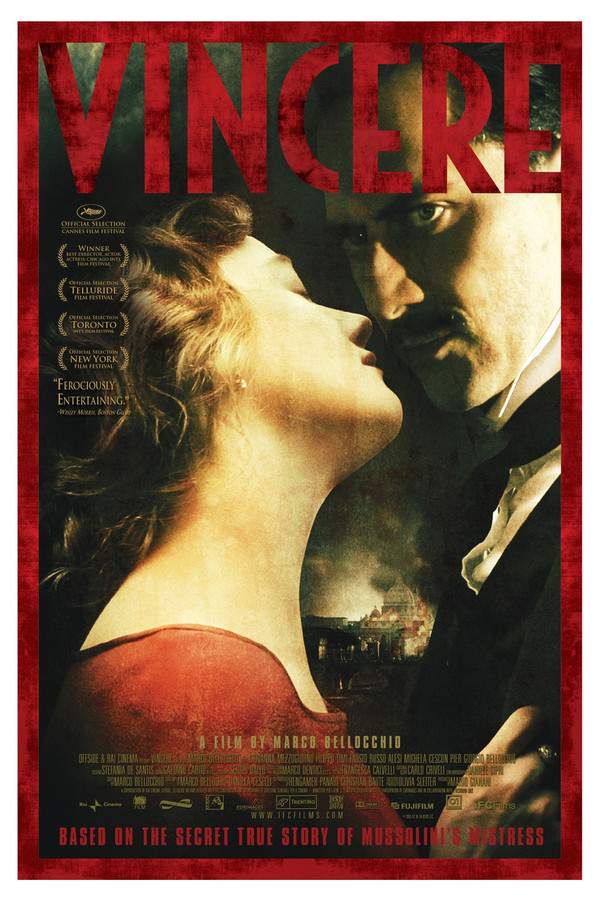
Vincere (2010) movie poster

Plot Summary

Vincere (2010) Plot Summary Explained

Release, runtime and language
2010 · 128 min · Italian
Directed by
Marco Bellocchio
Budget
$13M

During World War I, Ida Dalser becomes deeply involved with the charismatic and rising political figure Benito Mussolini. Blinded by her admiration for his revolutionary ideas, she fails to recognize his numerous infidelities. Following a painful separation and feeling abandoned, Ida finds comfort in her young son, but their fragile bond is shattered when they are both institutionalized. Stripped of their freedom and facing unpredictable circumstances, they struggle to maintain their connection amidst hardship and loss.

On this page (5)
  1. 1 What happens: full plot
  2. 2 Plot questions answered
  3. 3 Movie threads
  4. 4 Movies like Vincere
  5. 5 Every angle

Full plot summary · contains spoilers

What Happens in Vincere: Full Plot Summary

The whole story of Vincere (2010) explained, from the opening scene to the final frame: every key event, every twist and what it all adds up to. Read it as a quick recap before the sequel, to check a scene you missed, or to finally understand what really happened.

The narrative unfolds in the year 1907, where we find Ida Dalser captivated by a powerful speech delivered by the youthful journalist and fervent socialist, Benito Mussolini. Their connection ignites a passionate and tumultuous romance that soon engulfs both their lives. Initially, Mussolini is against Italy's participation in the mounting tensions of the European Great War, but he experiences a dramatic shift in perspective that leads him to embrace a new role in the political landscape. This transition results in his expulsion from the Socialist Party, paving the way for a radical new ideology that will evolve into fascism.

Determined to express his evolving views, Mussolini establishes a newspaper to articulate his convictions. In a selfless act of devotion, Dalser sells off all her possessions to support this venture. As time passes, they welcome a son, Benito, but the war soon claims Mussolini, who goes off to fight, leaving Dalser anxiously awaiting news from him. Eventually, word reaches her, but it brings not solace, but heartbreak; he is recovering in a hospital from his injuries. However, her joy turns to despair when she visits him, discovering that he has taken another wife and has a daughter of his own. Despite her insistence that they are legally married, Mussolini staunchly denies their bond.

From this point onward, Mussolini's presence is relegated to brief newsreel glimpses, symbolizing the increasing divide between him and Dalser, who is left to navigate her own fate in a tumultuous political climate. As the early 1920s roll around, Mussolini has ascended to become Italy's leader, engaging in high-stakes negotiations with the Vatican. Meanwhile, Dalser grows more relentless in her quest to validate her marriage and prove that her son, Benito Albino, is a legitimate heir. Unfortunately, her struggles are met with the full force of the fascist regime, culminating in her being committed to an asylum. Persisting in her efforts to be heard even from behind those walls, she writes to newspapers and even the Pope himself, yet her insistence ultimately leads to further tragedies, including the committing of her son to a separate asylum.

As the narrative progresses, Dalser experiences a gradual spiral into madness, ensnared by the oppressive grip of the regime and her haunting memories. The film culminates with a sobering caption detailing the official causes of death: Dalser’s demise in 1937 and her son's in 1942. However, the closing scenes present a chilling suggestion that the true fate of either—or both—may have involved foul play, shrouded in mysterious circumstances as a final commentary on their harrowing struggle against a formidable and ruthless political system.
Last updated: January 14, 2025 at 19:25

Was this helpful?

Plot questions answered

Vincere Plot Explained: Your Questions Answered

The questions people ask most about Vincere (2010): what happens in the confusing scenes, why the characters do what they do, the twists, hidden details and what the ending means. Each answer contains spoilers.

Q1

Why did Mussolini deny his marriage to Ida Dalser?

Mussolini denied his marriage to Ida Dalser primarily to protect his rising political career. By the time he became Italy's leader in the early 1920s, he could not afford the scandal of having a previous marriage and illegitimate son. Acknowledging Ida would have threatened his carefully crafted public image and his negotiations with the Vatican, which required him to appear as a traditional family man. The denial was a calculated political move to silence a woman who could expose his past and jeopardize his future power.

Foreshadowing: Earlier scenes show Mussolini transforming from a passionate socialist into a calculating politician willing to abandon his principles for power.

  • mussolini
  • ida dalser
  • marriage denial
  • fascism
  • political ambition
Q2

Why was Ida Dalser committed to an asylum?

Ida Dalser was committed to an asylum as part of a systematic campaign by Mussolini's fascist regime to silence her. After she persistently tried to validate her marriage and prove her son was Mussolini's legitimate heir, the regime labeled her as mentally unstable to discredit her claims. Being institutionalized effectively removed her from public view and ended her ability to fight for recognition. Her protests to newspapers and even the Pope only intensified the regime's efforts to permanently silence her.

Foreshadowing: The film shows Ida's determination to write letters to authorities even after being confined, which directly led to her being labeled dangerous.

  • ida dalser
  • asylum
  • institutionalization
  • fascism
  • silencing
Q3

What happened to Ida Dalser's son Benito Albino?

Benito Albino, Ida Dalser's son with Mussolini, was also committed to a separate asylum after his mother was institutionalized. The regime separated mother and son to completely sever their connection and prevent any unified testimony about their relationship to Mussolini. Officially, he died in 1942, but the film suggests his death may have been orchestrated by the fascist regime to eliminate the living proof of Mussolini's past. Like his mother, his fate was shrouded in mystery and potentially tied to state-sanctioned violence.

Foreshadowing: The timeline shows that after Ida was sent to the asylum, her son was quickly sent to a separate institution, eliminating any chance of them being together.

  • benito albino
  • ida dalser son
  • asylum
  • mussolini's child
Q4

Why did Mussolini abandon Ida Dalser?

Mussolini abandoned Ida Dalser when he realized their relationship threatened his political ambitions. After his shift on the Great War and expulsion from the Socialist Party, he needed to rebuild his image as a national leader. Having a relationship with Ida, who was previously married and had a son from that marriage, was politically inconvenient. When he was injured in the hospital, he had already begun a new relationship with another woman who would become his wife. His abandonment was a calculated decision to pursue a politically advantageous marriage that would help him gain power and legitimacy.

Foreshadowing: The film establishes early on that Mussolini is willing to change his political positions for power, foreshadowing his willingness to change his personal life as well.

  • mussolini
  • ida dalser
  • abandonment
  • betrayal
  • power
Q5

How did Ida Dalser die?

Officially, Ida Dalser died in 1937, with the cause recorded as cancer. However, the film strongly implies she was murdered by the fascist regime. The closing scenes suggest that her death, like her son's in 1942, was orchestrated to silence her permanently and eliminate the embarrassment she represented to Mussolini's regime. The film leaves the question of their true deaths unanswered but heavily implies state-sanctioned execution rather than natural causes.

Foreshadowing: The regime's earlier decision to institutionalize Ida shows they were willing to use extreme measures to silence her, culminating in her mysterious death.

  • ida dalser death
  • 1937
  • murder
  • fascism
  • mussolini
Q6

Why did Mussolini change his stance on World War I?

Mussolini initially opposed Italy's participation in World War I because of his socialist beliefs, but he dramatically shifted his position to support the war. This change was motivated by his desire for political relevance and power. His shift directly led to his expulsion from the Socialist Party, which ironically freed him to develop his fascist ideology. The war provided the chaos and nationalism that fascism needed to emerge as a political force in Italy.

Foreshadowing: The film shows Mussolini reading the newspaper and being influenced by changing public sentiment, indicating his willingness to abandon principles for opportunity.

  • mussolini
  • world war 1
  • socialist party
  • fascism
  • political shift
Q7

Why did Ida Dalser sell her possessions to fund Mussolini's newspaper?

Ida Dalser sold all her belongings to finance Mussolini's newspaper because she was deeply devoted to him and his revolutionary political ideas. Captivated by his charisma and speech in 1907, she believed in his vision for Italy. Her sacrifice demonstrated the intensity of her love and commitment to both Mussolini personally and his political mission. This act of devotion ultimately proved devastating when Mussolini abandoned her, leaving her with nothing.

Foreshadowing: The opening scene establishes Ida's immediate and intense attraction to Mussolini's words, showing she was swept up in his magnetic personality.

  • ida dalser
  • mussolini newspaper
  • sacrifice
  • devotion
  • fascism
Q9

How did Mussolini rise to power in the 1920s?

Mussolini rose to power in the 1920s by founding fascism and using his newspaper to promote nationalist, authoritarian ideas. After being expelled from the Socialist Party for supporting the war, he built a movement that capitalized on post-war discontent and fear of communism. By the early 1920s, he had become Italy's leader, negotiating with the Vatican and establishing a dictatorship. His rise came at the direct cost of silencing anyone who threatened his image, including Ida Dalser and their son.

Foreshadowing: The timeline shows Mussolini progressively gaining political influence while Ida's situation deteriorates, highlighting the parallel between his ascent and her fall.

  • mussolini rise to power
  • 1920s
  • fascism
  • italian leader
  • dictatorship
Q10

Was Ida Dalser actually legally married to Mussolini?

According to Ida Dalser, she was legally married to Mussolini and possessed a marriage certificate as proof. Mussolini, however, denied the marriage entirely, claiming they were never legally wed. The film presents Ida's claim as credible while suggesting Mussolini destroyed or concealed evidence of the marriage to protect his political career. The ambiguity reflects the power imbalance between a woman fighting for recognition and a man who controlled the state's narrative.

Foreshadowing: Ida's possession of the marriage certificate and her insistence on its validity drives her entire fight throughout the film.

  • marriage certificate
  • legal marriage
  • ida dalser
  • mussolini
  • proof

Movie threads

More Movies Like Vincere, by Mood & Story

Curated lists built around what makes Vincere tick: the same mood, the same kind of story or the same emotional payoff. Each list explains why these movies belong together.

Movies about being crushed by the system like Vincere

Stories where individuals are methodically erased by an uncaring institution. For viewers seeking films like Vincere, this collection features stories of individuals facing overwhelming institutional power. These movies explore themes of political oppression, injustice, and the devastating personal cost of resisting or being targeted by corrupt systems, offering bleak, heavy dramas with a similar tone.

  • oppressive
  • grim
  • desperate
  • tragic
  • haunting
  • institutional
  • Tone: bleak, oppressive, tragic
  • Pacing: steady, inevitable
Why these movies?

The story pattern: These narratives typically follow a protagonist whose initial passion or belief collides with an immovable, oppressive force. The plot structure is often a downward spiral, charting the loss of liberty, voice, and ultimately, humanity, as the institution uses legal, psychological, and physical means to achieve its goal, creating a sense of inevitable doom.

Why they belong together: Movies are grouped here based on their shared focus on the asymmetrical battle between a single person and a vast, impersonal system. They share a consistently bleak tone, a steady pacing that builds a sense of inescapable fate, and a heavy emotional weight centered on themes of injustice and erasure.

Bleak historical tragedy movies similar to Vincere

Sobering dramas based on true stories of suffering and loss. If you appreciated the grim historical setting of Vincere, this selection features other serious dramas based on true or realistic events. These films share a bleak tone, heavy emotional weight, and a focus on the tragic aspects of history, perfect for viewers who want impactful, somber period pieces.

  • somber
  • melancholic
  • tragic
  • haunting
  • historical
  • devastating
  • Tone: somber, melancholic, tragic
  • Pacing: steady, deliberate
Why these movies?

The story pattern: The narrative pattern is often a linear, factual-based progression towards a known or implied tragic outcome. The journey is less about surprise and more about the immersive, emotionally draining experience of witnessing resilience in the face of overwhelming historical forces, often ending with a profound sense of loss and reflection.

Why they belong together: These films are united by their foundation in historical reality, their commitment to a bleak and sobering tone, and their focus on the emotional weight of tragic events. They prioritize authenticity and emotional impact over escapism, creating a cohesive viewing experience for those seeking serious historical drama.

If you liked this

Movies Like Vincere

Similar movies to Vincere: the same genre, themes or kind of story. Each one comes with its own plot summary, timeline and ending explained.

Browse all movie summaries

Every angle

Vincere (2010) Explained: Plot, Timeline & Characters

Everything about Vincere in one place: what happens in the plot summary, the timeline in chronological order, the characters and meaning and a spoiler-free summary. What's After the Movie adds the cast, box office and post-credit scenes.

Coming soon on iOS and Android

The Plot Explained Movie Summary App

Plot summaries, endings explained and timelines on your phone. Catch up on any movie in minutes, save your favorites and never miss a twist again.

Be the first to know when we launch. Your email stays private, always.

Learn more about the app