Plot Explained Spoilers guaranteed!
Plot Explained

Browse by genre

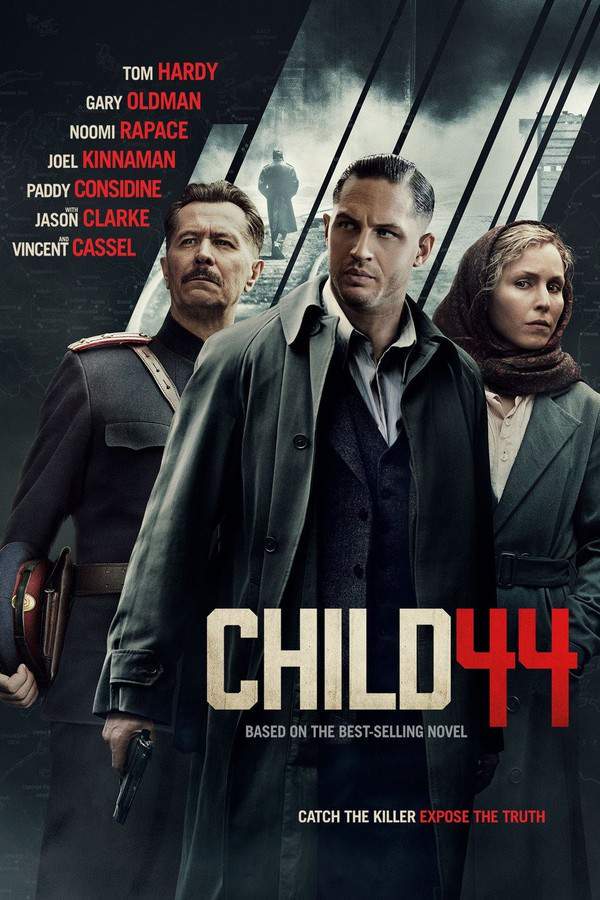
Child 44 (2015) movie poster

Plot Summary

Child 44 (2015) Plot Summary Explained

Release, runtime and language
2015 · 137 min · English
Loading streaming availability…
Directed by
Daniel Espinosa
Starring
Joel Kinnaman, Tom Hardy, Noomi Rapace

In 1953 Soviet Russia, idealistic agent Leo Demidov finds his life overturned when he attempts to shield his wife from unjust accusations. Exiled to a remote region, he and his wife, Raisa, partner with General Mikhail Nesterov to pursue a brutal serial killer preying on young boys. Their investigation unveils a disturbing network of lies and corruption, placing them directly in the path of Leo's manipulative adversary, Vasili, and threatening to expose the dark secrets of the regime.

On this page (7)
  1. 1 Where to watch
  2. 2 What happens: full plot
  3. 3 Plot questions answered
  4. 4 The book behind the movie
  5. 5 Movie threads
  6. 6 Movies like Child 44
  7. 7 Every angle
Loading streaming availability…

Full plot summary · contains spoilers

What Happens in Child 44: Full Plot Summary

The whole story of Child 44 (2015) explained, from the opening scene to the final frame: every key event, every twist and what it all adds up to. Read it as a quick recap before the sequel, to check a scene you missed, or to finally understand what really happened.

In the tumultuous year of 1933, a young boy, left orphaned amidst the Ukrainian Holodomor, escapes from his orphanage. He finds refuge with a Red Army unit and is kindly embraced by its commander, who names him Leo Demidov. By 1945, Leo has risen to the rank of sergeant and achieves national fame when he is immortalized in a photograph as he plants the Soviet flag atop the Reichstag during the Battle of Berlin. This heroic act earns him the prestigious title of Hero of the Soviet Union.

Fast forward to 1953, Leo is now a captain within the Ministry of State Security (MGB), residing in Moscow with his wife, Raisa. His unit is tasked with tracking down dissidents, but their operations take a tragic turn when they arrest a veterinarian named Anatoly Brodsky. During this arrest, the reckless but ambitious officer Vasili Nikitin, who harbors resentment towards Leo, shoots a farmer and his wife, leaving their two little daughters orphaned. Outraged, Leo confronts Vasili, but tensions escalate as Vasili finds himself in charge of Brodsky’s harsh interrogation and ultimate execution.

Vasili’s betrayal goes further when he implicates Raisa, a dedicated primary school teacher, in his report to their superior, Major Kuzmin. This forces Leo into a heart-wrenching predicament as Kuzmin demands that he investigate his own wife, who has just revealed her pregnancy. Amidst this turmoil, tragedy strikes when Alexei Andreyev, another officer in their unit, loses his young son Jora, found dead under suspicious circumstances that authorities refuse to investigate properly, deeming it merely an accident as per Stalin's beliefs.

Defying orders, Leo investigates Raisa's innocence and boldly refuses to denounce her. The couple is ultimately arrested by Vasili, enduring a humiliating internal exile to Volsk where Leo loses his rank and is demoted to a lowly policeman while Raisa is forced to work as a school cleaner.

As fate would have it, another child’s body is discovered near the railway in Volsk, echoing the circumstances of Jora's death. Leo deduces that a serial killer is on the loose, embroiling them both in danger once again. After a series of harrowing events, including troubling revelations about a local ticket collector and a violent confrontation with authorities, Leo and Raisa grapple with their loyalty to each other and their desperate quest for justice.

Their clandestine journey leads them to Rostov, where they uncover the identity of the serial killer, Vladimir Malevich. In a climactic encounter, Vasili tracks them down but meets his end in a brutal struggle with Leo and Raisa. Cleverly, Leo spins the narrative to portray Vasili as a hero, thus securing their own safety and reinstatement in their positions.

In a time of possible change with Stalin’s demise, Leo is offered a promotion, but he instead proposes the formation of a dedicated homicide division, emphasizing his commitment to justice. With the help of General Nesterov, Leo and Raisa take a poignant step forward as they decide to adopt Tamara and Elena Okun, the orphaned daughters of the farmer, uniting their family amidst a backdrop of political upheaval and personal redemption.
Last updated: October 27, 2024 at 23:08

Was this helpful?

Plot questions answered

Child 44 Plot Explained: Your Questions Answered

The questions people ask most about Child 44 (2015): what happens in the confusing scenes, why the characters do what they do, the twists, hidden details and what the ending means. Each answer contains spoilers.

Q1

Why does Vasili Nikitin implicate Leo's wife Raisa?

Vasili harbors deep resentment toward Leo and sees an opportunity to destroy him by implicating Raisa as a dissident in his report to Major Kuzmin. This betrayal is motivated by jealousy and Vasili's ambition to overtake Leo's position within the MGB. By framing Raisa, Vasili forces Leo into an impossible situation where he must either investigate his own wife or defy his superiors.

Foreshadowing: Earlier, Vasili's reckless behavior during Brodsky's arrest, where he shoots a farmer and his wife, establishes his willingness to use any means necessary to advance himself.

  • vasili nikitin
  • betrayal
  • raisa demidov
  • mgb
  • accusation
Q2

Why does Leo Demidov refuse to denounce his wife?

Leo refuses to denounce Raisa because he believes completely in her innocence. Despite being ordered by Major Kuzmin to investigate his pregnant wife, Leo conducts his own investigation and proves her innocence. His loyalty to Raisa overrides his duty to the state, leading to their arrest and exile to Volsk. This decision defines Leo's moral character throughout the film.

Foreshadowing: Leo's earlier confrontation with Vasili about the farmer's death shows his strong moral compass and willingness to challenge authority.

  • leo demidov
  • raisa
  • loyalty
  • exile
  • refusal
Q3

How does Leo realize there's a serial killer in Volsk?

Leo discovers the serial killer when another child's body is found near the railway in Volsk, matching the suspicious circumstances of Jora's death in Moscow. The authorities had dismissed Jora's death as an accident, but Leo recognizes the pattern and connects the two cases, realizing a serial killer is targeting young boys across different locations.

Foreshadowing: The mysterious death of Jora Andreyev earlier in the film, which authorities refuse to investigate, plants the seed of doubt in Leo's mind.

  • serial killer
  • volsk
  • jora
  • railway
  • child murder
Q4

Why does Leo investigate Jora's death when ordered not to?

Leo investigates Jora's death because he suspects it wasn't an accident as authorities claimed. When officer Alexei Andreyev's son is found dead under suspicious circumstances, Leo defies Stalin's official stance that serial killers cannot exist in Soviet society. Leo's determination stems from his need for justice and his growing distrust of the regime's corruption.

Foreshadowing: This moment establishes Leo's pattern of pursuing truth despite direct orders, foreshadowing his later actions with Raisa.

  • jora
  • alexei andreyev
  • investigation
  • stalin
  • dissent
Q5

Why does the Soviet regime deny the existence of a serial killer?

The Soviet regime denies the existence of a serial killer because Stalin's official doctrine stated that such criminals could only exist in corrupt capitalist societies, not in the Soviet Union. This ideological denial prevents proper investigations into child murders, leaving families without justice and allowing the killer to continue unchecked.

Foreshadowing: This denial directly contributes to Leo's exile, as his pursuit of the truth threatens the state's false narrative.

  • stalin
  • regime
  • soviet union
  • ideology
  • denial
Q6

How does Leo manage to kill Vasili and frame him as a hero?

In Rostov, Leo and Raisa confront Vasili, who has tracked them down. During the struggle, Vasili is killed. Leo then cleverly spins the narrative to portray Vasili as a hero who died fighting the serial killer, rather than the corrupt persecutor he truly was. This lie secures Leo and Raisa's safety and allows them to be reinstated in their positions.

Foreshadowing: Leo's survival depends on his ability to manipulate the corrupt system that previously condemned him.

  • vasili nikitin
  • rostov
  • vladimir malevich
  • framing
  • hero
Q7

Why does Leo propose creating a homicide division at the end?

After Stalin's death and with the possibility of change looming, Leo is offered a promotion but instead proposes establishing a dedicated homicide division. This reflects Leo's commitment to justice and his desire to create a legitimate system for investigating murders, replacing the arbitrary persecution of dissidents with actual criminal investigation.

Foreshadowing: Leo's proposal stems from his experiences pursuing justice outside official channels while in exile.

  • homicide division
  • promotion
  • stalin death
  • justice
  • nesterov
Q8

Why do Leo and Raisa adopt the farmer's daughters?

Leo and Raisa adopt Tamara and Elena Okun, the orphaned daughters of the farmer whom Vasili shot during the Brodsky arrest. This adoption represents their personal redemption and the creation of a family despite the trauma they endured. It symbolizes hope and healing after the loss and injustice they experienced throughout the film.

Foreshadowing: The farmer's daughters were left orphaned when Vasili shot their parents, a tragedy that haunts Leo throughout the story.

  • adoption
  • tamara
  • elena
  • okun
  • family
  • redemption
Q9

What is Leo's backstory with the Holodomor?

Leo was orphaned during the Ukrainian Holodomor in 1933 and escaped from an orphanage before being taken in by a Red Army unit. The commander named him Leo Demidov, giving him a new identity. This traumatic childhood shapes Leo's character, making him especially sensitive to the plight of orphaned children and driving his pursuit of justice for the young victims of the serial killer.

Foreshadowing: Leo recognizes the vulnerability of children without parents, explaining his intense dedication to solving the murders.

  • holodomor
  • ukraine
  • orphanage
  • red army
  • childhood
Q10

Why is Raisa accused of being a dissident?

Raisa is accused of being a dissident purely through Vasili's malicious fabrication. He includes her name in his report to Major Kuzmin as a way to destroy Leo. Raisa is a dedicated primary school teacher with no actual dissident activities. The accusation is entirely political and personal, designed to eliminate Leo through his wife.

Foreshadowing: Vasili's jealousy of Leo's position makes him willing to use any tactic to bring Leo down.

  • rais a
  • dissident
  • vasili
  • accusation
  • teacher
Q11

How did Leo become a Hero of the Soviet Union?

Leo became a Hero of the Soviet Union through his actions during the Battle of Berlin in 1945. As a sergeant, he was photographed planting the Soviet flag atop the Reichstag, an iconic moment that earned him national fame and the prestigious title. This heroic past contrasts sharply with his later persecution under the same regime he once served heroically.

Foreshadowing: The photograph represents Leo's belief in the Soviet ideal, which is later shattered by the regime's corruption.

  • reichstag
  • berlin
  • hero of soviet union
  • photograph
  • 1945

Movie threads

More Movies Like Child 44, by Mood & Story

Curated lists built around what makes Child 44 tick: the same mood, the same kind of story or the same emotional payoff. Each list explains why these movies belong together.

Crime Thrillers in Oppressive Regimes like Child 44

Investigating brutal crimes while navigating the treacherous politics of a totalitarian state. If you liked the tense atmosphere of 'Child 44', explore more movies like it where detectives and agents pursue justice within the shadow of a brutal political system. These similar historical thrillers and crime dramas capture the grim reality of investigating murders and corruption under totalitarianism, where every clue uncovered threatens to expose the investigator.

  • oppressive
  • tense
  • paranoid
  • gritty
  • persevering
  • melancholic
  • Tone: dark, tense, grim
  • Pacing: steady, methodical
Why these movies?

The story pattern: The narrative typically follows a law enforcement agent or investigator who begins a case that challenges the official state narrative. Their pursuit of truth pits them against a powerful and corrupt system, forcing them to operate in the shadows. The journey is as much about surviving the regime as it is about solving the crime, often leading to a pyrrhic victory or a bittersweet resolution.

Why they belong together: These movies are grouped by their shared high-stakes setting, where the political environment is as menacing as the criminal antagonist. They blend the tension of a crime thriller with the dread of a political drama, resulting in a consistently dark, intense, and heavy viewing experience focused on perseverance against overwhelming odds.

Movies with Bittersweet Justice Endings like Child 44

Achieving a personal victory that comes at a cost, leaving the system unchanged. For viewers who appreciated the complex ending of 'Child 44', this list features movies with similar conclusions. Discover films like it where the heroes achieve a personal, bittersweet victory against injustice, but the overarching corruption or darkness of their world persists, resulting in a heavy yet satisfying emotional payoff.

  • bittersweet
  • melancholic
  • grim
  • persevering
  • thought-provoking
  • heavy
  • Tone: bittersweet, heavy, dark
  • Pacing: steady, building
Why these movies?

The story pattern: The narrative arc involves protagonists fighting against an entrenched, powerful antagonist or system. Their struggle is brutal and costly. While they may succeed in their immediate goal—exposing a killer, saving a loved one, finding personal redemption—the broader evil or corruption is too powerful to defeat. The ending acknowledges the small win but underscores the enduring nature of the larger problem, creating a resonant, thoughtful conclusion.

Why they belong together: These films are united by their specific emotional payoff. They deliver the catharsis of a hard-won battle but refuse a simplistic, wholly optimistic ending. This creates a powerful and memorable experience that feels more authentic and weighty, resonating with audiences who appreciate narratives where good prevails, but not without significant scars and compromises.

If you liked this

Movies Like Child 44

Similar movies to Child 44: the same genre, themes or kind of story. Each one comes with its own plot summary, timeline and ending explained.

Browse all movie summaries

Every angle

Child 44 (2015) Explained: Plot, Timeline & Characters

Everything about Child 44 in one place: what happens in the plot summary, the timeline in chronological order, the characters and meaning and a spoiler-free summary. What's After the Movie adds the cast, box office and post-credit scenes.

Coming soon on iOS and Android

The Plot Explained Movie Summary App

Plot summaries, endings explained and timelines on your phone. Catch up on any movie in minutes, save your favorites and never miss a twist again.

Be the first to know when we launch. Your email stays private, always.

Learn more about the app