Plot Explained Spoilers guaranteed!
Plot Explained

Browse by genre

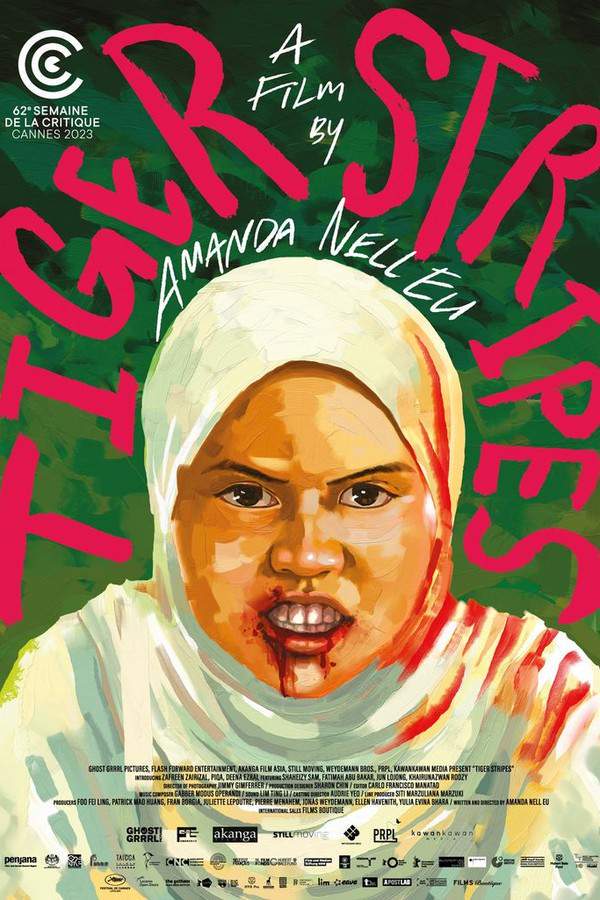
Tiger Stripes (2024) movie poster

Plot Summary

Tiger Stripes (2024) Plot Summary Explained

Release, runtime and language
2024 · 1 h 35 m · Malay
Echo score 72
Loading streaming availability…
Directed by
Amanda Nell Eu
Starring
Shaheizy Sam, June Lojong, Zafreen Zairizal, Deena Ezral, Piqa, Khairunazwan Rodzy

A twelve-year-old girl named Zaffan experiences a horrifying transformation that shatters her peaceful childhood. As unsettling incidents and strange fits affect her friends and spread through their school, fear and suspicion escalate within the community. A medical investigator is brought in to determine the cause of the disturbing affliction before it’s too late.

On this page (6)
  1. 1 Where to watch
  2. 2 What happens: full plot
  3. 3 Plot questions answered
  4. 4 Movie threads
  5. 5 Movies like Tiger Stripes
  6. 6 Every angle
Loading streaming availability…

Full plot summary · contains spoilers

What Happens in Tiger Stripes: Full Plot Summary

The whole story of Tiger Stripes (2024) explained, from the opening scene to the final frame: every key event, every twist and what it all adds up to. Read it as a quick recap before the sequel, to check a scene you missed, or to finally understand what really happened.

All-girls' elementary school student Nur Zaffan binti Azman begins to explore a new phase in her life marked by the onset of puberty, which includes her engaging in suggestive dances within the confines of the bathroom alongside her friends, Mariam and Farah, the class prefect. This journey into adolescence becomes complicated when teacher Azizah discovers Zaffan in the bathroom and, as a result, heads toward admonishing her with the aid of headteacher Sabariah. One day, while playing near a stream in the jungle with Farah and Mariam, Zaffan faces the wrath of her strict mother, Munah, when she returns home in nothing but her underwear after accidentally wetting her uniform.

As Zaffan navigates her first menstruation, she struggles with the societal expectations placed upon her, which keep her from participating in mandatory prayers. During this time, Farah shares with her the frightful legend of Ina, a demonic woman with pink eyes who supposedly roams the jungles, driven feral by her period. Zaffan, intrigued yet terrified, claims to see Ina perched high in a tree, an experience that Farah dismisses, leading to Zaffan’s feelings of isolation. Confronting the physical changes of puberty, Zaffan begins to develop acne and wear gloves to hide her shedding nails, marking her transition into a young woman.

After a rejection by Mariam when Zaffan invites her to walk home, Zaffan seeks independence and requests her father, Azman, to allow her to join the Girl Guides. At camp, she encounters Ina once again and later displays her bravery by rescuing a classmate, Liyana, who has fled up a tree to escape bullies. This action earns her recognition, culminating in a badge awarded during the school’s results ceremony. However, Zaffan's newfound admiration breeds jealousy in Farah, who perceives Zaffan as duplicating her social standing. The tensions between Zaffan and her mother, Munah, resurface as Zaffan insists on wearing gloves even in the comfort of home.

Additionally, Zaffan discovers a shocking secret: in moments of anger, she transforms into a ferocious, weretiger-like beast. This transformation becomes evident after a tumultuous incident in the bathroom with Farah and her group, who mock Zaffan for her fantasies and menstrual struggles. In the heat of the moment, Zaffan's transformation frightens her fellow students and faculty, causing chaos as her appearance deteriorates with hair loss and claw-like growths. Fear spreads within the school, leading administrators to call in Dr. Rahim, a self-styled faith healer, in a desperate attempt to restore peace to the school.

As events escalate, Farah claims to have experienced possession after a foot drill leads to her collapsing in hysteria while Rahim rushes to assist. Zaffan, now fully aware of her burgeoning powers, senses Mariam inching closer to her own menstrual journey. Moments of vulnerability reveal Zaffan's secret as she opens up to Mariam, showcasing her tiger transformation and expressing her wish to escape the confining walls of school life.

In a moment of desperation, Zaffan's clash with Munah ends in a promise from her mother to ensure Zaffan's safety, conflicting with Zaffan's own desires, as her eyes flash pink under the strain. Following their encounters with Dr. Rahim, who seeks to exorcise Zaffan but fails miserably amid accusations of fraud, Zaffan transforms once again during a confrontation, culminating in a shocking climax: she eliminates Dr. Rahim, leaving his head behind as she retreats into the jungle, a haunting reminder of the turmoil that has unfolded.

With the school under strict curfew regulations, Mariam and a now demoted Farah soon discover that Zaffan has managed to escape the confines of education. Despite Munah’s hope for Zaffan’s return, the unfolding narrative suggests that Mariam and Farah will join Zaffan in the jungle, alluding to their own transitions into womanhood as they unexpectedly embrace their evolving identities and the mysteries of adulthood by furthering their bond with Zaffan, who is left dancing in the moonlight at the stream—a symbol of their shared journey into maturity.
Last updated: September 18, 2026 at 09:00

Was this helpful?

Plot questions answered

Tiger Stripes Plot Explained: Your Questions Answered

The questions people ask most about Tiger Stripes (2024): what happens in the confusing scenes, why the characters do what they do, the twists, hidden details and what the ending means. Each answer contains spoilers.

Q1

Why does Zaffan transform into a weretiger?

In Tiger Stripes, Zaffan's transformation into a weretiger-like creature is triggered by intense anger and the emotional turmoil of puberty, serving as a physical manifestation of her hormonal upheaval and growing rebellion against the oppressive rules imposed on her by school, family, and religion. The film uses this body horror to literalize how female puberty is often treated as monstrous within Malaysian society. Her first transformation occurs when she kills a frog in a fit of rage, establishing that unchecked emotion, not supernatural intervention, is the catalyst.

Foreshadowing: Early in the film, Farah tells Zaffan the legend of Ina, a feral woman driven mad by her period, foreshadowing Zaffan inhabiting the same wild role.

  • zaffan transformation
  • weretiger puberty
  • body horror
  • tiger stripes explained
Q2

What is the legend of Ina and how does it connect to Zaffan?

The legend of Ina is a frightful folk tale shared by Farah about a demonic woman with pink eyes who roams the jungle, driven feral by her menstrual cycle. The story functions as both a literal supernatural element and a metaphor for how society fears and demonizes female bodily functions. Zaffan becomes obsessed with Ina after claiming to see her in a tree, and as her own puberty spirals out of control, Zaffan gradually becomes Ina herself, suggesting the legend was either a premonition or a self-fulfilling prophecy.

Foreshadowing: Zaffan seeing Ina in the tree early in the film foreshadows her later taking on the same feral identity in the jungle.

  • legend of ina
  • pink eyes demon
  • malaysian folklore
  • menstruation myth
Q3

Why does Zaffan kill Dr. Rahim during the exorcism?

Zaffan kills Dr. Rahim because the exorcism is not a genuine spiritual intervention but a violent assault orchestrated under the guise of faith healing. When his assistants physically abuse her while she is restrained, Zaffan's survival instincts trigger a full transformation into her weretiger form, and she decapitates him in self-defense. The killing represents the moment she fully embraces her monstrous identity rather than allowing the school's religious authorities to forcibly suppress it.

Foreshadowing: Zaffan's growing physical changes, claws, hair loss, feral behavior, throughout the film foreshadow the lethal capacity she unleashes during the exorcism.

  • dr rahim death
  • exorcism scene
  • zaffan kills faith healer
  • decapitation
Q4

What happens at the end when the three girls go to the jungle?

After Zaffan escapes into the jungle following Dr. Rahim's death, Mariam and a now-demoted Farah follow her there, discovering that both have begun menstruating as well. The ending suggests that the trio embraces their shared transition into womanhood together, dancing in the moonlight at the stream. It is an ambiguous resolution: Zaffan has liberated herself from oppressive structures but remains estranged from society, finding only tentative solidarity with her friends.

Foreshadowing: The stream where the girls first played together early in Tiger Stripes reappears as the location of their final reunion, completing the narrative circle.

  • tiger stripes ending explained
  • jungle dance
  • mariam farah zaffan
  • moonlight stream
Q5

What triggers Zaffan's first weretiger transformation?

Zaffan's first transformation is triggered by a moment of intense anger while she is alone in the jungle, where she kills a frog in a fit of rage. This establishes that her transformation is driven by unchecked emotion rather than any external magical cause. As the film progresses, the triggers become more frequent and tied to situations where she feels humiliated or threatened, such as the bathroom confrontation with Farah's clique.

Foreshadowing: Zaffan's suggestive dancing and emotional volatility at the start of Tiger Stripes foreshadow the explosive anger that catalyzes her first transformation.

  • first transformation
  • killing frog
  • anger trigger
  • weretiger origin
Q6

Why does the exorcism fail to cure Zaffan?

The exorcism fails because Zaffan is not genuinely possessed, she is undergoing a natural, if horrifying, physical transformation tied to puberty. Dr. Rahim's faith-healing methods rely on theatrics and physical coercion rather than any verifiable intervention, and Mariam openly questions his legitimacy during the session. The failure underscores the film's critique of religious exploitation and the way institutions pathologize female bodily changes rather than accepting them.

Foreshadowing: Dr. Rahim being introduced as a 'self-styled faith healer' rather than a licensed medical professional hints at his questionable credibility from the start.

  • exorcism fail
  • dr rahim fraud
  • possession scene
  • religious critique
Q7

Why does Farah become jealous of Zaffan?

Farah, the class prefect and clear social leader of their group, becomes jealous after Zaffan earns a Girl Guides badge for rescuing Liyana at camp. This public recognition threatens Farah's established social standing and signals that Zaffan is no longer content to follow her lead. Farah's jealousy escalates into active bullying, culminating in the bathroom confrontation where she mocks Zaffan's fantasies and menstrual struggles.

Foreshadowing: Farah's earlier dismissal of Zaffan's claim to have seen Ina in the tree hints at her unwillingness to share attention or validate Zaffan's experiences.

  • farah jealousy
  • class prefect
  • girl guides badge
  • friendship bullying
Q8

Why does Zaffan claim to see Ina in the tree?

Zaffan claims to see Ina in the tree shortly after hearing the legend from Farah, and her sighting can be interpreted as either a genuine supernatural encounter or a psychological projection of her own internal fears about becoming monstrous. The ambiguity is central to Tiger Stripes: Ina may be a real entity haunting the jungle, or Zaffan may be seeing her own future feral self. Either reading reinforces the theme that female puberty is treated as something alien and terrifying.

Foreshadowing: Farah telling the Ina legend just before the tree sighting plants imagery that allows Zaffan's subconscious fear to take visual form.

  • zaffan ina tree
  • sighting
  • premonition
  • feral woman vision
Q9

Why is Dr. Rahim exposed as a fraud?

Dr. Rahim is exposed as a fraud because he is introduced as a self-styled faith healer rather than a legitimate medical professional, and his exorcism methods rely on theatrics and physical coercion rather than any verifiable intervention. Mariam's skepticism during the exorcism session publicly undermines his authority, and the catastrophic failure of his treatment, culminating in his own death, confirms that his claims of curing possession were unfounded. His character is used to critique religious opportunism.

Foreshadowing: The school's desperation to bring in anyone who claims to solve the 'affliction' foreshadows that they will settle for an unqualified figure like Rahim.

  • dr rahim fraud
  • faith healer
  • religious exploitation
  • exorcism critique
Q10

Why does Farah claim to be possessed?

Farah claims to be possessed after collapsing in hysteria during a foot drill, shortly after the bathroom incident where Zaffan's transformation terrified her. Her 'possession' appears to be a psychological response to the trauma she experienced witnessing Zaffan's monstrous form. It may also represent Farah's own conflicted feelings, guilt over bullying Zaffan and anxiety about her own approaching puberty, which she had previously dismissed as something belonging to Zaffan alone.

Foreshadowing: Farah's earlier dismissal of Zaffan's claim to see Ina foreshadows her eventual confrontation with the same supernatural fears she ridiculed.

  • farah possession
  • hysteria collapse
  • bullying guilt
  • foot drill scene
Q11

Why does Zaffan wear gloves to hide her hands?

Zaffan wears gloves to conceal the shedding of her nails and the claw-like growths that develop as her transformation progresses. The gloves symbolize her attempt to hide the visible signs of puberty and her emerging monstrous identity from her family and peers. Even at home, she insists on keeping them on, which intensifies her conflict with her mother Munah, who views the gloves as defiance rather than concealment.

Foreshadowing: Zaffan's initial acne breakout foreshadows the more extreme skin and nail changes that later necessitate the gloves.

  • zaffan gloves
  • shedding nails
  • hiding transformation
  • puberty symbolism
Q12

Why is Munah so strict about Zaffan's behavior?

Munah's strictness stems from her adherence to conservative social and religious expectations about female modesty and discipline. She views Zaffan's puberty-driven behaviors, suggestive dancing, wetting her uniform, wearing gloves indoors, as moral failings that need immediate correction. Her refusal to allow Zaffan autonomy, even when Zaffan requests to join the Girl Guides, reflects a controlling approach rooted in cultural norms about female bodies. The film positions Munah as one of several oppressive forces Zaffan must rebel against.

Foreshadowing: Munah chasing Zaffan out of the house in her underwear foreshadows the deeper rift between maternal discipline and Zaffan's emerging independence.

  • munah strict mother
  • parental control
  • modesty rules
  • malaysian culture

Movie threads

More Movies Like Tiger Stripes, by Mood & Story

Curated lists built around what makes Tiger Stripes tick: the same mood, the same kind of story or the same emotional payoff. Each list explains why these movies belong together.

Folk body horror movies like Tiger Stripes

Ancient folklore and visceral transformation merge into deeply unsettling cultural nightmares. Explore folk body horror films like Tiger Stripes, where ancient folklore, cultural superstition, and visceral body transformation collide. If you loved Tiger Stripes' Malaysian mythology and unsettling physical metamorphosis, these similarly atmospheric horror movies blend cultural ritual with graphic bodily horror to create deeply disturbing, thematically rich nightmares.

  • folk horror
  • body horror
  • visceral
  • cultural
  • unsettling
  • ritualistic
  • Tone: dark, oppressive, unsettling
  • Pacing: steady, building dread
Why these movies?

The story pattern: Stories in this thread typically begin with the protagonist embedded in a community shaped by folklore, religious ritual, or ancestral tradition. As unsettling physical symptoms emerge, they are interpreted through the lens of myth or superstition, drawing in local healers, investigators, or spiritual authorities. The horror escalates through bodily transformation that resists medical explanation, while cultural beliefs weaponize shame and fear. Climaxes often involve visceral ritual or violence that forces the protagonist to reckon with both the physical horror and the community's role in it, ending with ambiguous transformation or uneasy liberation.

Why they belong together: These films share a commitment to grounding visceral body horror in specific cultural contexts, using folklore not as window dressing but as the literal mechanism of transformation. They feature communities where superstition intensifies the terror, body horror imagery that is graphic and unflinching, and narratives that critique how society responds to the unfamiliar body. The pacing tends to be steady and oppressive, building dread through accumulating unsettling incidents before climaxing in brutal, ritualistic sequences.

Female puberty horror movies like Tiger Stripes

Coming-of-age turns grotesque when the female body itself becomes the source of fear. Discover horror movies like Tiger Stripes that turn female puberty and bodily change into visceral, terrifying transformations. If you were moved by Tiger Stripes' brutal take on menstruation, adolescence, and bodily autonomy, these similarly intense coming-of-age horror stories use the changing female body as their central horror mechanism while exploring female solidarity and societal cruelty.

  • body horror
  • coming of age
  • female adolescence
  • puberty
  • bodily autonomy
  • bullying
  • Tone: dark, heavy, anxious
  • Pacing: steady, character-driven escalation
Why these movies?

The story pattern: Protagonists, often young girls on the cusp of womanhood, experience disturbing physical changes that mark them as different, freakish, or cursed. Peers, family, and community react with suspicion, bullying, or violent attempts at a cure through medical, religious, or supernatural means. The horror compounds as the protagonist is ostracized and assaulted, both physically and socially. Climaxes often involve a confrontation with the forces trying to control or pathologize the body, with endings that are ambiguous or bittersweet, finding tentative freedom through solidarity with other girls who share the transformation.

Why they belong together: These films share a focus on the female body as both the site of horror and a battleground for autonomy. They blend graphic body horror with the social violence of bullying, stigmatization, and gendered shame. The tone is consistently dark and emotionally heavy, with pacing that builds through accumulating unsettling incidents. They are united by their willingness to treat puberty not as metaphor but as literal, terrifying transformation, and by their thematic interest in how communities punish girls who cannot control their changing bodies.

If you liked this

Movies Like Tiger Stripes

Similar movies to Tiger Stripes: the same genre, themes or kind of story. Each one comes with its own plot summary, timeline and ending explained.

Browse all movie summaries

Every angle

Tiger Stripes (2024) Explained: Plot, Timeline & Characters

Everything about Tiger Stripes in one place: what happens in the plot summary, the timeline in chronological order, the characters and meaning and a spoiler-free summary. What's After the Movie adds the cast, box office and post-credit scenes.

Coming soon on iOS and Android

The Plot Explained Movie Summary App

Plot summaries, endings explained and timelines on your phone. Catch up on any movie in minutes, save your favorites and never miss a twist again.

Be the first to know when we launch. Your email stays private, always.

Learn more about the app