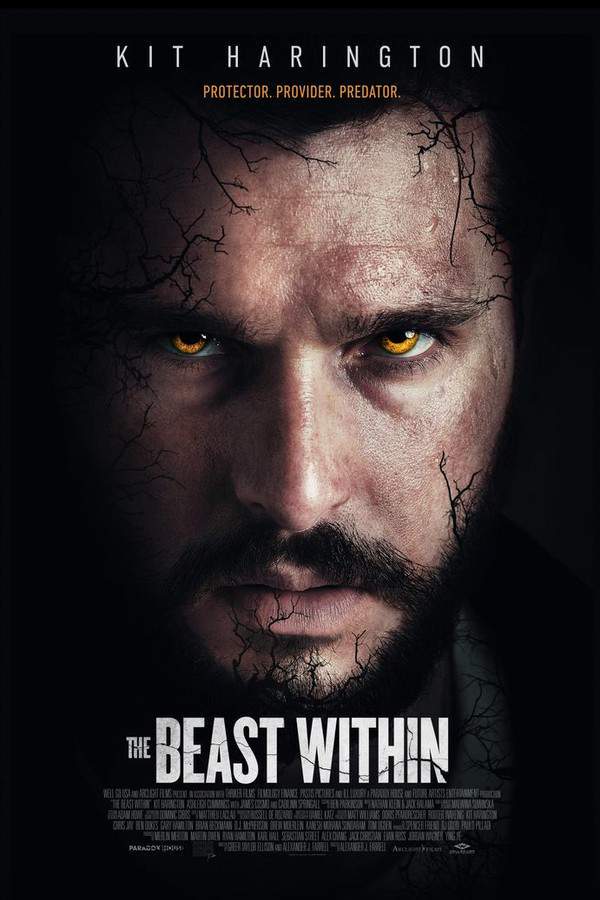
In a remote fortified compound tucked into the English countryside, Willow, Caoilinn Springall, grows up under the strict, protective watch of her parents, Noah Kit Harington and Imogen Ashleigh Cummings. Noah is quiet and stern, enforcing rigid rules that sharpen at night, while Imogen does her best to maintain a fragile balance within the family. The atmosphere of secrecy weighs heavy over the household, and Willow’s natural curiosity about the shadowy routines they keep intensifies as she senses a looming distance between the surface of their life and what remains hidden.
One night, driven by a need to understand, Willow follows her parents into the forest and witnesses a chilling transformation: Noah becomes a monstrous, wolf-like creature Adam Basil. The sight traumatizes Willow and forces her to reckon with the unsettling truth behind the family’s guarded behavior. She returns to the compound with questions that cannot be easily answered, and a keen sense that the danger is tied to a history stretching far beyond her own memory.
As Willow begins to piece together the dark legacy her parents have tried to keep secret, she uncovers an ancient curse that has been passed down through generations. This curse appears to bind Noah to a beastly nature he struggles to suppress, a fate that seems to be woven into the very fabric of the family’s past. The revelation reframes every memory Willow has of her father, casting a pall over the day-to-day tenderness she once believed her parents shared.
The family’s secrets pull in other figures from the edges of their world. Waylon James Cosmo and Grandmother Martina McClements loom in the background, their presence hinting at a longer, more painful history that the couple has tried to bury. William Ian Giles also appears as a quiet yet persistent witness to the mounting tension, quietly bearing witness to the fragility of the family’s armor as the truth presses in.
Willow’s loyalty to Noah and Imogen becomes a central test as she confronts the duality of her father: a loving caregiver during daylight hours and a terrifying, uncontrollable figure at night. The curse’s grip on Noah intensifies the danger, threatening not only his own safety but the entire household’s chances of breaking free from a cycle of trauma and violence that seems almost inescapable.
In the woods, the story builds toward a climactic confrontation that pushes Willow and Imogen to make impossible choices. They must decide whether to shield Noah from his fate or to confront the bloodline’s dark power head-on, even if doing so risks tearing their family apart. The ending sits in deliberate ambiguity, suggesting that the monster—if there is one—may be less a supernatural threat and more a complicated coping mechanism born of fear, suppression, and pain.
To deepen the sense of consequence, the film replays earlier moments with added detail, highlighting an abusive dynamic that has shaped Willow’s perceptions and choices. Those revisited scenes cast the final confrontation in a harsher light and invite viewers to question what was real and what was perceived through the lens of trauma, leaving the audience to decide how much of the fear was born of imagination and how much of it arose from a long-standing pattern that was never fully acknowledged.