Plot Explained Spoilers guaranteed!
Plot Explained

Browse by genre

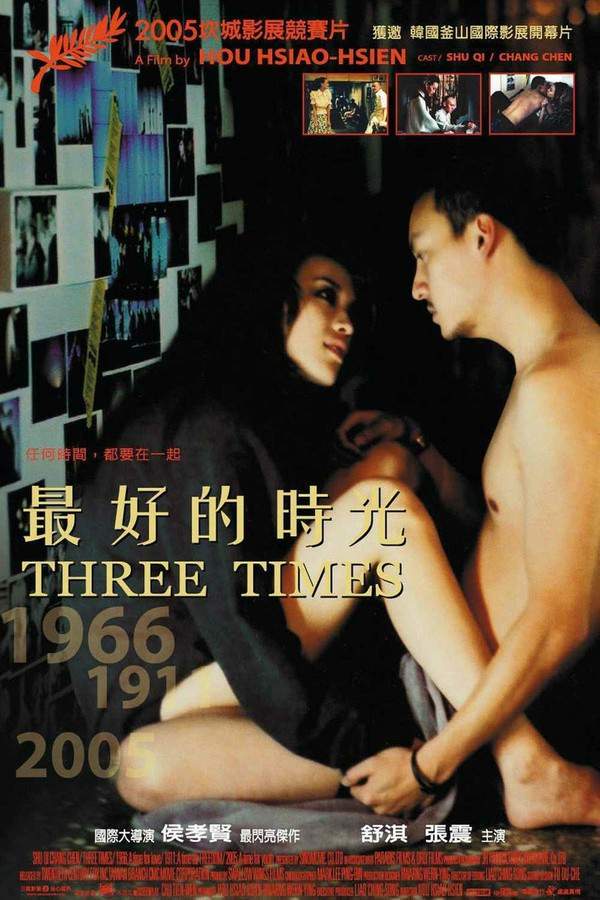
Three Times (2006) movie poster

Plot Summary

Three Times (2006) Plot Summary Explained

Release, runtime and language
2006 · 120 min · Chinese
Directed by
Hsiao-hsien Hou

Three interconnected stories explore themes of love and longing across different periods. In 1966, a solitary soldier experiences a brief but intense connection at a pool hall. The year 1911 finds a Taiwanese courtesan navigating a difficult choice between romance and survival amidst Japanese occupation. Finally, in 2005, a singer grapples with a critical decision concerning her artistic inspiration and career ambitions, as these separate narratives subtly intertwine.

On this page (5)
  1. 1 What happens: full plot
  2. 2 Plot questions answered
  3. 3 Movie threads
  4. 4 Movies like Three Times
  5. 5 Every angle

Full plot summary · contains spoilers

What Happens in Three Times: Full Plot Summary

The whole story of Three Times (2006) explained, from the opening scene to the final frame: every key event, every twist and what it all adds up to. Read it as a quick recap before the sequel, to check a scene you missed, or to finally understand what really happened.

In the sweltering summer of 1966, amidst the chaos of the Cultural Revolution tearing through mainland China, a different kind of turmoil was unfolding in Kaohsiung, Taiwan. It was here that Chen, a young soldier on leave, found himself captivated by the enigmatic May, who served customers at a lively pool hall. Their initial encounter was marked by a game of chance and skill, which eventually transformed into a delicate dance of attraction, characterized by stolen glances and soft whispers amid the clattering of balls and the joyous laughter of patrons. When May prepared to lock up for the night, Chen's promise to write her a letter before he returned to his station ignited a flicker of anticipation in her heart.

Months passed, and May finally received the letter she had been yearning for, brimming with sentimental words reflecting Chen's unwavering affection. However, as the mundane patterns of life in Kaohsiung enveloped her, she grew restless, longing for change. She decided to return to Chiayi, seeking solace in the memories of a time long past. Little did she know that Chen had been stealthily following her journey, driven by a desire to reignite their fragile connection, trailing her from one pool hall to another.

Their paths serendipitously crossed again in Huwei, where the familiar sights and sounds of the game provided them a bittersweet reunion. As they lingered at the train station, the atmosphere thickened with unspoken words—the tension of anticipation mingled with regret. Then, as if moved by the whims of fate, Chen took May’s hand, and the two nestled beneath an umbrella, finding warmth and shelter against the uncertainties that loomed ahead.

Transitioning to a contrasting tale set in 1911, during the era of Japanese occupation of Dadaocheng, a different narrative unfolds against the backdrop of silent films. This segment introduces us to a brothel, where a singing courtesan yearns not only for personal freedom but also a release from the constraints imposed by her life. Her heart beats in unison with that of Mr. Chang, a traveling writer and political dissident, whose tales of adventure incite her own dreams of escape.

Yet, despite his genuine affection for her, Mr. Chang firmly denies her request to become his concubine. His objections stem from two beliefs: a deep-seated disdain for the concubinage system and his commitment to battling the Japanese through diplomatic means, which forbids any personal entanglements. As the courtesan's fantasies of liberation linger tantalizingly close yet out of reach, her songs become an echo of hope in a world filled with despair.

As fate intervenes, Mr. Chang's noble act of purchasing Ah Mei's freedom is realized, prompting him to revisit the brothel where her sister resides. Aware of her own unstable reality, Ah Mei gazes at him with an unarticulated desire for salvation, yet Mr. Chang remains untouched by her silent plea. With the arrival of a new young courtesan, Ah Mei begins to absorb her newfound liberty; however, her inquiries into Mr. Chang’s intentions unveil an emotional chasm that deepens her feelings of hopelessness.

Three months into this tumultuous journey, solace comes in the form of melodic lessons taught by the new girl. Yet, when a poignant letter from Mr. Chang arrives, filled with a haunting poem contemplating the sorrow awaiting Taiwan post-liberation, Ah Mei’s tears begin to dry, replaced by an emerging sense of resilience.

The final segment whisks us to the vibrant scene of Taipei in 2005, where Jing, a club singer, smoothly navigates the intricate layers of her romantic relationship with photographer Zhen. Their affair blossoms against the pulsating backdrop of city life. During one electrifying performance, Zhen captures Jing's essence, sparking jealousy as his girlfriend departs in a huff. As their connection intensifies, Zhen uncovers Jing's epilepsy management badge, which leads him down a path of emotional turmoil when he spots his girlfriend and faces rejection once more.

As night falls, a palpable tension transforms into connection as Jing and her partner share an intimate embrace. Yet, Jing's thoughts linger elsewhere—distracted by a text from Zhen, inviting her to meet for a long-awaited exchange of photos and her badge. Deep in her creative process the next day, Jing channels her feelings into lyrics, forming a raw, reflective song that captures her inner strife while Zhen waits, eager for their forbidden bond to deepen.

Amidst this emotional tempest, Jing's girlfriend finds herself alone, entangled in feelings of abandonment and desperation. In a moment of vulnerability, she sends a chilling message to Jing, hinting at the hurt that awaits if her love remains unreciprocated. As Jing arrives home, the weight of those words hits her hard, leading to a breakdown on their bed. In contrast, the sound of her song fades as Jing and Zhen speed down the freeway, love glowing as brightly as the roads themselves.

Last updated: November 22, 2024 at 19:07

Was this helpful?

Plot questions answered

Three Times Plot Explained: Your Questions Answered

The questions people ask most about Three Times (2006): what happens in the confusing scenes, why the characters do what they do, the twists, hidden details and what the ending means. Each answer contains spoilers.

Q1

Why does Chen follow May to Chiayi after she receives his letter?

Chen follows May because his feelings for her have not diminished despite their time apart. After she returns to Chiayi, he is compelled to reconnect with her, demonstrating his persistent affection. He tracks her movements from one pool hall to another until they serendipitously reunite in Huwei, where their connection is rekindled.

Foreshadowing: Earlier, when May locks up the pool hall, Chen promises to write her a letter, showing his initial commitment to maintaining their connection.

  • chen
  • may
  • chiayi
  • follow
  • love
  • reunion
Q2

Why does Mr. Chang refuse to take Ah Mei as his concubine?

Mr. Chang refuses for two reasons: he deeply despises the concubinage system, considering it morally wrong, and he is committed to fighting the Japanese through diplomatic means, which requires him to avoid personal entanglements that could distract from his political mission.

  • mr chang
  • ah mei
  • concubine
  • refusal
  • political
  • japanese occupation
Q3

What happens after Mr. Chang purchases Ah Mei's freedom?

After purchasing Ah Mei's freedom, Mr. Chang returns to the brothel where her sister still works. Ah Mei looks at him with longing, hoping he will take her with him, but he remains unmoved by her silent plea. She gains physical freedom but remains emotionally trapped, discovering that freedom does not automatically bring the relationship she desired.

Foreshadowing: Mr. Chang's earlier refusal to make her his concubine foreshadows his inability to offer her the emotional connection she seeks.

  • ah mei
  • freedom
  • mr chang
  • brothel
  • rejection
Q4

Why does Zhen react so strongly when he finds Jing's epilepsy badge?

Zhen discovers Jing's epilepsy management badge while they are together, which reveals a vulnerable side of her he did not previously know. This discovery triggers emotional turmoil because it connects to his own complicated situation, his girlfriend has just left after seeing Zhen take photos of Jing, and finding out Jing has a medical condition adds to the emotional complexity of their forbidden relationship.

  • zhen
  • jing
  • epilepsy
  • badge
  • discovery
  • emotion
Q5

Why does May decide to return to Chiayi after receiving Chen's letter?

Despite finally receiving the letter she had waited for, May feels restless and trapped by her mundane life in Kaohsiung. The letter, though sentimental, does not provide the change she desperately seeks. She returns to Chiayi seeking solace in past memories, drawn to a place that represents a different time in her life.

Foreshadowing: The promise of the letter and the anticipation of Chen's return had earlier ignited hope in May, showing her desire for something more.

  • may
  • chiayi
  • letter
  • restlessness
  • return
  • memory
Q6

How are the three different time periods connected in the film?

The three stories, set in 1966, 1911, and 2005, are thematically connected rather than linearly. Each explores love and longing against the backdrop of social constraints: war and military duty in 1966, Japanese occupation and gender hierarchy in 1911, and modern romantic complexity in 2005. The parallel structures highlight how romantic struggles persist across different eras despite changing historical contexts.

  • three stories
  • connection
  • theme
  • time periods
  • parallel
  • love
Q7

Why does Ah Mei cry when she receives Mr. Chang's letter in 1911?

Mr. Chang's letter contains a haunting poem about the sorrow that awaits Taiwan after liberation. The letter touches Ah Mei deeply because it reflects his political consciousness and foreshadows the collective suffering of her homeland. Her tears represent a turning point, moving from personal heartbreak to a broader emotional resilience as she connects her own struggle to Taiwan's larger historical fate.

  • ah mei
  • mr chang
  • letter
  • poem
  • tears
  • taiwan
Q8

Why does Jing break down after receiving her girlfriend's threatening message?

Jing's girlfriend sends a chilling message hinting at the hurt that will come if Jing's love remains unreciprocated. This message represents the consequences of Jing's affair with Zhen, her betrayal of her girlfriend and the guilt it carries. The weight of these words, combined with the emotional turmoil of her complicated situation, causes Jing to collapse in distress on her bed.

  • jing
  • girlfriend
  • message
  • breakdown
  • guilt
  • betrayal
Q9

What does the moment under the umbrella signify for Chen and May?

At the train station in Huwei, as clouds gather, Chen takes May's hand and they find shelter beneath an umbrella. This intimate gesture represents their connection finding warmth and protection against the uncertainties of their situation, Chen being a soldier who must return to his station, and May yearning for something more from life. It is a poignant moment of unity amid external pressures pulling them apart.

Foreshadowing: Their earlier interactions at the pool hall, with stolen glances and whispered conversations, build toward this physical expression of their emotional bond.

  • chen
  • may
  • umbrella
  • hand
  • intimacy
  • shelter
  • reunion
Q10

Why does Zhen want to exchange photos and Jing's badge?

Zhen has been waiting to meet Jing for what they had planned as a long-awaited exchange of photos he took of her and her epilepsy badge. The badge represents Jing's vulnerability that Zhen discovered earlier, creating a deeper level of intimacy between them. This planned exchange symbolizes their relationship moving beyond surface-level attraction toward something more personal and authentic.

Foreshadowing: Zhen's earlier discovery of the badge while at Jing's place planted the seed for this desire to connect on a deeper level.

  • zhen
  • jing
  • photos
  • badge
  • exchange
  • waiting
Q11

Why doesn't Mr. Chang return to take Ah Mei with him after freeing her?

After purchasing Ah Mei's freedom, Mr. Chang does not return for her because his commitment to the political cause against Japanese occupation takes priority over personal relationships. His earlier refusal to make her his concubine, due to his disdain for the system and his need to remain unentangled, means he sees freedom as an end in itself, not as a pathway to being together. Ah Mei remains at the brothel where her sister still works, trapped by circumstances beyond physical freedom.

Foreshadowing: Mr. Chang's political writings and adventures, which initially captivated Ah Mei, reveal his prioritization of the collective struggle over individual happiness.

  • mr chang
  • ah mei
  • freedom
  • not return
  • political
  • priorities
Q12

Why does Jing channel her emotions into writing a song?

After the tense night involving Zhen, his girlfriend's departure, and the threatening message from her own girlfriend, Jing is overwhelmed by emotional turmoil. She channels these feelings into writing lyrics, creating a raw, reflective song that captures her internal strife. This creative process becomes her way of processing guilt, confusion, and the complexity of her relationships.

Foreshadowing: The earlier mention of Jing as a club singer establishes her artistic expression as a natural outlet for her emotional state.

  • jing
  • song
  • lyrics
  • emotion
  • 创作
  • turmoil
Q13

What is the purpose of showing three separate love stories in different eras?

The film uses three separate love stories set in 1966, 1911, and 2005 to explore how love, longing, and relationships are shaped by their historical contexts. Each era presents different obstacles: military service and separation in 1966, colonial occupation and gender oppression in 1911, and modern relationship complications in 2005. By presenting these parallel narratives, the film suggests that while the details change across time, the fundamental human experiences of love and yearning remain constant.

  • three stories
  • era
  • love
  • comparison
  • theme
  • historical context

Movie threads

More Movies Like Three Times, by Mood & Story

Curated lists built around what makes Three Times tick: the same mood, the same kind of story or the same emotional payoff. Each list explains why these movies belong together.

Movies with Intertwined Love Stories Across Time Like Three Times

Intertwined romantic narratives that explore connection across different time periods. For viewers who enjoyed the episodic, romantic structure of Three Times, this collection features films that weave together multiple love stories set in different historical periods. Find similar movies that explore longing and connection across time, from poetic dramas to intricate historical romances.

  • romantic
  • melancholic
  • nostalgic
  • reflective
  • longing
  • atmospheric
  • Tone: bittersweet, melancholic, nostalgic
  • Pacing: slow, deliberate, reflective
Why these movies?

The story pattern: Films in this thread typically present two or more distinct love stories set in different eras, connected by overarching themes rather than direct plot causality. The narrative pattern emphasizes the universality of emotions like love, loss, and longing, showing how they manifest differently against various historical and social backdrops.

Why they belong together: These films are grouped together because they share a specific narrative architecture that uses time as a central character. They create a reflective, comparative experience for the viewer, focusing on the bittersweet and often fragile nature of romance as it is shaped by its time.

Slow, Atmospheric Mood Pieces Similar to Three Times

Character-driven films where atmosphere and emotional tone take precedence over plot. If you liked the reflective, melancholic atmosphere of Three Times, this selection features movies with a similar poetic sensibility. Discover character-driven dramas where the pacing is slow, the tone is bittersweet, and the mood is as important as the story itself.

  • atmospheric
  • melancholic
  • contemplative
  • slow burn
  • reflective
  • poetic
  • Tone: melancholic, bittersweet, reflective
  • Pacing: slow, contemplative, atmospheric
Why these movies?

The story pattern: The narrative journey in these films is often internal and emotional rather than driven by external events or high-stakes conflict. The focus is on creating a specific, immersive mood—often melancholic, nostalgic, or contemplative—through visual poetry, soundscapes, and nuanced character moments that unfold at a leisurely pace.

Why they belong together: These movies are united by their shared commitment to crafting a powerful, consistent atmosphere. They offer a meditative viewing experience where the feeling of the film—its bittersweet longing, its quiet loneliness—is the primary takeaway, making them perfect for thoughtful, reflective viewers.

If you liked this

Movies Like Three Times

Similar movies to Three Times: the same genre, themes or kind of story. Each one comes with its own plot summary, timeline and ending explained.

Browse all movie summaries

Every angle

Three Times (2006) Explained: Plot, Timeline & Characters

Everything about Three Times in one place: what happens in the plot summary, the timeline in chronological order, the characters and meaning and a spoiler-free summary. What's After the Movie adds the cast, box office and post-credit scenes.

Coming soon on iOS and Android

The Plot Explained Movie Summary App

Plot summaries, endings explained and timelines on your phone. Catch up on any movie in minutes, save your favorites and never miss a twist again.

Be the first to know when we launch. Your email stays private, always.

Learn more about the app