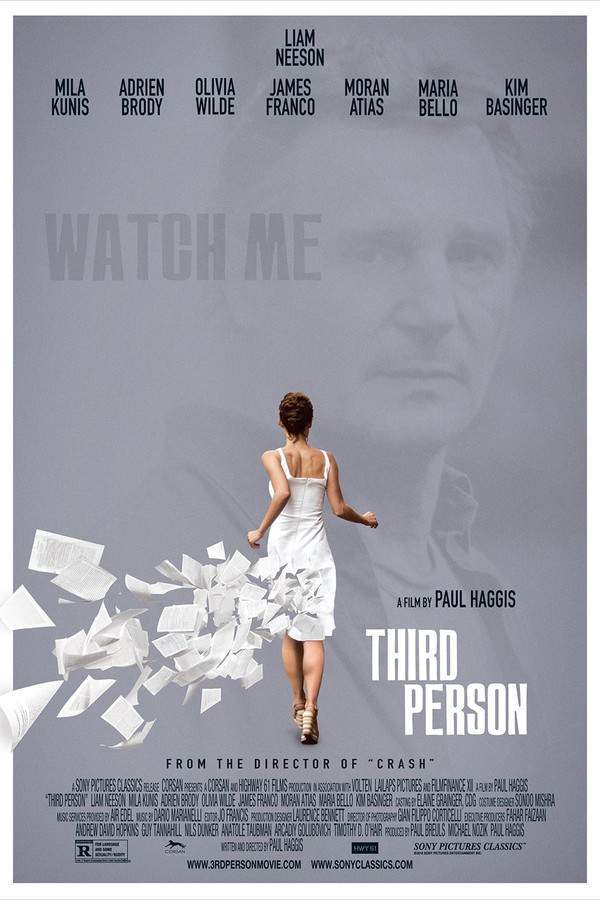
Three interconnected love stories unfold across three iconic settings—Paris, New York, and parts of Italy—each weaving romance with secrets, emotional conflict, and difficult choices. As the individual threads accumulate, it becomes clear that the film is more than a simple travelogue of relationships: most of the characters and events are imagined by a writer named Michael, who is drafting a novel while grieving the death of his son. The ideas he conjures up become a reflection of his own interior world, turning fiction and memory into a single, carefully arranged tapestry.
In Paris, Michael, a writer who has recently separated from his wife Elaine, finds himself drawn back into a fervent, complicated relationship with Anna, his lover. Their on/off dynamic is charged with passion, but Anna carries a terrible secret that complicates her capacity to commit. The allure of reunion is tempered by fear and distance, and the narrative gradually reveals that Anna is not merely a lover in Michael’s life but a character within the novel he is writing. Through their scenes, the film explores how longing can blur the lines between what is real and what is imagined, and how a writer might use an invented romance to process loss and guilt. The Paris chapters bloom with intimate conversations, silent understandings, and the ache of choices made and withheld, all set against the city’s elegant and shadowed streets that mirror Michael’s internal landscape.
Across the ocean in New York, Julia—an ex-soap opera actress who has become a hotel maid—faces a crisis that tests her strength and raises questions about truth, blame, and maternal love. She is accused of harming her young son, a charge she vehemently denies, and the drama shifts as her ex-husband Rick intensifies his fight to gain custody. The tension in this storyline stems from the precarious balance between public perception and private reality, as Julia fights to protect her relationship with her child while navigating the skepticism and legal maneuvering that accompany such accusations. The intensity of the custody battle reveals deeper themes: the fragility of trust, the resilience of a mother under siege, and the way fear can distort memory and motive. The New York episodes carry a blunt emotional honesty, contrasting with the dreamlike quality of the Paris segment yet remaining tethered to Michael’s overarching project—the way a writer returns to the same wounds from different angles to glimpse the truth beneath them.
In the Rome and Taranto sequence, Scott, an American businessman traveling through Italy, falls for Monika, a Romani woman whose world intersects with danger and a sense of urgency. The plot thickens as Scott becomes entangled in a perilous situation involving Monika’s daughter, who has been taken by an Italian gangster in Taranto and is held for ransom. As Scott is pulled deeper into this peril, the film threads questions of trust, fate, and the possibility that what he hopes to be a straightforward romance may be tested by a harsher reality. The Taranto act intensifies the mood with stakes that feel immediate and personal, foregrounding moral complexity and the emotional pull of rescue and protection in the face of coercion and crime. Yet, as with the other stories, the danger and tenderness are framed by the broader literary conceit: these experiences may be part of Michael’s fictional world, designed to probe how love can survive or unravel when threatened by secrets and manipulation.
The overarching structure binds these vignettes through a shared meditation on grief, memory, and the power of storytelling. The film continually invites viewers to question what is real and what is crafted, and it uses the different locales to reflect varied emotional tones—paradoxically intimate in Paris, raw and claustrophobic in New York, and high-stakes and cinematic in Italy. The characters’ journeys—whether about commitment with a reluctant partner, a mother’s fight for her child, or a man who chooses to risk everything for love—are presented with a steady, observational lens that favors nuance over melodrama. Emotions unfold in quiet moments of dialogue, in the tension of misunderstandings, and in the quiet resilience that surfaces when secrets come to light.
Throughout, the film maintains a neutral, contemplative mood, treating romance and danger as interconnected aspects of a single human experience. The writing-and-reality premise never veers into sensationalism; instead, it deepens the viewer’s awareness of how we assemble stories to cope with loss, and how those stories can illuminate connections between people who otherwise seem worlds apart. By the end, the audience is left with a richer understanding of Michael’s grief and creativity: a reminder that storytelling can be a bridge between memory and healing, between longing and truth, and between the lives we imagine and the lives we actually live.