


Plot Explained Spoilers guaranteed!
Plot Explained

Browse by genre

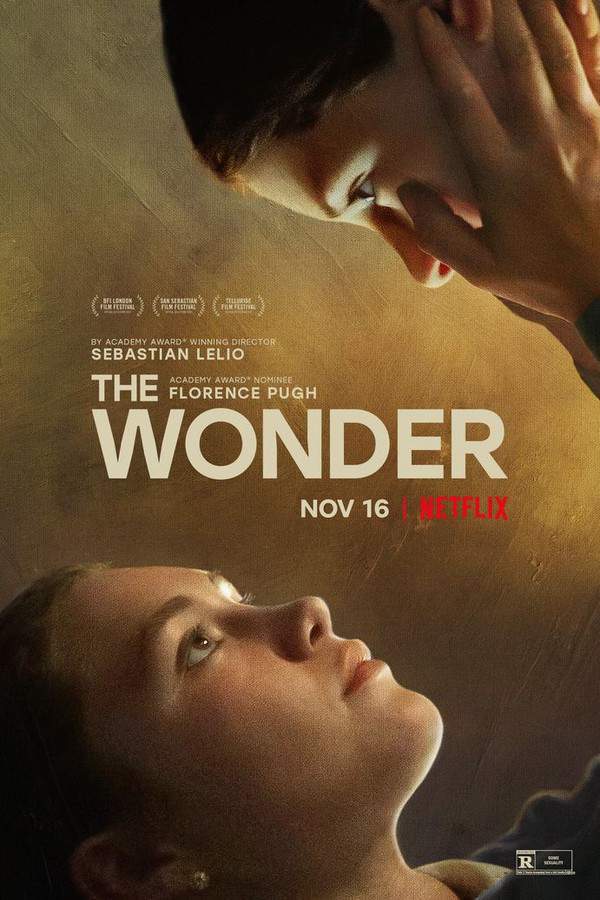
The Wonder (2022) movie poster

Ending Explained

The Wonder (2022) Ending Explained – Final Scene & Meaning

Release, runtime and language
2022 · 108 min · English
Echo score 72
JustWatch #32,221 5
Directed by
Sebastián Lelio
Starring
Toby Jones, Florence Pugh, Tom Burke, Abigail Coburn, Brían F. O'Byrne, Carla Hurley O'Dwyer

In 1862, amidst the Irish Midlands, a puzzling event captivates a community: eleven-year-old Anna O’Donnell has miraculously survived for months without food. English nurse Lib Wright, skeptical and pragmatic, is brought in to investigate the seemingly impossible situation. As Lib observes Anna and interacts with the devout villagers, she finds herself entangled in a web of faith, suspicion, and long-held secrets, questioning both the girl's condition and the motivations of those around her.

On this page (7)
  1. 1 Where to watch
  2. 2 What happens at the end
  3. 3 Final events in order
  4. 4 Ending questions answered
  5. 5 Movie threads
  6. 6 Movies like The Wonder
  7. 7 Every angle

Where to watch

Where to Watch The Wonder (2022)

Where can you watch The Wonder? Stream, rent or buy it in the US, including on Netflix and Netflix Standard: current JustWatch availability with up-to-date prices.

Streaming availability powered by JustWatch

Ending explained · contains spoilers

What Happens at the End of The Wonder?

How The Wonder (2022) ends, what the final scene means, which earlier moments set it up and how to read the ending if the film leaves it open. The full ending explained, with every spoiler.

At the end of “The Wonder,” we see that Nurse Lib Wright has taken drastic measures to free Anna from her abusive and exploitative situation. After convincing Anna that she is going to die and be reborn as Nan—an act designed to free her from the cycle of abuse and the false religiosity imposed on her—Lib runs away with Anna, performing a ritual that involves her pretending to pass out and then awakening with a new identity for Anna. She then destroys all evidence of their plans—burning her sedative and the baby booties—to erase her past memories, symbolized by fire, which in many traditions represents purification and destruction. Lib then claims that her accidental act of knocking over a lamp was the cause of the fire, and she leaves the house with Anna, now calling her Nan, to live together in London as a family unit, safe from the falsehoods and exploitation of the village.

Throughout the film, there are film set and storytelling meta-elements, such as the opening showing that the story is being shot like a movie, and the final scene revealing a modern person, Kitty O’Donnell, watching everything unfold and breaking the fourth wall. These elements suggest that “The Wonder” is also commenting on the nature of stories—how they shape our understanding and perceptions of truth. It’s implied that the story of Anna’s fasting and Lib’s intervention is as much a constructed narrative as it is a real event, emphasizing that stories, whether fictional or based on reality, serve to shed light on issues of oppression and the power of storytelling itself.

In the end, Lib successfully liberates Anna, not through conventional means, but by staging her death and creating a new beginning in a safer, modern world. The film leaves the audience pondering whether the truth of Anna’s past is truly erased or suppressed deep within her subconscious, and it highlights how narratives can be manipulated to bring about what we perceive as justice or liberation. Ultimately, the story is a reflection on the power of stories to both imprison and free, depending on how they are told and who tells them.It’s a reminder that sometimes, to truly free someone, you have to rewrite the story altogether.

Last updated: June 25, 2025 at 08:57

Was this helpful?

The last 4 events

How The Wonder Ends: The Final Events in Order

The last events of The Wonder (2022) in chronological order, the run-up to the ending explained above. The complete timeline has all 15 events, scene by scene.

Open the full timeline
  1. A Dramatic Shift

    While at the well, Anna appears to slip away entirely, but upon Lib's encouragement, she revives enough to eat. This moment signifies a potential turning point in Anna's miraculous fasting.

    Where
    Clootie well
  2. Destruction of Evidence

    In a desperate bid to cover her actions and protect Anna, Lib sets fire to the O'Donnell home, ensuring all evidence, including her laudanum, is destroyed. She later claims Anna died of natural causes.

    Where
    O'Donnell family home
  3. Aftermath of the Fire

    The committee is left in shock, realizing they have lost a potential saint. They terminate Lib’s employment to distance themselves from the fallout and lack of physical evidence.

    Where
    Council meeting
  4. New Beginnings

    Eventually, Lib reconnects with William and the revived Anna, who has taken on the name 'Nan.' Together, they adopt the identity of the Cheshire family and set sail for Sydney, marking a fresh start.

    Where
    Dublin

Ending questions answered

The Wonder Ending: Your Questions Answered

The questions people ask most about the ending of The Wonder (2022): what the final scene means, how the twist works, what happens to each character and how to read the ending. Each answer contains spoilers.

Q1

Why does Lib stage Anna's death at the end?

Lib stages Anna's death because Anna is trapped in an abusive, exploitative situation perpetuated by her family and the village's false religiosity. Anna has been led to believe she possesses miraculous powers, which has kept her trapped and starving. Lib realizes that the only way to free Anna permanently is to make her believe she is dying and being reborn as someone else, Nan, so she can psychologically escape her trauma and start fresh without the burden of her past identity.

Foreshadowing: Earlier in the film, Anna tells Lib about a dream of flying away, hinting at her desire to escape her confined life.

  • lib wright
  • anna odonnell
  • staged death
  • nan
  • escape
  • rebirth
Q2

What happens to Anna at the end of The Wonder?

Anna survives and escapes to London with Lib. After the staged ritual where Anna believes she dies and is reborn as Nan, Lib destroys all evidence of their plan by burning the sedative and baby booties (symbolic of Anna's traumatic past), then claims the fire was accidental. The two leave together to start a new life as a family unit in London, far from the oppressive village.

Foreshadowing: The baby booties hidden in the room represent the secret Anna has been forced to keep about her abuse.

  • anna odonnell
  • london
  • nan
  • new life
  • escape
Q3

Why does Lib burn the sedative and baby booties?

Lib burns these items to erase Anna's past memories and the evidence of the exploitation she suffered. The sedative represents Lib's own complicity in keeping Anna docile, while the baby booties symbolize the hidden truth of Anna's abuse and the child she was forced to give birth to. By burning them, Lib attempts to symbolically purge these traumatic elements from Anna's consciousness, helping her embrace her new identity as Nan.

Foreshadowing: Throughout the film, the booties are shown as a dark secret the family hides, and Lib discovers evidence of Anna's hidden pregnancy.

  • sedative
  • baby booties
  • fire
  • memory erasure
  • evidence
Q4

What does the fire symbolize at the end of The Wonder?

The fire symbolizes purification and destruction of the old narrative. In many traditions, fire represents both cleansing and transformation. By burning the sedative and booties, Lib uses fire to destroy the evidence of Anna's traumatic past while also creating the cover story for their escape. The fire literally and figuratively burns away the false miracle narrative that imprisoned Anna, allowing her to be reborn as Nan.

Foreshadowing: Fire imagery appears earlier during the fasting observations, where candles and heating were carefully controlled in Anna's room.

  • fire
  • purification
  • rebirth
  • transformation
  • symbolism
Q5

Who is Kitty O'Donnell in the final scene?

Kitty O'Donnell is a modern-day observer who appears in the final scene, watching the events unfold and breaking the fourth wall. Her presence suggests that the entire story is being retold or reconstructed, emphasizing the film's meta-commentary on storytelling. Kitty represents the audience or future generations looking back at this historical event, highlighting how stories are retold and how narratives shape our understanding of truth.

Foreshadowing: The film opens with meta-cinematic elements showing the story being filmed like a movie, establishing this self-aware storytelling approach.

  • kitty odonnell
  • fourth wall
  • meta
  • modern scene
  • audience
Q6

Why does Lib pretend to pass out during the ritual?

Lib pretends to pass out as part of the staged ritual to convince Anna that death and rebirth are real. By performing this dramatic act, Lib gives Anna a powerful psychological narrative to cling to, the idea that she has died as Anna and been reborn as Nan. This transformation is essential for Anna to psychologically escape her traumatic identity and embrace a new life without the weight of her past suffering and the false miracle narrative.

Foreshadowing: Lib has previously used subtle deceptions to keep Anna calm, showing her willingness to manipulate the situation for Anna's benefit.

  • lib wright
  • ritual
  • passing out
  • deception
  • rebirth
  • nan
Q7

Does Anna truly recover from her trauma in the ending?

The film leaves this question ambiguous, reflecting its theme that stories can both imprison and free. While Anna is physically saved and given a new life in London, the film poses whether the truth of her past is truly erased or merely suppressed deep in her subconscious. The staged rebirth gives her a new identity, but whether psychological healing truly occurs is left open, suggesting that recovery from such trauma is complex and ongoing.

Foreshadowing: Anna's conditioning runs deep throughout the film, making her belief in the miraculous feel genuine rather than performed.

  • anna recovery
  • trauma
  • psychological healing
  • subconscious
  • nan identity
Q8

What is the meaning of the fourth wall break at the end?

The fourth wall break, featuring Kitty O'Donnell watching the story unfold, serves as the film's commentary on the nature of storytelling itself. It suggests that Anna's story, like all stories, is a constructed narrative. The film blurs the line between historical event and fictional retelling, emphasizing that stories, whether based on reality or entirely fictional, serve to illuminate truths about oppression, faith, and the power of narrative. The audience is reminded that they, like Kitty, are observing a story being told.

Foreshadowing: The opening sequence already establishes the film as a deliberate construction, shot like a movie with visible sets.

  • fourth wall
  • meta
  • storytelling
  • narrative
  • kitty odonnell
  • audience
Q9

Why does Lib lie about causing the fire?

Lib lies about accidentally causing the fire to cover their escape and protect Anna's new identity. By claiming the fire was accidental, Lib provides a believable explanation for the destruction in the room and the disappearance of Anna's body. This lie allows them to leave the village without suspicion and ensures Anna's family cannot pursue them. The lie is also part of rewriting the narrative, the official story becomes an accident rather than an elaborate rescue scheme.

Foreshadowing: Lib has been collecting evidence of the family's secrets throughout the film, showing her strategic approach to exposing the truth.

  • lib wright
  • fire lie
  • cover story
  • escape
  • narrative rewrite
Q10

Where do Lib and Anna go at the end of the movie?

Lib and Anna travel to London together to start a new life as a family unit. This represents their escape from the oppressive Irish village and its false religious community. London symbolizes modernity, safety, and freedom from the exploitation and secrecy that trapped Anna. The move also represents a break from the past and an opportunity for both characters to build new identities away from the trauma of the village.

Foreshadowing: Lib mentions earlier that she has no family left in Ireland and has worked internationally, establishing her willingness to leave.

  • london
  • new life
  • escape
  • family
  • freedom
  • modern world
Q11

What does the ending say about truth and stories?

The ending presents a complex view of truth and storytelling, suggesting that sometimes stories must be manipulated to achieve what we perceive as justice or liberation. Lib essentially rewrites Anna's story, creating a fake death and rebirth, to free her from imprisonment. The film asks whether this manipulation of truth is justified if it saves someone from oppression. The meta-layer, with Kitty O'Donnell observing, reinforces that all narratives are constructions, and the power of stories lies in how they are told and who tells them.

Foreshadowing: The entire film plays with narrative perspective, showing multiple viewpoints on the "miracle" and who controls the story.

  • truth
  • stories
  • narrative
  • manipulation
  • justice
  • liberation
  • theme
Q12

Why doesn't Lib simply take Anna away without the elaborate ritual?

Lib understands that Anna is psychologically trapped by her belief in her miraculous purpose and religious destiny. A simple rescue would not have freed Anna from her internal prison, her identity was tied to being the fasting girl. By staging the death and rebirth, Lib gives Anna a new narrative to believe in, one where she dies as Anna and is reborn as Nan. This psychological transformation is essential because Anna needed to genuinely believe she was starting fresh, not just being moved to another location.

Foreshadowing: Anna repeatedly expresses her belief that God speaks through her and that her fasting has spiritual purpose.

  • ritual
  • psychological rescue
  • nan identity
  • belief
  • transformation

Movie threads

More Movies Like The Wonder, by Mood & Story

Curated lists built around what makes The Wonder tick: the same mood, the same kind of story or the same emotional payoff. Each list explains why these movies belong together.

Mysteries in insular communities like The Wonder

Stories where a tight-knit community hides dark secrets from an outsider. If you enjoyed the slow-burn suspense of unraveling a village's secret in The Wonder, you'll find similar tension in these movies. This thread gathers thrillers and dramas where an outsider investigates a mystery within a closed-off, often deeply traditional community, facing resistance and uncovering hidden trauma.

  • claustrophobic
  • suspenseful
  • unsettling
  • gothic
  • somber
  • meditative
  • Tone: tense, unsettling, suspicious
  • Pacing: slow, methodical
Why these movies?

The story pattern: The narrative typically follows an external protagonist—a detective, journalist, or expert—who enters a seemingly homogeneous community to investigate an anomaly. The central conflict arises from the clash between their modern, rational perspective and the community's archaic beliefs or coded rituals. The plot unfolds as a puzzle, where interrogating individuals reveals layers of collective guilt, historical trauma, or systemic abuse that everyone is complicit in hiding.

Why they belong together: Movies are grouped here for their shared focus on the dynamic between an isolated setting and a pervasive secret. They generate suspense not through action, but through the palpable tension of societal pressure, the fear of exposure, and the moral quandaries faced by characters trapped by geography and tradition.
Slow burn psychological thrillers like The Wonder

Methodical films where tension builds from psychological manipulation and unease. For viewers who appreciated the methodical tension and heavy atmosphere of The Wonder, this section collects similar films. These are psychological thrillers and dramas with a slow pacing, where the suspense builds from character studies, moral dilemmas, and a pervasive sense of dread rather than jump scares or chase sequences.

  • slow burn
  • suspenseful
  • psychological
  • unsettling
  • somber
  • meditative
  • Tone: tense, melancholic, heavy
  • Pacing: slow burn, deliberate
Why these movies?

The story pattern: These stories unfold patiently, focusing on the gradual unraveling of a character's psyche or the meticulous dissection of a troubling situation. The plot is driven by observation, conversation, and the slow revelation of information, often leading the protagonist (and the viewer) to question reality, motives, and their own assumptions. The climax is typically an emotional or psychological reckoning rather than a physical confrontation.

Why they belong together: These films are grouped by their shared approach to suspense—a slow, creeping build-up of tension that is primarily psychological. They share a heavy emotional weight, a tense or melancholic tone, and a commitment to exploring dark themes like trauma, faith, and deception through a deliberate, character-focused lens.

If you liked this

Movies Like The Wonder

Similar movies to The Wonder: the same genre, themes or kind of story. Each one comes with its own plot summary, timeline and ending explained.

Browse all movie summaries

Every angle

The Wonder (2022) Explained: Plot, Ending, Timeline & Characters

Everything about The Wonder in one place: what happens in the plot summary, the timeline in chronological order, the characters and meaning, the ending explained and a spoiler-free summary. What's After the Movie adds the cast, box office and post-credit scenes.

Coming soon on iOS and Android

The Plot Explained Movie Summary App

Plot summaries, endings explained and timelines on your phone. Catch up on any movie in minutes, save your favorites and never miss a twist again.

Be the first to know when we launch. Your email stays private, always.

Learn more about the app