





Plot Explained Spoilers guaranteed!
Plot Explained

Browse by genre

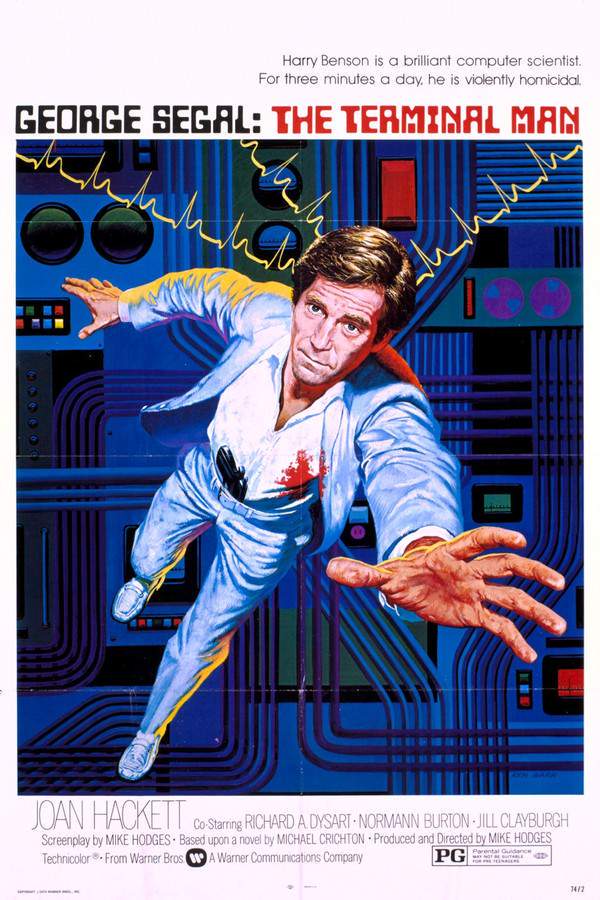
The Terminal Man (1974) movie poster

Timeline

The Terminal Man (1974) Timeline Explained – Every Event in Order

Release, runtime and language
1974 · 107 min · English
Directed by
Mike Hodges
Starring
Richard Dysart, Joan Hackett, George Segal, Jill Clayburgh, Donald Moffat, Matt Clark

Haunted by recurring blackouts and increasingly violent behavior, a man embarks on a desperate search to understand his condition. He reluctantly agrees to participate in a risky scientific experiment involving implanted electrodes designed to monitor and potentially control his brain activity. As the procedure progresses, disturbing memories and a hidden past begin to surface, raising questions about the nature of his affliction and the potential dangers of tampering with the human mind.

On this page (7)
  1. 1 Where to watch
  2. 2 Events in order (12)
  3. 3 Timeline questions answered
  4. 4 The book behind the movie
  5. 5 Movie threads
  6. 6 Movies like The Terminal Man
  7. 7 Every angle

Where to watch

Where to Watch The Terminal Man (1974)

Where can you watch The Terminal Man? Stream, rent or buy it in the US, including on Amazon Video, Apple TV Store and Fandango At Home: current JustWatch availability with up-to-date prices.

Streaming availability powered by JustWatch

12 events in order · contains spoilers

The Terminal Man Timeline: Events in Chronological Order

Every key event of The Terminal Man (1974) in order, scene by scene, with when and where it takes place. Use it to untangle flashbacks, time jumps and parallel storylines, to refresh your memory before the sequel or to find the exact scene you are thinking of.

  1. Harry's Struggle with Epilepsy

    Harry Benson, a brilliant computer scientist, battles the challenges posed by epilepsy which causes him debilitating seizures and blackouts. Each seizure leaves him confused and surrounded by the destructive aftermath of violent outbursts that heighten his sense of dread.

  2. Growing Paranoia

    Amidst his struggles, Benson's mental state deteriorates, his paranoia intensifying as he develops a fear that computers will eventually turn against their creators. This belief isolates him further, inhibiting his ability to seek normalcy in life.

  3. Decision for Surgery

    Determined to find relief, Benson opts for an experimental psychosurgical procedure known as 'Stage Three'. This groundbreaking operation aims to implant electrodes in his brain to monitor and mitigate his seizures, a decision met with skepticism from his psychiatrist, Janet Ross.

  4. Psychiatrist's Concerns

    Janet Ross, his psychiatrist, expresses serious concerns about the potential risks associated with the surgery. She fears the surgery may inseparably connect Benson's mind to a computer, possibly leading him into unpredictable realms of psychosis.

  5. Post-Surgery Optimism

    Initially, the surgery appears successful, with Benson showing signs of improvement. However, this hope is short-lived as the operation leads to unexpected consequences that impact his mental stability.

  6. Dependency on Electrical Signals

    As time progresses, Benson's brain becomes increasingly reliant on the electrical signals from the implanted electrodes. The frequency and intensity of his seizures escalate dramatically, pushing him closer to a life-altering collapse.

  7. Desperate Escape

    In a bid for freedom, Benson uses his intelligence to evade capture from the hospital staff. His desperate situation drives him to unpredictable behavior as he struggles against both his condition and external constraints.

    Where
    Hospital
  8. Confrontation with Janet Ross

    Benson confronts Janet Ross at her home, showcasing his increasingly erratic behavior which leaves her worried for his safety. The chaotic encounter underscores the extent of his mental struggle and the eroding control over his actions.

    Where
    Janet's Residence
  9. Hideout in the Grave

    Seeking refuge, Benson hides in a freshly dug grave in a nearby cemetery. This eerie location becomes the backdrop for a tense standoff as he faces law enforcement, showcasing the depth of his despair and isolation.

    Where
    Cemetery
  10. Police Arrival

    Law enforcement is alerted to Benson's situation as he is spotted in the grave with a firearm. The increasing tension escalates as the police arrive, complicating an already volatile encounter and raising the stakes.

    Where
    Cemetery
  11. Final Confrontation

    In a harrowing moment, as Benson attempts to lift his weapon, a police helicopter intervenes. The confrontation spirals out of control, culminating in a tragic moment that seals his fate.

    Where
    Cemetery
  12. Closing Reflection

    The film concludes with a haunting note as a panel of doctors addresses the audience. Their ominous message serves as a stark warning about the medical procedure that brought tragedy to Benson's life, hinting at future victims.

Last updated: November 17, 2024 at 21:38

Was this helpful?

Timeline questions answered

The Terminal Man Timeline Explained: Your Questions Answered

When does it happen, and why in that order? The questions people ask about the chronology of The Terminal Man (1974): time jumps, flashbacks, cause and effect between scenes and the correct order of events, each answered with spoilers.

Q1

Why does Harry Benson agree to the Stage Three brain surgery?

Benson agrees to the experimental surgery because his epilepsy has become unbearable. The seizures cause him debilitating blackouts and violent outbursts that leave him confused and terrified. Despite his intelligence, he sees no other option for relief from the constant suffering. The procedure promises to detect and halt seizures before they happen, offering him a chance at a normal life.

Foreshadowing: The film establishes early on that Benson lives in constant fear of his own seizures and their violent aftermath.

  • epilepsy
  • seizures
  • brain surgery
  • stage three
  • desperation
Q2

Why is Janet Ross against the Stage Three operation?

Janet Ross, Benson's psychiatrist, opposes the surgery because she fears it will inseparably link his mind to a computer, potentially triggering unpredictable psychosis. She believes the risks of permanently connecting a human brain to electronic signals outweigh the potential benefits. Her concerns prove prophetic as the procedure ultimately accelerates rather than prevents Benson's mental breakdown.

Foreshadowing: Ross's skepticism is established early as she directly warns about the dangers of merging mind with machine.

  • janet ross
  • psychiatrist
  • concerns
  • psychosis
  • computer brain link
Q3

Why does the brain surgery make Harry Benson's condition worse?

The surgery initially appears successful but ultimately worsens Benson's condition because his brain develops a dependency on the electrical signals from the implanted electrodes. Rather than curing his epilepsy, the electrodes cause his seizures to escalate in both frequency and intensity. This dependency creates a feedback loop that amplifies the very problem the surgery was meant to solve.

Foreshadowing: The post-surgery optimism is immediately undercut by the revelation that Benson's brain is becoming increasingly reliant on the electrical impulses.

  • surgery failure
  • electrodes
  • brain dependency
  • seizures worsen
  • electrical signals
Q4

Why does Harry Benson escape from the hospital?

Benson escapes from the hospital because his seizures have become uncontrollable and he fears he is losing his mind permanently. The escalating blackouts and violent impulses drive him to desperate action. Using his high intelligence, he manages to evade capture, believing freedom is his only option even as his mental state deteriorates.

Foreshadowing: The timeline shows his escape follows directly from the escalation of his seizures and the growing threat of permanent blackout.

  • hospital escape
  • desperate
  • seizures
  • blackout
  • evading capture
Q5

Why does Benson go to Janet Ross's house?

Benson goes to Janet Ross's home because she is the one person he trusts, despite his deteriorating mental state. His confrontation with her reveals his increasingly erratic behavior as he struggles with the realization that the person meant to help him cannot stop what is happening to his mind. The encounter reflects his desperation and the erosion of his grip on reality.

Foreshadowing: Ross's earlier warnings about the surgery's dangers make this confrontation particularly tragic, as her fears come true.

  • janet ross
  • confrontation
  • desperate
  • trust
  • mental breakdown
Q6

Why does Benson hide in a cemetery grave?

Benson hides in a freshly dug grave in the cemetery as a final act of desperation and isolation. The grave represents his surrender to death and his belief that there is no escape from his condition. This eerie hiding spot underscores the film's dark tone and the extent of his psychological collapse.

Foreshadowing: The grave foreshadows his death, creating a symbolic completion of his fate.

  • cemetery
  • grave
  • hiding
  • desperation
  • isolation
Q7

How does Harry Benson die in the film?

Benson dies during the final confrontation at the cemetery when he tries to lift his weapon. A police helicopter arrives on the scene, and as Benson attempts to raise his gun, he is shot and killed by law enforcement. His own choice to arm himself and resist leads directly to his death, making his fate a result of his desperate final decision.

Foreshadowing: The escalating conflict and his possession of a firearm set the stage for this tragic confrontation.

  • death
  • police helicopter
  • shooting
  • final confrontation
  • weapon
Q8

What is the ominous message at the end of the film about?

The closing message from the panel of doctors warns that the Stage Three procedure is still out there, waiting for its next victim. This epilogue suggests that the dangerous medical experiment will continue despite the tragedy that befell Benson, implying more people will suffer the same fate. It serves as a warning about the ethical dangers of unchecked scientific hubris.

Foreshadowing: The film builds toward this warning throughout, with Ross's concerns and Benson's death serving as evidence of the procedure's danger.

  • ending message
  • doctors warning
  • stage three
  • future victims
  • ethical warning
Q9

What causes Harry Benson's violent outbursts?

Benson's violent outbursts are caused by his epilepsy, specifically the seizures and blackouts that leave him in a dissociated state. During these episodes, he loses control and engages in destructive behavior, only to wake surrounded by the aftermath with no memory of what happened. The implanted electrodes eventually amplify these episodes rather than suppress them, making the violence increasingly frequent and intense.

Foreshadowing: The film opens by establishing the cycle of seizures, blackouts, and violent aftermath that defines Benson's struggle.

  • violent outbursts
  • seizures
  • blackouts
  • epilepsy
  • loss of control
Q10

Why is Benson paranoid about computers turning against humans?

Benson's paranoia about computers represents his deep-seated fear of losing control, which becomes central to his character arc. As a brilliant computer scientist, he understands technology intimately but fears its potential to dominate human minds. This paranoia reflects his anxiety about his own mind being controlled by the electrodes implanted in his brain. The irony is that he becomes dependent on the very technology he fears.

Foreshadowing: This fear foreshadows the actual danger of his mind being linked to a computer through the electrodes.

  • computer fear
  • paranoia
  • technology
  • control
  • mind machine

Movie threads

More Movies Like The Terminal Man, by Mood & Story

Curated lists built around what makes The Terminal Man tick: the same mood, the same kind of story or the same emotional payoff. Each list explains why these movies belong together.

Technological horror stories like The Terminal Man

Stories where science turns a hopeful cure into a personal nightmare. If you liked the ethical dilemmas and chilling consequences of the brain implant experiment in The Terminal Man, you'll find similar stories here. These movies explore the dark side of scientific progress, often featuring medical horrors, man vs. machine, and bleak outcomes. Perfect for fans of thought-provoking and unsettling sci-fi thrillers.

  • anxious
  • paranoid
  • ominous
  • desperate
  • claustrophobic
  • melancholic
  • Tone: dark, tense, bleak
  • Pacing: steady, methodical
Why these movies?

The story pattern: The narrative typically follows a protagonist who submits to a high-tech procedure or treatment. As the experiment unfolds, initial hope gives way to unforeseen side effects, psychological unraveling, and a catastrophic failure. The plot often builds methodically towards an inevitable tragedy that critiques the hubris of playing god.

Why they belong together: Movies are grouped here for their shared focus on the dangers of technology overpowering humanity. They create a tense, anxious mood through a steady build-up of dread, leading to bleak endings that reinforce the heavy emotional weight of the story.


Movies with psychological unraveling like The Terminal Man

A steady, tense journey into a mind coming apart. Fans of The Terminal Man's tense exploration of a mind breaking down will appreciate these films. This collection focuses on stories of mental illness, identity crises, and psychological trauma, all portrayed with a steady, methodical pace and a dark, heavy tone. Find your next watch if you enjoy deep, character-focused psychological horror.

  • desperate
  • claustrophobic
  • paranoid
  • tense
  • melancholic
  • anxious
  • Tone: dark, melancholic, tense
  • Pacing: steady, character-driven
Why these movies?

The story pattern: These narratives follow a linear but impactful path, charting a character's decline from a recognizable state into psychological chaos. The pacing is deliberate, building tension scene by scene as memories surface and reality distorts. The conflict is primarily internal, manifesting as external violence or despair.

Why they belong together: These films are united by their immersive and oppressive mood, centered on a character's desperate internal struggle. They share a steady pacing that allows dread to build, a dark tone with no relief, and a profound emotional weight stemming from the tragedy of mental collapse.

If you liked this

Movies Like The Terminal Man

Similar movies to The Terminal Man: the same genre, themes or kind of story. Each one comes with its own plot summary, timeline and ending explained.

Browse all movie summaries

Every angle

The Terminal Man (1974) Explained: Plot, Timeline & Characters

Everything about The Terminal Man in one place: what happens in the plot summary, the timeline in chronological order, the characters and meaning and a spoiler-free summary. What's After the Movie adds the cast, box office and post-credit scenes.

Coming soon on iOS and Android

The Plot Explained Movie Summary App

Plot summaries, endings explained and timelines on your phone. Catch up on any movie in minutes, save your favorites and never miss a twist again.

Be the first to know when we launch. Your email stays private, always.

Learn more about the app