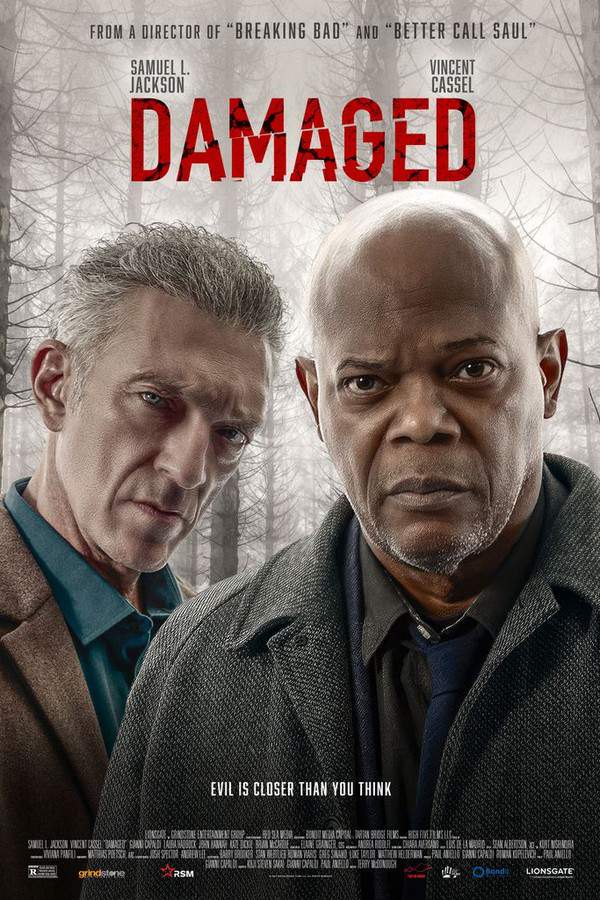
A veteran Chicago detective is pulled into a tense investigation when a cold case he thought was long closed resurfaces in Scotland. Partnering with a local investigator, he must face demons from his past while trying to stop a relentless killer from committing further crimes.
Find where to stream, rent, or buy Damaged (2024) in the US with current JustWatch availability, up-to-date pricing, and platform listings for subscription, rental, and digital purchase options.
Warning: spoilers below!
Haven’t seen Damaged yet? This summary contains major spoilers. Bookmark the page, watch the movie, and come back for the full breakdown. If you're ready, scroll on and relive the story!
Read the complete plot breakdown of Damaged (2024), including all key story events, major twists, and the ending explained in detail. Discover what really happened, and what it all means.
A woman named Abigail meets a tragic fate in Scotland when a delivery boy, disguised as a harmless courier, ruthlessly kills her. The investigation into her death reveals a gruesome scene, with her head, arms, and legs arranged in a cross-like formation while her torso is notably absent. This bizarre pattern eerily resembles a series of murders that terrorized Chicago over five years earlier. To assist in the case, the police enlist the expertise of Detective Dan Lawson, who had worked on the previous killings alongside his now-retired partner, Walker Bravo.
Upon arriving in Scotland, Lawson collaborates with investigating officer Glen Boyd and chief of police Laura Kessler. Boyd is grappling with personal turmoil related to the loss of his son, which complicates his ability to focus solely on the case. During their investigation, Lawson and Boyd discuss the nature of the crimes, suggesting that the primary difference from the original Chicago murders may lie in a religious motivation, hinting at the possibility of hate crimes.
As the two detectives grow closer, Boyd reveals the strain his family has endured following their child's death, detailing how his wife, Marie, has become distant, resulting in a betrayal during their grief. Lawson shares his own past pain involving a victim named Sarah from the Chicago murders, and they bond over their shared heartaches while vowing to track down the killer targeting innocent lives in Scotland.
As their investigation deepens, Lawson returns to consult with Bravo to gain further insight into the case. Meanwhile, Boyd suspects that Abigail's neighbor may have some connection to the crime. However, they hit a dead end when the neighbor proves uninvolved, making the path to justice seem daunting.
Their efforts take a dark turn when another victim, a woman named Grace Hall, turns up dead, similarly staged. Boyd learns of Grace's ex-boyfriend, Colin McGregor, and works to question him, but Colin's evasiveness under the presence of his lawyer complicates matters. Tensions heighten as Boyd discovers Colin's previous involvement with a local cult, only to find additional clues leading him back to another suspicious sighting near the crime scene.
As the investigation escalates, Boyd successfully apprehends Colin; however, upon returning home, he experiences a devastating discovery when he finds Marie murdered in a fashion hauntingly similar to the other victims. Stricken with loss, Boyd vows to catch her killer, suspecting Colin's connection to the crime. When Boyd threatens Colin during interrogation, his actions begin to unravel the thin threads of the investigation, leaving Lawson and Boyd in disarray.
A complex game of cat and mouse ensues as Colin meets a brutal end at the hands of the real killer, who proves to be a far more formidable foe. Upon discovering Colin's history and a chilling resemblance to previous murder methods, Lawson realizes they are not yet finished. As further investigation reveals Lawson's knowledge of Colin's crimes and a possible connection outlines a more profound truth, the shocking reality of the case unfolds.
Through layers of deception, it is ultimately revealed that Lawson himself is behind the murders, driven by revenge and the dark corridors of his own past intertwined with Boyd's family. In a calculated move, Lawson eliminates those who remind him of his own unforgotten pain. The final confrontation leaves Boyd grappling with enormous loss and frustration as he desperately pursues Lawson, who stays one step ahead.
The film concludes on an unsettling note, leaving Boyd's pursuit of justice incomplete and Lawson eluding capture, enjoying a serene moment in nature, suggesting a chilling justifying of his horrific actions. With the case now in the hands of Interpol, Boyd's anguish echoes as the unresolved ache of his wife's murder continues to haunt him, marking the end of a harrowing journey filled with betrayal and darkness.
Last updated: May 12, 2025 at 07:03
Explore frequently asked questions about Damaged (2024) with spoiler-rich answers covering the full plot summary, major story beats, character motivations, hidden details, and ending meaning. This movie summary FAQ helps explain confusing scenes, plot twists, and narrative decisions in clear, searchable detail.
Detective Dan Lawson is revealed as the killer because he has been committing these murders for years, starting in Chicago. During the final confrontation with Boyd, Lawson admits to being the actual murderer behind all the killings, including both the original Chicago murders and the current Scotland murders. He confesses to killing Sarah, his former love who was involved with his partner Bravo, and then murdering others as part of his revenge plot.
Lawson's intimate knowledge of the case and his insistence on working alone on certain aspects of the investigation hints at his deeper involvement.
Lawson's motive is revenge rooted in jealousy and betrayal. He was motivated by the death of Sarah, his former lover, who was involved with his partner Walker Bravo. Lawson believed Bravo and others were responsible for Sarah's death, so he killed anyone who reminded him of his own pain and those he deemed complicit in the tragedy. His murders were calculated acts of retribution against people he associated with his loss.
Lawson's sharing of his painful past involving a victim named Sarah signals his personal connection to the case.
Lawson kills Marie, Detective Boyd's wife, because she represents another target in his pattern of killing people who remind him of his own grief and loss. After Marie's death, Boyd discovers her body arranged in the same cross-like formation as the other victims. Lawson targets her as part of his broader scheme to inflict pain, exploiting the emotional vulnerability of those around him.
The investigation reveals Lawson has been watching Boyd's family, with Colin McGregor revealed to have been spying on them.
The bodies are arranged with the head, arms, and legs positioned in a cross-like formation while the torso is missing. This religious symbolism suggests the murders may have been motivated by religious hatred or a twisted form of spiritual expression. Lawson initially presents this theory to Boyd, suggesting the Scotland murders differ from the Chicago cases due to this potential hate crime element.
Early in the investigation, Lawson and Boyd discuss the possibility of religious motivation, which turns out to be a deliberate misdirection.
Colin McGregor becomes a suspect because he was Grace Hall's ex-boyfriend and had a history with a local cult. Boyd discovers Colin was expelled from the cult for non-compliance and learns he had been spying on him and Marie. These suspicious activities make him appear connected to the murders, but he is ultimately a red herring - Colin is killed by the actual killer before the truth emerges.
Boyd's discovery of Colin's surveillance of his family creates immediate suspicion about his involvement.
Lawson manipulates the investigation by positioning himself as an expert consultant while actually controlling the direction of the case. He suggests the religious motive theory to redirect suspicion away from himself, deliberately focuses attention on Colin McGregor as a viable suspect, and uses his insider knowledge to stay ahead of the investigation. His access to case files and his relationship with Boyd allow him to quietly eliminate threats to his freedom.
Lawson's insistence on certain investigative approaches and his ability to anticipate next steps reveal his manipulation.
Lawson escapes by using an imposter as his getaway driver during the final confrontation with Boyd. This calculated maneuver allows him to slip away while Boyd is preoccupied with the confrontation. Despite Boyd's desperate pursuit, Lawson remains one step ahead and eludes capture, ultimately being seen enjoying a peaceful moment in nature, seemingly at ease with his actions.
The film's tension builds toward Lawson's characteristic cunning in evading justice.
The Chicago and Scotland murders are connected because Detective Lawson is the killer in both locations. The Scotland murders replicate the exact methodology of the Chicago killings - the cross-like body positioning and staging - because Lawson is the one committing them. He brought his pattern to Scotland, using his expertise as a detective to guide the investigation away from himself while continuing his killing spree.
The immediate recognition of the murder pattern by Lawson's former partner Bravo establishes the direct connection.
Boyd threatens Colin during interrogation because he is desperate to find the killer after Marie's brutal murder. Consumed by grief and vengeance, Boyd's personal turmoil overrides his professional judgment. His aggressive approach toward Colin reflects his emotional breakdown, but this threats actually complicate the investigation as Colin lawyer up and becomes even less cooperative.
Boyd's personal loss intensifies his behavior, pushing him to cross professional boundaries.
Detective Walker Bravo is Lawson's former partner in Chicago who worked on the original murder cases. Now retired, Bravo is consulted by Lawson during the Scotland investigation. The crucial revelation is that Bravo was involved with Sarah, Lawson's former lover, which became the catalyst for Lawson's revenge-fueled killing spree. Lawson ultimately admits to killing Sarah and frames Bravo as partially responsible for her death.
Lawson's return to consult Bravo early in the investigation hints at the deeper historical connection.
Boyd suspects Abigail's neighbor early in the investigation because law enforcement typically looks at people close to the victim as potential suspects. The neighbor represents the most obvious lead in a case with few immediate clues. However, this lead proves to be a dead end when investigation shows the neighbor had no involvement in the crime.
The initial focus on the neighbor represents standard investigative procedure rather than meaningful evidence.
Lawson appears to justify his murders by viewing them as retribution for his personal pain. In the final scenes, he is seen smiling and enjoying nature, seemingly at peace with his actions. This chilling conclusion suggests he believes his killings were justified responses to the betrayal and loss he experienced. The film presents this as a disturbing example of how grief and revenge can扭曲 a person's moral compass.
Lawson's calm demeanor throughout the investigation foreshadows his psychological detachment from his crimes.
Still wondering what the ending of Damaged (2024) really means? Here’s a spoiler-heavy breakdown of the final scene, major twists, and the deeper themes that shape the film’s conclusion.
In the conclusion of Damaged, it is ultimately revealed that Samuel L. Jackson’s character, Dan Lawson, is the real serial killer, not the presumed copycat. Lawson’s story gradually unravels to show that his murders were motivated by a tragic event involving his wife, Sarah, whom he believes he accidentally killed during a confrontation. Rather than accept responsibility or seek reconciliation, Lawson went on a spree, killing those who had helped cover up his wife’s death or were connected to his wife’s affair, in a violent attempt to erase his guilt and control his trauma.
The film cleverly manipulates the audience into suspecting others, especially Bravo, the security expert, whom Lawson later frames as the killer using his knowledge of security systems and connections to the case. However, this is just part of Lawson’s plan to divert suspicion away from himself. Ultimately, Lawson's own confession reveals that he was the mastermind behind the murders all along. His act of guilt and rage manifests in a chaotic killing spree that mimics, but does not actually stem from, the religiously motivated copycat killings seen earlier in the story.
The final scenes depict Lawson driving aimlessly in the Scottish mountains, knowing he will never be caught. This ending leaves the viewer with a sense of the protagonist’s complete psychological breakdown—his guilt, violence, and desire for control culminating in his escape and continued freedom, even if only in his own mind. It’s a disturbing revelation that underscores the film’s dark themes: how trauma, obsession, and a need for vengeance can push a person to become the very monster they once fought against.
Last updated: June 25, 2025 at 09:02
Discover curated groups of movies connected by mood, themes, and story style. Browse collections built around emotion, atmosphere, and narrative focus to easily find films that match what you feel like watching right now.
Grim investigations where the hunt for a killer unearths devastating personal truths.For viewers who enjoyed the grim, personal investigation in Damaged, this list features movies with a similar tone. Discover other crime thrillers and procedurals where tormented detectives face serial killers, uncovering betrayals that lead to heavy emotional consequences and unresolved, somber endings.
The narrative follows a seasoned investigator, often haunted by a past failure, as they pursue a cunning killer. The procedural elements are intertwined with a deep character study, where the line between the detective and the criminal blurs. The climax typically reveals a profound personal betrayal or failure, leaving the protagonist emotionally shattered and the case unresolved in a conventional sense.
Movies in this thread share a dark, oppressive tone, a steady pacing that builds dread, and a high emotional weight stemming from grief and moral collapse. They are united by the archetype of the damaged detective and the theme that some investigations end not with justice, but with a deeper understanding of darkness.
Stories where trust is systematically dismantled, leading to a devastating reveal.If you liked the shocking twist and psychological manipulation in Damaged, explore these similar movies. This collection features tense, high-intensity thrillers with moderate complexity, where a trusted figure is revealed as the antagonist, resulting in a heavy emotional impact and a bleak, unsettling conclusion.
The narrative pattern involves a protagonist grappling with a external threat or mystery, partnered with or guided by a seemingly trustworthy ally. Clues are carefully placed to misdirect, while the true antagonist operates from within the circle of trust. The story's complexity lies in the dual-layered mystery—solving the crime and uncovering the betrayal—culminating in a reveal that is emotionally catastrophic for the protagonist.
These films are connected by their high tension, dark tone, and the core theme of betrayal by a close associate. They share a steady, methodical pacing that allows the dread to simmer, a moderate complexity with clever misdirection, and an ending feel that is overwhelmingly bleak due to the personal nature of the treachery.
Don't stop at just watching - explore Damaged in full detail. From the complete plot summary and scene-by-scene timeline to character breakdowns, thematic analysis, and a deep dive into the ending - every page helps you truly understand what Damaged is all about. Plus, discover what's next after the movie.
Track the full timeline of Damaged with every major event arranged chronologically. Perfect for decoding non-linear storytelling, flashbacks, or parallel narratives with a clear scene-by-scene breakdown.
Discover the characters, locations, and core themes that shape Damaged. Get insights into symbolic elements, setting significance, and deeper narrative meaning - ideal for thematic analysis and movie breakdowns.
What really happened at the end of Damaged? This detailed ending explained page breaks down final scenes, hidden clues, and alternate interpretations with expert analysis and viewer theories.
Discover movies like Damaged that share similar genres, themes, and storytelling elements. Whether you’re drawn to the atmosphere, character arcs, or plot structure, these curated recommendations will help you explore more films you’ll love.
Damaged (2024) Scene-by-Scene Movie Timeline
Damaged (2024) Movie Characters, Themes & Settings
Damaged (2024) Ending Explained & Theories
Damaged (2024) Spoiler-Free Summary & Key Flow
Movies Like Damaged – Similar Titles You’ll Enjoy
Destroyer (2018) Movie Recap & Themes
Chaos (2003) Complete Plot Breakdown
Stolen (2010) Story Summary & Characters
Hard to Kill (1990) Plot Summary & Ending Explained
Detective Story (1951) Detailed Story Recap
Stolen (2012) Complete Plot Breakdown
Criminal (2016) Full Movie Breakdown
Exposed (2016) Detailed Story Recap
Chaos (2005) Full Summary & Key Details
The Offence (1973) Complete Plot Breakdown
Broken (2014) Full Movie Breakdown
Striking Distance (1993) Story Summary & Characters
Crime (1000) Complete Plot Breakdown
Damage (2009) Complete Plot Breakdown
Incident (1948) Detailed Story Recap